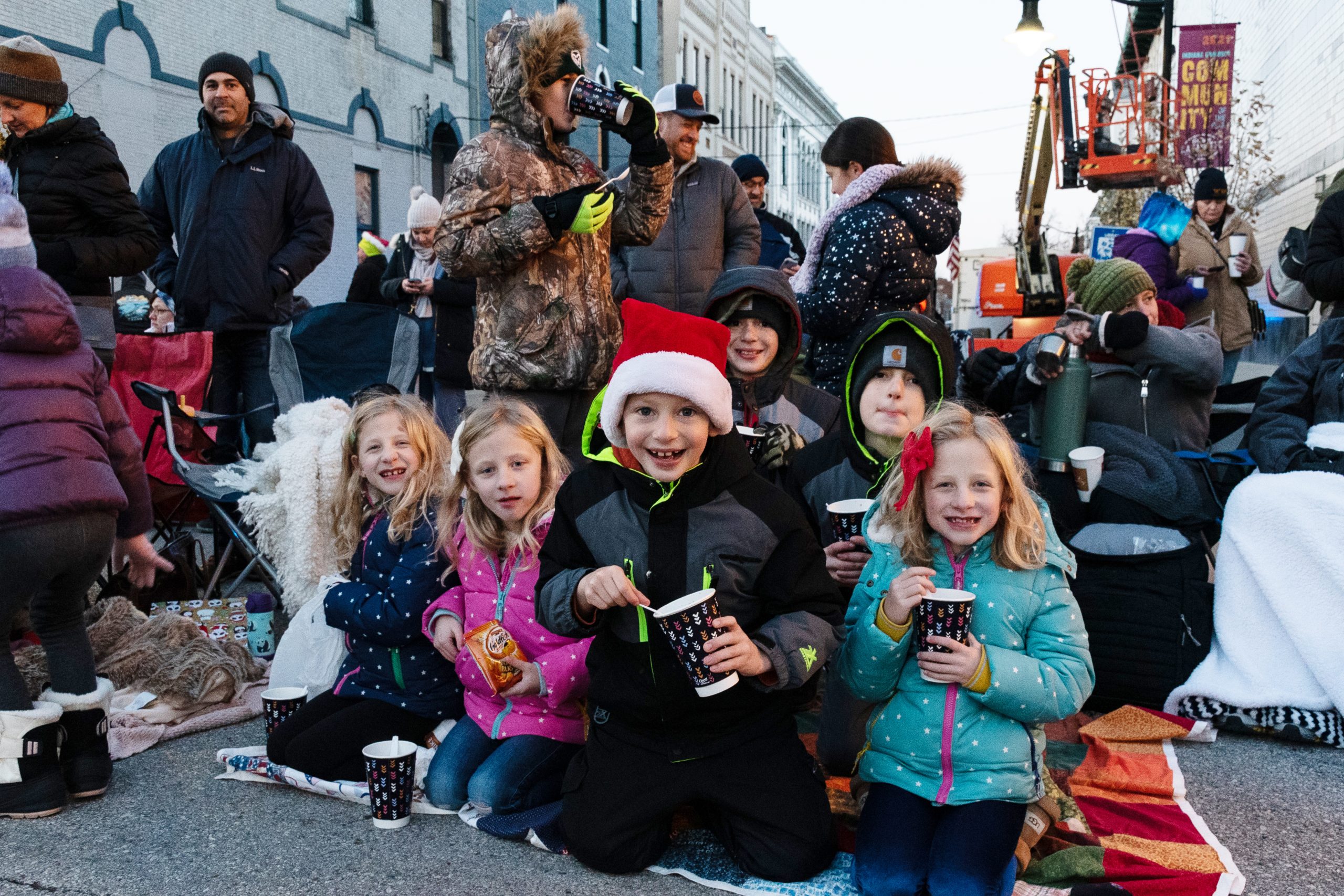
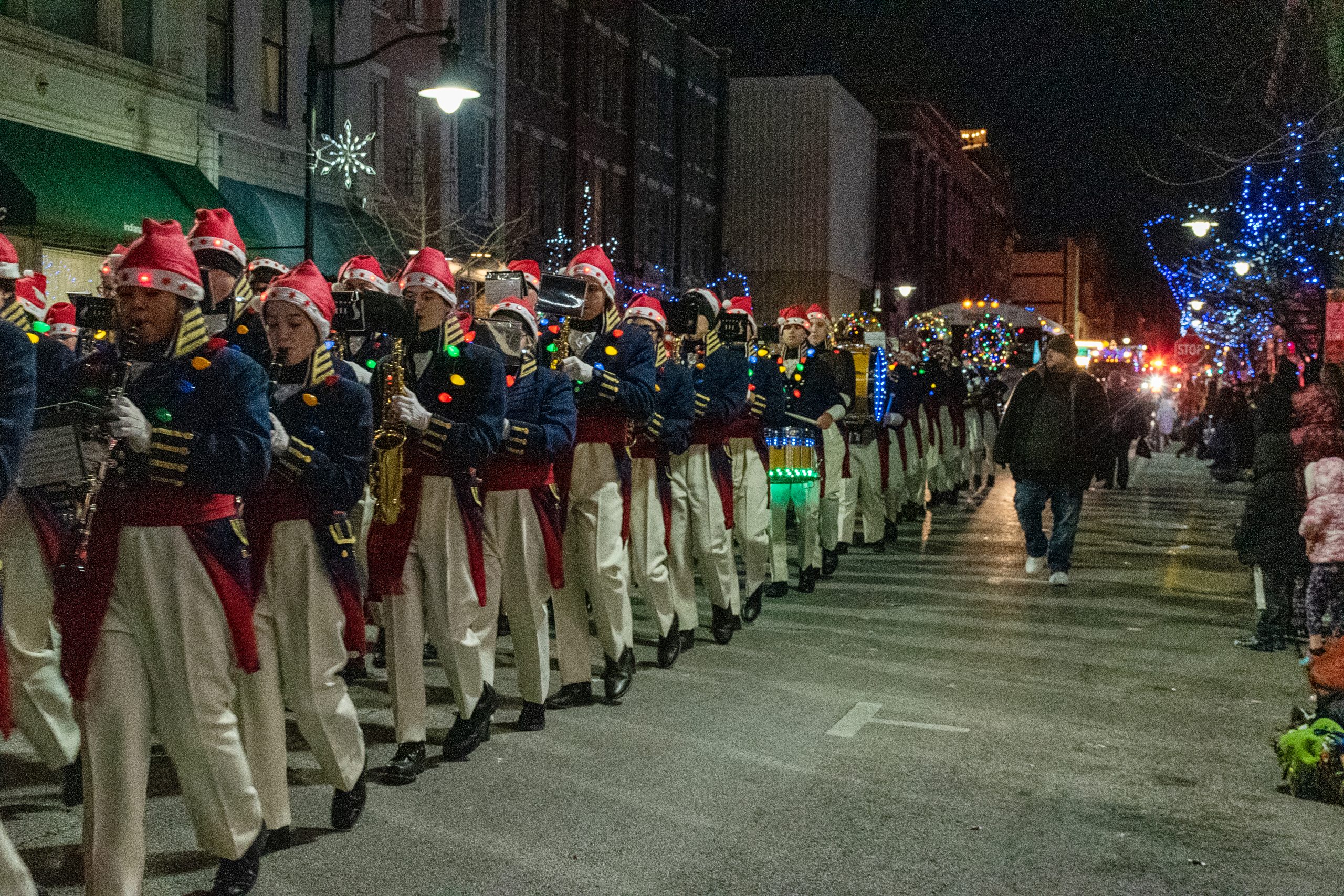
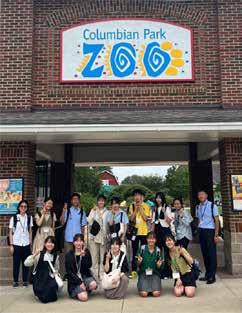
An annual cultural exchange honoring a sister city agreement between Greater Lafayette and Ota City, Japan, will take place August 5-14. Around one dozen middle and high school students and two chaperones are expected to visit Tippecanoe County, continuing a tradition started in 1998, the first year Ota City sent students to Greater Lafayette.
“The sister city relationship was formalized in 1993,” says Collin Huffines, economic development manager for Greater Lafayette Commerce and program coordinator for the sister city student exchange. “The impetus for establishing the relationship with Ota City was the opening of the Subaru plant in Tippecanoe County in 1989. At the time, Subaru was headquartered in Ota City and although the headquarters has since relocated to Tokyo, the company’s main manufacturing presence remains in Ota City.”
Huffines was part of the Greater Lafayette cohort of 11 students and two chaperones who traveled to Ota City for the student exchange in July 2024. During their visit, students participated in a diverse range of activities, including visits to local police and fire stations, a traditional tea ceremony, meetings with local officials and tours of Subaru’s main manufacturing facility, the Museum of Kanayama Castle Ruin and city hall. They also experienced the Kegon Falls and the summer festival. Participants stay with host families, providing for a more immersive experience and broadening the cultural exchange.
“My host family drove me to the drop off point every morning — that was my first experience in a Smart car,” Huffines says. “Ota City has more urban density than Greater Lafayette, so their streets are smaller, and therefore their vehicles are a lot smaller than what we’re used to. People avoid driving as much as possible. They spend more time walking and biking. Whereas for people who live here, especially in subdivisions, that might not be practical.”
The American students who visited Japan learned to observe cultural norms, such as using chopsticks, taking shoes off at the door or carrying around a hand towel because public restrooms don’t typically provide paper towels or hand dryers.
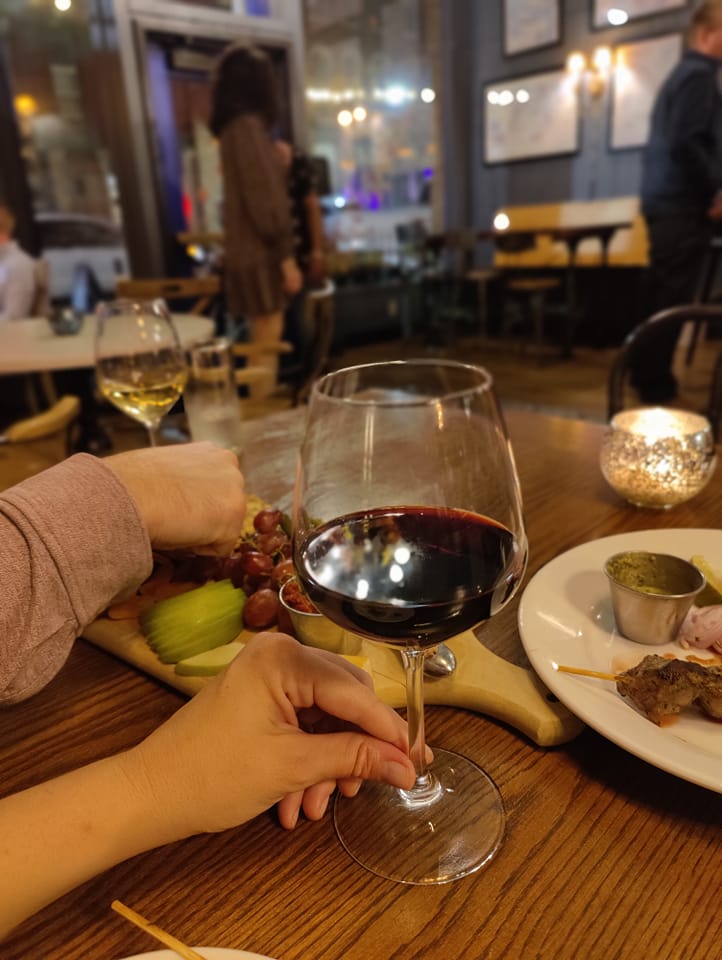
“I had never used chopsticks prior to my first visit to Ota City,” Huffines says. “The Japanese use chopsticks at every meal. My host family recognized early on that I did not have experience using chopsticks, so they’d always get a fork out for me, but I wanted to try and learn. By the end of the week they were pleasantly surprised with how capable I became.”
This year, it’s Greater Lafayette’s turn to show the students from Nippon the best of our community, and Huffines is looking for families willing to host visiting students. Activities are planned during the weekdays, so host families are expected to provide transportation for students in the morning and late afternoon as well as provide dinner and breakfast. On the weekend, host families are encouraged to explore local attractions or introduce students to their favorite places in Greater Lafayette.
“Staying with host families is an important part of the program because it allows students to participate in American family life,” Huffines says. “They would not get the same cultural experience staying in a hotel.”
Recruiting volunteer host families also helps reduce the cost of the trip for participating students. Funding for the student exchange program also is provided by Tippecanoe County, the cities of Lafayette and West Lafayette, Duke Energy, Subaru of Indiana Automotive and Wintek.
Greater Lafayette Commerce organizes the weekday activities, which in past years have included meeting with the mayors of Lafayette and West Lafayette as well as the Tippecanoe County commissioners, touring Purdue’s campus, the Subaru plant and Cook Biotech and, of course, local delicacies such as the Original Frozen Custard and Arni’s pizza.
“In 2023, the Japanese students were playing Rock, Paper, Scissors to figure out who would have to finish the last few slices of pizza,” Huffines says. “They were obviously stuffed, but one of the chaperones explained that the Japanese aren’t big fans of leftovers. If something is served at the table, you finish it. These are the types of moments where you learn little things that you could never pick up from a textbook.”

Color-packed tulip fields welcome the season with vibrant displays
BY RADONNA FIORINI | PHOTOS BY CHRISTINE PETKOV
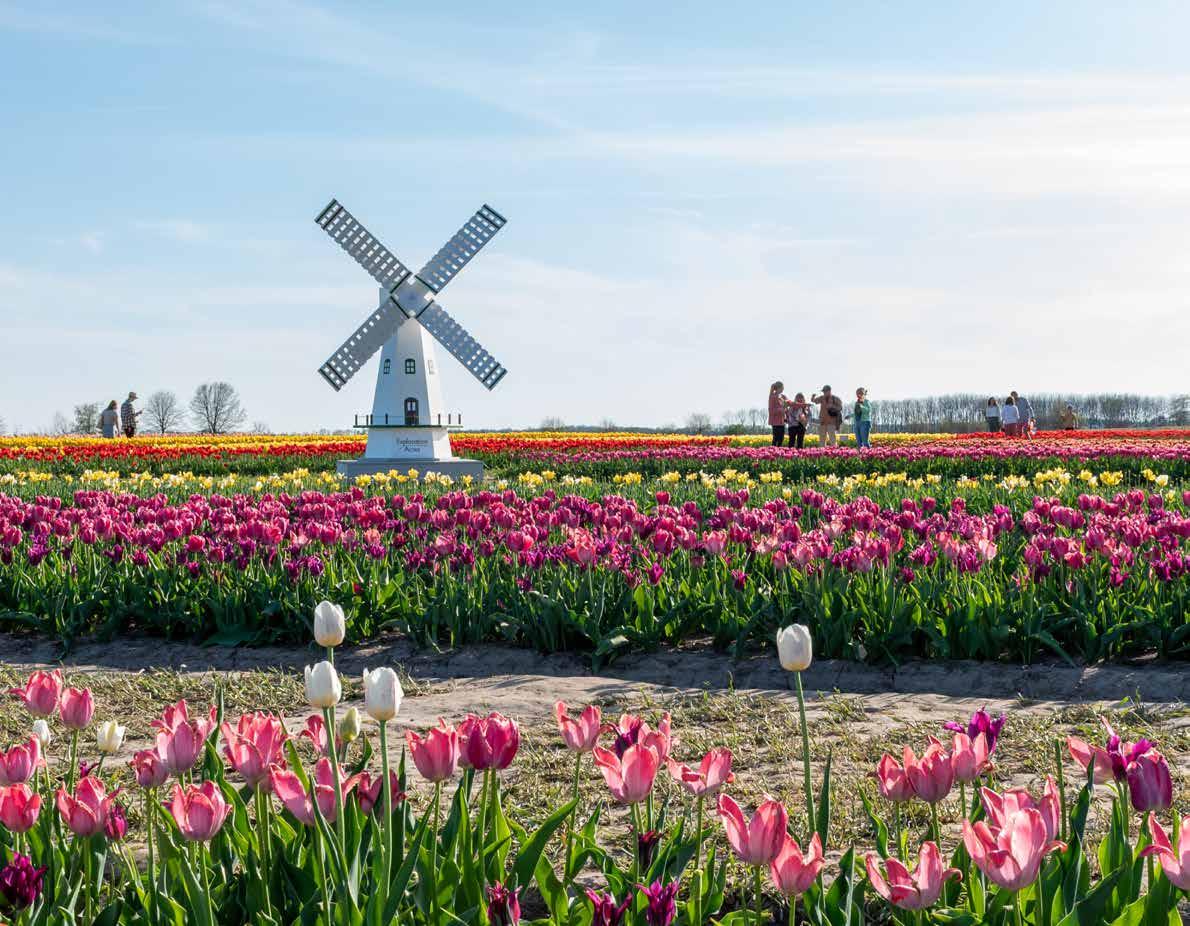
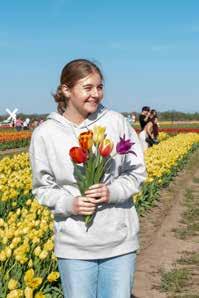
What better way to bid goodbye to winter than to meander through a field of tulips? Especially if those tulips are planted in the shape of a butterfly and a hummingbird.
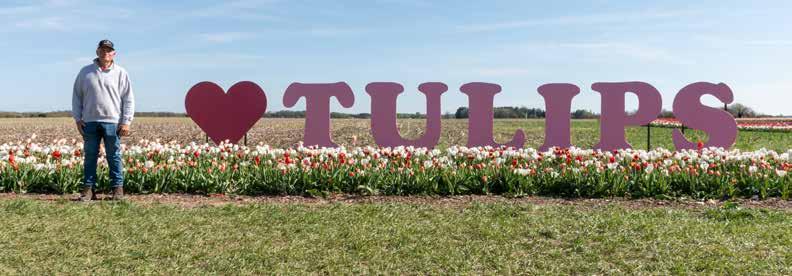
Now’s your chance! For the second year, Exploration Acres is hosting Tulip Days, a three-week celebration of this cheerful flower that has long been a symbol of perfect love and rebirth. For people of a certain age, Tiny Tim’s campy and inexplicably popular 1968 song “Tiptoe Through the Tulipsˮ also comes to mind, but wandering, ambling or strolling through the eight acres of blooms is also completely appropriate.
Tim Fitzgerald, who co-owns Exploration Acres along with his sister Mary Branstetter, says Tulip Days is an effort to offer an educational and entertaining event in the spring at the venue that has hosted a corn maze each fall since 2008. The 15-acre corn maze now attracts more than 45,000 people annually and includes a pumpkin patch, hayrides, fire pits and other activities on land southeast of Lafayette that was the Fitzgerald family farm.
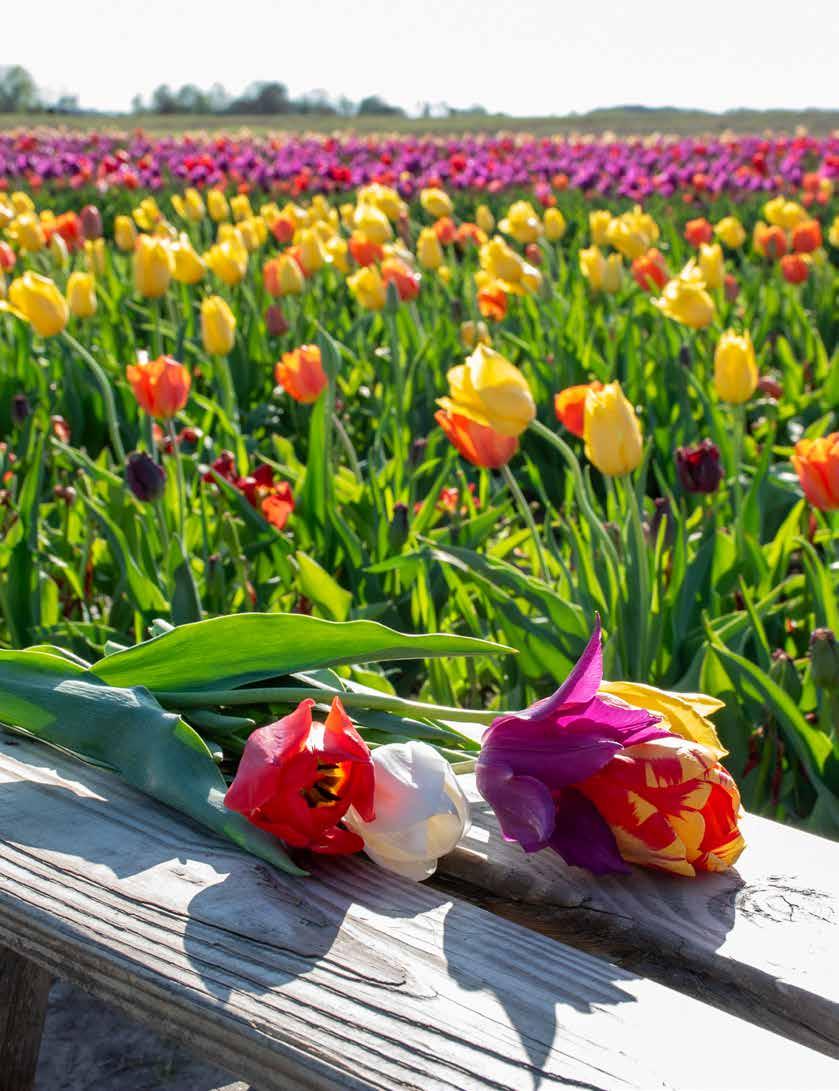
Tulip Days is a less expansive offering without many add-ons, but it offers a unique opportunity to see 55 varieties of tulips sprouting from more than 600,000 bulbs. Fitzgerald hopes to open Tulip Days in mid-April and welcome guests for at least three weeks. The opening date will be determined by unpredictable spring weather, and if coolish temperatures prevail and the blooms are still coming, the season might be extended. The event is a somewhat risky business proposition for Fitzgerald and company.
“One tragic weather event and there’s no return on our investment,” he says, adding that in 2025, rain plagued Tulip Days for two of the three weeks the flowers were blooming. In spite of the inclement weather, some 13,000 people came out to take pictures and harvest blooms to take home. Visitors came from throughout the region including Kokomo and Indianapolis, and Fitzgerald is lowering ticket prices this year after receiving feedback from guests. The weather did not deter Lorralyn Wallen and her boyfriend from visiting Tulip Days last year, and since they attended the final week of the event, the paths were dry and the weather decent.
“I love flowers and I’m always looking for local, easy and cheap things to do around Lafayette,” Wallen says. “When I saw the ads on Facebook, we decided to go.”
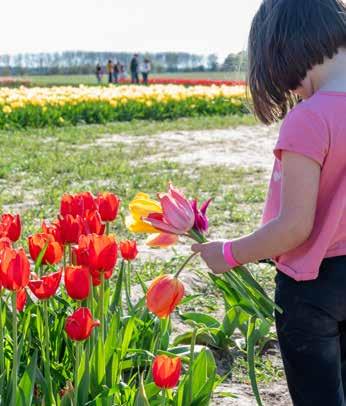
Wallen noticed tulip varieties she had not seen before and says the butterfly design in which the flowers were planted was very full and colorful. The paths were wide and easy to navigate, and she enjoyed taking a bouquet home.
“We spent about 40 minutes there and although it was a little chilly, it was so pretty and really enjoyable,” she says. “I cut about six tulips in a mix of colors to take home.”
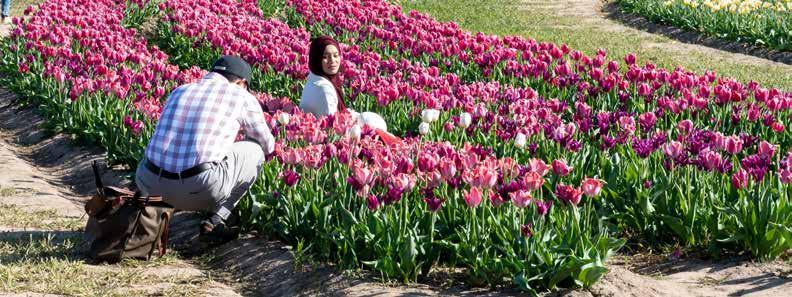
For the 2026 event, some 300,000 tulip bulbs were planted last fall in the shape of a hummingbird across a four-acre field. Grass was planted between flower beds to form walkable paths. Because tulips usually bloom more than one year, the 2025 butterfly field should also be resplendent with a variety of colors and forms, including yellows, pinks, reds and some with feathery and variegated petals.
The mastermind behind the field designs and actual planting is Shawn Stolworthy, owner of Mazeplay, an Idaho-based company that designs and plants corn mazes across the country and has expanded into designing flower fields. Stolworthy has worked with Fitzgerald from the beginning of Exploration Acres and says the interest in tulip fields is expanding.
“We’ve been doing tulip fields for about five years, and a lot of people really like them,” he says, adding that Mazeplay has designed fields in eight states, including Indiana.
“We figure out the best bulb varieties for each area and create designs that will make a neat display that is interactive.”
After using computer programs to design the display, Mazeplay brings special equipment in to plant the bulbs and create a parklike area with walking paths.
“These kinds of displays really haven’t been done before, so walking through them and enjoying the flowers is a unique experience,” says Stolworthy. “Because tulips are not very tall, you can see a lot of the design from the ground.”
As with any agricultural endeavor, including agro-tourism, weather determines the outcome. Early spring flowers are particularly susceptible to changeable weather: a late, hard freeze can kill the buds, but unseasonably warm weather means the blooms come early and don’t last long. Tulip bulbs need extended cold and plenty of winter moisture to produce good blooms, so the outcome of the event is really up to Mother Nature.
Each flower blooms for about 10 days but because the many tulip varieties produce blooms at different times, guests will likely not see all the varieties flowering at once, Fitzgerald says. About 20% of the planted bulbs bloom early, around 60% are intermediate bloomers, and the remaining 20% bloom later, so a repeat visit will provide new vistas of color and form.
But guests likely will see all the stages of growth a tulip bloom goes through, from the emerging bud to full bloom to falling petals, providing a good learning opportunity for children. If the weather is on the cool side, the show may extend further into May.
Each bed of tulips containing the same type of bulb will include markers identifying the variety, and a map of the field’s design also will list varieties, Fitzgerald says. Part of the designs include beds of mixed varieties for an explosion of color.
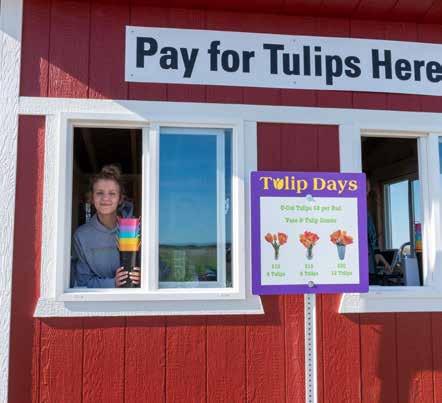
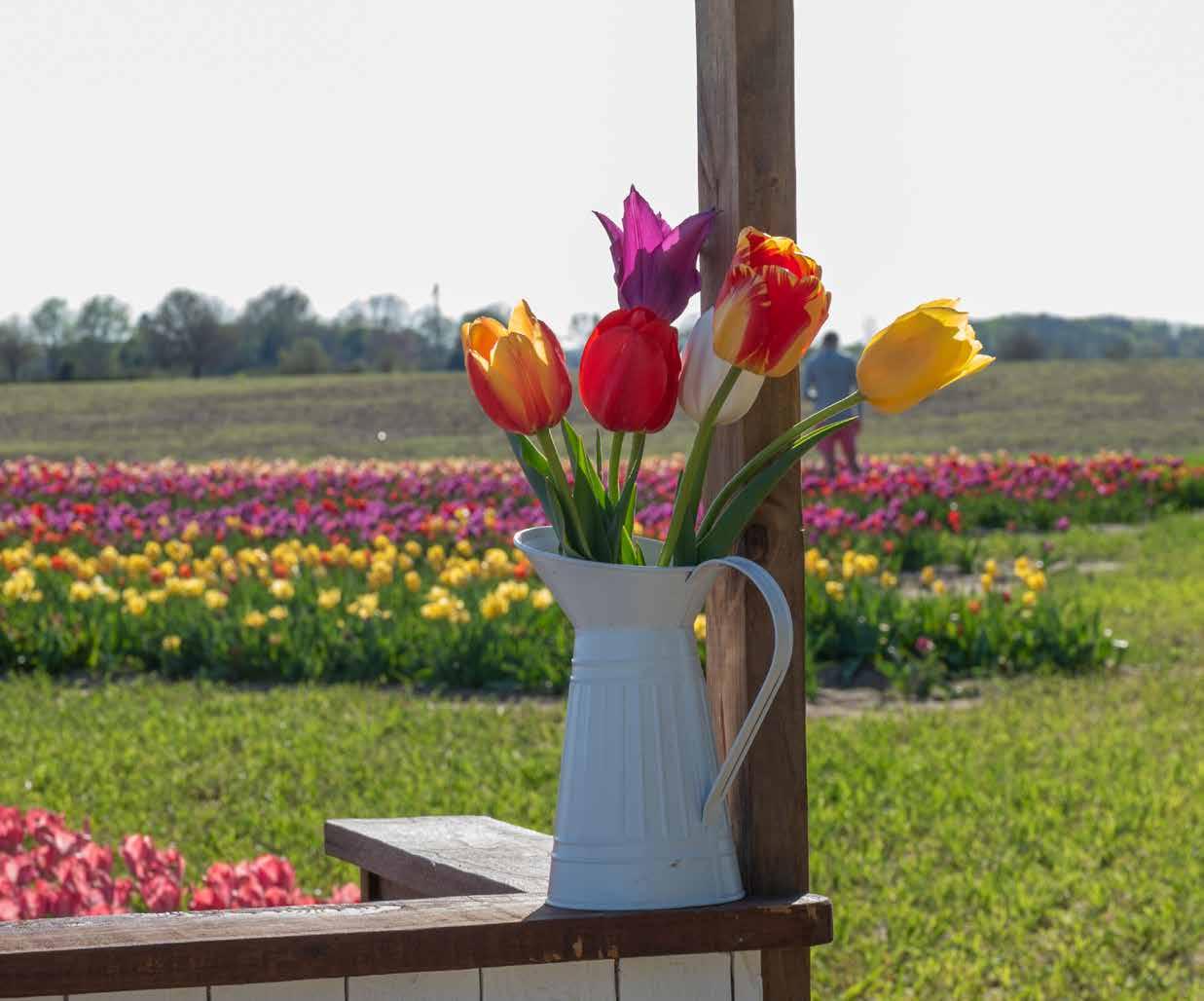
Scissors are available for guests to cut their own bouquet, with flowers priced by the stem. This year, vases and pastel containers will be available for purchase, or people can bring their own.
While Tulip Days does not offer other activities, guests will be able to take pictures with fun props in the fields such as a giant picture frame, a Dutch windmill, giant chair, and butterfly wings. A frame with the words “Class of 2026” makes the flower field a great place for senior pictures, Fitzgerald says. Children are welcome at Tulip Days and those younger than two get in free, but Fitzgerald emphasizes that no playgrounds are open and there are no special activities for kids. Portable toilets will be available near the fields, and the permanent bathrooms will be open, although those are a distance away.
Food trucks will be available on weekends, and other special activities may be planned, depending on the weather. The best way to keep up with changes or additions to Tulip Days is to follow Exploration Acres on social media or check the website.
And planners are hoping the weather cooperates this year.
A three-year effort at planting sunflower fields proved too costly and unpredictable, Fitzgerald said. While the first year with sunflowers was a success, the second year brought a drought, so the plants didn’t produce many flowers. The third year was so hot and humid people didn’t come out to walk through the fields. Add to that the proliferation of festivals and outdoor events in the area and such ventures become more financially risky.
The tulip fields are very expensive to design and create and the future of the event rests on whether it’s sustainable.
“We may have to rotate the tulips to different fields just like we have to rotate the corn maze,” Fitzgerald says. “We have to be responsible in how we rotate crops and sustain the soil, and we’re always thinking about fertilizer and weed control.”
Best agriculture practices are still required to keep the lavish displays fresh and inviting.
“I don’t know what’s going to happen,” he says. “It’s all an experiment, but we’re trying to create a really special customer experience.” ★
Exploration Acres Tulip Days at a Glance
For the latest news and details about Tulip Days, follow Exploration Acres on Facebook or check out the Exploration Acres website: explorationacres.com/tulips
Location: 6042 Newcastle Rd., Lafayette Planning to open mid-April and continue into early May, weather permitting
Hours of operation: Daily, noon – 7 p.m.
Tickets: Range between $12.95 and $17 for adults, and between $7.95 and $9 for children ages 3-12, depending on whether you buy online or at the gate. Weekend tickets are more expensive. Children two and younger are free. Pet policy: No pets other than trained, identified service dogs
Food: Food trucks available on Saturdays and Sundays
Purchasing tulips: You cut $2 per stem wrapped in paper with adjusted pricing for larger amounts; vases and decorative containers available for sale
How Aurora Wilson built a wellness hub on Main Street
By Kat Braz | Photos by Christine Petkov
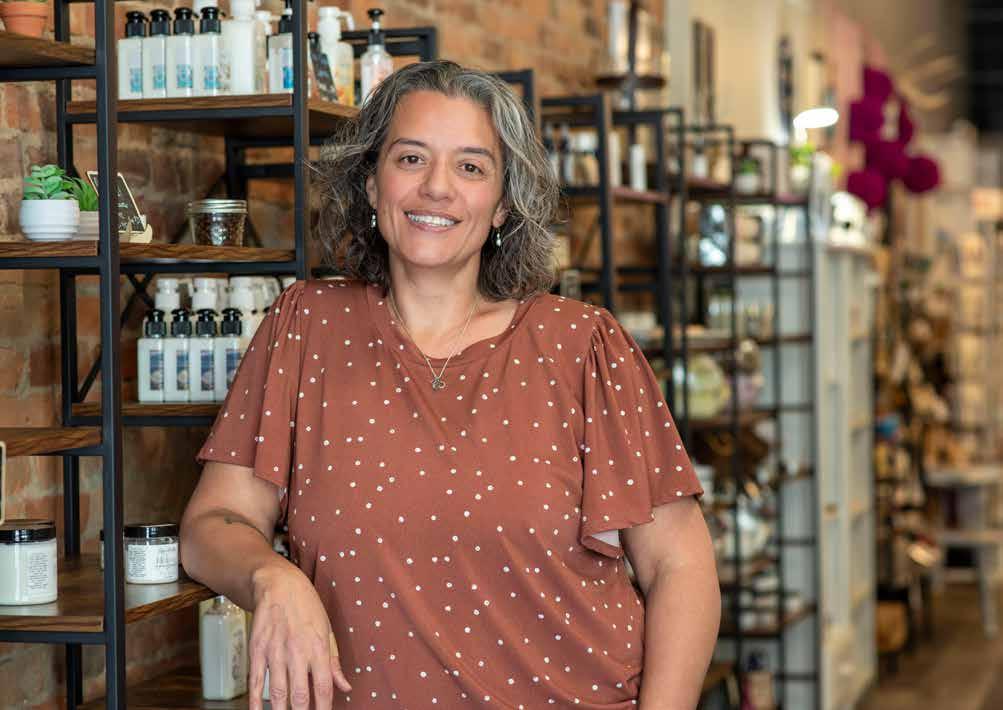
Aurora Wilson didn’t set out to become an entrepreneur. She was just trying to feel better.
Years ago, Wilson was managing chronic migraines, fibromyalgia and Hashimoto’s disease — conditions that sent her searching for answers beyond what traditional medicine was offering at the time.
“I kept asking for solutions, and they just weren’t there,” she says. So she began researching on her own, drawn to the idea that plants could be medicine and that the body, given the right support, could heal.
Around that same time, Wilson was introduced to essential oils. Curious and cautiously hopeful, she invested in a starter kit and began experimenting — diffusing oils, learning their properties and paying closer attention to how her body responded. But it was her youngest daughter who unknowingly sparked what would become a business.
During a winter cold snap, Wilson’s daughter came to her with painfully dry hands, the skin on her knuckles cracked and bleeding. Searching for a solution, Wilson found a simple recipe for a lotion bar made with shea butter, coconut oil, beeswax and lavender. With the ingredients already on hand, she made a small batch and rubbed it into her daughter’s hands.
“Two days later, they were completely healed,” Wilson says. “Like they had never been bleeding at all.”
That moment changed everything.
What started as a single lotion bar turned into a quiet obsession. Wilson began making lip balms, soaps and bath products for her family and friends. She paid close attention to ingredients, intentionally avoiding the chemicals and synthetic additives she had learned could disrupt hormones and irritate skin. Over time, her “fun little hobby” became something more refined, more scientific and more in demand than she ever expected.
Encouraged by friends, Wilson decided to test the waters. During the 2018 holiday season, she listed just four products on Facebook: lotion bars, lip balm, rose water and bath bombs. Within a day, she had made $300. She was fresh out of college with a background in computer information systems and web development, but the traditional job search wasn’t clicking. Her husband encouraged her to try selling her products at farmers markets, and business boomed. Customers lined up not just for soap, but for solutions — for products that felt good, smelled good and aligned with a growing interest in natural ingredients that support wellness. Then COVID-19 shut everything down.
Rather than closing the chapter, Wilson and her husband made a bold decision: if markets were gone, they would open a store. In November 2020, in the middle of a pandemic, Wilson unlocked the doors to Essentially Aqua in her first brick-and-mortar space on Main Street in downtown Lafayette.
Five years later, now located just a few doors down at 525 Main St., the shop has become a fixture — celebrated for its inclusive atmosphere, delightfully scented offerings and Wilson’s stalwart commitment to wellness.

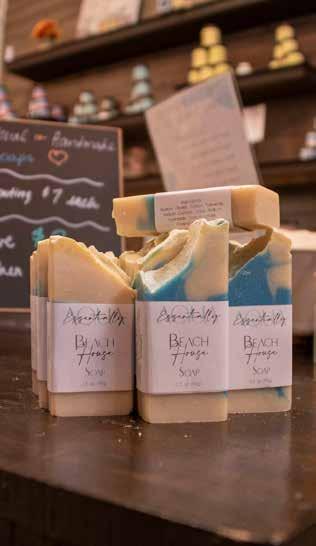
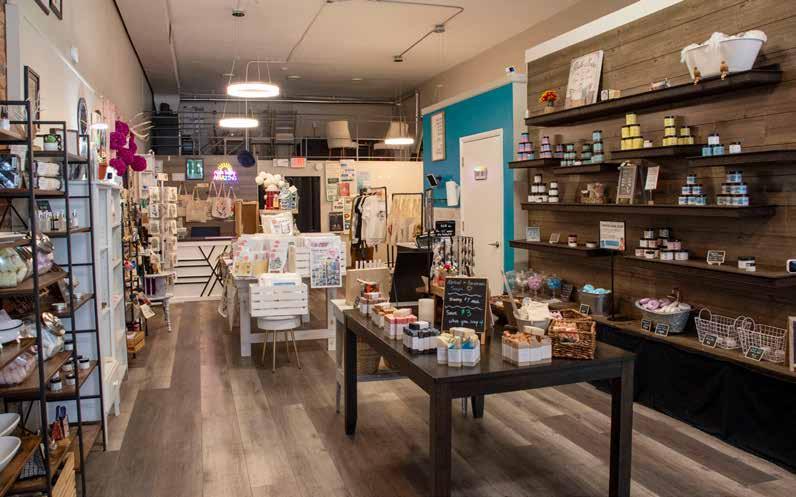
Wilson produces her products on site in the basement below the store. The operation is less craft time and more chemistry lab: precise recipes, weighed ingredients and meticulous consistency. Her product lineup includes cold-process bar soaps, shower steamers, bath bombs, lotions, body butters, body oils, shampoo and conditioner bars and foaming sugar scrubs with seasonal scent collections launched four times a year.
Soaps remain the foundation. “If your skin feels tight or itchy when you get out of the shower, it’s usually the soap,” Wilson explains. Her bars are superfatted — made with extra oils and butters — so they cleanse without stripping the skin. For customers new to wellness-focused skincare, she encourages starting small, just one bar of soap, and building from there.
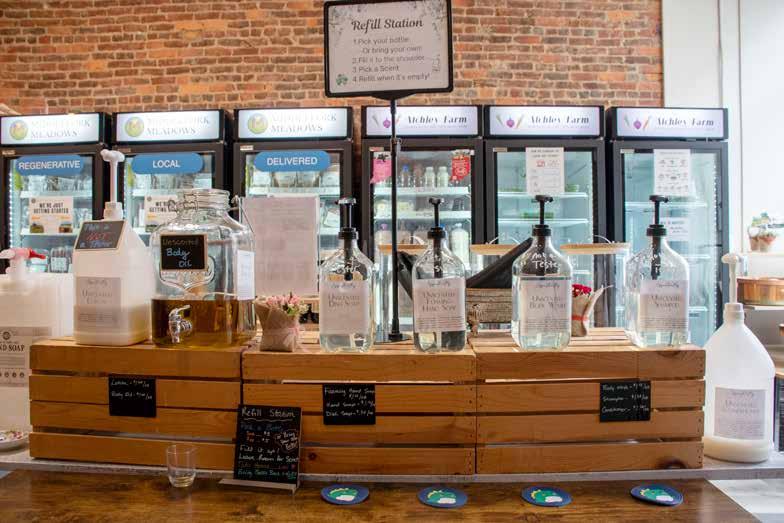
The shop also features a refillery, where customers can bring in a bottle to refill everyday essentials such as hand soap, dish soap, body oil and lotion — all available unscented. But beyond the products, what customers often observe is how the space makes them feel.
“The goal is that everybody feels welcome,” Wilson says. “It doesn’t matter what you look like or where you’re from.” The store is intentionally homey, inviting people to explore at their own pace. Many linger. Some come just to breathe.
That sense of care and community inspired Wilson’s next chapter: Market on Main.
Launched in October, Market on Main is a cooperative housed within the same space — a year-round, indoor take on a farmers market designed to support local makers and producers. The idea came from fellow vendor Nick Atchley of Atchley Farms who noticed Wilson’s shop had room to grow and asked a simple question: what if downtown had a permanent market?
Today, Market on Main includes a curated mix of vendors offering local meat, farm products, whole food supplements and handmade gifts. Refrigerators stocked with locally sourced food sit alongside shelves of artisan goods, drawing in curious passersby and helping address what many consider a downtown food desert.
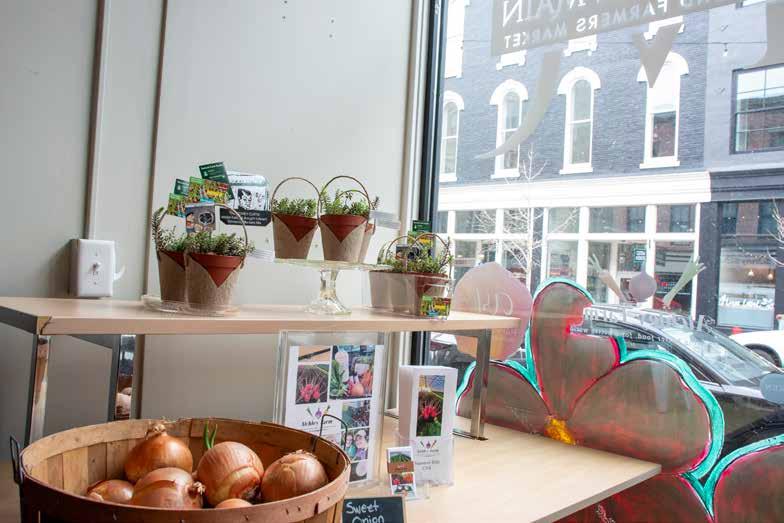
More importantly, it lowers the barrier for small businesses. Vendors can gain a brick-and-mortar presence without the financial risk of leasing their own storefront. The cooperative model gives each partner a voice, while shared staffing and seven-day-a-week hours offer stability and visibility.
For Wilson, it’s a natural extension of her original mission.
“Wellness isn’t just soap,” she says. “It’s food, it’s sustainability, it’s community.”
In a city she describes as deeply rooted in connection, Wilson credits Lafayette’s support for her longevity. Customers know her name. She knows theirs. And even in uncertain economic times, she sees people choosing local — understanding that every purchase supports families, not faceless corporations.
What began as a mother trying to soothe her daughter’s cracked hands has grown into a downtown hub for healthier living, thoughtful consumption and shared success. On Main Street, wellness isn’t a trend — it’s a community practice, built one bar of soap at a time. ★
Three Tips for Healthy Skin
1) Drink more water. Your body — and your skin — need it. Hydration starts from the inside.
2) Use real sunscreen. Handmade sunscreen isn’t safe or regulated.
Buy a tested, FDA-approved product and use it consistently.
3) Stay informed. Awareness matters. Understanding ingredients, triggers and habits is key to long-term skin health.
Winter Market Update
The winter market was held at the Bistro 501 Atrium at the Lahr one Saturday a month, January through April. Molly Welch, quality of life manager at Greater Lafayette Commerce, says there were consistently 20 vendors at each market, with an estimated total of 1,200 visitors.
“We received a lot of positive feedback from patrons, saying that this has been much needed as a way to get out during the colder months,” Welch says.
“The Bistro 501 Atrium is a beautiful space that a lot of people forget is downtown. I’m glad that we could get the community back in there for at least one Saturday a month.”
Welch says she received helpful feedback from vendors about layout, time and overall feasibility of a winter market. “I’m excited to see how we can continue to grow our winter market,” she says.
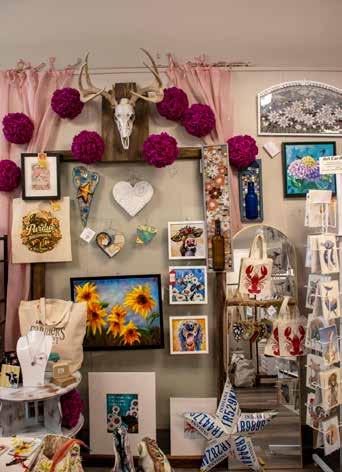

Market On Main Vendors
Current partners include:
10:10 & Healthy: Whole food supplements
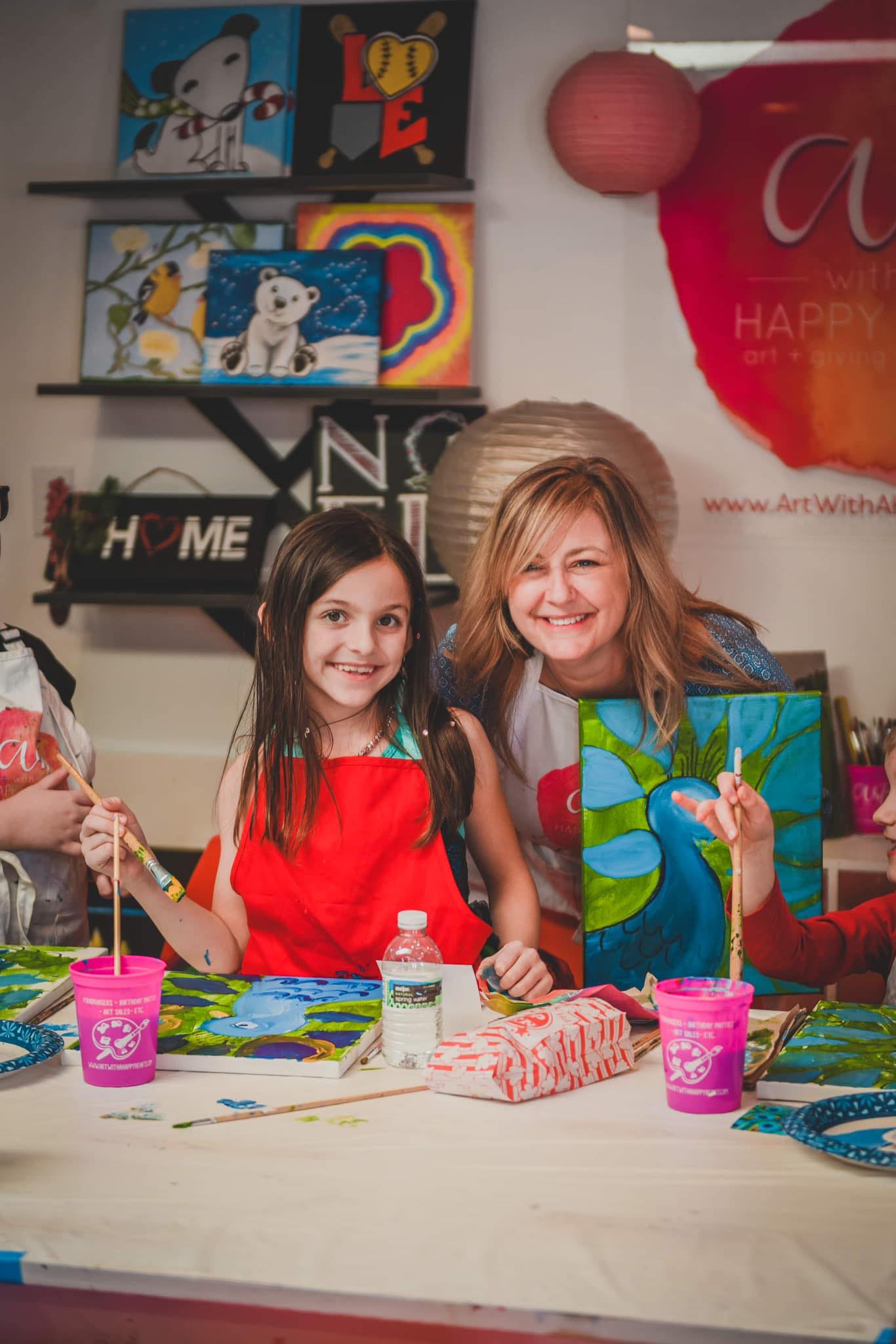
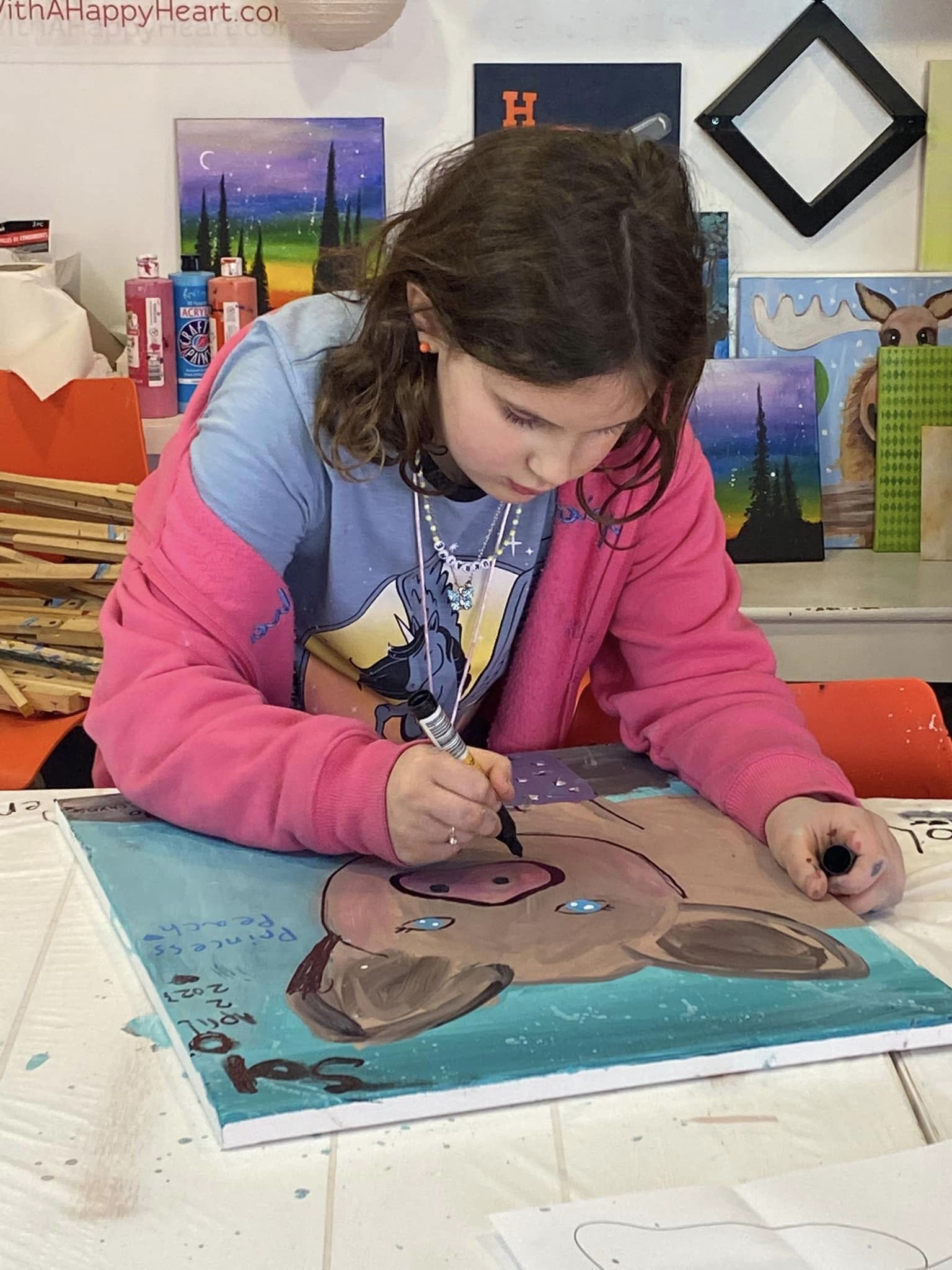
Art with a Happy Heart: Take and make art kits, original art and unique gifts
Atchley Farms: Certified naturally grown produce
Essentially Aqua: Natural skincare, bath, body and home products
Middlefork Meadows: Locally raised beef, pork and chicken
Interested In Becoming A Vendor?
Market on Main is actively seeking additional partners for its year-round farmer’s market concept. Local producers and makers looking for a low-risk entry into a brick-and-mortar space are encouraged to reach out directly at the shop at 525 Main St.
Area Farmers Markets Open In May
West Lafayette Farmers Market: 3:30-7:30 p.m. Wednesdays, through October. The market is held at Cumberland Park in West Lafayette with more than 50 vendors.
Lafayette Farmers Market: 8 a.m.-12:30 p.m. Saturdays, through October, on Fifth Street between Columbia Street and mid-block to Ferry Street, and Main Street between Fourth and Sixth streets.
Thursdays, through October.
The rebirth of Tippecanoe County’s historic school buildings
BY ANGELA K. ROBERTS | PHOTOS BY CHRISTINE PETKOV
The ring of the school bell once signaled the start of the day for generations of Tippecanoe County students, echoing through city blocks and wooded groves. From the grand brick structures of early 20th century urban high schools to the simpler construction of 19th century rural outposts, the buildings shaped the region’s early educational history. While many of these landmarks have succumbed to the passage of time, some are experiencing a second chapter. Including a Quaker meeting house, a community park centerpiece and a senior apartment complex with a faithful addition, these repurposed school buildings demonstrate how preservation can offer new purpose long after classes have ended.
The county’s first rural academy
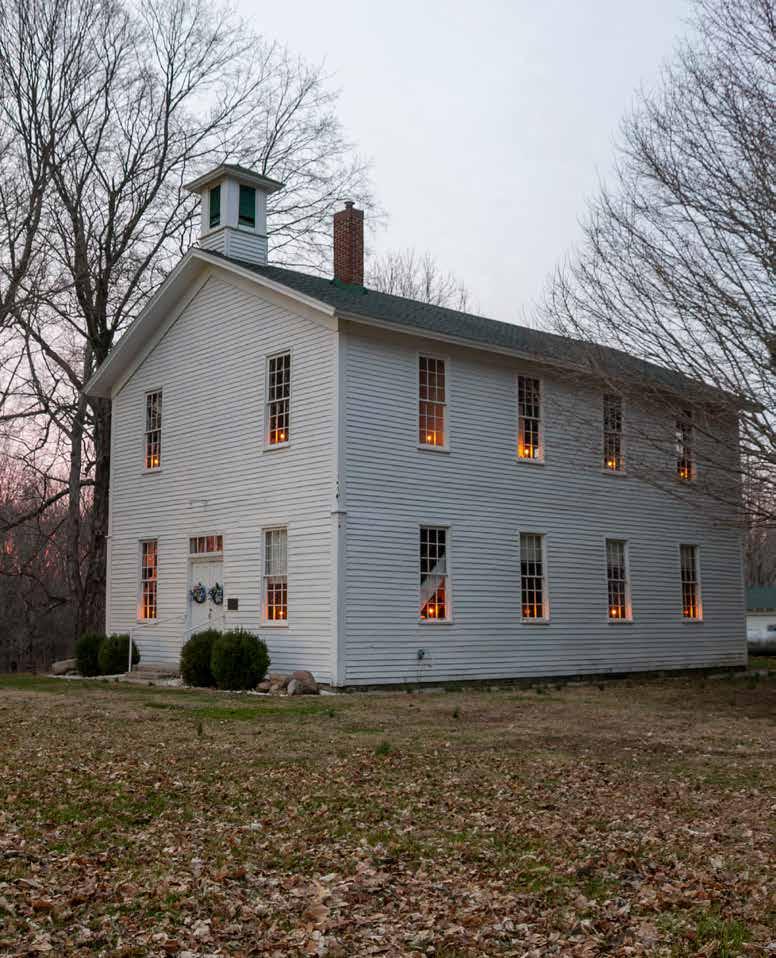
In a shady grove along a quiet stretch of Shadeland, a white two-story frame building stands as a monument to early Indiana education.
In 1851, the Society of Friends opened Farmers Institute, considered to be the first academy in rural Tippecanoe County. Drawing boys and girls from the neighboring towns of Lafayette, Thorntown and Stockwell and from as far away as Ohio, the school offered a boarding house for residential students.
The curriculum included reading, writing, spelling, arithmetic, English, grammar, geography, history, chemistry, physiology, algebra, geometry, trigonometry, Greek and Latin. At the school’s busiest, 75 to 125 students attended each year. According to a historical marker in front of the meeting house, “The library was large and of exceptional quality.”
When the school closed its doors after the founding of Purdue University, the building eventually became a Quaker meeting house, which was later renamed Farmers Institute Friends Meeting.
Saving an endangered building
In 2012, Indiana Landmarks listed Farmers Institute among Indiana’s most endangered historic buildings, citing structural deterioration. By then, the institute had been “laid down” – a Quaker term for a meeting that has closed its doors.
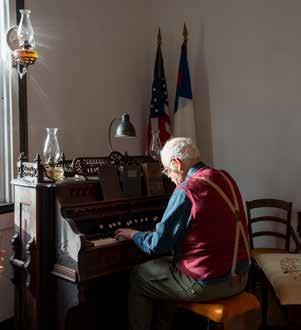
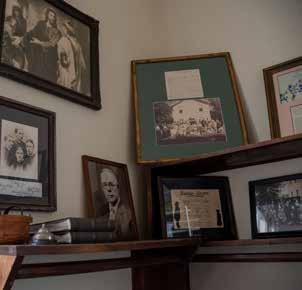
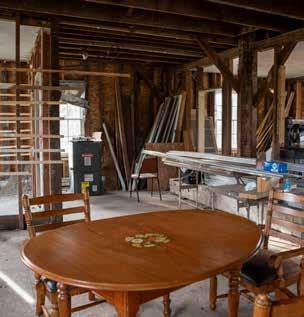
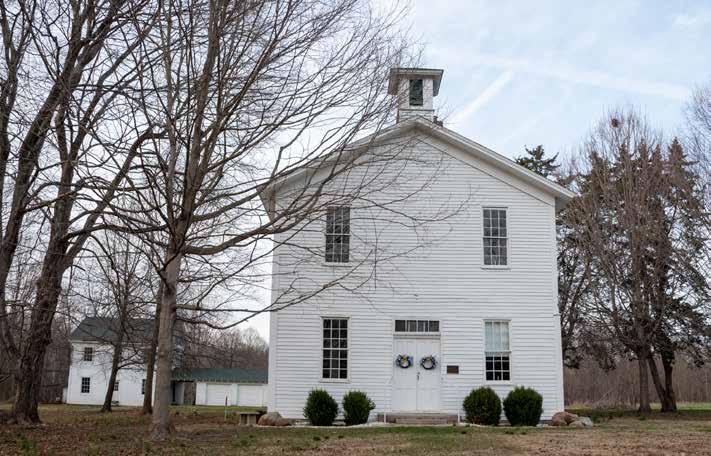
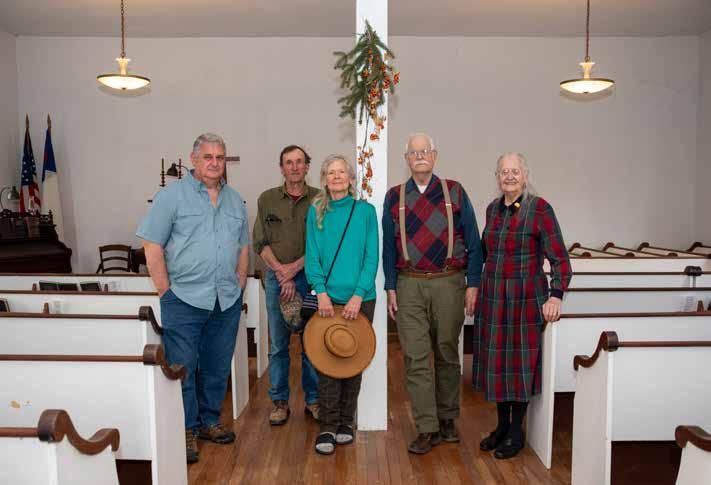
That year, a group of locals vowed to save the structures. They began meeting again for silent worship on the first Sunday of each month and gathering regularly to work on the buildings and grounds.
After tackling critical repairs to the exterior and interior of the meeting house, they turned their attention to the section of boarding house that remains.
Volunteers like Karla Ross, a retired clinical assistant professor from Purdue University, are part of the institute’s renaissance. With the foundation of the boarding house now shored up, they are currently replacing its windows and re-siding the building with southern Indiana poplar, which they are painting and nailing by hand. By this fall, Ross says, they hope to have the exterior of the boarding house completed so that they may tackle the inside.
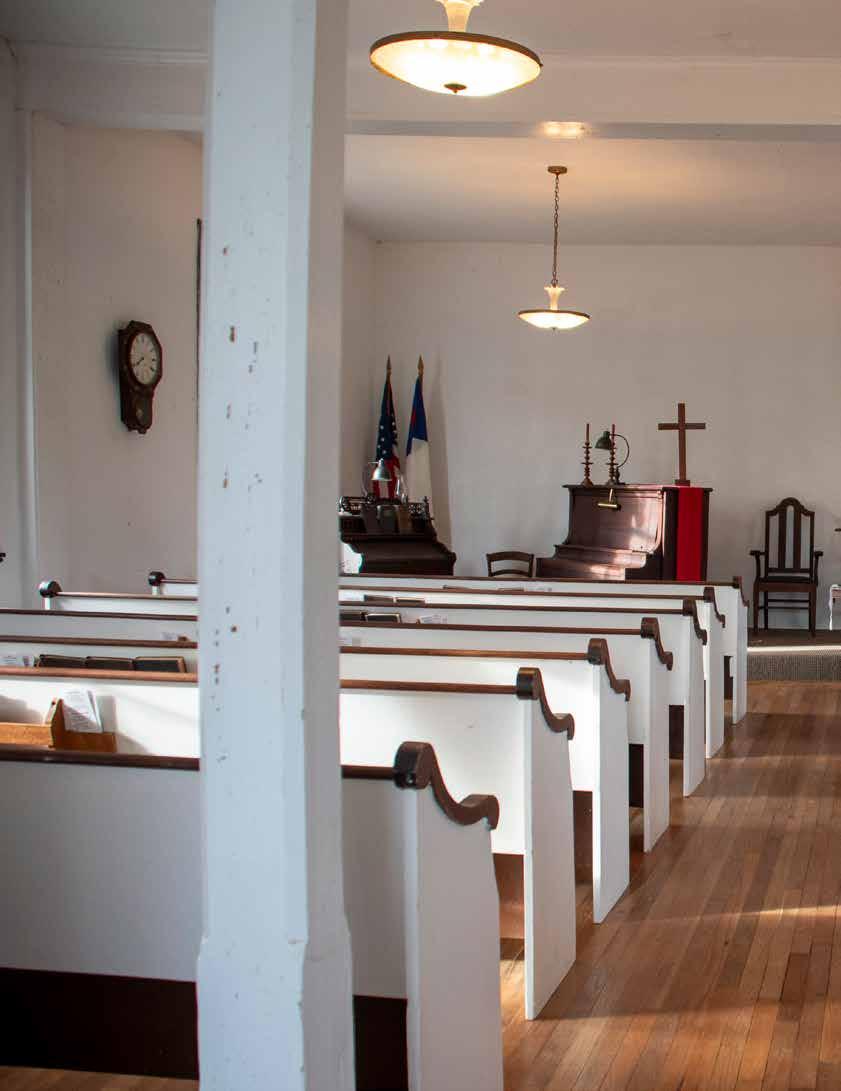
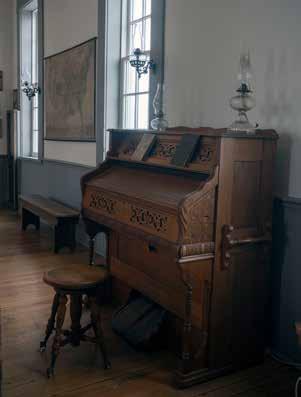
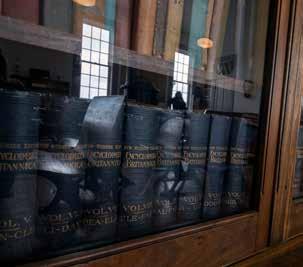
Next door, the meeting house has retained much of its 19th century aesthetic. Inside a quiet vestibule, glass bookcases preserve a collection of vintage books and photos. The entryway opens into a bright meeting room defined by glazed windows, wide-plank wood flooring and soft white walls.
On either side of a center aisle, wooden pews await folks gathering for silent worship once a month, the quiet sometimes punctuated by hymn singing and piano music. During evening events, kerosene lamps mounted on the walls offer a soft amber glow, supplementing electrical lighting.
Despite a small monthly attendance of 10 to 15 people, the group remains active in its mission. “It’s one thing I’ve learned, which is humbling. It isn’t the size of the group. It’s the commitment to what they’re doing,” Ross says.
Each fall, Farmers Institute puts on a Quaker Fair. Drawing hundreds, the fundraising event features an old-fashioned bean dinner, historical talks and displays, music, quilt exhibits and handmade crafts.
In early December, the meeting hosts an annual carol sing. As guests arrive in the dark of winter, electric candles illuminate each window of the meeting house, guiding them toward the double front doors and the communal warmth waiting inside.
History, on the move and hands on
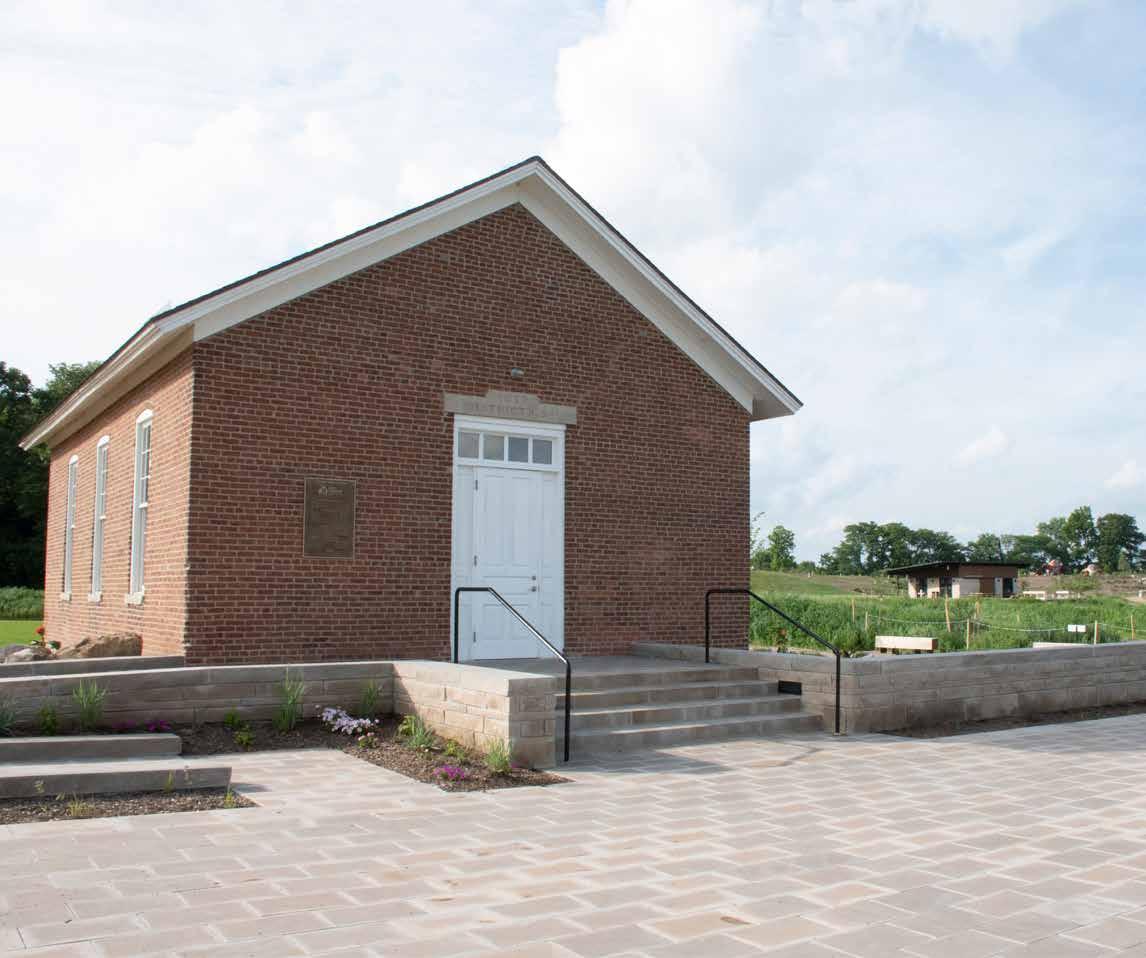
While many historic structures remain tethered to their original foundations, the Morris Schoolhouse, built in 1879, embarked on a unique journey to ensure its preservation. Situated on land slated for new development by Franciscan Health, the schoolhouse required a new home to avoid being lost to history.
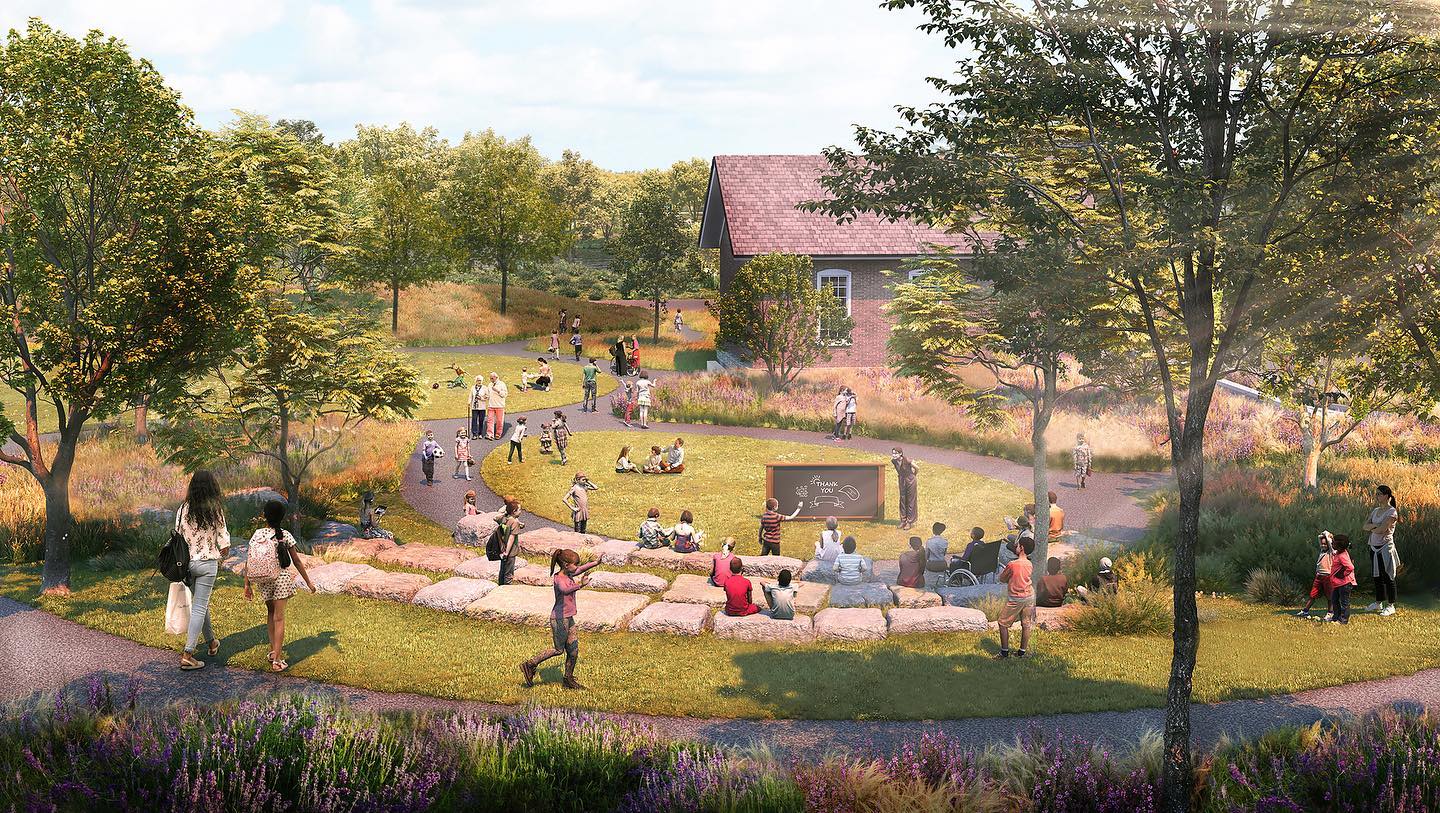
Lynn Cason, a local resident, donated 13.6 acres of retired farmland along Cumberland Avenue to serve as a permanent sanctuary for the building. On a clear, late-winter day in 2017, as hundreds of spectators watched, the schoolhouse was lifted with hydraulic jacks, placed on steel beams and driven across a barren soybean field to its current location.
Today, the red brick landmark stands as the centerpiece of the new Cason Family Park, nestled among prairie grasses and connected to West Lafayette’s 27-mile trail system.
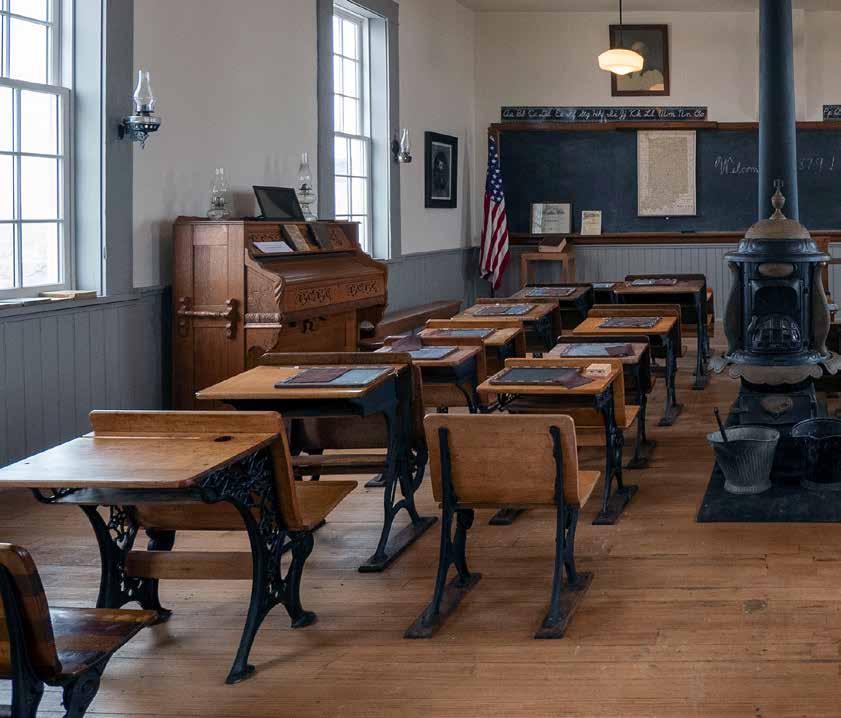
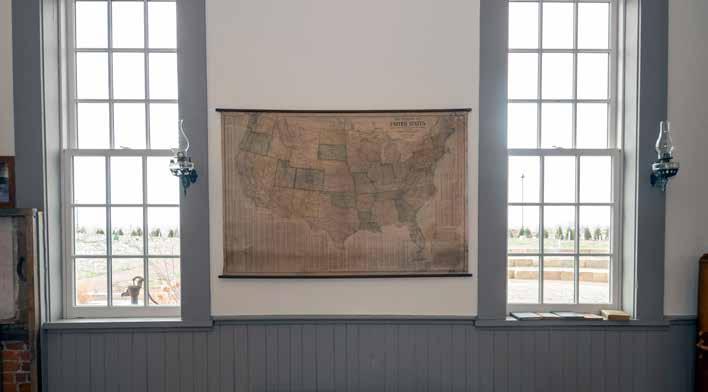
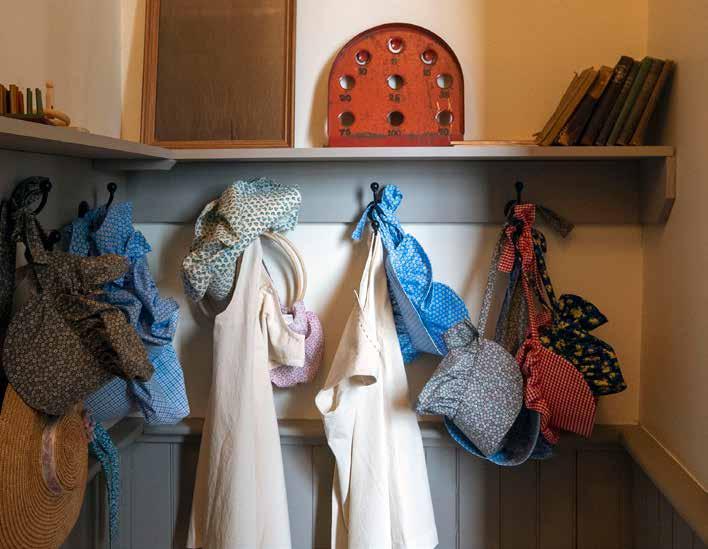
Walking into the restored schoolhouse feels like stepping back 150 years. A cast-iron stove presides over the room, flanked by rows of wooden desks standing on ornate legs. Stretching across the back wall is a chalkboard with the phrase “Welcome to 1879!” written in cursive letters. In the tiny cloakroom, bonnets, lunch pails and caps hang on black pegs, harking back to an earlier generation of students. Wood floors and beadboard complete the scene.
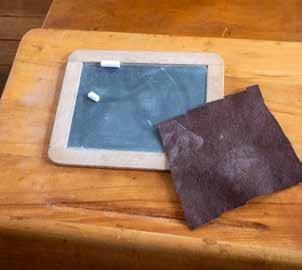
“We have slate boards at each desk. Visitors are welcome to sit in the desks and write on the slates,” says Amanda Jeffries, recreation coordinator at West Lafayette Parks and Recreation Department. “There are many books that can be looked through. There are maps and photos around the room to look at. There are some replica toys in the closet as well.”
Starting in April, the building will be open for weekend tours, with future plans for immersive field trips where 21st century students can experience the rhythms of a 19th century school day.
Preservation and historic reproduction in the Old City
The Historic Jeff Centre Senior Apartments represent a meticulous preservation of the Old City’s architectural and educational heritage. Built in the 1910s and expanded
in the 1920s to include a gymnasium, the brick Tudor Revival served as Lafayette’s public high school for nearly 60 years before transitioning into a junior high and then a home for Ivy Tech Community College of Indiana. In 2000, the landmark reopened after an adaptive reuse transformation, finding new purpose as an affordable senior apartment complex with 74 units. Last December, Homestead Resources debuted a nearly $13 million addition. Named after the school’s newspaper, the new Jeffersonian contains 50 affordable senior housing units.
Rising from the site of the old Jeff gymnasium that had been demolished decades before, the new apartment building was designed with input from residents of the Historic Jefferson Neighborhood. “We did work with the neighborhood – and they’re an integral part of our partners – to make sure we got them something they could be proud of, to look outside their windows every day at,” said Marie Morse, executive director of Homestead Resources, at the grand opening in December.
Physically separated from the historic school building by a parking lot, the Jeffersonian complements its next-door neighbor in an updated traditional style. Like its historic predecessor, the new building is three stories high. Brick masonry veneer mimicking the older building’s exterior mixes with modern fiber cement panels. Double-hung windows, a staple of early 20th century architecture, are embellished with cast stone lintels and soldier course brickwork, evoking the ornamental details of surrounding historic homes.
Inside, contemporary furnishings such as vinyl plank flooring, glass public doors and stainless-steel appliances offer modern comforts. Memorabilia from past athletic events are on display, showcasing the land’s historical significance.
Located on North Ninth Street, the Historic Jeff Centre Senior Apartments and the Jeffersonian offer up-to-date living within a historic framework, ensuring that the site where high schoolers once wrote on chalkboards and tossed basketballs continues to play a meaningful role in the life of Greater Lafayette residents.
BY BRAD OPPENHEIM
If you’ve spent any time in downtown Lafayette, you’re familiar with the diverse mix of establishments to dine, grab a drink and explore. A couple of years ago, the city made an effort to enhance that experience even more, launching what’s known as the Designated Outdoor Refreshment Area (DORA).
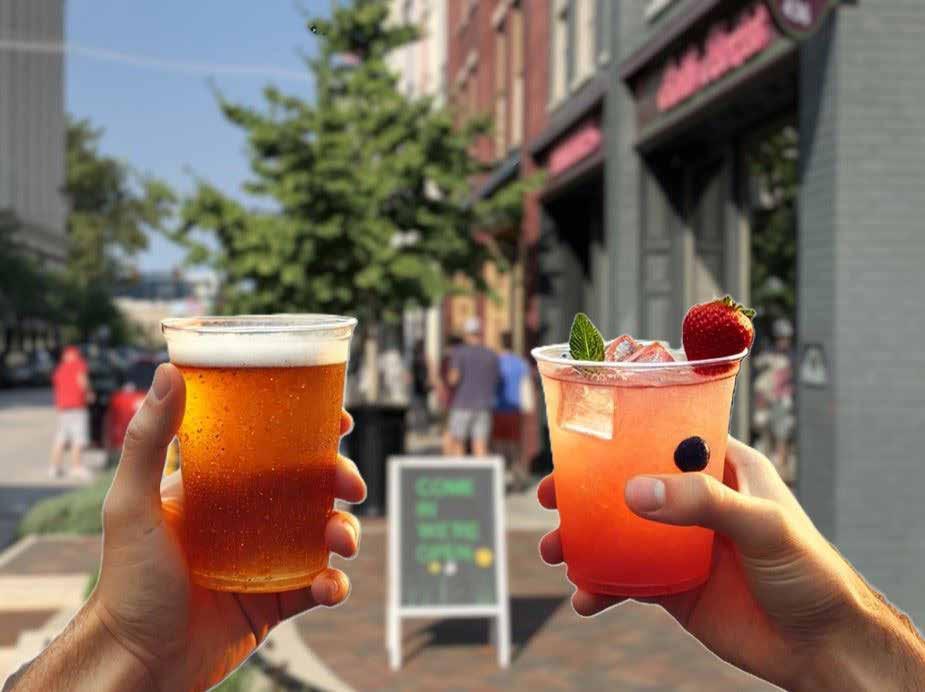
Introduced in summer 2024, the pilot program allowed individuals of legal drinking age to purchase an alcoholic beverage from participating businesses within the approved area. Visitors could then stroll through a defined section of downtown, enjoying their drink during various hours throughout the week. The initial DORA began on a modest scale, spanning just a single block along Main Street, from 10th and 11th streets.
Following what was dubbed a successful launch of the pilot, the area was expanded in summer 2025, encompassing a much larger portion of Main Street, stretching from Second Street all the way east to 11th Street. This includes landmarks such as the courthouse square and the area that makes up the farmers market.
DORA boundaries are clearly posted with signage throughout downtown. Rules state that beverages must remain outdoors and are not allowed to be brought into businesses unless the establishment explicitly allows it, which will be indicated by posted signs.
As the temperatures begin to rise and we begin to spend more time outdoors, heading into the third year of offering a DORA, city leaders are looking ahead and touting the success of years past.
“With last year’s expansion the feedback has been entirely positive,” says Myles Holtsclaw, senior community development manager at the City of Lafayette’s Economic Development Department. “I have received positive feedback about the program from business owners, downtown employees and people purchasing beverages from the DORA locations.”
Holtsclaw says that more downtown businesses have shown interest, and he hopes even more will choose to join. Currently, 15 establishments are actively participating in the DORA.
“I have encouraged all downtown businesses to share any issues they have with the DORA, and so far I haven’t received any,” he says. “My hope is that continues.”
Along with businesses, downtown event organizers also are expressing interest in using the DORA to facilitate their beverage needs, creating an easier and streamlined process.
Holtsclaw says as of now, there are no plans to expand the current boundaries.
“Our last expansion covered all qualifying vendors in the downtown area, and we haven’t received any requests to expand the DORA footprint,” he says. “Communities are allowed to have multiple DORAs, but we do not have any plans to create an additional DORA currently.”
Broadening DORA’s appeal
To further enhance the vibrancy and charm of downtown, the city is looking to broaden its appeal to visitors of all ages, exploring the addition of live entertainment within the DORA boundaries, creating a dynamic and welcoming atmosphere for everyone.
“For a long time, the mayor [Lafayette Mayor Tony Roswarski] has envisioned having live entertainment downtown in the evenings as residents and guests enjoyed our historic downtown for shopping, shows and events, and our wonderful restaurants and eateries,” says David Huhnke, director of marketing and communications for the City of Lafayette.
Huhnke says the plan is to offer live music performances at least once a month, creating regular opportunities for people to come together and experience the vibrant atmosphere of downtown.
“We want this live entertainment to be family friendly to draw an audience of all ages so visitors can appreciate what Lafayette has to offer while enjoying the sights and sounds of our historic downtown,” he says.
The plan calls for scheduled performances on designated dates (e.g., the first and third Thursday of each month) or based on the availability of a specific group. Huhnke says these performances will not compete with scheduled events or annual festivals that are already scheduled downtown.
Huhnke says there will be a variety of entertainment, from live bands that encompass high school music departments; dance studio groups; bands of all genres, or performing arts groups from around Greater Lafayette.
Performances will pop up at varioius locations throughout the designated area, from Riehle Plaza to open-air spots along Main Street, in front of local storefronts, and the former train stop at Main and 11th streets, bringing energy to all corners of downtown.
To ensure a positive experience for everyone, shows will begin around 7 p.m. and conclude by 10 p.m., striking a balance between lively entertainment and respect for nearby residents and businesses. Additionally, Huhnke says the city is open to partnerships with businesses or organizations interested in helping offset the costs of hosting live entertainment.
“So far, we have evaluated the live entertainment by the feedback we have received and the number of attendees,” he says. “It has been appreciated by those who have attended in the past and the feedback that has been shared on the city’s social media sites.”
For individuals or groups that are interested in performing, they can contact the city at LafayetteLive@lafayette.in.gov
“We are still in the beginning stages of this program, so there will be adjustments as we go forward,” Huhnke says.
For more information regarding hours, guidelines and participating businesses, visit: lafayette.in.gov
Wabash Riverfront projects keep rolling along
BY BRAD OPPENHEIM
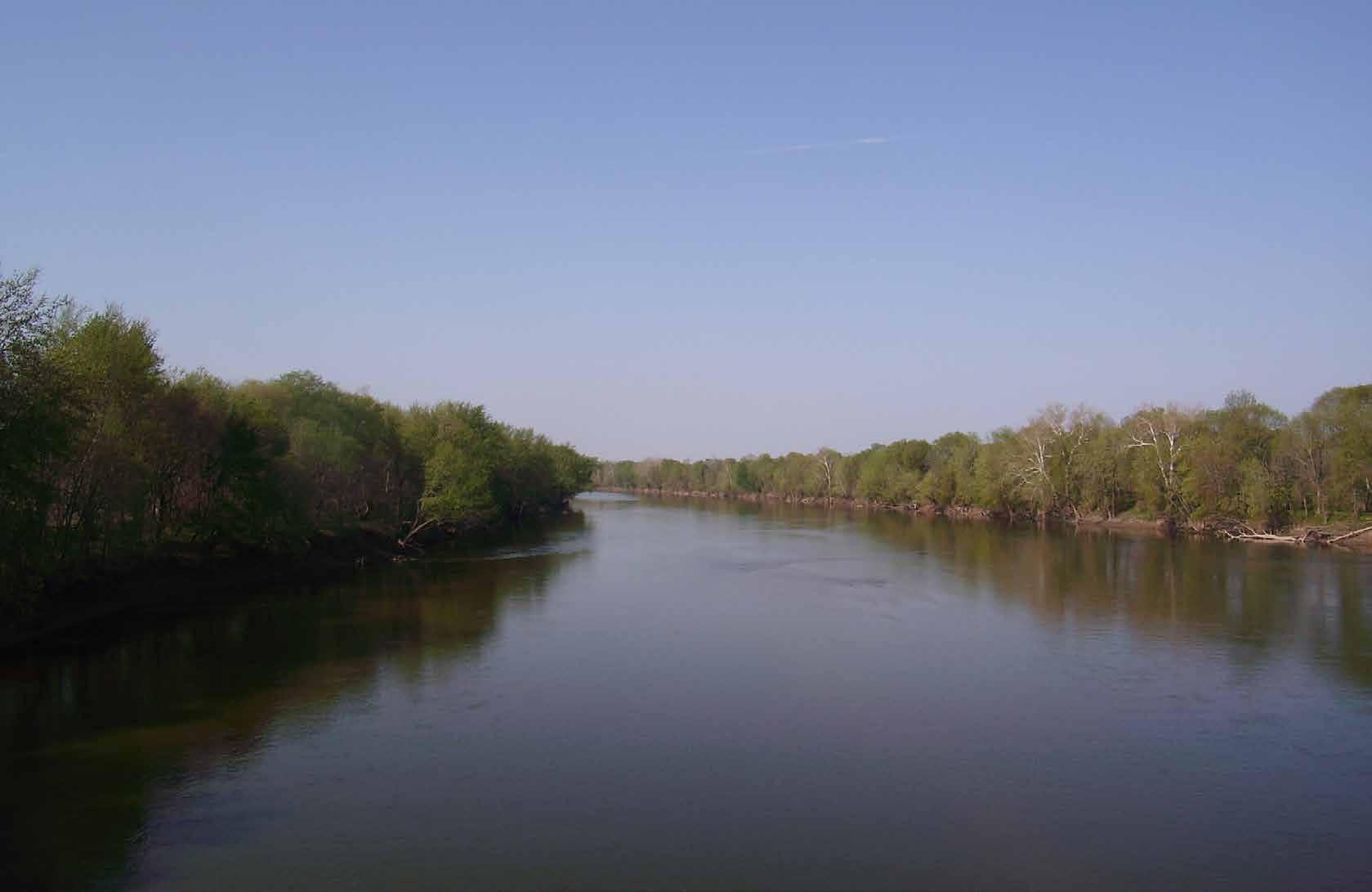
Several projects are underway along the Wabash River in Tippecanoe County, aimed at enhancing and revitalizing the riverfront and making it more accessible and enjoyable for everyone.
Spearheading these projects is the Wabash River Enhancement Corporation (WREC). Established in 2004 as a 501(c)(3) nonprofit, WREC was created by the City of Lafayette, the City of West Lafayette, Tippecanoe County and Purdue University to serve as the point agency for planning and implementing enhancement of the Wabash River corridor.
Its mission is to enhance the quality of life in the Wabash River corridor by providing sustainable opportunities to improve health, recreation, education, economic development and environmental management to promote the longterm sustainability of the Wabash River through environmental stewardship, recreational development and economic growth.
WREC is leading a regional effort that has developed a Corridor Master Plan to develop a 5-county, 90 river-mile Wabash River Greenway (WRG), and development projects are underway throughout the WRG region.
Three current projects are supported primarily by a $2.9 million Regional Economic Acceleration & Development Initiative (READI) grant awarded by the state, along with $5 million from the Lilly Endowment’s College and Community Collaboration Initiative grant through Purdue University, and matched with an additional $1.47 million from North Central Health Services.
According to Stan Lambert, executive director for WREC, these projects, all expected to wrap up in May of this year, aim to expand and enhance the WRG trail network on both sides of the river.
Trailheads and connectors
The first project, the North River Road Trailhead & Connector Trail, is located on the West Lafayette side of the river, beneath the Sagamore Parkway bridges along North River Road. Plans call for constructing a new trailhead with a small parking lot, a rest area with benches and bike racks, a bike repair station and a connector trail linking to the West Lafayette Sagamore Parkway Connector Trail. Lafayette Rotary funded the development of the bike repair station and trailhead components.
According to Lambert, this connection will provide access to the City of West Lafayette’s trail system and the existing protected bike lane attached to the Sagamore Parkway vehicular bridge, allowing cyclists and pedestrians to travel into Lafayette and connect with its trail system.
The second project, the Wabash River Greenway Connector Trail, is located on the Lafayette side of the river and will strengthen connections between Lafayette and West Lafayette’s trail systems.
This includes the construction of a boardwalk extending from Lafayette’s Sagamore Parkway Connector Trail and overlook, and the protected bike lane on the Sagamore Parkway bridge, down to the Wabash River Heritage Trail that extends along the river.
This will allow for a continuous route into downtown Lafayette, connecting the Lafayette Sagamore Parkway Connector Trail, the Wabash River Heritage Trail, the protected bike lane on the Sagamore Parkway bridge, the WL Sagamore Parkway Connector Trail, the North River Road Trailhead, and the future Wabash River Greenway trail along North River Road.

Canoe and kayak dock
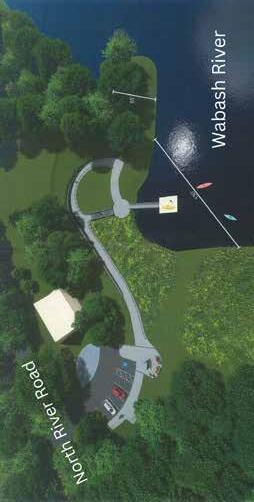
The third project, the Wabash River Greenway Trailhead and ADA-Accessible Canoe and Kayak Facility, will construct a new trailhead along North River Road and an ADA-accessible canoe and kayak put-in/take-out dock and harbor. The trailhead will include a small parking lot, benches and bike racks and a bike repair station.
The canoe and kayak facility will be accessible via a ramp and floating gangway connecting to an ADA-accessible dock.
Additionally, a $25 million federal Rebuilding American Infrastructure with Sustainability and Equity (RAISE) grant will help fund another large project: the construction of the North Ninth Street and North River Road segment of the Wabash River Greenway Active Transportation Loop. That will extend along the North River Road and North Ninth Street Road corridors to eventually connect to Prophetstown State Park in Tippecanoe County.
Safety improvements and ADA upgrades are planned for the existing North Ninth Street trail that extends south into Lafayette. The project will include construction of a new trail beginning at the end of the current path. From there, the trail will continue south to Canal Road before turning west toward the Wabash River. It will then connect to a new bicycle and pedestrian bridge across the Wabash River, landing at the intersection of Happy Hollow Road and North River Road.

Safety improvements and ADA upgrades are planned for the existing North Ninth Street trail that extends south into Lafayette. The project will include construction of a new trail beginning at the end of the current path. From there, the trail will continue south to Canal Road before turning west toward the Wabash River. It will then connect to a new bicycle and pedestrian bridge across the Wabash River, landing at the intersection of Happy Hollow Road and North River Road.
“We’ll have signalized crossing so that bikers or hikers will be able to get across to that trail on Happy Hollow Road and go to Happy Hollow Park. Or to get onto the existing Wabash River Heritage Trail that’s on the west side of North River Road, and take the south end to downtown West Lafayette,” Lambert says.
From the new Wabash River bike/pedestrian bridge West Lafayette landing, the new trail will extend north along the east side of North River Road. It will then pass beneath the Sagamore Parkway bridges with a signalized crossing for safe access to the WRG Trailhead and connector trail. It will continue north through the new WRG Trailhead and ADA canoe/kayak facility and extend to Tecumseh Trails County Park.
At Tecumseh Trails, a new bike and pedestrian bridge will cross the ravine connecting to Tippecanoe County Amphitheater Park, and the trail will end at the Amphitheater Park parking lot.
“This project is in design development and is set to go out to bid in June 2027,” Lambert says.
Lambert says updates about the ongoing projects will be posted on wabashriver.net and on WREC’s Facebook page.
West Lafayette’s shopping and housing ventures
As for housing and retail development along the riverfront, Lambert says, “That calls for enhancing and increasing the existing green space, mixed use development and improved multi-modal connectivity in and along the riverfront, and we identify areas where we think these components would be best suited.”
He says WREC has worked closely with both Lafayette and West Lafayette on envisioning the future of development in the urban river corridor.
“The West Lafayette downtown plan pretty much incorporates our vision for the central reach of the Lafayette-West Lafayette riverfront with mixed use development, enhanced and increased green space, connectivity to the river and multimodal connectivity,” he says. “If developers see that there’s going to be riverfront activity and vitality occurring and being developed along the riverfront and drawing people down to the riverfront, through trails and increased park space, that’s going to spur people to take that chance and do that development project on the West Lafayette side and/or on the Lafayette side of the riverfront.”

Pedestrian bridge: Closed for repairs
Another upcoming project includes improvements to the John T. Myers Pedestrian Bridge between Lafayette and West Lafayette, which will close the majority of the bridge for several months.
“This bridge was built in 1914, and It has been over 50 years since the last major paint job,” says Jeromy Grenard, city engineer for the City of Lafayette. “There has been an overcoat about 30 years ago. This project will remove the paint down to the metal, then repair any corrosion on the stiffeners, and then repaint it.”
Additionally, there will be very minor deck surface paver repair, but Grenard says that’s not the focus of the project, which is under the deck, and mainly out of sight. The contractor will need to tent off the underside of the bridge and stage some materials and equipment on the bridge. At this point, the plan is to leave a path open for everyday pedestrians and bicyclists, but summer events traditionally hosted on the bridge will need to be relocated.
“There was another time that the bridge was closed about 10 years ago and the Beers Across the Wabash was held adjacent to the bridge and was called Beers Along the Wabash,” Grenard says. “It sounds like the Friends of Downtown are considering something similar to that this year. During the Stars and Stripes, people will be allowed to gather in the Riehle Plaza area, the Depot and on the Promenade. They will not be allowed to congregate on the bridge. Riverfest is also considering alternate layouts that do not require any gathering on the bridge.”
As for the duration of the closure, Grenard says an approximation is May 1 – November 15. Updates will be communicated through the City of Lafayette’s website and through its social media channels.

Haan Museum selected to represent Indiana in the nation’s 250th celebration
BY CINDY GERLACH
As the United States gets ready to celebrate its 250th birthday – its semiquincentennial –Indiana – and Greater Lafayette — will have a special part to play, as the Haan Museum of Indiana Art has been named a participant at the national level, representing the state in the Kennedy Center National Scrollathon.
And that energy will continue locally as the Haan Museum plans to implement a Museum Without Walls to further tell Indiana’s story and the part the state has played –and continues to play – in the arts.
It’s a very exciting opportunity, says Haan Museum Executive Director and Chief Curator Kerrie Bellisario.
For the National Scrollathon, one museum was chosen from each state, and the Haan Museum was chosen to represent Indiana.
“They were specifically looking for which museum was going to best tell the story of that state’s art and culture,” Bellisario says.
“And the Haan Museum is the only museum in Indiana that is only dedicated to Indiana art and culture.”
This public art installation will be on the grounds of the Kennedy Center, opening on the Fourth of July. The American public can attend for free and experience what art and culture look like across the entire country through a very engaging art exhibit.
Indiana’s participation will include voices from Lafayette, with videos; it will be an interactive experience. The exhibit will run through Memorial Day 2027.
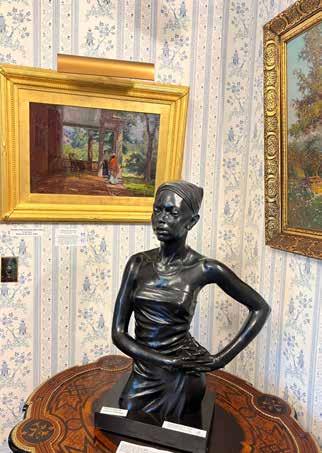
As the museum considered its involvement at the national level, the staff wondered what it could do to share those stories locally, how to bring that experience back to the community, making it accessible to everyone. So for America 250, the Haan has pitched a Museum Without Walls. It will be in five downtown storefronts that are currently vacant or underutilized, transforming them into mini-museums. These spaces will focus on telling the story of art and culture in Indiana.
The spaces will feature a combination of stories from the area, including Lafayette’s incredible connection to the 1904 World’s Fair in the very way that the Haan Museum found its way here.
“The idea is that you can go to Washington, D.C., and experience this public art project,” Bellisario says. “But if you don’t have the chance to go to Washington, D.C., we are going to have our Museum Without Walls project right here, in downtown Lafayette. So, people will be able to experience the best of what Indiana art and culture is through incredible stories.”

Five exhibit paths
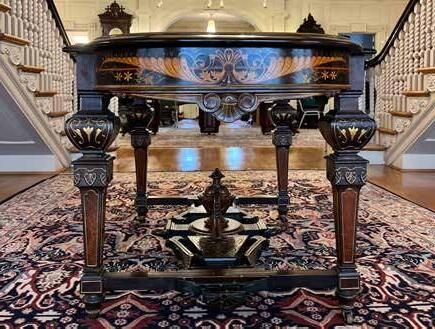
The plan is to feature five exhibit paths. One will focus on the 1904 World’s Fair, including the collection of unique souvenirs, furnishings and arts from the World’s Fair. The museum has a large collection that is not on permanent display. Thus, this will allow people to see items they can’t ordinarily see.
Another path will feature interviews with Indiana makers. The museum is partnering with an Indiana University-Bloomington professor who will curate oral history interviews with Indiana artists. The focus will be on contemporary ceramic artists who continue to create work using the old traditions. This includes using clay from the river, a process that is not like anywhere else, Bellisario says. Each exhibit will include QR codes that will connect people to audio or video, so people can hear stories about how artists learn these traditions. A professor in Arizona is working on augmented reality – if participants are looking at an image of the living room of the Haan, for example, they might suddenly see the music box start playing. Magical and imaginative experiences will come to life through technology, as the museum partners with Purdue and IU.
There will be a focus on young people as well, with field trips and opportunities to learn these traditions.
“It’s all about really helping our community discover the power and impact of our stories,” Bellisario says.

From Potter mansion to museum
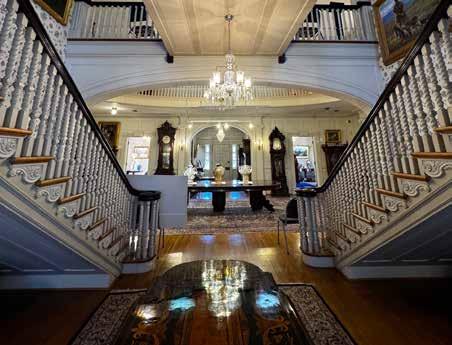
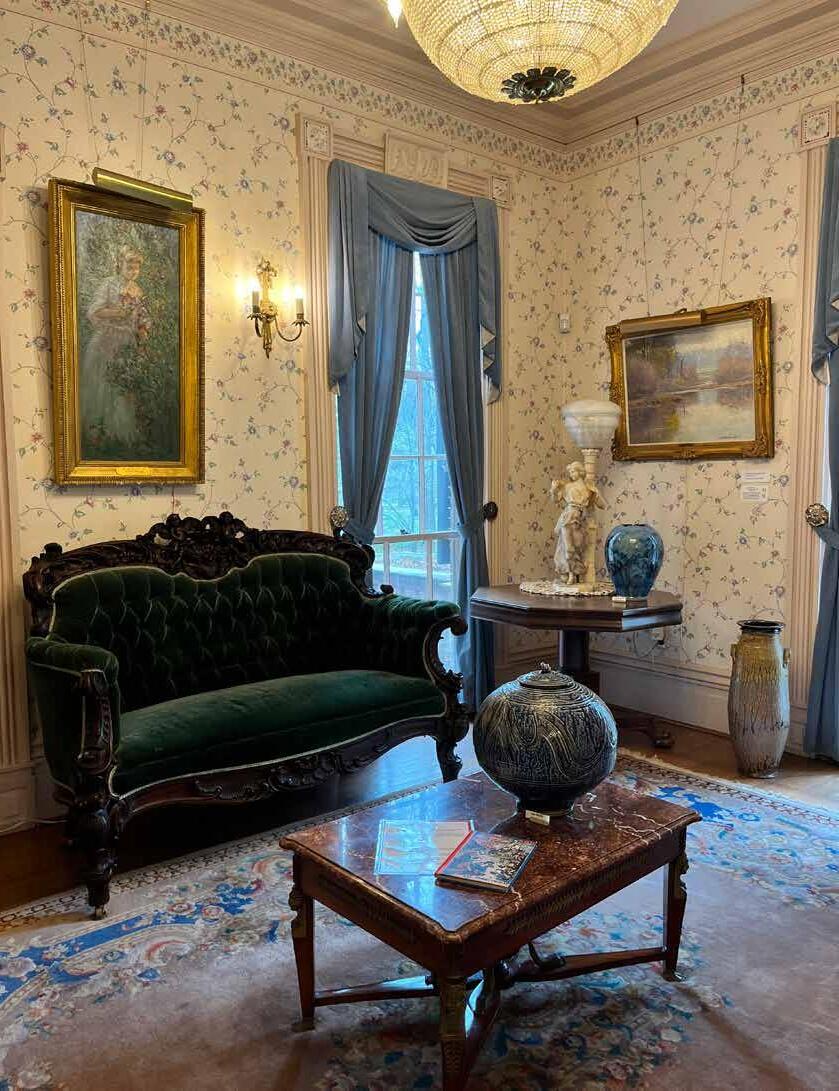
The Haan Museum of Indiana Art is history itself. The building was the State of Connecticut pavilion at the 1904 World’s Fair in St. Louis. The Potters, from Lafayette, purchased the building when it was auctioned at the conclusion of the fair. It took 22 train cars to move it to Lafayette, and then nearly an entire year of construction to rebuild it on a lot on State Street, where it sits today. The mansion has three floors plus a basement, with a total of 16,000 square feet. Only 15 buildings from the 1904 World’s Fair survive today.
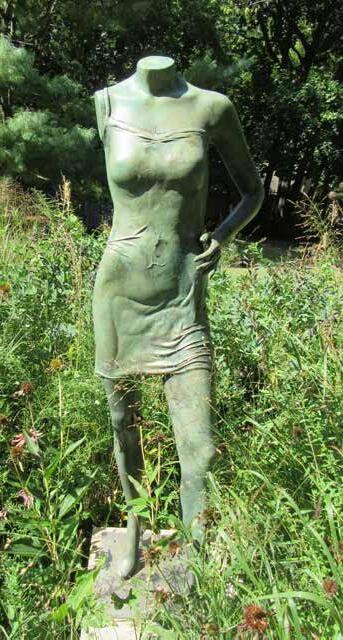
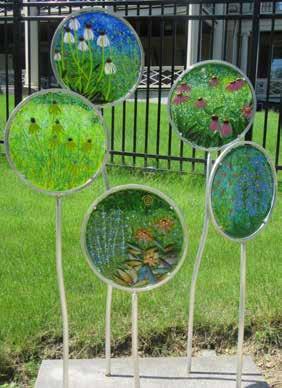
Bob and Ellie Haan purchased the mansion in 1984. It became a home for their collection of Indiana art, which continued to grow while they lived there. In 2015, they created the nonprofit Haan Museum of Indiana Art, donating the building and grounds to the museum, along with much of the artwork. Understanding the Haans’ vision and working to implement that vision is an important part of the museum, Bellisario says. The Haans envisioned a nature trail with a sculpture garden and working with school groups. The staff works to helps these dreams come to fruition.
“The Haans, in their mission for collecting art, have a collection of pieces that are really, truly extraordinary,” Bellisario says. “It’s the best of the historical, but they also had this lens toward the contemporary. There will be pieces that they say, ‘Well, we didn’t like it, but we knew it was important.’
“Let’s lean into the glory that it is. Make this a shining gem.”
‘Pure democracy’
Bellisario loves that these exhibits, through the Museum Without Walls, will help expand the museum’s mission. Imagine, she says, walking down Main Street and suddenly you find yourself standing in the middle of the Haan living room.
“America 250 – it’s pure democracy in a sense, making art accessible,” she says. “Right into your daily lives. We take away the cost of an admission fee. We do our magic.”
She is particularly excited about the access for children and young people. An encounter with art in this way could change their lives.
“How do we pass stories on, inspire one another?” she says. “Art brings people together. It inspires us, to find the best in each other, to find the best in ourselves.
“We see those moments all the time when kids come in this building. And that’s our life’s work. We are truly devoted to helping people find those connections.”
The opening of these exhibits will roll out starting in July. Programming will be coordinated, bringing people together to celebrate these stories.
“When history gets really exciting is when we make our local connection to the larger stories,” Bellisario says. “And that is what we’re able to do here. You’re hearing and seeing stories that unite and connect us.
“In Indiana, the traditions of our makers are so rich. It’s through them and their stories that we learn about how interconnected we are to the greater story. And that continues to this day.”
Golden age of art
The years 1880 to 1920 were a golden age of art and culture, Bellisario says. And Indiana was a huge contributor.
“We were as vibrant as New York City,” she says. “People don’t realize that. Indianapolis was a huge cultural hub at that time. Through this program we’re finding more and more ways to bring that spirit to life in Lafayette.
“The Great Societies were based on art and ideas. Interconnectedness. A celebration of ideas.”
The Haan Musuem has all these stories –these and more, Bellisario says. This project will touch everyone, engaging all who come in contact. And with the strategic locations downtown, she hopes these stories reach the entire community.
“The Museum Without Walls – it’s bringing people together through the arts,” she says.
“And allowing everyone a pathway in to discover the incredible role that artists played in Indiana, in shaping Indiana as a state.
“And when we look at the fabric of American art history, to really understand that we played a really central part of that and I think, there really is great art here. You can go to New York and see fabulous things, but there are fabulous things here.”
Ben Carson sees bright future for Imagination Station
BY KEN THOMPSON | PHOTOS BY CHRISTINE PETKOV
Turning a child’s curiosity into an educational experience has been Imagination Station’s mission for nearly 30 years.
Ahead of its time when it comes to STEAM (Science, Technology, Engineering, Arts and Mathematics) education, Imagination Station’s mission is to provide hands-on learning experiences to increase the scientific literacy of children and families in Greater Lafayette.
“It’s giving kids opportunities to play, explore and take on a handson approach to learning rather than the didactic classroom style you might typically get where they’re talked at,” says Ben Carson, executive director of Imagination Station.
“It has its value, but kids learn really well when they’re engaged not just with their brain but physically.”
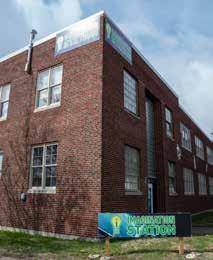
Located inside the former home of Indiana Gas Co. at Fourth and Cincinnati streets since Oct. 1996, Imagination Station boasts two floors of interactive exhibits and toys.
“We like to have our exhibits on the first floor, making sure they’re very tactile and interactive and learn cause-and-effect. That’s something adults take for granted. That’s a huge part of science and fits under the STEAM umbrella,” Carson says. Imagination Station’s target audience is children ages 2 to 12, but Carson says 5- to 10-year-olds are the most typical visitors with their parents.
“There’s an immediacy of fun that the exhibits give, and the upstairs playroom with the giant building blocks and all the different things they can play with, learn with and explore,” Carson says. “That tends to fit more into the mold of a younger child’s brain where they just want to go to something and grab it and twist it. That really speaks to them very well.”
Carson admits to having a couple of favorite exhibits.
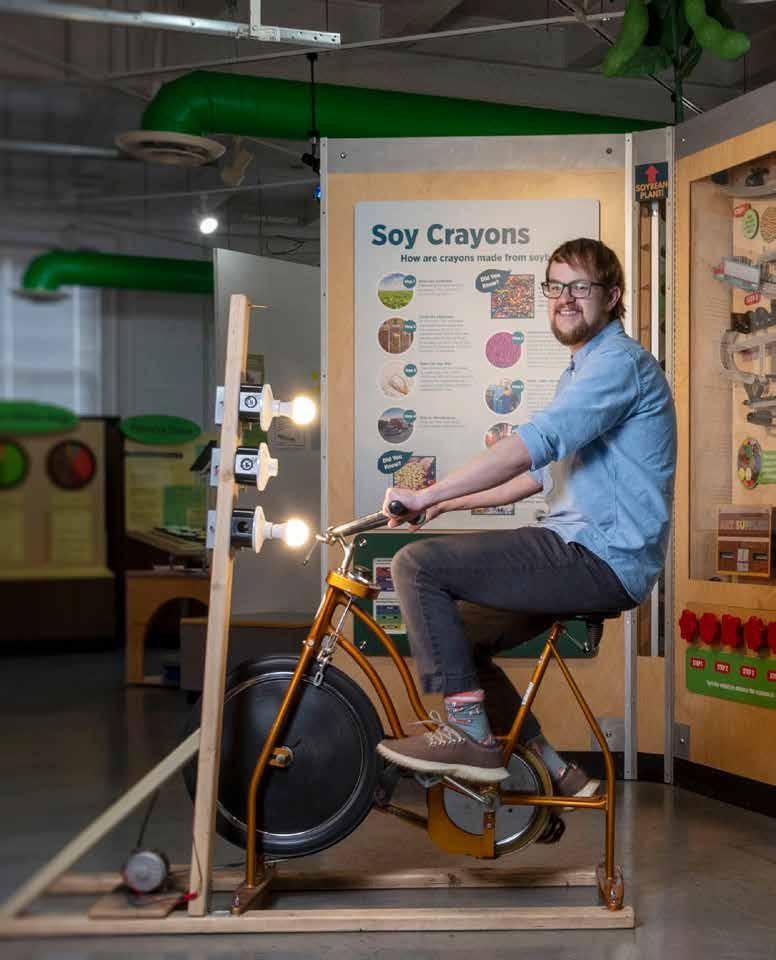
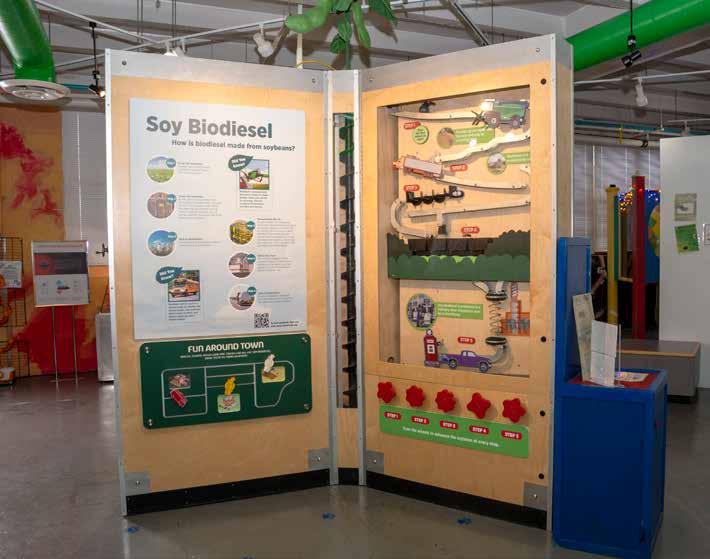
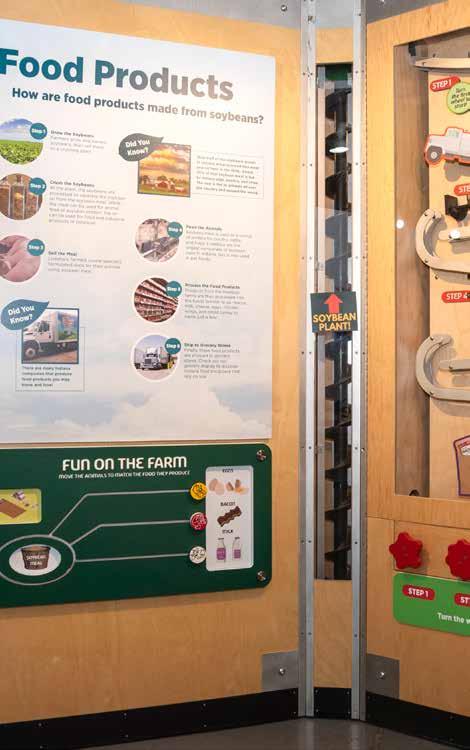
“We have a really cool soybean exhibit that combines play with learning,” he says. “It shows the steps that it takes from soybeans getting farmed and processed to going all the way into being, for example, made into the soy wax for a crayon. It shows the steps on a board in an informational way so that a parent or older kid can heed it and follow along.
“But it also has these handles. As you turn the handles there’s a ball that goes through a miniature Rube Goldberg machine that represents the steps in the process. There’s a horizontal auger that pushes the ball through. It’s just a fun way to watch the ball go through these steps of the soybean manufacturing process.”
Another Carson favorite demonstrates the effect of air pressure.
“It’s really simple and one I enjoy a lot,” he says. “It’s a set of tubing that has an air compressor at the bottom. You can put a ping pong ball through it and watch the air pressure suck it through and spit it out. It’s very easy for them to understand the simple cause-andeffect process. (Children) can repeat it over and over again and have a lot of fun with that.”
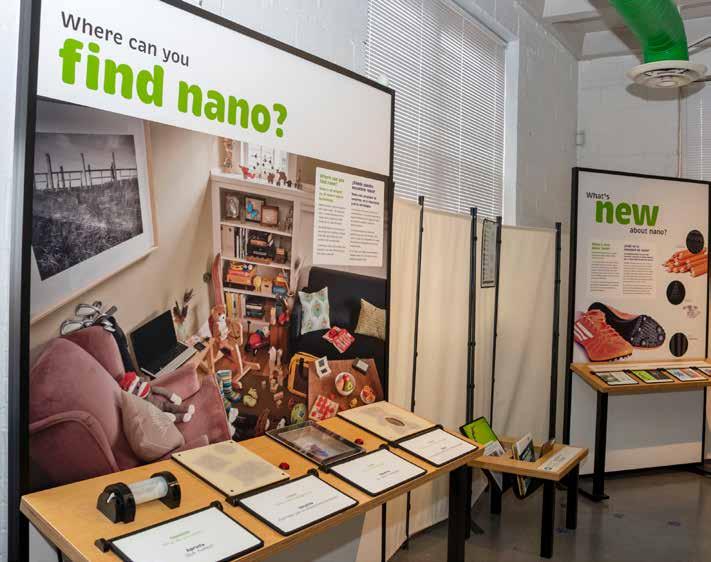
Thanks to a donation from the Purdue Nanotechnology Center, children also can discover how materials and devices are created by the manipulation of matter.
Good timing, good fit
Carson’s background in education technology and computer engineering made the Imagination Station post a good fit when he became executive director in September 2025. The timing of the opening helped, too.
“I was just finishing with an education technology startup,” says Carson, whose high school curriculum included robotics. “That didn’t pan out as well as I had hoped. I’d come back into town looking for the next step I wanted to do in my career.”
Carson saw an opportunity to use his experience in the classroom as a speech and debate teacher for middle school and high school students in a different way.
“When I saw the job posting, it really fit nicely with a lot of different interests that I have,” he says. “I started off at Purdue in computer engineering and did that for about two years. I ended up switching majors but that engineering side of me has stuck around.
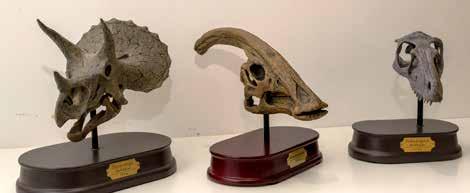
“When I saw this opening it was a nice intersection of building relationships with the community, helping improve kids’ lives and also developing interest in science and engineering.”
Carson came on board Imagination Station with two goals in mind.
“The first one is a bit more short term,” he says. “Simply, maximize all the ways that a kid can come into Imagination Station and explore and learn. We’re trying to improve and expand the diversity of options we have, cover as many different science concepts … even arts and humanities concepts. That there’s something for everybody. Different exhibits are going to click for different kids. We’re trying to give kids as many options as we can to keep them interested and engaged. Maybe help them find a passion area or a science that speaks to them more.”
Carson’s long-term goal is to expand Imagination Station beyond its current capabilities.
“We’re trying to improve and professionalize the space, things like bringing in new exhibits and increasing community awareness,” he says. “We want to have more events that bring in a lot of community collaborators. Right now we have one annual event called Hands on Transportation. We bring in lots of different forms of transportation: fire trucks, emergency vehicles. Caterpillar will bring in a bulldozer, Wabash National will bring over a freight truck. We have one of the larger farm drones. Kids get a chance to learn in a very hands-on way and get to sit in these vehicles.”
Building partnerships, spreading the word
The presence of Purdue University, as well as a large number of industry partners and the support of Greater Lafayette gives Carson optimism that he can increase the number of Imagination Station events.
“We have two amazing cities that are so closely connected,” Carson says. “We have a really good university with so many different areas of expertise. We’re looking to see what are all the ways we can bring everybody together and give kids a chance to see everything that happens in our community.”
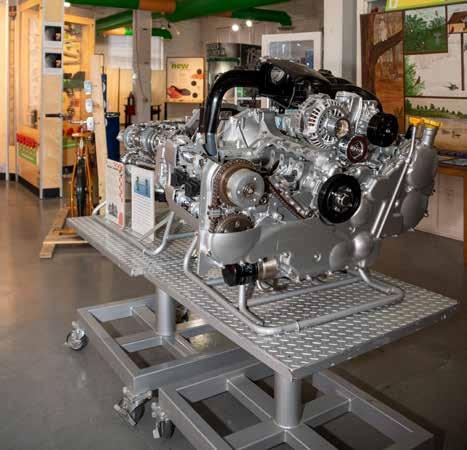
But doing that requires making Greater Lafayette aware of Imagination Station. One way is to get more directly involved with schools.
“We do field trips, and we’re trying to expand those and meet some of the core curricular standards (schools) need,” Carson says. “We want the community to be more aware of Imagination Station. During the pandemic it got very close to shutting down for good. Thankfully we were able to power through that. There are a lot of people in the community who either don’t know much about us or remember going there as a kid but maybe don’t realize we’re still open. We’re trying to spread that awareness and give people a chance to check us out again.”
Several membership levels are available and can be found at imagination-station.org. Carson notes that there’s an extra benefit for Imagination Station members.
“Our membership program is part of the ASTC (Association of Science and Technology Centers) passport program,” he says. “For example, if you buy a family membership at Imagination Station, it also gets you free access to any other ASTC facility in the world, outside of a 90-mile radius of Lafayette. That includes the Science Centers and the Museum of Science and Industry in Chicago, and the Columbus (Ohio) Science Center.”
Walk-in visitors are welcome during regular hours for a $10 admission fee. Imagination Station is open Wednesdays and Thursdays 10 a.m. to 1 p.m.; Fridays and Saturdays 10 a.m. to 5 p.m.; and Sundays 11 a.m. to 5 p.m.
Discover some of the area’s top locally owned businesses in 2025
Locally owned businesses are the backbone of Greater Lafayette, and those small business owners invest time, finances, energy and passion into their companies. Here we take a look back at the small business of the month winners recognized by Greater Lafayette Commerce in 2025, along with the Small Business of the Year winner. Old National Bank is a longtime sponsor of the Small Business of the Month & Year program. The winners were recognized each month at a ceremony at Ripple & Co.
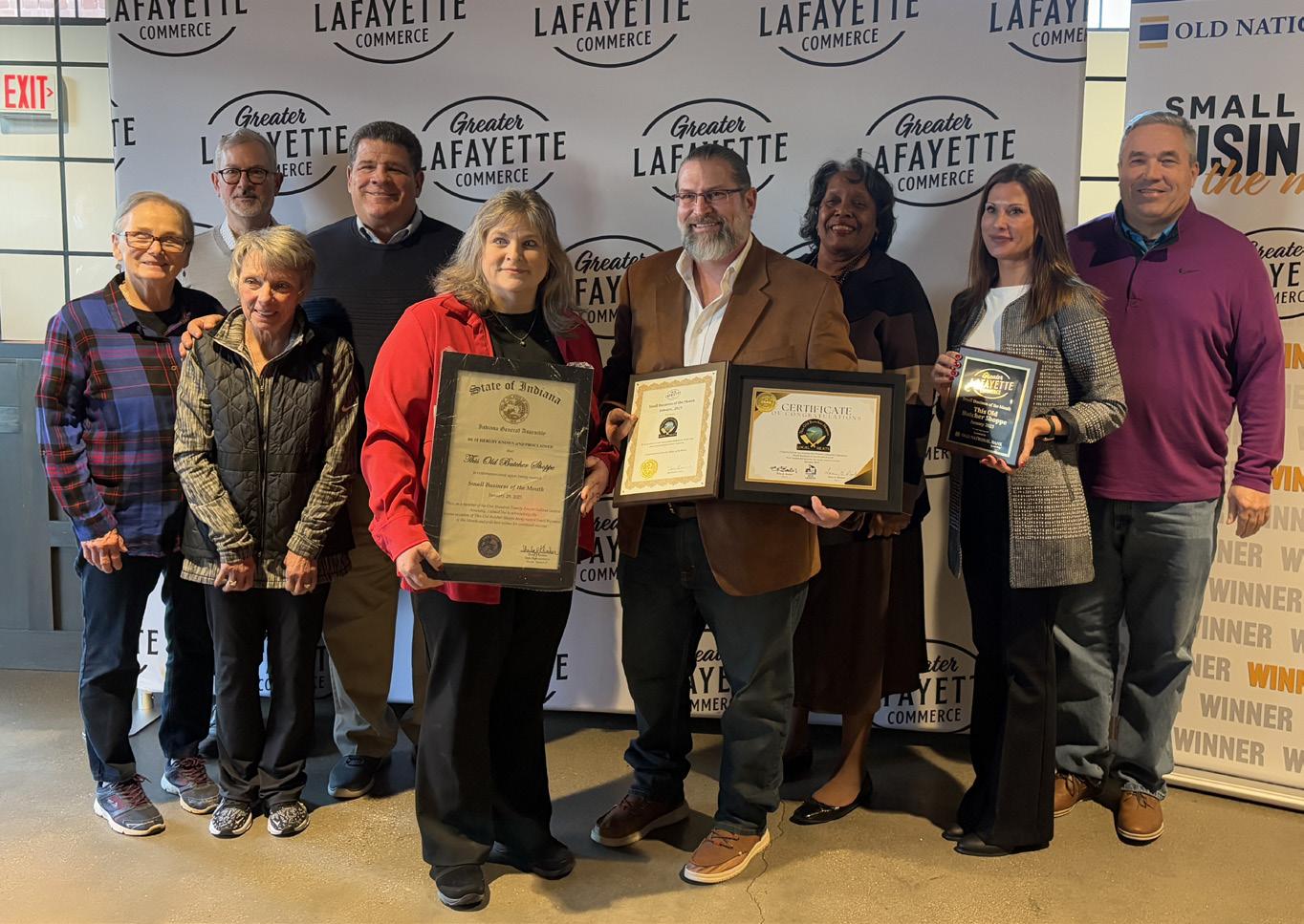
JANUARY – THIS OLD BUTCHER SHOPPE
This locally owned full-service butcher shop serving the Greater Lafayette area was launched in September 2021 by owner Jessica Roosa, a Purdue University graduate, as an offshoot of the family’s agriculture business (This Old Farm) and with a mission to bring sustainable, locally sourced meats to the community. What sets This Old Butcher Shoppe apart is its emphasis on transparency, regenerative agriculture and traceability. It offers pasture-raised pork, non-GMO-fed poultry, grass-fed lamb and beef, and dry-aged beef cuts — all sourced from known local farms and processed under USDA inspection. Beyond its product selection, the shop is praised for knowledgeable staff and superior customer experience: reviewers highlight the butchers’ willingness to explain cuts, give cooking advice and consistently deliver high quality.
This Old Butcher Shoppe
3623 Braddock Dr., Suite B Lafayette (765) 767-4886
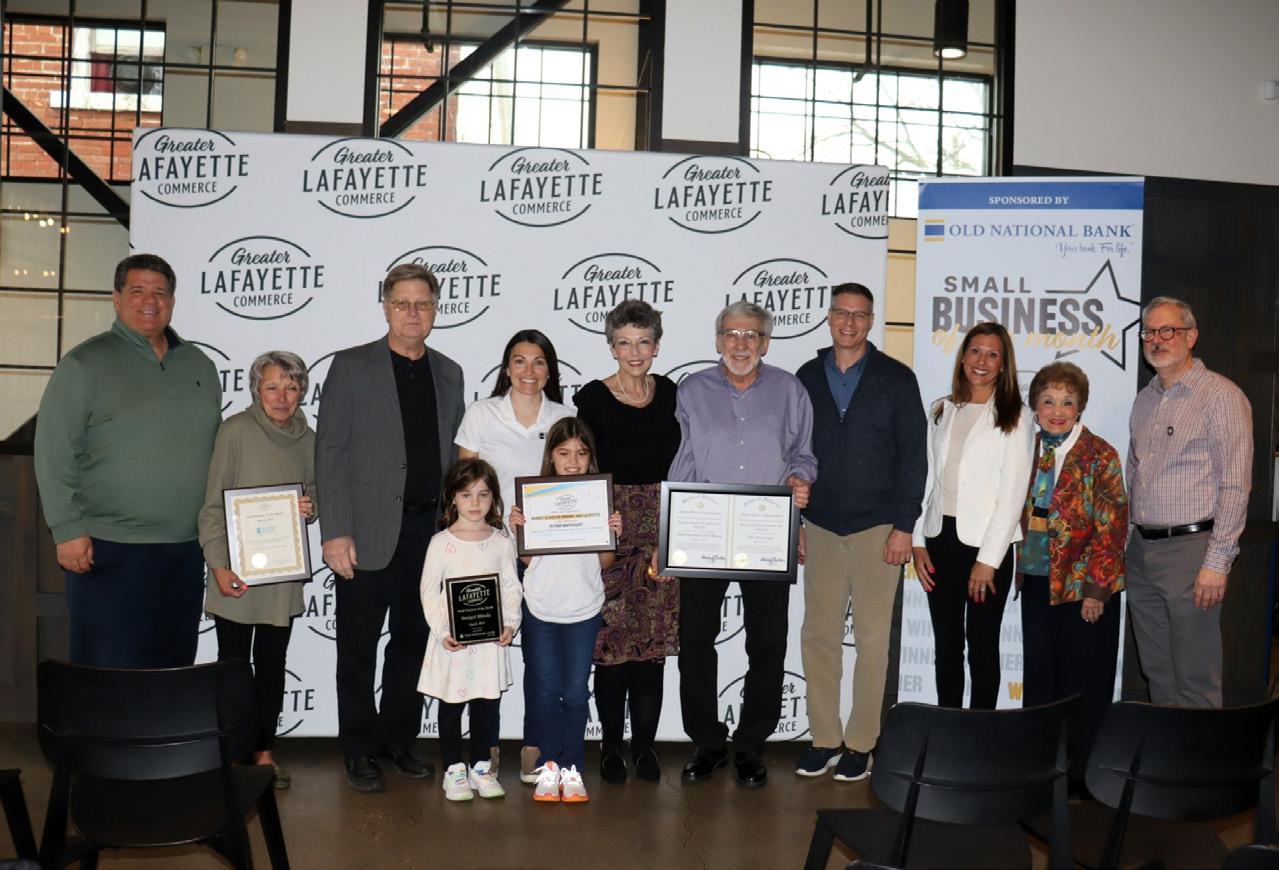
FEBRUARY – BUDGET BLINDS OF KOKOMO AND LAFAYETTE
Serving the Kokomo and Lafayette areas, Budget Blinds has been operated by owner John Fansler since 2005. The business emphasizes a full-service model: it provides free in-home (or virtual) consultations, brings the “showroom to your home,” takes precise measurements, manages the ordering of custom window coverings (blinds, shades, shutters, drapes) and performs professional installation. This business is known for focus on design consultation and customized solutions. Products offered include a wide variety of blinds (wood, faux wood, vertical); shades (roller, cellular, Roman, woven); shutters (plantation and vinyl); draperies, outdoor shading solutions and motorized/automated coverings.
Budget Blinds of Kokomo and Lafayette John Fansler jrfansler@budgetblinds.com (765) 234-1681
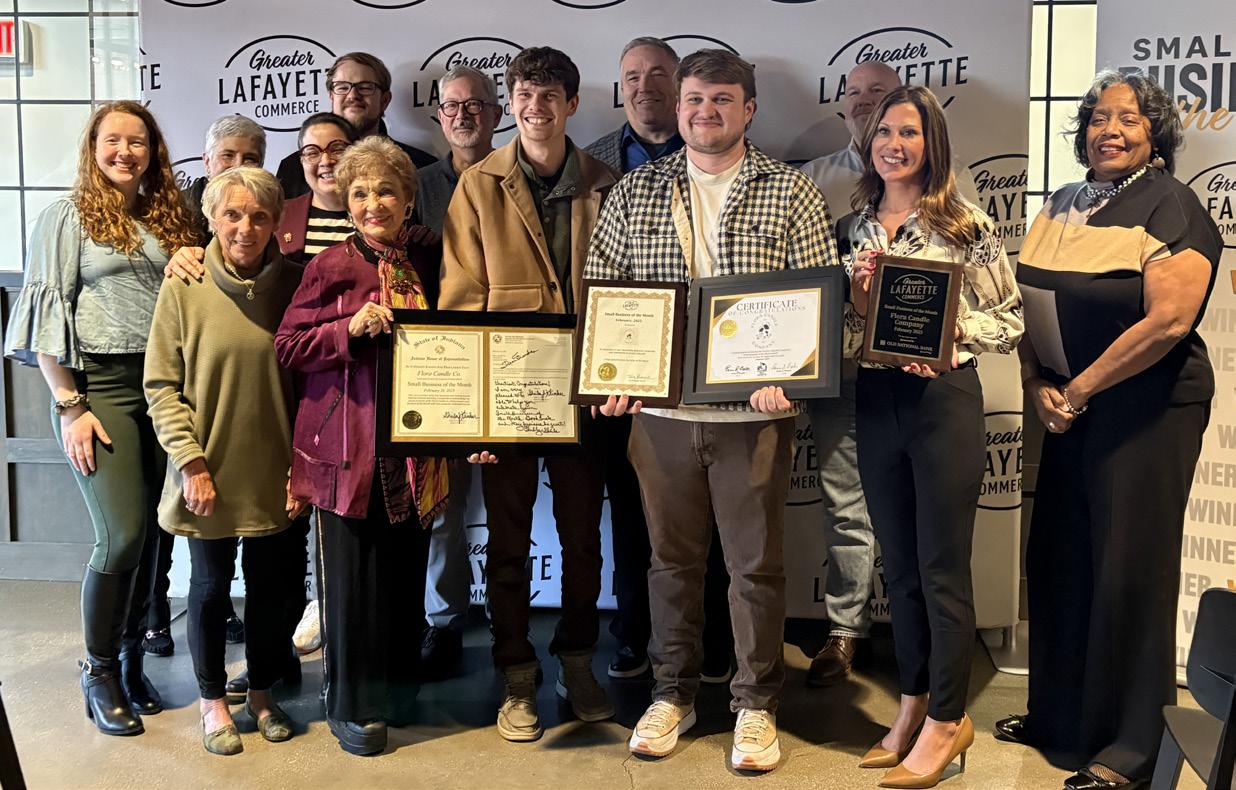
MARCH – FLORA CANDLE COMPANY
Flora Candle Company is a locally owned artisan candle shop whose mission is rooted in sustainability, inclusivity and community. The business was founded by Nolan Willhite and Troy Weber in tribute to Nolan’s late great-aunt Florann, and they chose to keep the name “Flora” as a way to honor her memory.
The two use 100% soy wax sourced from the Midwest, favor natural and low-emission materials and maintain an eco-friendly business model—emphasizing local sourcing to reduce transportation impact and using toxin-free ingredients. Inside the store, you’ll find a lively selection of hand-poured candles, room and linen sprays, wax melts and other fragrance products. Its catalog features hundreds of unique scents, such as names inspired by regional themes, pop culture and seasonal moods.
Flora Candle Company 609 Main St. Lafayette (765) 767-4819
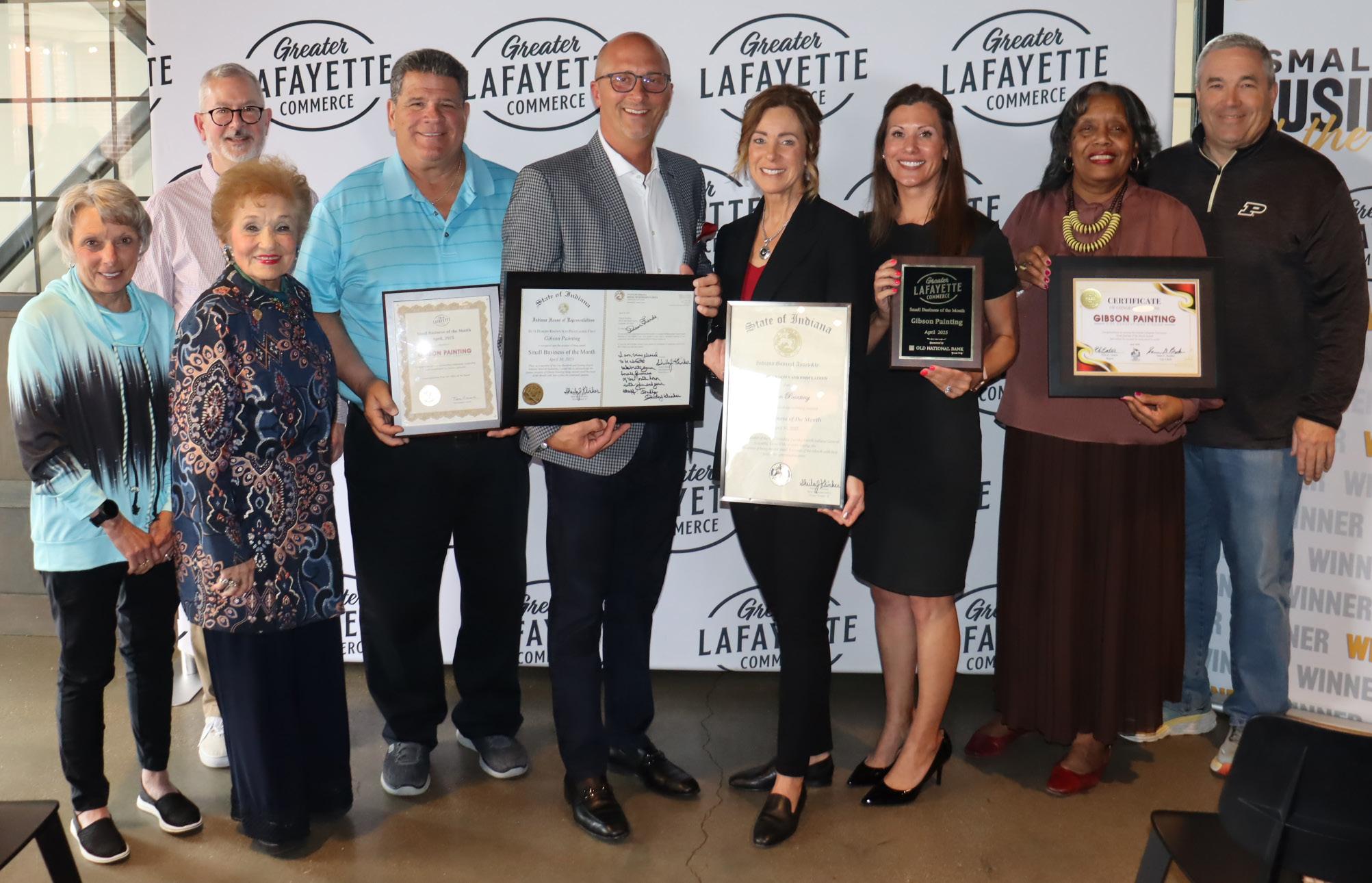
APRIL – GIBSON PAINTING GROUP
Gibson Painting Group is a family-owned painting and construction contractor serving the Greater Lafayette area. With a long legacy of five generations of experience, Gibson is committed to craftsmanship, attention to detail and delivering projects on time and on budget.
Its services cover both commercial and residential painting: everything from new construction and large facility repainting to home interior and exterior work, refinishing kitchens and bathrooms and preparing homes for sale.
Gibson Painting Group
105 N. 36th St., Suite C
Lafayette (765) 838-1233
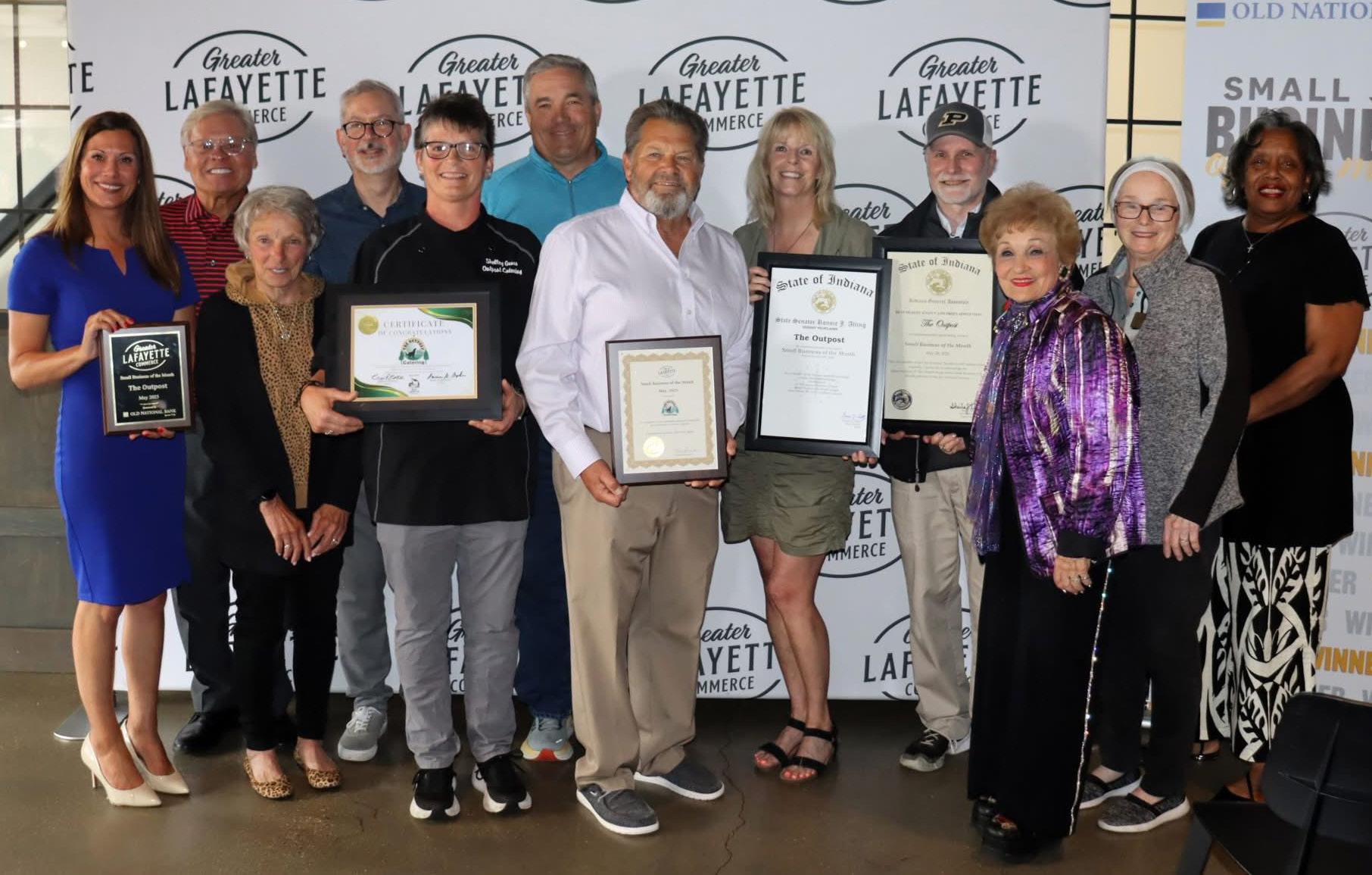
MAY – THE OUTPOST CATERING
Established in the early 2000s originally as Sgt. Preston’s Catering before rebranding to The Outpost in 2007— the company grew from a downtown catering operation into a full-service venue offering onsite and off-site catering for weddings, corporate events, reunions and more. The Outpost’s catering service is highlighted by a diverse menu and flexible service styles, which include plated dinners to buffet setups, outdoor cookout themes and full bar service with licensed bartenders. THe Outpost is owned by Doug and Karen Cooper.
The Outpost Catering
2501 Old U.S. 231 Lafayette (765) 471-1706
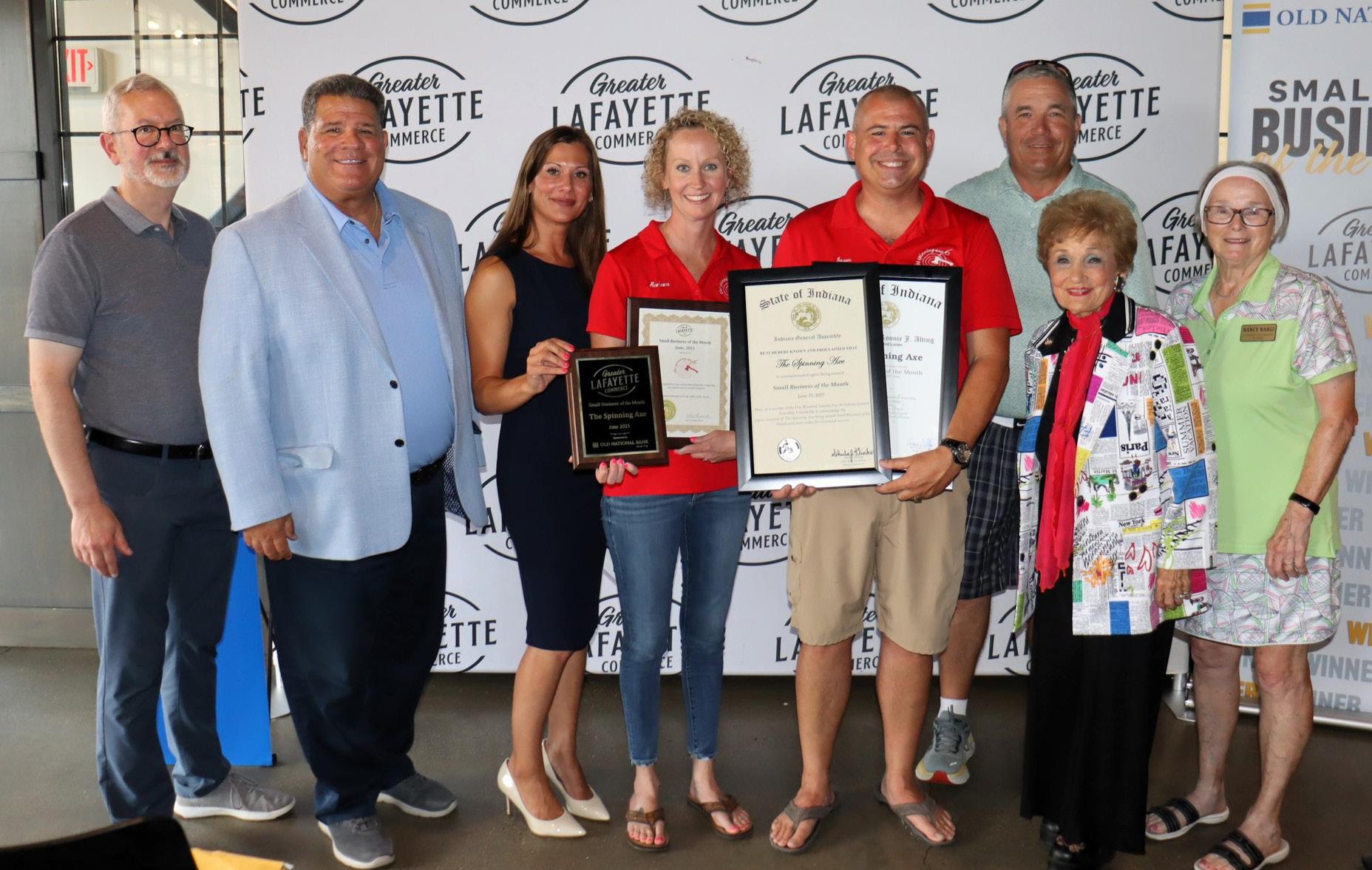
JUNE – THE SPINNING AXE
The Spinning Axe is an indoor axe-throwing venue offering an energetic and unique entertainment experience. It opened in January 2021 after owners Barbara and Jason Whitenight were inspired by a visit to an axe-throwing facility in Kentucky.
This physically entertaining business caters to a broad audience—from families and birthday parties to corporate team-building and private events. Inside, guests will find multiple throwing lanes, a full-service bar, a patio with games, and concession-style food offerings, creating a lively atmosphere that blends sport, socializing and casual fun.
The Spinning Axe
351 South St.
Lafayette, IN (765) 637-7775
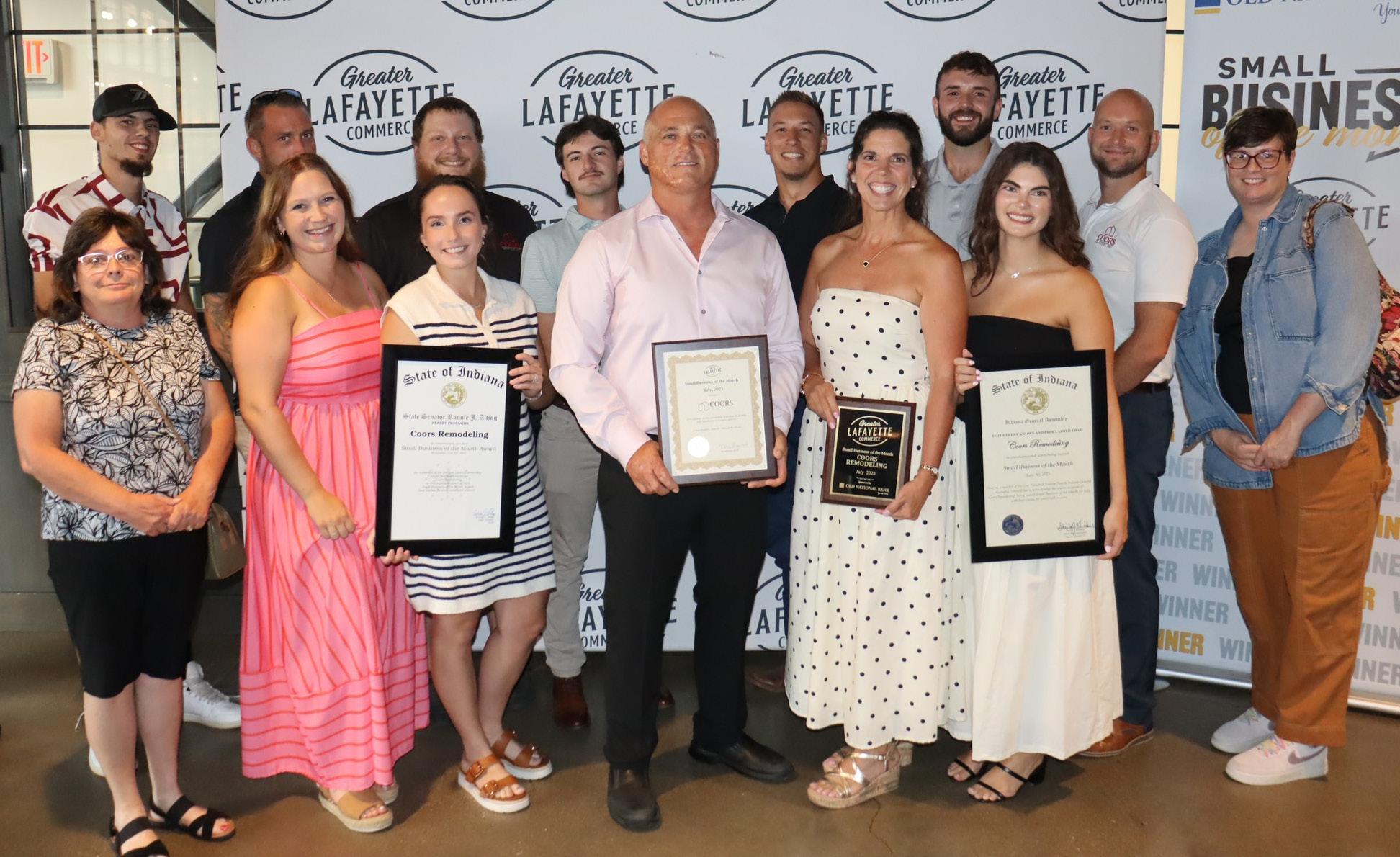
JULY – COORS REMODELING
Coors Remodeling is a family-owned, full-service residential remodeling company that has been serving the Greater Lafayette region since 1993. Founders Bart and Michelle Coors leveraged their backgrounds—Bart in construction and Michelle in interior/design education—to evolve the business from an exterior-focused remodeling company into a full-scope firm covering kitchens, bathrooms, basements, decks and whole-home renovations.
Coors Remodeling offers a wide spectrum of services across both interior and exterior domains. On the interior side, it handles kitchen remodels (custom cabinetry, quartz/granite counters); bathroom updates (luxury surrounds, accessible design); basement finishing and living-space reconfiguration. For exteriors, the company designs and builds custom decks and outdoor living areas, as well as siding, windows and doors from premium brands.
Coors Remodeling
3480 Kossuth St., #5
Lafayette (765) 449-2600
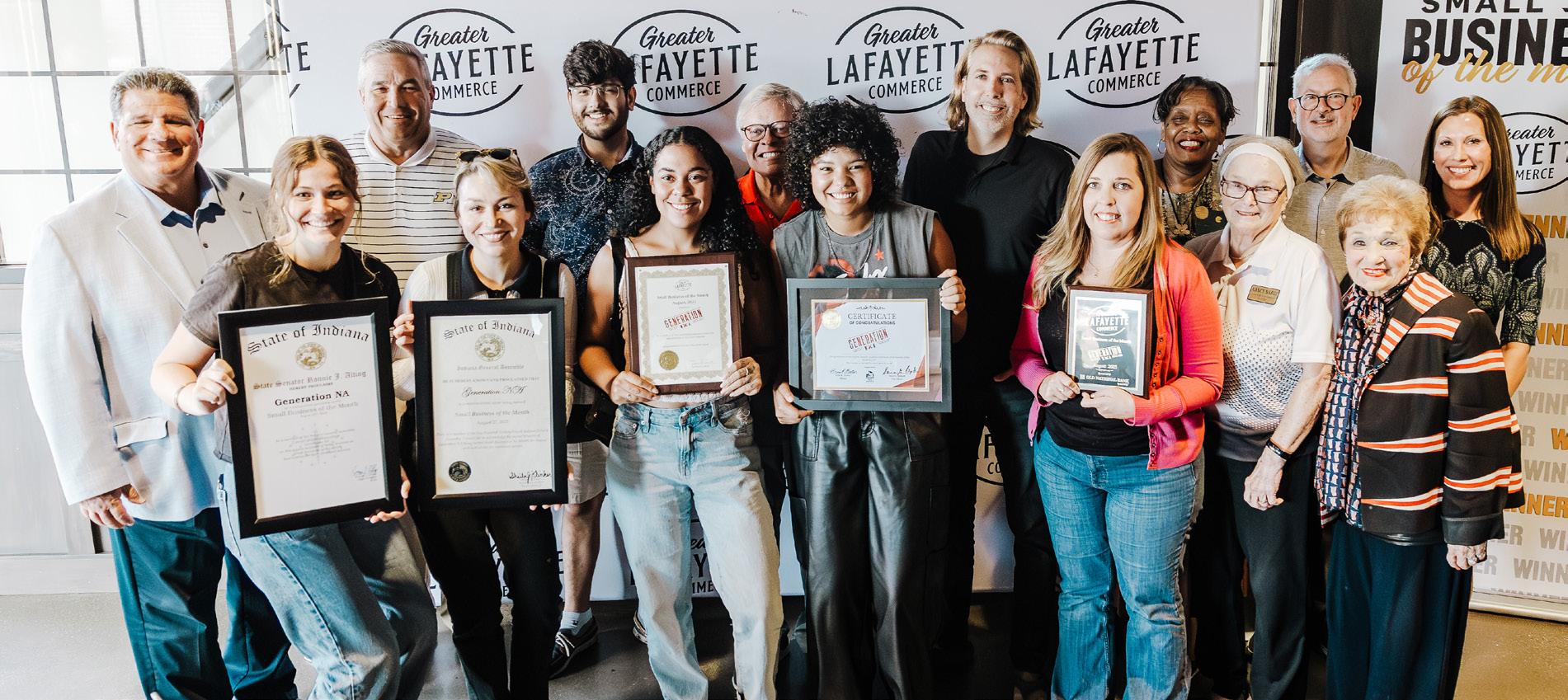
AUGUST – GENERATION NA
Generation NA is a pioneering functional bottle shop and taproom specializing in non-alcoholic (NA) beverages. Founded in 2022 by owner Rob Theodorow, the business launched with the aim of providing an inclusive social space where people could enjoy beer, wine and spirits without alcohol. With an exclusive variety of unique non-alcoholic beverages, there also is a lively atmosphere with pinball machines and relaxed events such as open mic nights. The venue positions itself as a social space not just for those abstaining from alcohol, but for anyone seeking a different kind of drink experience — for health, wellness or simply curiosity.
Generation NA
504 Main St. Lafayette (765) 233-2366
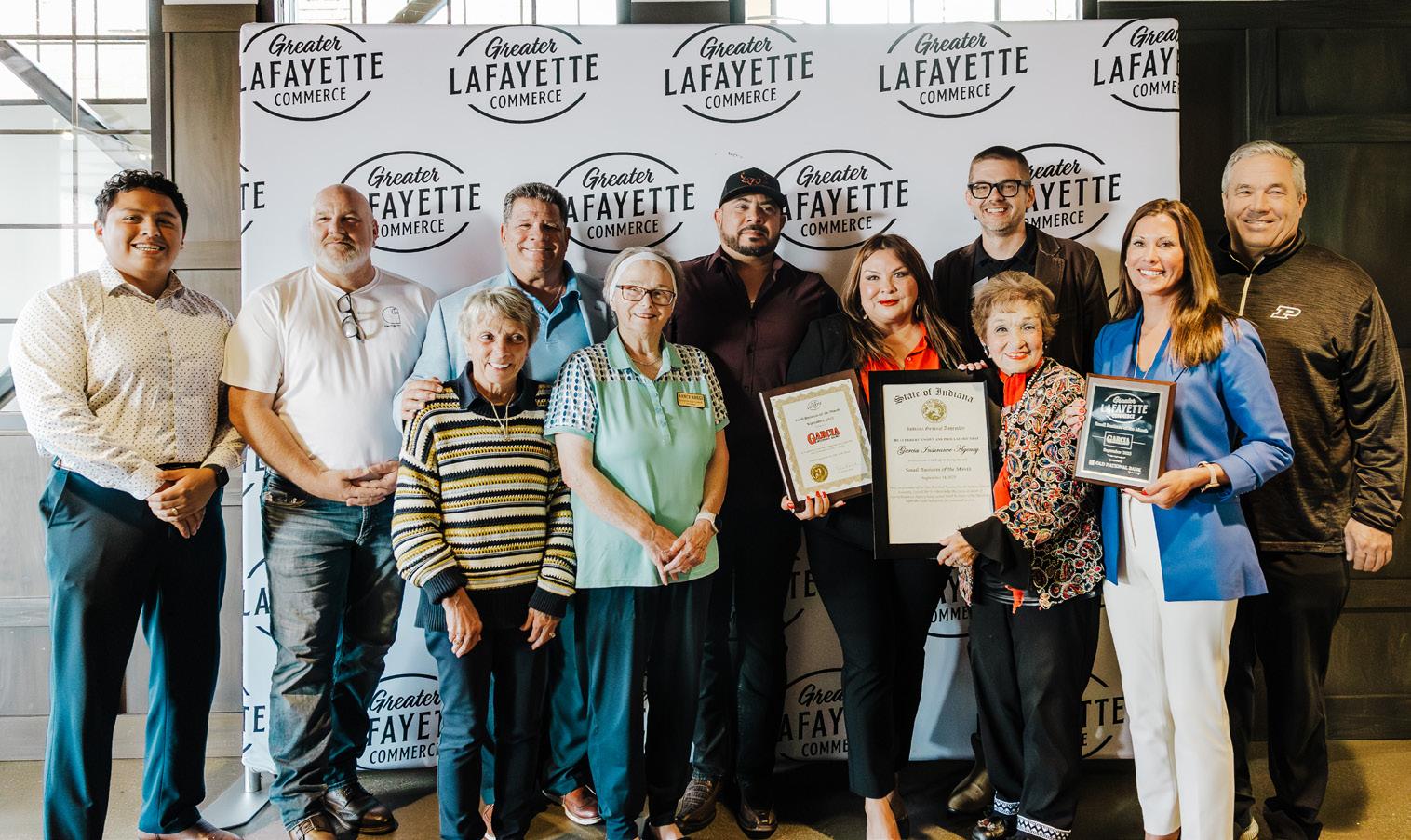
SEPTEMBER – GARCIA INSURANCE AGENCY
Garcia Insurance Agency is an independent insurance firm that offers a variety of coverage options tailored to individuals, families and small businesses. According to its website, it carries policies for auto, home, renters, business, bonds, special events and more. Affordable and responsive service is a key selling point, especially for clients who may appreciate a more personalized experience than large national carriers. Owned by Diana Garcia, the independent agency represents multiple carriers rather than a single insurance company, which allows the agency to compare options and find competitive rates and coverage combinations for its clients.
Garcia Insurance Agency
2927 Union St. Lafayette (765) 449-4544
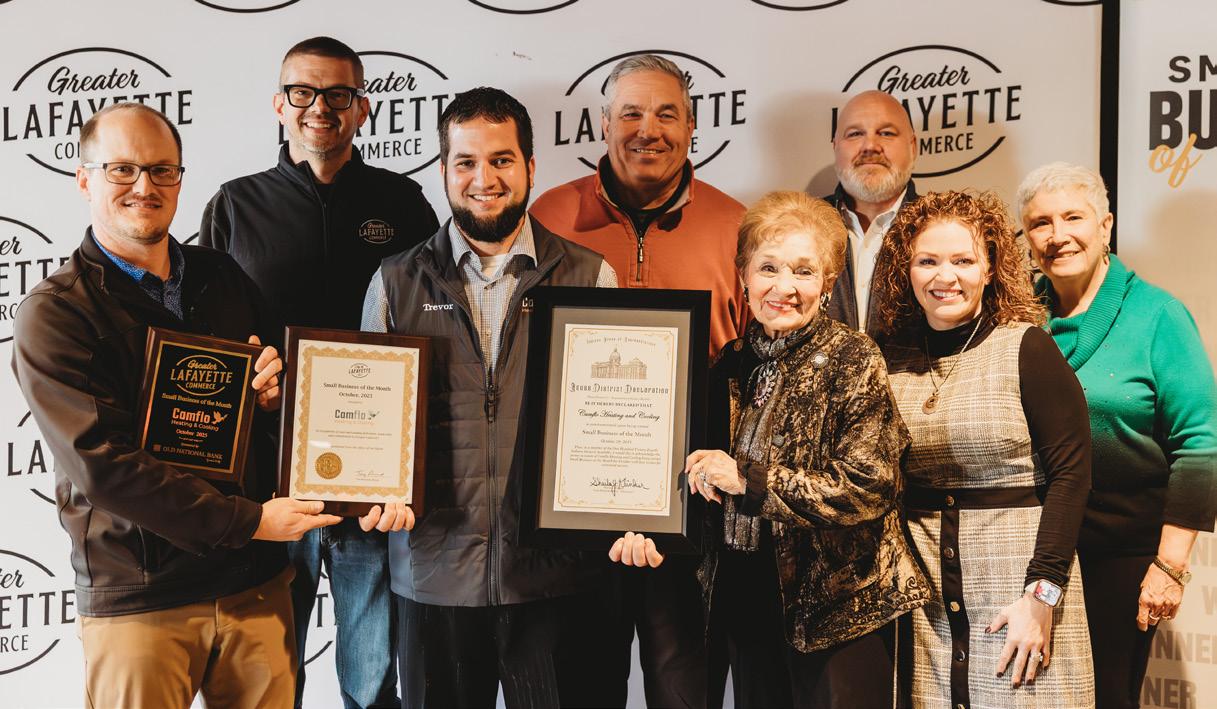
OCTOBER – CAMFLO HEATING & COOLING
Camflo Heating & Cooling, LLC is a familyrun HVAC firm that has been serving the area since 2009. Its name reflects its origins in the towns of Camden and Flora, and the leadership of the Hess family emphasizes a people-first philosophy: being easy to do business with, valuing your time and delivering on its word. The business places strong focus on honest service, expert workmanship (with many NATE-certified technicians), and longterm relationships rather than high-pressure sales.
Camflo offers a full range of HVAC services for both residential and commercial clients across the Greater Lafayette area. Its offerings include heating system repair, installation and maintenance (furnaces, boilers, heat pumps, ductless systems) and cooling services, including central air, ductless systems and full replacements.
Camflo Heating & Cooling
110 S. Center St.
Flora (574) 381-9919
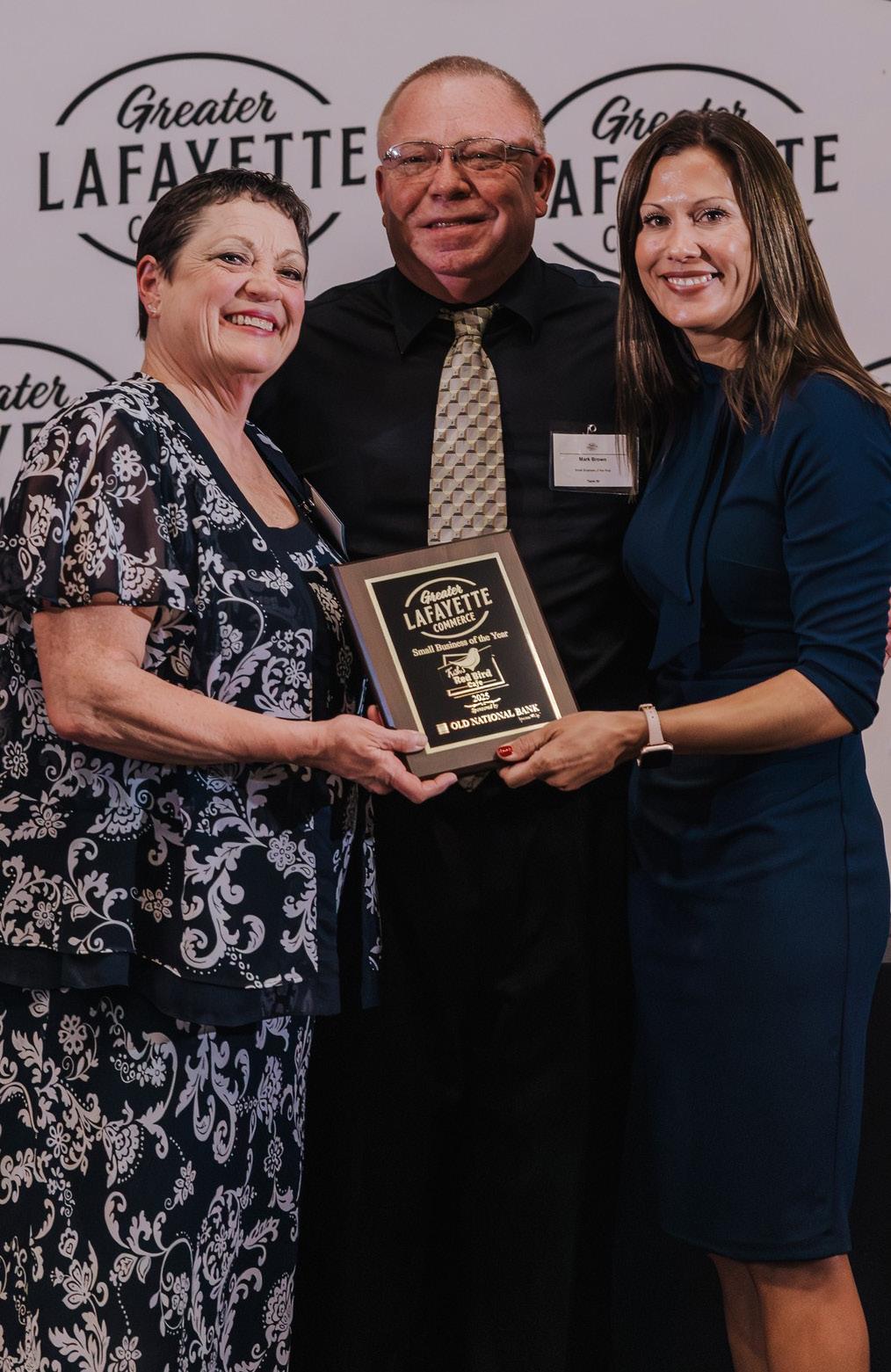
TRISH’S RED BIRD CAF É
This year’s Small Business of the Year winner is Trish’s Red Bird Café, which was a Small Busines of the Month Winner in 2023.
Trish’s Red Bird Café opened in April 2018 in the historic community of Dayton just off I-65 — making it a convenient stop for locals and travelers alike. Named after the “Red Bird” horse-drawn sleigh that once transported people from Lafayette to Dayton in the 1800s, the café embraces a strong sense of local history and nostalgia.
“Being Small Business of the Year for 2025 is beyond anything we could have dreamed of receiving,” says owner Trish Brown. “We do the things that we do just because it is the right thing to do. Being able to give back to those that need help is just a dream come true. As I mentioned in my speech [after accepting the award], my husband and I just wanted to make a small profit to support ourselves, and anything above that was a blessing that we would be more than happy to share.”
Trish’s Red Bird Café offers a full-day menu: breakfast, lunch and dinner. Its breakfast menu includes pancakes, omelets, biscuits with
sausage or pepper gravy, eggs any style, and its “Bird in the Nest” — eggs in toast — among others. For lunch and dinner, the café serves a broad array of comfort-style American fare: burgers, sandwiches, wraps, chicken tenders, catfish and cod meals, pulled-pork BBQ sandwiches and more hearty options such as country fried steak or prime rib sandwiches.
Brown adds, “The fact that we are becoming a favorite restaurant makes us very proud. We love sharing our family recipes with a modern-day twist. That is what we are based on and love to share. We hope to be able to continue to share our dreams for many years to come with our amazing staff that are so dedicated to our dream.” ★
Trish’s Red Bird Cafe
696 Walnut St
Dayton
(765)-296-6964
Greater Lafayette Kennel Club an Invaluable resource for dog owners
Greater Lafayette loves its dogs. So, the question begs: Why don’t more people know about the Greater Lafayette Kennel Club?
It’s not like the club is a new venture. The Greater Lafayette Kennel Club is celebrating its 80th anniversary inside a new home at 5139 E 400 S in Lafayette.
“We don’t really know,” says Deb Biesemeier, president of the Greater Lafayette Kennel Club. “It’s not like we keep it a secret. One of our big missions is to provide dog training and education to the community. Every time someone comes to us, they always say ‘Oh my gosh. I had no idea you existed.’
“We don’t do a lot of advertising. It’s just pretty much word of mouth. A great many of our students in our entry-level classes are not members of the club. They just seem to come and take a class and fade back into the community.”
The Greater Lafayette Kennel Club was founded by a group of men who enjoyed hunting sports and conformation, which the American Kennel Club (AKC) describes as how closely a dog conforms to the standard of its particular breed.
“Conformation is not just a beauty contest,” Biesemeier says. “Any reputable pure bred dog breeder will take part in conformation because that’s the stamp of approval by a judge that your dog conforms to that breed standard.”
Those standards include appearance, temperament and instinct.
As the years passed, the club’s emphasis shifted to classes and dog sports.
“It’s really mindboggling all the things you can do
with your dog and all the things people have thought of to do with your dog,” Biesemeier says. “It’s wonderful to have a dog as a pet. It’s a whole different level to have a dog as a teammate. It develops a relationship with a dog that’s hard to duplicate if you’re not in dog sports.”
Every dog is unique
While some dog owners struggle to teach their pets the simplest tricks, Biesemeier takes a different approach. She currently has three standard poodles, two of which she trained for agility sports. The youngest poodle, a 5-year-old, currently is active in agility.
“When I train my dogs, it’s not just a one-way street where I’m saying this is what I want you to do,” she says. “I just need to figure out a way for you to do it. I’m also taking feedback from my dog. Dogs are like children in that they learn in different ways. I recently taught my dog several tricks that she could demonstrate to some Girl Scouts. I’ve been training dogs for a long time, so I had a pretty good idea how I was going to train it. It was a pretty elaborate trick, so I put a blanket on the floor. She laid on the floor, took a corner of the blanket in her mouth and rolled over and rolled herself up in the blanket. So I started calling her my burrito dog.
“It took many, many steps to get there. Those steps were not necessarily what I envisioned they would be when I started. As I trained her I got signals from her that I don’t understand what you want me to do. It would force me to step back and say OK, how can I break this down into something easier or find a different way to teach her?”
A wish come true
The Greater Lafayette Kennel Club is not totally unknown in the community. It occupied a building in Shadeland for nearly 20 years.
“It was an old building. It was perfect for us, just a big old warehouse/garage-type building,” Biesemeier says.
One day, the landlord – a.k.a. the town of Shadeland — decided the building needed to be razed to make room for a community center.
The club moved to Delphi for three years, but that building was half the size of the club’s Shadeland home. Biesemeier and her fellow club members wished for a donor or donors to come along and fund a larger building in Lafayette.
“We had been saying for years we needed a fairy godmother to build us a building because we are a non-profit. We don’t have gobs and gobs of money.”
Their wish came true, thanks to a woman in Indianapolis who loves dogs and loves dog sports. The building’s final cost? Nearly $3 million.
“It’s still to me the most amazing thing to think about,” Biesemeier says.
The club received a certificate of occupancy in mid-September 2025 and slowly began building its classes back up. But for now, events will pay the bills.
One of them is a Fast CAT, which features dogs running one at a time, chasing a lure, to measure speed and agility. The club sponsors four three-day events a year in agility sports. Seminars and workshops also bring in needed funds.
Classes for every dog
The Greater Lafayette Kennel Club offers classes in fundamentals, conformation, competition obedience and therapy dog skills as well as dog sports (agility, rally and scent work). Classes are for eight weeks and cost $120 for members or $160 for non-members. Some classes have prerequisites to enroll.
“We have a lot of entry-level classes,” Biesemeier says. “Puppy training classes. Basic manners classes. What we call our ‘click obedience’ classes. It’s a form of training we like to use.
“Our training methods at the club are 100 percent positive reinforcement training. There’s no punishment, there’s no yanking on the leash when they do something wrong. It’s all letting the dog figure out what it is you want them to do.
“If you have a dog, I can’t stress enough you should take at least one dog training class. Hopefully if you come to the club and you get introduced to what dog
training has to offer that you would become interested in something and take another class.”
Biesemeier teaches the puppy training class and assists in the basic dog manners training class.
A community-centered club
“We are 100 percent volunteers,” she says. “We have some great instructors, but there are not enough hours in the day available for classes, nor do we have enough instructors. Our classes are open to anyone. There are benefits to being a member of the club. One of them is you get discounts on classes. You get the first option to take a class.”
Biesemeier wants the community to know that club members have a passion to teach people how to be good and responsible dog owners.
“People can’t do that if they don’t know how,” Biesemeier says. “We’re not a club that just exists to serve our own needs. It’s really a big mission that we serve the community.
“We are community centered. We want people to know we’re out there. We want them to come to us and let us help them train their dogs.” ★
With Handholder, entrepreneurial couple brings craft, care and community to every pour.
When Michael McCarty talks about bartending, it’s not really about the drink. It’s about the story that unfolds across the bar — the quiet exchange of trust, the laughter that bubbles up halfway through a cocktail, the way strangers become a little less so.
“I’ve always loved that connection,” McCarty says. “You’re not just making drinks — you’re part of someone’s night, their celebration, their memory.”
That sense of connection became the cornerstone of Handholder, the mobile bar service McCarty co-founded in 2024 with his partner, Amanda Findlay. Together, the couple has turned a simple idea — thoughtfully crafted drinks served
with genuine hospitality — into a business that brings warmth, personality and polish to events across Greater Lafayette.
Where craft meets community
Handholder began with a spark of possibility. McCarty has spent more than a decade devising drink recipes and developing bar programs for restaurants throughout Greater Lafayette. Known for his artistry with cocktails and his easy rapport with guests, he’d long imagined what it might look like to take that craft beyond brick and mortar.
“Over the years, people have asked me if I’ve ever considered starting my own business,” he says. “Conversations with
Amanda made what initially felt like an overwhelming dream become an actual possibility. Together, I knew we could build something that feels personal and special.”
Findlay, the executive director of MatchBOX Coworking Studio, was already immersed in Greater Lafayette’s entrepreneurial scene — coaching founders, marketing new ventures and building creative collaborations across the community.
“When you work with entrepreneurs every day, it’s easy to get caught up in their excitement,” Findlay says. “This is my first time co-founding a business, but in my decade at MatchBOX, I’ve learned a lot about what makes a small business thrive. With Handholder, Michael brings this incredible craft and hospitality experience and I bring the marketing and business strategy. It’s the perfect balance.”
Their first business experiment together came not as a grand opening but as a community fundraiser. In 2022, McCarty was invited to take part in Mental Health America’s inaugural Mocktail Monday event as a restaurant bartender. Findlay joined as a community representative. They served up a pineapple-shrub mocktail with flaming sage as a finishing touch — a creation that drew longer-than-expected lines and was named the event’s most creative mocktail. That experience working together led
to serious conversations about opening a liquid catering business.
What’s in a name
The pair were poring over lyrics by one of their favorite musical artists, Isaac Opatz, looking for inspiration for drink names when McCarty suggested “Handholder” might be a good moniker for a mocktail they were creating. Findlay replied it’d be a great name for a bar.
“We have a playlist that includes every song we’ve ever sent each other in the entirety of our relationship,” Findlay says. “It’s 67 hours and 46 minutes long, and ‘Handholder’ is one of the first songs Michael ever sent me.”
Not only does the name have significance for their relationship, it’s also a nod to the connection between bartender and guest — the simple, human act of reaching across a counter or a crowd to share something made with care.
“It’s about presence,” McCarty says. “Being there in that moment, paying attention to someone, making them feel seen. That’s what bartending is at its best.”
Pouring personality into every event
From intimate backyard weddings to downtown corporate mixers, Handholder has become a sought-after presence across the region. The pair’s reputation for professionalism and creative flair sets them apart, but it’s their warmth and personalization that keeps clients coming back.
“Every event is customized based on conversations with our client,” McCarty says. “We want to design a sensory experience that considers each client’s inspirations and influences to help them achieve their vision of the event.”
That approach shapes everything Handholder does, from the menus they design to the way they set up their custom-built bar. Every event is tailored — a signature cocktail that reflects the couple getting married, a locally sourced ingredient that ties into a company’s story or an inventive mocktail that makes every guest feel included.
For the Art Museum of Greater Lafayette’s Surrealist Costume Ball in 2024, McCarty and Findlay donated their supplies and services to contribute Handholder’s memorable signature touches for the event. Using the dreamlike and illogical imagery representative of surrealism as their inspiration point, the pair conceived the menu for Eggs Three Ways.
A Cynar sour, the only liquid item on the menu, featured a foamy egg white as part of a classic Italian amaro cocktail. A Negroni was presented as a Campari and sweet vermouth faux caviar — tediously made using an eyedropper — served with a juniper berry and orange zest crostini. Finally, a lemon drop that looked suspiciously like a deviled egg. A limoncello Jell-O shot molded to look like the boiled
egg white was topped with a lemon whipped créme filling and garnished with lemongrass.
Cocktails you can eat? That’s the kind of surreal challenge McCarty and Findlay enjoy concocting together. And attendees are still talking about the thought and creativity Handholder injected into the evening.
“We love when clients trust us to have fun with it,” McCarty says. “That’s when the magic happens.”
As the business grows, both founders are deliberate about keeping its soul intact.
“We’re not trying to scale so fast that we lose what makes it special,” Findlay says. “We’d rather focus on building something sustainable — something that stays rooted in the kind of experience we love to create.”
For McCarty, it always comes back to the small, human moments — the reason he started bartending in the first place.
“When you hand someone a drink, you’re giving them your time and attention,” he says. “It’s this little gesture that says, ‘I made this especially for you.’ That feeling of recognition, that’s what people remember.”
And that’s what Handholder is built on: the idea that a drink, done right, is never just a drink — it’s a shared moment, an act of connection, a story that lingers long after the glass is empty. ★
Try Your Hand
Looking to step up your cocktail game at home? McCarty and Findlay shared the recipe for a drink dubbed A Bushel & A Peck. The name was inspired by their grandmothers and the sweet saying from the classic song, “I love you, a bushel and a peck. A bushel and a peck and a hug around the neck.”
It contains a shrub, a mixture of fruit, sugar and vinegar that’s used to add complex flavors to both alcoholic and nonalcoholic drinks, and a homemade cinnamon syrup. Crafting bespoke ingredients is one way Handholder develops its signature flavor profiles. “This drinks like a peach whiskey sour, and I think it’s so delightful,” Findlay says.
A Bushel & A Peck
• 2 oz. High West Bourbon
• ½ oz. pickled peach shrub*
• ½ oz. lemon juice
• ½ oz. cinnamon syrup**
• 1 egg white
1. Add all ingredients to an empty cocktail shaker.
2. Shake vigorously.
3. Add ice to the shaker and shake again until chilled.
4. Strain into a coupe glass.
5. Garnish with a sprig of rosemary. Cheers!
Cinnamon Syrup
• 2 cups water
• 4 cinnamon sticks
• ½ cups white sugar
1. Bring water and cinnamon to a boil. Simmer for 10 minutes.
2. Strain out the cinnamon. Add sugar. Stir until dissolved.
3. Refrigerate in an airtight container.
Yields approximately 3 cups.
Pickled Peach Shrub
• 2 cups Turbinado sugar
• 2 cups water
• 4 cups fresh or frozen peaches
• 1 cinnamon stick
• 3 cloves
• ¼ tsp. black peppercorns
• ¼ tsp. allspice
• ¼ tsp. vanilla extract
• 2 cups apple cider vinegar
1. Combine water and sugar. Bring to a boil while stirring continuously. Reduce heat to a simmer.
2. Add peaches and spices. Return to a boil and simmer for 20 minutes.
3. Add vinegar and refrigerate overnight.
4. After approximately 24 hours, strain out the solids while pressing the peaches with the back of a spoon to extract any remaining liquid.
5. Refrigerate in an airtight container.
Yields approximately 5 cups.
“And wouldn’t you know it. On Resurrection Sunday, the Purdue Boilermakers have turned the doubters into believers. Believe this! For the first time since 1980, Purdue is headed back to the Final Four.”
Rob Blackman calls it his favorite broadcasting moment, that April 1, 2024, afternoon when the Purdue men’s basketball team ended the school’s 44-year absence from the NCAA Tournament’s Final Four.
Amid his sixth full-time season as the play-by-play voice of the Boilermakers on the Purdue Global Radio Network, Blackman has been asked frequently if he prepared those remarks in the final moments of Purdue’s 72-66 victory against Tennessee in Detroit.
“I did not prepare that word for word,” Blackman says. “I did however jot down a few notes in my hotel room the night before just in case Purdue did win. I wanted to tie it into the fact it was Easter Sunday. In my mind I had rehearsed a few different scenarios that I could somehow tie into Easter Sunday, and luckily for me it came out damn near perfect.”
Blackman and his broadcasting partner, Bobby Riddell, had different emotional reactions to the victory. Turning doubters into believers felt satisfying to Blackman, a member of the broadcasting team since 2004.
“The team had just fallen flat on its face the year before in the NCAA Tournament,” Blackman says, referring to the loss to No. 16 seed Farleigh Dickenson in the first round. “You had all these expectations and all these doubters out there ready to say ‘Ha ha, we told you so. You can’t win in the tournament.’ So many people were ready to say that.”
Riddell had played for Purdue Coach Matt Painter from 2005 to 2009 as a walk-on guard from Harrison High School.
“As someone who bleeds Gold and Black, it was such a surreal moment to witness Purdue go to the Final Four and be on the broadcast for it,” Riddell says. “Rob Blackman just totally knocked it out of the park with his closing of Purdue going to the Final Four. I made a rookie mistake even though I wasn’t a rookie. I was so nervous and wanted Purdue to win I could never get myself to say ‘if Purdue wins …’ I thought, ‘Is there something cool I should say on the broadcast?’ Rob had that awesome close and he came to me. I was like, ‘Oh, I should talk now and say something great.’ Off the top of my head, I rattled off something excited. It was a dream come true moment.”
TAKING OVER FOR A LEGEND
Blackman and Riddell are in their sixth season together. Blackman took over play-by-play duties from Larry Clisby when the long-time announcer’s health declined. Clisby passed away Feb. 27, 2021, following a nearly three-year battle with Stage 4 lung and metastatic brain cancer.
Growing up in Monticello, Indiana, Blackman idolized Clisby. “To me, he was an icon in broadcasting,” Blackman says. “I was born in 1970. Back then, as you know, it was antenna television. You had very few options, but Channel 18 was an option. I can remember ‘Cliz’ doing the sports anchoring on Channel 18. Then you add on top of that he’s the voice of the Boilermakers, so anything related to Purdue or Lafayette sports he had some kind of connection. He’s a childhood hero of mine, and the next thing you know I’m working alongside the guy, thinking to myself, ‘How did this happen?’
“His passion was so contagious. Some would argue over the top at times, and that’s a fair criticism. But look, there was never any doubt about where the Cliz stood on his thoughts about Purdue basketball. I think that’s endeared him so much to the fans.”
Clisby called 1,189 Purdue basketball games that spanned much of the careers of Naismith Basketball Hall of Fame coach Gene Keady and Painter. Keady taught Clisby a lesson that he passed along to Blackman.
“You can’t fool the fans,” Blackman says. “Look, if we’re playing poorly or badly – we being Purdue – then you need to let the fans know. Just as when we’re playing well, playing at a high level, you need to let the fans know. You can’t fool Purdue basketball fans. They’re too smart. Granted, these last handful of years there haven’t been too many bad nights for Purdue.”
Since Blackman and Riddell teamed up for the 2020-21 season, Purdue has won nearly 77 percent of its games (134-41) with two Big Ten regular season championships, a Big Ten Tournament title and a national runner-up finish in 2024.
That run of success included another memorable moment for Blackman. On Dec. 6, 2021, Purdue earned its first No. 1 ranking in The Associated Press poll.
“I will remember that day for the rest of my life,” Blackman says. “We had a Matt Painter coaches radio show that night, and we were doing it in the Union at Walk-Ons. He comes in about five minutes before the show begins and gets a standing ovation. What a great show that was that night.”
PAYING IT FORWARD
Just as Clisby mentored Blackman, Blackman has paid it forward to Riddell. After graduating from Purdue, Riddell was working for Heman Lawson Hawks in West Lafayette. The firm handled tax returns for Painter and other members of his staff.
“Because of my connection with Purdue basketball, my boss at the time who had been overseeing those accounts allowed me to take the lead,” says Riddell, who had no radio or media experience prior to joining the Purdue Global Radio Network. “That probably helped keep me fresh on their minds compared to any other former player.”
When Blackman ascended to the play-by-play role, it was “right place, right time” for Riddell.
“Coach Painter, Elliot Bloom (director of basketball operations) and some of those guys thought highly enough of me to give me an opportunity,” he says. “It couldn’t have worked out any better for me starting out in this industry to have a guy like Rob who literally had my job alongside Larry Clisby all those years. It was great to have someone like Rob who I could ask for feedback and constructive criticism.”
Blackman also had good timing in getting his foot in the door with Purdue. After graduating from North White High School in 1989, Blackman played four years of football at the University of Evansville. There, he got the bug to be a sportscaster.
“Evansville had a campus radio station at the time – they no longer do – so they allowed the students to also broadcast some of the college’s different sporting events,” Blackman says.
After graduation, Blackman began his career calling high school and junior college games in Mount Carmel, Illinois. A move to Nashville, Tennessee, followed to announce football and basketball games for Tennessee State and Lipscomb. Blackman and his wife returned to Indiana in 2001.
“I was calling Arena League football games on the radio, which isn’t that glamorous, but I needed something,” he recalls. “I did a lot of high school stuff and started cold calling every college and university in the state of Indiana hoping to catch a break.”
The person who picked up the phone at Purdue was a college classmate of Blackman’s. While no fulltime position was available, Blackman accepted the role of fill-in announcer.
“Luckily a full-time position opened up and somehow, some way a guy who grew up watching Larry Clisby on TV, figuring he was the coolest guy ever, was now working alongside him,” Blackman says.
learning the dance
Riddell says being a radio color analyst isn’t as easy as it sounds to the casual listener.
“It’s kind of a dance between the two broadcasters to make sure you’re not talking over each other,” Riddell says. “You have limited windows to get your point across. Rob would do a good job of giving me
those windows. The more reps we’ve had together, the more comfortable we’ve gotten with each other. I feel our personalities jibe together and we can joke with each other.”
The breaking-in period for Riddell was complicated by the COVID-19 pandemic. Blackman and Riddell called home games from an upper concourse position in Mackey Arena. Neither traveled with the Boilermakers, and they were forced to call games while watching television monitors inside a small room in Mackey.
“That was quite a challenge because you do not have the ambience of the crowd to feed off of, whether good or bad,” Blackman says. “The other part that we found was when the games are on the road, you are always at the mercy of the home team in how well they were going to film the game. Some schools you had five or six different camera angles, and you really felt you could call the game pretty accurately. Other schools might have two camera angles and maybe neither of the two showed you the score and time on the clock.”
There was one other challenge calling a game remotely.
“We would follow the games live on the laptop on the scoreboard tracker,” Blackman says. “Often the video was behind the score so you might see the score change (on the laptop) and someone’s at the free throw line getting ready to shoot. So you know they’re about to make the free throw.”
GREAT PLAYERS, GREAT COACH
Noting the outstanding players to come through Purdue during his tenure on the radio network – Zach Edey, Braden Smith and Jaden Ivey came quickly to his mind – Riddell admits he’s been spoiled.
“It’s probably my great vibes I have around the team,” Riddell says. “They feed off my presence apparently.
“All kidding aside, Coach Painter is in his coaching prime I’d say. I’ve been really lucky to get my radio career started with such a great team. It gives us a lot of fun things to talk about.”
Blackman hopes for more excitement with this year’s team, which began the 2025-26 season ranked atop the Associated Press preseason poll for the first time. Perhaps a moment might eclipse that Easter Sunday in 2024.
“Hopefully, that will move into second place one of these days,” Blackman says. ★
Restored White County acreage returns the love with maple syrup production
BY KATHY MATTER | PHOTOS BY CHRISTINE PETKOV AND PROVIDED
When Rich Hines was young he loved to doodle in spare moments — and it was always trees.
“I thought trees were wonderful things,” he recalls.
So six decades later it’s not really surprising to find this former North End Lafayette kid and retired vice president of the Indiana Design Consortium living on 37 forested acres nestled along the banks of the Tippecanoe River in White County. But what might come as a surprise is his retirement hobby, which involves making syrup from the sugar maples dotting the hills and valleys of his Springboro Tree Farms. But if you’re imagining a small operation with a handful of collection buckets allowing him to make a dozen bottles of maple syrup for his family’s pancakes, erase that image.
His picturesque 20-by-30-foot sugar shack houses the most modern, gleaming stainless steel equipment available for making maple syrup on a professional level, and he turns out 1,000 bottles during a typical winter.
When Hines moved to the Tippecanoe River property some 30 years ago, syrup wasn’t really on his mind. He wanted to be a good steward to some “classic Indiana woodlands” by making them even more beautiful and enhancing the habitat for wildlife. He trucked out junk that littered the river bank and started a never-ending crusade to eliminate invasive species such as multiflora rose and brush honeysuckle that strangled native plants.
One of the first things he did was enroll his farm in a program with the Indiana Department of Natural Resources and act on advice from forestry and water management experts. Along with tackling the invasives, Hines dredged a spring-fed pond on the property and stocked it with largemouth bass, perch, catfish and more. He established a bee colony topping out at 35 hives and two million bees, and he planted a small apple orchard, dozens of black walnut trees, and pines for use as Christmas trees.
His love for the land, a passion he shares with his brother Jim, was something they both came by naturally. Time spent on their grandfather’s farm influenced the boys. Hines did tree planting with the Boy Scouts, another influence. And with their father, the brothers spent summers hunting squirrels, playing with an old rowboat and generally enjoying being out in nature at a family cottage on the Wabash River.
Prophetically, the boys and their father undertook an annual fishing float trip down the Tippecanoe River from the Oakdale Dam to the Wabash River. The trip floated them through the property Hines now owns.
“So many stories we tell are about our time in the woods,” Jim Hines says. “It left an impression that never left us.
“I’m really proud of Rich and what he’s done there, taking on this woodland and putting money and effort to get rid of invasives. Who thinks about that? Richard thinks about that. Damn! That’s pretty cool!”
Making maple syrup was an idea born out of a chance comment by a state forester about the huge number of maples on his property. It led Hines to buy a kit at Rural King that had all the supplies needed to tap three trees and collect sap that he cooked all day in a tall, turkey roasting pot.
He was hooked.
“It was 10 trees the next year, then 30 trees. Now we do 500,” he says. Instead of buckets hanging from spiles pounded into the trees in nostalgic tradition, the spiles dump their watery sap into plastic tubing that gravity feeds into a large collection tank. When the season is in full swing, the 350 gallon tank will fill at least once a day.
Instead of boiling the sap in a pot on the stove, there’s now a sophisticated reverse osmosis process, a wood-fired evaporator, a filtering operation and, finally, bottling. It takes about 50 gallons of sap to make just one gallon of syrup.
“If you cook the sap really, really slow it’s dark and robust. We make a dark amber product,” Hines says.
He religiously uses a hydrometer to make sure the sugar content matches the high end of the Vermont standard for maple syrup. Not all the syrup goes into bottles. Some goes into a bourbon barrel and ages for five months for a richer taste. While the syrup resides in the white oak barrel, temperature changes draw out the oak and bourbon flavors along with hints of vanilla.
All this happens in six super busy weeks in February and March where brother Jim, son Sam and other friends pitch in to make it all happen. Sap runs most freely when temperatures are freezing at night but up into the 40s in the daytime, and it can be a bit of a guessing game deciding exactly when to tap.
In a side operation Hines also taps a hundred walnut trees to make a syrup with a sweet nutty flavor. But he admits, “It’s four times as much effort so not as profitable.”
Overall, “mastering the process of syrup making is satisfying and a lot of fun,” says Hines. Although he gives most of his bottled syrup to charitable causes so they can raise money, what he does sell provides the cash to continually upgrade his operation.
“I never had any interest in making money,” he says. “I like supporting things that make our community better.” Our Grace Lutheran Church in Lafayette, where Hines attends, St. Peter’s Episcopal Church in Lebanon, Camp Tecumseh, White County Soil and Conservation District and Toast to Mental Health (his wife, Jean, is a mental health therapist) top the long list of charities that benefit from donations of bottled syrup and honey.
“It’s a blessing,” Kim Reneau says over and over as she talks about the syrup’s impact on a particular project she heads at Our Grace Lutheran Church. Members of the church contribute to Operation Christmas Child, a project of the disaster relief agency Samaritan’s Purse, by filling festive shoeboxes with school supplies, hygiene items and small toys. Boxes collected from across the nation are shipped to needy children in countries around the globe. But each box needs to be accompanied by $10 to help with distribution costs, among other expenses.
The sale of honey and maple syrup from Hines’ Springboro Tree Farms raises enough money each year to cover distribution costs, making it possible for the project to expand.
Reneau says they’ve gone from putting together 68 boxes to 250 this year.
When parishioners see the small sales table set up in September each year, “we have long lines waiting to buy his syrup and honey. It’s just a huge blessing for our church and a blessing for the children.”
Women of the church’s altar guild bake whole wheat bread for communion and “use Rich’s honey in baking the bread, which makes it really, really good,” Reneau says.
“My grandkids love his syrup and our former pastor said a little dab of the bourbon barrel syrup in his coffee made it really special.”
Comments like Kim Reneau’s are all the payment Hines desires.
“I remember when I was in my 30s hearing a lot of older people say ‘I used to be’ this or that. I didn’t want to be the ‘used to be ad guy’ or ‘used to be marketing guy.’ I wanted to be the guy who grows trees.”
In growing the trees and making maple syrup he found a new definition of happiness along with immense satisfaction.
“Finding something meaningful to do is a key to having a happier retirement,” he says.
And “I’m still learning.” ★
If you want to read up on the maple syrup
Sample international cuisines, no passport needed
BY JANE McLAUGHLIN ANDERSON | PHOTOS BY CHRISTINE PETKOV AND PROVIDED
Let’s plan a culinary trip this year! We’ll visit Italy, Puerto Rico, Mexico, Japan, Greece and India to sample the best cuisine each country has to offer. Thanks to my friend, AI, here’s a logical travel itinerary to avoid backtracking: North America (Mexico, Puerto Rico); Europe (Italy, Greece); and Asia (India, Japan). We’ll need to allow a minimum of six weeks to three months to travel and spend a little time at each destination. OR, we could simply taste our way through these international cuisines by visiting Greater Lafayette’s wide selection of global restaurants on both sides of the Wabash River.
Just for fun, we’ll imagine our culinary tour starts in Mexico. With over 19,000 Latinos living and working in Greater Lafayette, roughly 10 percent of the population, Mexican cuisine has become a favorite, delicious staple of the community. There are 30 to 40 Mexican restaurants to fit every taste and budget. However, one of our favorites goes above and beyond, offering upscale Mexican cuisine amid authentic Dia de los Muertos (Day of the Dead) decor.
NOM NOM TACOS & TEQUILA creates bold and memorable taste sensations such as handcrafted ceviche filled with fresh shrimp, mango, pineapple, red onion and celery wrapped in thin cucumber slices and garnished with micro-greens and edible flowers, all served with a spicy sauce and a side of plantain chips. It’s art on a plate.

Every dish is a little masterpiece of inviting, surprising flavors. With tacos in their name, Nom Nom delivers on taste and variety. Choose from pulpo (char-grilled octopus), tempura shrimp, fish Ensenada style, roasted chicken, vegetarian, pork carnitas (confit pork) or rajas poblanas. With ingredients like pickled red onion, cabbage, chipotle crema and chihuahua cheese, the tacos are a burst of flavor in every mouthful.
Signature dishes are delicious and filling. The Sizzling Molcajete includes grilled steak, chicken, shrimp and onions with a cream cheese-stuffed poblano pepper wrapped in bacon. Caution, that little pepper packs the heat―keep cold milk handy! Desserts, like churros and pan de muerto, are beautifully plated and an exceptional sweet ending to the meal. Don’t forget to try a Mexican cocktail, too. Nom Nom offers more than 100 tequilas and 50 mezcals. The agave-based spirits are Mexico’s gift to the world. Experience the taste of Mexico by dining at Nom Nom at one of its locations in Lafayette. The meal, atmosphere and service will not disappoint.
- Downtown: 102 N. Third St., Lafayette
- Southside: 3209 Builder Dr., Lafayette

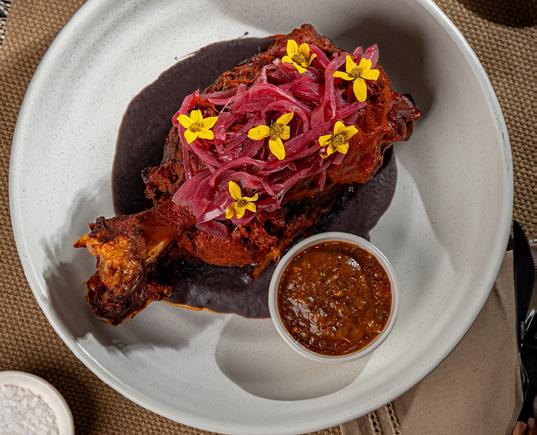

A short flight due east of Mexico will take us to the sun-drenched island of Puerto Rico in the Caribbean. Luckily for us, we don’t need to pack a bag to sample Puerto Rican food at one of Lafayette’s newest international restaurants.
WEPA! CAFÉ celebrates unique Creole cuisine that’s uniquely influenced by Spanish, African and indigenous Taíno cultures that once lived on the small island before it became a U.S. territory in 1898. Wepa is a Spanish expression used to express excitement, joy, congratulations or pride. It is exciting to introduce traditional Puerto Rican dishes to Greater Lafayette. As they approach the restaurant, guests are greeted by the gentle nighttime chirping sounds of native coqui frogs.

Key ingredients found on the island-inspired menu include plantains, yuca, rice and beans, tropical fruits, fresh fish, pork, chicken and steak. Wepa Café golden fries and mashes green plantains with garlic in its traditional mofongos, served with a choice of meat or shrimp. Green plantains are high in potassium, magnesium, fiber, vitamin C and vitamin B6, whereas sweet plantains have a higher sugar content, like bananas. Both plantains and yuca can be boiled, fried or roasted like potatoes.
Barbecued meats are popular at the restaurant and are a part of the island’s earliest history. The word “barbecue” comes from the ancient Taíno word “barabakoa,” meaning a raised framework for slow-roasting or smoking food over a fire. The indigenous Taíno culture predates Christopher Columbus. Cooking low and slow creates a delicious stick-to-your-ribs kind of meal.

Popular items on Wepa’s menu are Taíno sandwiches, served on crispy tostones (plantains), made with roasted pork, chicken or steak. They’re flavorful, but not hot spicy. Try the ever-popular Cuban Taíno with savory roasted pork, honey ham and provolone cheese, topped with all the fixings and signature Taíno sauce (ketchup, mayo, garlic). Fresh bread can be subbed for plantains, if desired.
Don’t forget to try traditional drinks such as passion fruit juice, coco rico (coconut-flavored beverage), cola champagne (sweet, sparkling, creamy soda), or café con leche (coffee with steamed milk). The desserts (flan, rice pudding and coconut pudding) are the perfect ending to the island tour before we fly to Europe.
- 513 N. Earl Ave., Lafayette
The flight to Rome, including layovers, takes 12 to16 hours from the Caribbean. The trip is well worth it to visit one of the culinary capitals of the world. Fortunately, Italian cuisine has spread across the globe and is widely accessible. Greater Lafayette alone boasts more than 25 restaurants serving various versions of pizza. However, our featured pick specializes in a complete menu of authentic Italian specialties.
LA SCALA is a chef-owned family ristorante located in the gargoyle-adorned historic Ross Building on Main Street across from the Tippecanoe County Courthouse. It has been Lafayette’s premier Italian eatery for 25 years, winning the Journal and Courier’s vote for Best Italian Restaurant. The cozy interior features a deep shotgun layout, with tables lined up on both sides of the restaurant and open dining in the bar area. A spacious outdoor café is open during the warmer months. The humble beginnings in 2000 for Chef Francisco “Paco” and Kirsten Serrano, and their daughter, Lillian, have evolved and grown into a delicious and self-sufficient farm-to-table family enterprise.
What’s special about La Scala? The extensive menu of mouthwatering authentic Italian dishes such as Calamari Friti (octopus with lemon and marinara) for starters; Sacchetti Napolitana (cheesefilled “beggar’s purse” pasta with tomato cream sauce) and Steak Pepperonata (a flat iron steak with Italian peppers, basil, tomato and linguine) for main dishes; and Bomba Exotica (gelato or sorbetto dipped in a chocolate shell and drizzled with chocolate sauce and whipped cream) or tiramisu for dessert please any palate. Gluten-free pastas are offered alongside traditional Italian favorites. La Scala’s full bar includes house-made limoncello and seasonal sips. If you’ve ever traveled to Italy, you know that each dish is made and served with pride and pleasure. Using fresh quality ingredients, the Italians have mastered the art of eating well and have one of the world’s healthiest cuisines. That mission to provide the same freshness to Greater Lafayette helped inspire another unique feature of La Scala. You’ll enjoy fresh, chemical-free, locally grown ingredients from the family’s Small Wonder Farm. The Serranos grow and supply fresh and seasonal produce for La Scala dishes and their innovative chef-prepared subscription meal service, Good to Go. The meal program delivers ready-made meals within Tippecanoe County for busy individuals or families looking for easy, nutritious, restaurant-quality meals at home — perfect as a gift for the cooking impaired. Downtown’s longest-running fine dining restaurant is open Thursday through Saturday evenings, starting at 5 p.m. Reservations are encouraged.
- 312 Main St., Lafayette
The trip from Italy to Greece is the shortest leg of our trip. The two-hour flight takes us to another ancient culture along the Mediterranean Sea, famous for its distinctive, delicious cuisine. Fresh vegetables, olive oil, cheeses and herbs give the food its unique flavor profile. A quicker way to experience the culture is to drive across town to one of the area’s best Greek restaurants in West Lafayette.
PARTHENON GREEK AMERICAN GRILL is a new restaurant concept for the 45-year-old Pitoukkas family-owned West Lafayette landmark. What’s new is offering traditional Greek favorites in a more contemporary, Greek-inspired atmosphere with quicker service to accommodate their customers’ busy lifestyles. It may be faster to get in and out, but there is no compromising on the four-generation family recipes or ingredients.
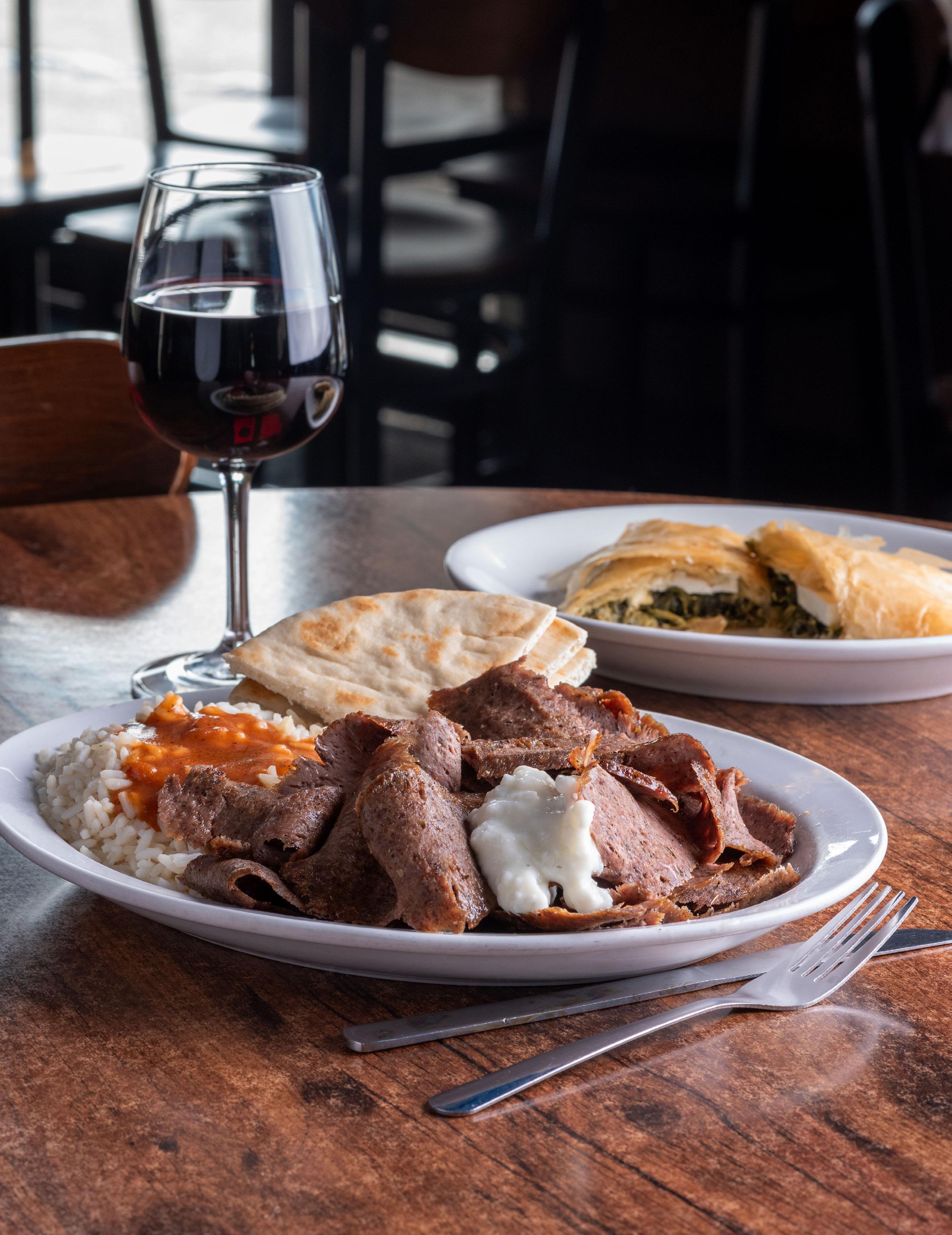
Opa! is a common expression used in Greece and surrounding areas to denote enthusiasm, joy, surprise or after making a mistake. In Greek culture, it can accompany the act of plate smashing at weddings or parties. At Parthenon, it’s exclaimed when a pan of hot saganaki (kefalograviera cheese) is set on fire before it’s brought to the table. By the way, it’s delicious and is served on fresh pita bread. Another signature dish is spanakopita, a homemade blend of seasoned spinach and feta hand-wrapped in flaky phyllo dough and baked. We would be remiss not to highlight the famous Gyro sandwich. Made from scratch in the kitchen from ground beef, lamb and Parthenon’s own blend of herbs and spices, the flavors will not disappoint. It’s wrapped in warm pita bread and adorned with onion and tomato slices and a dollop of homemade tsatsiki (cucumber yogurt) sauce. Complete your meal with Greek fries or rice pilaf and a fresh Athenian salad made with kalamata olives and feta cheese cubes.

For dessert, dive into a classic baklava, sure to satisfy any sweet tooth with layers of honeyed nuts between layers of phyllo dough. Another option is a Greek wedding cookie, a rich buttery cookie with almonds drenched in powdered sugar. Parthenon caters special events and has a drive-thru, too. The Greeks still celebrate life in many Old World traditions, with lively music, dancing and sharing delicious meals with family and friends. If you’ve not tried Parthenon yet, feta late than never. Opa!
- 2060 Sagamore Parkway W., Suite M, West Lafayette
Now for the long-haul trip to Asia, taking 10 to15 hours, starting from Athens to New Delhi, India. There are 3,610 foreign-born residents from India living in Greater Lafayette, including students, who contribute to the community.
ADDA INDIAN CUISINE is located at Wabash Landing. Its flagship store is in Chicago, with West Lafayette as its second family-owned location with a mission to bring the flavors of India to the world. The chefs pride themselves on recreating traditional Indian foods while putting a twist on others to create a new taste sensation, raising a toast to the old and the new. The spices in Indian food are what make the dishes flavorful and memorable, including ginger, turmeric, curry, cumin, cloves, coriander, cardamom, cinnamon, mustard, fennel, chilies, garam masala, black pepper and more. On a spicy heat scale of 10, Indian food ranks between 5 and 10, says Chef Sid Savale. You’ll taste the heat of India.

In India, ADDA means “An everyday place or spot where friends gather.” Upon entering, you’ll be greeted with the soothing, burbling sounds of a fountain and the aroma of warm spices. The restaurant seats couples and larger groups who are gathering for an Indian food experience. There are many wonderful vegetarian dishes, including lentil soup and veg specialties like malai kofte (cheese and veggies in a white, creamy sauce). It pairs well with long-grain basmati rice. The menu features a wide selection of chicken, lamb and seafood dishes. A popular favorite is chicken tikka masala. Tikka means “bits” or “pieces” of the meat, vegetable or cheese used in a dish. Andhra lamb curry is a favorite slow-roasted lamb dish, rich in coriander, curry leaves and a complex blend of spices. Many of the dishes are cooked tandoori style―in clay pots after being marinated. Don’t forget the naan, the warm, leavened bread perfect for sopping up gravy or sauces.


Desserts are sweet puddings, pastries or ice cream to calm the taste buds after a spicy repast. Carrot halwa is a rich pudding made with grated carrots, cooked with milk, water, sugar, spices and ghee (clarified butter)―a popular sweet during winter and festive seasons. Experience Indian authenticity in every bite at ADDA.
- 332 E. State St., West Lafayette
A direct flight from the Indira Gandhi International Airport to Tokyo, Japan, takes only 8 hours. Greater Lafayette is home to 15,940 Asian residents, roughly 8.29% of the total population. Many come to Purdue University to pursue higher education and bring their ancient and evolving cuisine to the community.
SAKANAYA IZAKAYA’S dining experience transcends the ordinary. Cross the threshold, and you are transported to Japan with cool vibes and clean bamboo lines. The Name Tree greets you at the door, festooned with wooden ornaments hanging from red ribbons. Guests are encouraged to add their names or sentiments to an ornament and string it to the tree. The upscale interior features honeycombed, intimate seating for one or two couples, or tables for bigger parties. There is art in décor and art in every dish. Fresh. Colorful. Beautifully plated. Tasty. Healthy. Japanese fusion. It’s a delightful place to gather, share food, and celebrate little occasions. Like Happy Hour on Sunday-Thursday from 2-5 p.m. for special pricing on sushi rolls and festive cocktails.

Located close to our Greek friends in Market West, Sakanaya is one of the hottest new restaurants in the area. Several ingenious varieties of sushi, maki rolls, sashimi and yakitori are on the menu. One of Chef’s favorites is the Sakanaya Wagyu Roll, made of spicy shrimp, avocado, torched A5 wagyu, tobiko, masabo, green onion oil and beef tartare sauce. A great starter is the Dinosaur Egg, a large egg-shaped container filled with avocado, spicy tuna, cream cheese and shrimp. Entrees come with a house salad or miso soup and range from hearty sushi rice bowl selections from the sushi bar or culinary favorites like teriyaki chicken or curry katsu (panko-battered chicken with Japanese-style braised curry) from the kitchen. Everything’s almost too pretty to eat, but you’ll be sorry if you don’t.


But wait, there’s more. Sakanaya features delicious lunch specials from 11 a.m.-3 p.m. Theoretically, you could come for lunch and stay through Happy Hour. Japanese whiskey and beer, sake, shochu and handcrafted cocktails complete the dining experience. Every month, a unique seasonal cocktail is featured. Enjoy the taste and culinary artistry of authentic Japanese cuisine right here in Greater Lafayette.
- 2060 Sagamore Parkway W., Suite T, West Lafayette
The culinary quest has ended. Time to head back home. It takes 12 hours for a nonstop flight from Tokyo to Chicago, followed by a short United Express flight to the Purdue University Amelia Earhart Airport. Luckily for us, these global gastronomic destinations are right here for the tasting. ★
J.L. Hufford transformed its popular coffee counter into a thriving gourmet goods enterprise with global reach.
BY KAT BRAZ | PHOTOS BY CHRISTINE PETKOV
When Joe Hufford started J.L. Hufford Coffee and Tea Co. in 1991, Lafayette didn’t have a single espresso machine in sight.
“I remember visiting every coffee shop between Chicago and Indianapolis,” Hufford says. “There wasn’t a place around here to get an espresso or cappuccino. Maybe something on campus, but that was about it.”
So, in his mid-20s, he took a leap. With no deep love for coffee but a lifelong itch to run his own business, Hufford opened a small coffee shop inside the Tippecanoe Mall. “I wish I had some romantic story about sipping espresso on the Seine and thinking I should bring this back to Lafayette,” he says. “But it was purely a business decision. Coffee’s the second-most-drunk beverage in the world. That sounded like good math to me.”
Hufford signed a six-month lease — just long enough to see if the idea could work. It did. This year marks the business’s 35th anniversary.
Learning the craft
When J.L. Hufford first opened, most customers didn’t even know what an espresso was. “People would come in and say, ‘I want one of them expressos,’” Hufford recalls. “We’d pour out this ounce-and-a-half shot and charge $3, and they’d look at us like we were crazy.”
Education became part of the sale. “We’d explain what an espresso was or turn it into a cappuccino so it looked like something worth three bucks,” he says. “It was a lot of trial and error.”
In those early years, J.L. Hufford was more gift shop than coffee counter, with shelves of mugs, teapots and coffee makers. Over time, the small counter in the back that sold drinks began generating the bulk of the revenue. “Eighty percent of our space
was devoted to stuff that made 20% of our sales,” he said. “That little coffee counter was doing 80% of the business.”
When the store moved to a new location in the mall, Hufford redesigned it around what customers actually wanted: convenience. “We realized people weren’t looking for a place to sit and linger,” he says. “It was more of a grab-and-go crowd — get a drink, head back to shopping.”
The top-selling drink today isn’t even brewed coffee. “Our No. 1 seller is what we call a Glacier,” Hufford says. “It’s a coffee smoothie — our version of a Frappuccino. Funny thing is, we didn’t even have a blender when we opened.”
Expanding online
While the coffee business thrived, Hufford noticed another shift happening — this time online. Long before e-commerce was mainstream, he saw potential in selling coffee beans to Purdue alumni and former customers who had moved away. But that first online experiment flopped. “We tried selling coffee online, thinking people would want to reorder once they left town,” he says. “That failed miserably. Too much competition.”
What didn’t fail was a niche he stumbled into by accident: high-end home espresso machines. “At the time, these were $1,000 to $2,500 coffee makers,” Hufford says. “They’re fully
automatic — push a button, and it grinds, brews and froths your cappuccino for you.”
He started with Jura, a Swiss brand, and quickly added others. Demand exploded. Within a few years, J.L. Hufford became one of the top three online retailers for premium home coffee makers in the United States.
That success opened new doors. “We realized if someone’s willing to spend $2,500 on a coffee maker, they might also buy a $300 chef’s knife or a $500 Dutch oven,” Hufford says. “So we brought in Wüsthof knives, Le Creuset cookware, Vitamix blenders — all the big gourmet brands.”
Today, J.L. Hufford has grown far beyond its mall roots. The company operates out of a 45,000-square-foot warehouse across from the mall — once an RV dealership, now stacked floor to ceiling with kitchenware. “We have several million dollars’ worth of inventory,” Hufford says. “We ship about 100,000 packages a year through Amazon alone.”
Most customers have no idea one of North America’s largest gourmet kitchenware distributors operates quietly in Lafayette. “We’re a bit of a best-kept secret,” Hufford says. “We don’t sell retail anymore, so people don’t realize what’s happening just down the road.”

Change is constant
J.L. Hufford’s next chapter is already underway — the company has begun manufacturing cookware in its own facility. The company also has expanded into logistics, helping other businesses get their products into the U.S. market.
“We do the shipping, warehousing, even warranty repairs for other companies,” he says. “If you’re not adapting, you’re falling behind.”
It’s a philosophy that’s guided Hufford since his first espresso shot.
“I always say I’m a pirate, not a pioneer,” he says. “My best ideas are ones I steal from other successful people, from other industries. You don’t have to reinvent the wheel, just look for ways to make it roll better.”
For a business that began with a six-month lease and a small coffee counter at the back of the store, J.L. Hufford’s reach today is remarkable. From Lafayette, the company ships gourmet cookware and coffee equipment around the globe.
Still, Hufford insists his success rests not on products but on people. “I’ve got really good employees,” he says. “I take good care of them, and they take good care of me. Most of them treat the business like it’s their own. That’s what makes it work.”
And while J.L. Hufford’s product line has evolved from mugs to gourmet kitchen tools and cookware, the spirit behind it hasn’t changed. It’s still the story of an entrepreneur who saw opportunity where others didn’t — and kept adapting to meet it.
“The only thing constant is change,” Hufford says. “If I didn’t believe that, we’d still just be selling cups of coffee.” ★
BY BRAD OPPENHEIM
If you’re familiar with downtown Lafayette, you’re well aware of the variety of establishments to eat, drink and explore. To boost the experience even more, the city launched its first-ever Designated Outdoor Refreshment Area (DORA) during the summer of 2024, allowing visitors the freedom to stroll through a designated area of downtown while enjoying their favorite alcoholic drink from participating spots.
The current area, known as the Upper Main Street DORA, spans a single block along Main Street, from 10th to 11th streets, and includes East End Grill, Ripple & Company and The Cellar Wine Bistro.

“This pilot DORA was established in July 2024 at the request of these vendors, who encouraged the city to explore a DORA as a way to support downtown activation and encourage foot traffic,” says Myles Holtsclaw, senior community development manager at the City of Lafayette’s Economic Development Department. “While small and relatively quiet due to its limited size and number of participants, the DORA has been considered successful.”
Holtsclaw says the plan has always included expanding the designated area, but the pilot has served as an opportunity to identify any logistical or operational issues.

“Many downtown businesses expressed interest in participating from the start and have continued to show enthusiasm for expansion,” he says. “While the pilot area was intentionally limited, it served as a stepping stone toward broader inclusion.”
Now, a year later, the city is ready to roll out that expansion, encompassing a much larger portion creased foot traffic has the potential to boost business, not only leading to higher sales and greater visibility for those who sell alcohol, but the broader downtown community. It also makes it easier to include alcohol sales at events—while ensuring those sales benefit local businesses. of Main Street, stretching from Second Street east to 11th Street, including landmarks such as the courthouse square and the area that makes up the Lafayette Farmer’s Market.
“Many of the participating restaurants have limited waiting areas, so the DORA offers guests the option to grab a beverage and enjoy downtown while waiting for a table, improving the customer experience,” he says.
The DORA also is expected to help create a more welcoming and adaptable atmosphere downtown, making it easier for organizers to plan and host events. This added flexibility could allow for more events and more regular programming—further making the case for Lafayette’s reputation as a must-visit destination.
Holtsclaw says for businesses within the DORA footprint, increased foot traffic has the potential to boost business, not only leading to higher sales and greater visibility for those who sell alcohol, but the broader downtown community. It also makes it easier to include alcohol sales at events — while ensuring those sales benefit local businesses.alcohol
As for any concerns, Holtsclaw says some were raised by the public about potential issues such as increased litter, the area becoming a “party environment” and general safety. But following a smooth and issue-free rollout of the initial phase, no public comments were received during either of the readings for the proposed expansion.
“This suggests increased public comfort and confidence in the program’s responsible management,” Holtsclaw says.
Several businesses already are included in the application for the expansion, including Thieme & Wagner Brewery, located near North Seventh and Main streets.
A well-known name in Lafayette, the brewery was originally founded in 1863 by Frederick August Thieme and was located at the corner of Fourth and Union streets, according to the Tippecanoe County Historical Association. The brewery shuttered its doors due to Prohibition, but the family remained in the beer business.
Decades later, David Thieme and his father brought the brewery back to life—reviving the legacy at its current Main Street location.
“We have always believed in filling humanity’s need for socialization and have been blown away by the amount of friendships we’ve helped start and foster in our eight years on Main Street,” Thieme says.

When the pilot rolled out, Thieme says he was cautiously optimistic.
“I really wanted it to include all of downtown and have more structure in how it’s executed,” he says. “But I’m being told there are strides in that direction, which is great!”
He says the brewery has always benefited from being allowed to partake in carry out sales on the beer they brew, but it’ll be nice to now have the option for liquor and wine as well.
“I overall support it but feel currently there aren’t enough regulations to the types of alcohol that can be sold,” says Thieme. “It’d be nice to see the DORA rules on beer limited to beer made in Lafayette only or even Indiana only.”
Down the street near North Fifth and Main streets sits Generation NA, the first non-alcoholic bottle shop to open in the Midwest. Open just over three years now, the establishment specializes in non-alcoholic and functional drinks and different types of adaptogens and nootropics to help people boost energy, focus, sleep and relax, without the hangover.
Owner Rob Theodorow says when the original DORA concept was floated, he didn’t think too much of it since his business was located outside of the boundaries. But once plans for an expansion were up for discussion, and his business would now be located inside of that expanded boundary, he initially wasn’t thrilled.
“However, thinking about it more I feel it’s a great opportunity for us to be part of a mindful consumption effort,” Theodorow says. “Many of our customers still drink, and we are here to let them know they have options. We aren’t anti-alcohol, we are anti-alcohol being the only option for people. We provide a safe space from alcohol for the local sober community and have a unique setup allowing people to have the experience of a liquor store/bar/brewery, without being around alcohol.”
Theodorow says he does anticipate the new area to have an impact on his business.
“We have tables out front that are commonly used by our customers,” he says. “Now that we will be within the footprint I imagine these will also be used by patrons consuming alcohol, which makes it difficult to provide a fully sober/alcohol-free space for us in the community.”
Addressing his initial concerns, he says the city’s economic development team has been very helpful and are even working with Generation NA on signage promoting non-alcoholic options. He says there are pros and cons with everything, and as the expansion is officially put into place, both will be uncovered.
“We have worked hard over the past three to four years to provide something very unique and progressive for the city,” he says. “Our shop brings in a lot of traffic from outside of Lafayette, even outside of Indiana, and drives more business locally. I hope Lafayette realizes the potential we have here and will help us expand the brand deeper into the community and beyond.”
As far as a timeline, Holtsclaw says approval is pending from the Indiana Alcohol and Tobacco Commission, but as soon as they receive the green light, the expansion is ready to be implemented.
For more information regarding hours and guidelines, visit lafayette.in.gov/3641/Designated-Outdoor-Refreshment-Area-DORA ★


From pigeons to pigs, WoodHaven Rescue thrives to provide the best life for the forgotten
BY KEN THOMPSON
WoodHaven Rescue was Susan Slayton Whaley’s destiny from infancy. Her earliest memory of displaying love for all creatures great and small was picking up earthworms and putting them in her pockets.
“My mom would throw the baby jeans in the washing machine and have worms floating on top of the water,” says Whaley, who also remembers crying when her parents walked over an ant hill.
During a recent visit to the rural Tippecanoe County rescue, there were no earthworms or ants in sight. Goats, llamas, donkeys, mini horses, mini mules, peacocks, pheasants, guineas, dogs, cats and kittens, chickens, turkeys, rabbits, a goose and a steer provided the soundtrack on a cool afternoon. The animal population at WoodHaven ranges between 80 and 90 at any given time.
“We take in animals who are needing rescue or are extremely elderly — the animals no one else wants,” Whaley says. “The 4 Rs for the animals of WoodHaven are rescue, rehabilitate, rehome, retire. If we rescue, we want to rehabilitate. We want to rehome or adopt out. If they can’t be rehomed, we retire.”
WoodHaven first got its name from the farm in Tennessee that Whaley and her husband shared. A graduate of McCutcheon High School (1985) and Purdue University (1989), Whaley moved back to Lafayette in 2014 after her husband passed away.
“I lost my husband. I had to sell the business we had,” she says. “I brought with me all the rescue animals we had: dogs, cats and horses.”
During COVID, Whaley decided to pursue her dream of opening a non-profit animal rescue.
“Somewhere back in second grade, I wrote what I wanted to do when I grow up. I wanted to save animals,” Whaley says. “The timing was here. After selling the business and understanding the corporate world, what’s stopping me? The fact that I found this place with a lot of trees and a lot of woods, it just made sense to still call it WoodHaven.”
Whaley received the 501(c)(3) letter, given by the IRS for tax-exempt non-profit organizations, in 2022. While there have been sleepless nights worrying about the next vet bill, Whaley has been rescued by the animals who return her love.
“These animals do more for me than I will ever do for them,” she says. “After losing Gary … these animals are my reason to get up and get out every morning. Even on the days when I have my sinus trouble, I can still walk in the barn, and you feel the love. Every single animal on this property is grateful. All animals are wonderful.
“I may be a little biased, but I have had other people say the animals here are special. How they look at you, how they interact. Part of why I think that is we don’t allow our wants to be pushed on them. I want to love on this animal, but if this animal does not want to do that, we let them be animals. We let them tell us what they are comfortable with, and they give us back so much more.”
While Rescue is part of WoodHaven’s title, it is not a pet shelter.
“Every animal has a stall, a barn we can shut in. Otherwise, we won’t take them,” Whaley says. “I’ve had to turn people away. We are a rescue. We are not a rehoming service. Because you are tired (of the animal) and you don’t want to take care of it anymore, I’ll give you resources to try to find a home, but it’s not an urgent rescue. The exception is someone passed away unexpectedly and there was no place. If it was short term, we would try to help out if we could. But I don’t want to help someone else’s animal and hurt one of ours.”
A recent rescue brought 22 chickens from Ohio. Another rescue ended up with a place in Whaley’s home.
“We get a lot of calls from the sheriff’s department when shelters are full,” she says. “Elvis the dog, he was a case. The sheriff called and asked if we had an empty stall. He says unless we take him in they are going to euthanize him. When they brought Elvis out, he was laying in the back of a squad car. He had just given up.”
Elvis got his name from the hound dog eyes that gazed at Whaley as she took him from the squad car.
Every animal has a story. Here are a few. Three orphaned kittens were given the names Wilma, Barney and Betty from “The Flintstones.” We met Betty during a tour and discovered she loves to unexpectedly launch herself into your arms. Another cat, Gus, has scarred lungs from a respiratory infection as a kitten and breathes unusually, like a human with COPD or emphysema. Behavior issues mean Betty and Gus will spend the rest of their days roaming WoodHaven.
Rachel, Monica and Phoebe (“Friends”) were three llamas rescued from a breeding operation in Ohio. Rachel has since passed away but Monica, at age 32, and Phoebe, at 27, have well exceeded the average life expectancy of 15 years.
They were joined in June 2022 by Nightmare and Champagne, who Whaley says welcome extra love and attention. “They have settled in nicely with the other seniors, and we hope they will be able to live out their lives all together here.”
And then there’s Franklin the steer, named for President Franklin Delano Roo- sevelt, who also wore leg braces. Born with contracted tendons, Franklin was unable to stand or walk when he came to WoodHaven shortly after birth in 2021.

“I made his braces out of PVC pipe,” Whaley recalls.
After plenty of physical therapy got him on his feet, Franklin has become one of WoodHaven’s ambassadors.
“He’s a lifer here,” Whaley says. “We do a lot with him for educational purposes.”
Visitors to WoodHaven are greeted by Bandit and Coot, peafowl who don’t like to get out of the way but will beg for treats. The duo’s favorite treat is cat food.
Among the more than 30 bird residents is Homer, a failed racing pigeon. Homer traveled more than 350 miles from home to WoodHaven after flying the wrong direction.
After tracking down Homer’s owner from his leg band, the elderly owner asked if Homer could remain at WoodHaven.
A recent intake of a mama goat and her two babies from Michigan joins a population that are all CAE (Caprine Arthritis Encephalitis)-positive.
“We work to educate that CAE goats can have a very healthy long life. Some don’t,” Whaley says. “The equivalent if you had to think in human terms would be HIV. CAE can cause arthritis, hind leg paralysis, weakness and other neurological issues. Some goats, they can live their entire life and never have a sign. They are carriers.

“It’s a virus they are saying as high as 70 percent of all dairy goats in the U.S. have. Some farms and breeders will routinely test for it. There’s no vaccine, there’s no treatment, there’s no cure. If any flag positive, the breeders euthanize them.”
The mama goat and her two babies came from a breeder who pleaded with Whaley to take them in.
“She called me crying. ‘She’s the sweetest little doe and there’s two doelings. I don’t want to kill her.’ ”
Fortunately, a rescue from Michigan had to bring animals to Purdue University for a veterinarian visit, and it transported the goat family to WoodHaven.
The mother was already named Cinnamon, so Whaley named the babies Nutmeg and Ginger. She calls them “our Spice Girls.”
“Our hope is to adopt out the two babies,” Whaley says. “We may or may not adopt out the mom. If someone wants to take all three and it’s a good home, I would love that. But because she has issues so young, Cinnamon may end up being a lifer here. I know how to manage it. We do joint supplements, pain medication, anti-inflammatory medication.”
A tribute with a prominent place in the WoodHaven Barn is The Memorial Plaque, which honors WoodHaven’s departed animals. Time has allowed Whaley to remember them fondly.
“The goat we just lost, Hefty, was pretty special,” she says. “I went to a sale barn where there were CAE babies. He was one of the triplets, and no one wants a boy dairy goat. They were going to (cut his throat), let him bleed out and throw him in the dump- ster. The dumpster had great big Hefty trash bag stickers on it. I said we’re going to call you Hefty because you’re going to be strong and you’re going to come home.
“He was touch and go, touch and go. Then Hefty just thrived. We lost him a couple of months ago to cancer, but Hefty had 10 amazing years.”
Another recent loss was Henry, a pig who was the size of a football when Whaley brought him to WoodHaven. “He was much beloved by all who met him,” she says.
Because WoodHaven specializes in rescuing geriatric animals, there’s a higher than normal attrition rate.
“I don’t care if they are here only for a very short period of time,” Whaley says. “They will know love. I get emotional, and I do shed tears over every single animal.
“I always tell everyone the biggest gift we can give our animals is to take their pain and suffering and put it on yourself. I am willing to hurt, I am willing to cry and miss you horribly so you are not in pain any more. That is the only way. I have sat with so many animals when we said goodbye, and it’s peaceful. Everyone says, ‘I could never get an animal again. My heart would break.’ You know what I’ve found? Every time my heart breaks a little bit it’s like an earthquake. My heart opens and it makes it a little bigger. Now something else can fit in that break.”
Working 14 hours a day, seven days a week, Whaley couldn’t keep the rescue operating smoothly without volunteers and donors. Three regular Tuesday and Thursday morning volunteers are ladies in their 70s.
Sandy Schelle was WoodHaven’s first official volunteer and has been coming to the rescue for four years. Schelle is part of a group of retired women in their 70s. What keeps Schelle coming back?
“The love and appreciation you get from the farm,” Schelle says. “The joy of working and helping the family of animals have a better life.”

What does Schelle wish people knew more about WoodHaven?
“The love and care that is given to these animals who otherwise would have been forgotten,” she says.
No minimum commitment is required to volunteer. In addition to weekday shifts, there’s also help needed Saturdays and Sunday afternoons after church.
A veterinarian in Crawfordsville gives WoodHaven a discount for its services. A plaque inside the barn salutes Animal Advocates, people who have made a substantial donation in memory of a loved one or who in their obituary request gifts to WoodHaven Rescue Farm.
“Our biggest needs right now are money or materials/supplies and volunteers,” Whaley says.
“I’m very much aware that everybody is hurting financially right now, which is why we hold so many things like garage sales. We are thrilled with material donations. Things that don’t mean anything to you that you want to donate to our garage sale — someone might not have $5 to give to WoodHaven but they have $5 to give to this table that they need to make their life better. And that $5 comes back to WoodHaven.”
A two-day garage sale in March raised $9,774.04.
Visits to WoodHaven are by appointment only. Private tours are $200 for up to 10 people. Open house events are free, including the largest of the year on Oct. 18.
“My heart, my true comfort is being with them,” Whaley says. “The rest of the world goes away for me. It’s a beautiful thing. It’s something I’m so passionate about. I am so blessed to do this every day.”

WoodHaven Rescue Farm, Inc.
6310 S 900 E Lafayette 47905
931-205-8774
Email info@woodhavenrescue.com
Go to woodhavenrescue.com for more information about volunteering.
BY KAT BRAZ
In her final days of life, a woman rests in bed surrounded by loved ones. A trio of harmonic voices softly sing, filling the air with warmth and tenderness akin to a lullaby. The meditative repetition of lyrics exudes comfort and peace to all who listen.
You are not alone.
We are here beside you. You are not alone.
We are here now.
Founded in California in 2000, Threshold Choir celebrates its 25th anniversary this year. Through nearly 200 chapters worldwide, volunteers sing songs of comfort to people facing death, illness, grief or suffering. The local group, Greater Lafayette Threshold Singers, was initially formed in 2018 and formally launched as a Threshold Choir chapter the following year.
“It’s a special privilege to sing at the bedside of someone who is dying,” says Bridget Baker, director of the Greater Lafayette Threshold Singers. “Not only are we soothing the individual, but we are also supporting the family by helping them come to terms with the emotions they are feeling. Often, family members feel like they must be stoic in front of a loved one who is dying and they don’t really process their emotions. Once we start singing, we see family members begin to cry, to grasp their loved one’s hand or even climb into the bed and hold them. Those moments are so special because we witness their profound love for one another and we offer compassion for their grief.” Baker, who also serves as co-chair of the board for the international organization, is helping to organize a regional gathering in Lafayette in August. This event will be one of 25 regional gatherings in honor of the 25th anniversary of Threshold Choir.
Greater Lafayette Threshold Singers welcomes new members. Formal voice training is not required, but choir members should meet some vocal guidelines outlined on the organization’s website, thresholdchoir.org:
• Be able to carry a tune
• Be able to hold your own part while others sing harmony
• Be able to sing softly and blend your voice with others
• Be able to communicate kindness with your voice
• Be willing to use self-monitoring and accept peer feedback as we work together to bring the sweetest, most blended and graceful sound to our precious clients.
The local chapter of about a dozen singers meets weekly to rehearse in the chapel at Westminster Village in West Lafayette. Many of the clients the group has sung to are residents of Westminster, however Threshold Singers welcomes requests from individuals and families throughout Greater Lafayette. They’ve sung in hospitals, in homes and even at memorial services. Typically three singers come together to allow for harmonization, and they always sing a cappella. The repertoire of songs has been developed specifically for Threshold Choir chapters over the years.
“We describe the songs as adult lullabies,” Baker says. “Many have a spiritual component that can be interpreted through any religious lens, but they’re all written with calming rhythms and comforting words.”
During rehearsals, members take turns in the center of the circle, being sung to as if they were a client. The soft voices begin singing the melody in unison, then separate into harmonies as the lyrics layer over themselves, unlocking emotions within. Jack Albregts, a founding member of Greater Lafayette Threshold Singers, says choir members receive as much from singing as they give to others through their songs.
“It’s very fulfilling to sing at someone’s bedside,” Albregts says. “To be welcomed into that precious space — it’s a pleasure. It’s very per- sonal to us. They say hearing is the last of the senses to go. We want to give them comfort, and in doing so, it brings us so much joy.”
Learn More
To request Greater Lafayette Threshold Singers or learn more about joining the organization, contact director Bridget Baker at lafayette@thresholdchoir.org or 765-357-5217.
Blue Moon Rising
Ever been told that you can’t sing? Or carry a tune in a bucket? Denise Wilson begs to differ.
The founder of Blue Moon Rising has spent the past decade building a supportive and welcoming community to sing for the pure enjoyment of singing — no previous experience required.
A lifelong musician, Wilson played in the Tippecanoe Fife and Drum Corps as a teen. Performing music — mostly Celtic, French-Canadian and folk music — with Bon Jolais in the ’80s and ’90s and Traveler’s Dream for the past 25 years gave her confidence in her own voice.
“Over decades of performing, I had many conversations with audience members who told me they’d always wanted to sing but they’d been told by someone — often parents or teachers — that they have a bad voice,” Wilson says. “Coming from someone you respect, that’s a message people can carry for a lifetime.”
Searching for a way to help others feel comfortable and confident with their singing, she attended a two-week Community Choir Leadership Training that’s held in Victoria, British Columbia, annually. There, she learned how to create and lead a welcoming choir, one open to anyone who wants to participate. She founded Blue Moon Rising in 2015 and the choir is celebrating its 10th anniversary this year.
In April, 80 audience members packed into The Arts Federation for a relaxing and funfilled evening of community singing for Blue Moon Rising’s Spring Sing event. Throughout the evening, the audience was invited to join in singing familiar or easy-to-learn songs. Wilson primarily teaches using a call and response method, which makes it easier for singers who don’t read music to learn their parts. In Blue Moon Rising, the process of singing together is more important than perfecting music for a performance.
“For thousands of years, people came together to sing to express joy, celebration and grief; to accompany work tasks; and to enjoy the way music lifts the spirit as it was woven into daily life,” Wilson says. “Singing was for everyone, not just those with a good voice. The emphasis is on community.”
In selecting songs for Blue Moon Rising, Wilson draws from many oral traditions, such as South African freedom songs, African American spirituals, sea shanties and well-known folk songs. She also leans in to her love for traditional music from the 18th and 19th centuries.
Many of the songs fall into categories of songs for peace and hope or songs of resilience and justice. All foster a spirit of belonging and community. One group favorite is “Hold Everybody Up” by Melanie DeMore, a songwriter and vocal activist whom Wilson brought to town in November 2024 to lead a community concert and offer singing workshops for the public.
Just because you look like you and I look like me
It doesn’t mean we can’t be friends You’re not my enemy
We gotta hold everybody
We gotta hold everybody up
“There is so much more to a community choir than singing,” Wilson says. “Shy singers move past their fears. Friendships blossom as members connect before and after our practices. I am filled with awe when we sing a song of peace or unity and at the end, there is just a holy silence. Each of us feels such a deep gratitude from contributing to that beauty.”
Over the years, Blue Moon Rising has participated in numerous community events, including the LUM Community Thanksgiving Feast, Earth Day celebrations at the Celery Bog, community MLK Jr. Day celebrations and gatherings at the courthouse. The group performs at area senior living centers including Westminster Village, Friendship House and Joyful Journey. Wilson also periodically holds informal one-time sings at pubs and parks so individuals who are unable to commit to a full session in the choir can still share in the benefits of community singing.

“I’ve watched the healing power of song to build community, to lift people who are struggling, to build hope and resilience in hard times,” Wilson says. “Singing with others is good medicine for just about whatever ails you.” ★
Join Blue Moon Rising Blue Moon Rising is a community choir open to anyone who wants to sing. There are no auditions and all voices are welcome. Fifteen-week sessions are held in fall and spring with a membership fee of $165 per session. Scholarships are available and no one is turned away due to inability to pay. The next session begins August 19. Visit denisewilsonmusic. net/blue-moon-rising.
BY GREG LINDBERG
PHOTOS BY CHRISTINE PETKOV
The opening of Main Street Amusements in downtown Lafayette’s Arts & Market district in January 2012 brought a flurry of pinball machines in a single space, helping to ignite a passion and buyin for many locals to indulge. Dan St. John opened the space with his own passion for repairing these complex machines, which also helped to bring in a variety of older, rare machines mixed with brand new pop-culture themed games.
Lindsey Sickler of Lafayette had limited experience with pinball and arcades until 2022, when she ventured with her bowling league friends into the fun, hangout atmosphere of Market Square Lanes and North End Pub, which features more than 20 pinball machines. This led her group to continue to go to Market Square Lanes, but for pinball instead of bowling.
“Right away, I discovered how welcoming the pinball community at North End Pub is. Everyone was happy to help new players, whether it was tips on flipper skills or strategies for scoring more points,” Sickler says. “I learned about an international group called Belles and Chimes, which was created to encourage more women to get involved in pinball. At the time, there were chapters in Indianapolis and Fort Wayne, and I thought it would be great to bring something like that to Lafayette.”
In May 2023, Sickler did just that with the launch of the Lafayette Belles and Chimes chapter and has held monthly events since. Sickler emphasizes, “Our events are super laid-back and welcoming, especially for women who are brand new to pinball. We play together for about two hours, and it’s a great way to learn the game in a fun, supportive environment.”


Another local staple in the pinball community is Tommy Skinner, who became heavily invested in pinball after Main Street Amusements opened. Skinner says, “My uncle had an old EM (Electro-Mechanical) pinball machine in his house, and I grew up relatively poor at times, and I remember my parents not having 50 cents to give me to play an ‘Addams Family’ pinball machine at a local pizza place. It wasn’t a big deal but obviously something that stuck with me.”
Now Skinner competes and helps host regular tournaments and competitions at North End Pub. “Lafayette is very spoiled by our pinball scene, and you can’t really lose going to either North End Pub or Main Street Amusements,” Skinner says.
“I’m the operator at North End Pub, and I have a silent partner who helps me obtain games for the location, and really our community helps keep it going. Michael (Alexander), Brett (Heininger), and Dan St. John, who is the owner of Main Street Amusements, have all helped me work on the games at North End Pub to keep the spot up and running.” Skinner, Alexander and Heininger are members of the Lafayette Pinball League.
Discussing his favorite games, Skinner was quick to remind that the pinball community frowns upon calling these machines “cabinets” or “tables,” primarily due to their complexity. Conflicted on his favorite, he decides, “My favorite game is probably ‘Creature from the Black Lagoon.’ It is the first game that I really learned everything about and mastered the rules, but it is DMD era, essentially the ‘90s to 2019-ish in design.” (Dot Matrix Display — DMD — is a screen that can show characters, symbols or simple graphics on a pinball machine.)

But pinball isn’t all that Greater Lafayette has to offer. Jason and Barbara Whiteknight are co-owners of Game On Arcade & Bar. It opened last year in downtown Lafayette and features freeplay of more than 50 vintage arcade games for a flat fee of $20. The arcade also includes a party room for birthdays, concession-style food and a full bar.
Detailing the journey, Jason Whitenight says, “Our first venture was The Spinning Axe also located in downtown Lafayette. We believe in providing wholesome family fun where adults and kids alike can play and enjoy time together.” Whiteknight continues, “Additionally, we wanted to bring back the nostalgia of a retro arcade with some modern titles to the next generation.”
When asked his favorite games to play at Game On, Whiteknight says, “My favorite to play is ‘PowerPutt’ because I love mini golf. Barbara’s favorite is ‘BurgerTime’ and Skee Ball. The best game I’ve ever played is ‘Gauntlet 2.’ ” Their adoration for classic arcade games shows with their enthusiasm to bring families and friends a space to relax and enjoy the surrounding lights, sounds, joysticks and buttons.
Looking toward the future for Game On, Whiteknight adds, “We are currently working on a ‘Mario Kart 8’ tournament for this summer as well as monthly ‘Killer Queen’ tournaments. We will be adding cosplay and costuming events throughout the year with different themes, discounts and drink specials.”
All of these local arcade game enthusiasts make one thing clear: that gaming environments bring families and friends closer together. Sickler adds, “Pinball is also a great way to bridge generational gaps. In a world where video games and online gaming tend to dominate, pinball offers a nostalgic, hands-on experience that people of all ages can enjoy.”


Reminiscent of his pinball journey, Skinner adds, “Main Street Amusements has some amazing machines, especially ‘Big Bang Bar’ that make it an amazing location. Main Street Amusements offers weekend pinball and North End Pub offers pinball 7 days a week with weekly events on Thursday nights.”
Skinner continues to be excited and passionate about the pinball community but also with working with charities to create excellent fundraising events. “Every December we host a charity event that raises money for Sleep in Heavenly Peace. If you are only coming to one event for the year that is the one to be at. We put all the machines on free play for the day, and it’s just a donation to play. A lot of kids in our community have received a bed to sleep in thanks to the efforts of our community!”
Skinner knows his passion for pinball wouldn’t be possible if not for St. John’s efforts to bring such a vibrant establishment to the city. “If it wasn’t for Dan opening Main Street Amusements all those years ago, I never would have gotten into pinball, and North End Pub wouldn’t exist.”
St. John says, “To say that I’m surprised by the growth in pinball’s popularity over the past decade or so would be an understatement. When I was toying with the idea of opening Main Street Amusements my expectation was that it would be a flop, and that I would just end up with my own personal pinball place/man cave. And, actually, I would have been okay with that. To think that we’re still here 13-plus years later is pretty amazing. That’s the second longest I’ve ever held a job.”
Pinball facts (courtesy of Lindsey Sickler):
» Fort Wayne is home to Wizard World, which has a collection of more than 140 pinball machines ranging from classics to modern, and is an awesome place to check out if you are a pinball enthusiast.
» Chicago is considered the pinball capital of the world and many of the leading manufacturers are headquartered there.
» Pinball was outlawed in major American cities between the 1940s-1970s, as it was viewed as a form of gambling. In the 1970s, a pinball enthusiast demonstrated in court that pinball is not just luck, and rather requires a lot of skill, and was able to overturn the ban. (There’s a cool movie about this called “Pinball: The Man Who Saved the Game,” available on Hulu and Disney+)
Additional information:
Main Street Amusements, 642 Main St., Lafayette. Hours: Weekends only, Friday 7 .-11 p.m., Saturday 5 -11 p.m., and Sunday 7 -11 p.m., mainstreetamusements.wordpress.com
North End Pub, 2100 Elmwood Ave., Lafayette. Hours: Weekdays 5 p.m. to midnight; Saturday and Sundays noon to midnight.
Game On Arcade & Bar, 209 N. Fifth St., Lafayette. Hours: Wednesday and Thursday 3 p.m.-midnight, Friday 3 p.m.1 a.m.; Saturday 11 a.m.-1 a.m. and Sunday 11 a.m.-8 p.m.
Belles and Chimes meets on the second Sunday of each month at North End Pub (21+). Check them out on Facebook at Belles and Chimes Lafayette, IN or on Instagram @Belles.and.Chimes.Lafayette.IN

Singer celebrates Lafayette Bicentennial with musical memories
Audrey Johnson’s soaring, emotion-filled mezzo soprano causes eyes to mist up, as happened to a room full of people attending a program on the Underground Railroad in Lafayette when they joined her in “The Battle Hymn of the Republic.”
Her voice brings joy to the soul as it did when she performed “God Bless America” with the Lafayette Citizens Band at its Memorial Day concert in Columbian Park.
A classically trained opera singer with a master’s degree from the University of Houston’s award-winning opera program, Johnson marches to a different drummer.
Instead of pursuing a glittery stage career performing Verdi, Puccini or Mozart in foreign languages, she chooses a more intimate stage where she can perform American heritage tunes in English.
She’s particularly busy this Bicentennial year performing before clubs, school groups, at concerts, festivals and community events in Greater Lafayette and beyond.
As a student pursuing a career in opera, “the pinnacle is ‘the Met or bust,’ or some equivalent,” Johnson says. “I drank that Kool-Aid for a long time.”
While doing outreach performances as part of her artist’s residency with the Shreveport (Louisiana) Opera, however, she experienced an “aha moment” in a decidedly non-grand opera — “The Ugly Duckling” — that ultimately led to a change in her career path.
Johnson says it was what she saw in the eyes and faces and reactions of the young audience that opened her eyes to performing in a different, more intimate way. But it didn’t all come together until she spent time singing opera professionally in Austria and Germany. As much as she enjoyed those opportunities, she became unexpectedly homesick.
“I really did find this completely newfound appreciation for American culture,” Johnson says. “It took a physical ocean between me and the United States to become aware of that.”
She found herself tinkering with the idea of smaller shows that were more personal. Heartfelt American history instead of grand European themes. Lessons in leadership and moral character. “If you can learn morals from a duck or billy goat or a pig, how about from Frederick Douglass, from Abigail Adams, Susan B. Anthony, from actual Americans that have lived?” she says.

“I felt like I was called to do something with everything that I had been taught, and how I had been trained, but it wasn’t necessarily going to look like the career path I had envisioned.”
She worried that “I didn’t have what it takes. But of course, I did. I had been in this field forever. But still it was scary.”
Being scared, she found out, motivates her. Dipping her toe into genealogy waters, she discovered that her great, great, great, great grandfather was a Minute Man at Lexington, and that seemed like a sign she was on the right track. Lafayette entered the picture because her husband (at the time) was finishing degree work at Purdue University. Johnson felt this town could be home, finding it to be “really astounding. I really wonder if people that have lived here their whole lives know what a unique community they have here.”
In 2018 she started to develop one-woman theatrical shows under the banner of “American Heritage Through Song,” a combination of spoken history, photography and vintage songs cleverly focused on music as an instrument of social change.
“It’s my mission to be an ambassador for this music. That’s why I sing,” she says.
“And if I was going to ask them (audiences) to trust me, to go on this journey where we reflect on who we are as people, then I needed to have fun. I needed to provide an atmosphere where we could really do that.”

The story in each program not only features historical music but projections of historical images and song lyrics. Each encourages audience interaction.
Costumes and wigs were also necessary to create precisely the right era. Some period outfits she had made especially for her. Others were pieced together from finds at a going out of business sale at Midwest Rentals.
Among the programs that evolved:
• “We’ve Come a Long Way, Ladies,” a musical celebration of the 19th Amendment, was her first program. During Covid she video recorded it and marketed it that way.
• “A More Perfect Union” high lights the colonists’ transformation from loyal Britons to American patriots.
• “The Setting for Our Dreams,” is a musical celebration of early Lafayette history.
• “First Lady of the Air,” explores Amelia Earhart’s heroism, again through song.
• “Christmas in the Heartland,” blends religious and revolutionary sentiments during early American history.
Working with the Lifelong Arts Institute of the Indiana Arts Commission, she developed a special program for older adults called “Lest We Forget: Voices of American Women Yesterday and Today.” It takes her into a senior living facility such as Westminster Village a week before the performance where she teaches the songs to interested seniors.
“They (the seniors) co-lead the audience with me and they also write an original song using the melody from ‘My Country ’Tis of Thee’,” Johnson says. Typically, “they write about their experiences with women’s rights that younger generations may not have experienced so it bridges generations.”
The open arms the Greater Lafayette community and the Midwest have offered to her programs have impacted her. “People don’t know me, but they are supporting me. It’s amazing, I mean it really is,” she says.
“I just really feel honored. When something’s in your heart and you let it out into the world and somebody else grabs ahold of your hand and says ‘Let’s go,’ it’s special.” ★
If you want to hear vocal snippets from Audrey Johnson’s programs visit: oftheeising.com


July 11-12 Sydney Pollack Film Festival Long Center
July 11-Aug. 1 TAF Exhibit | Grand and Gone: Lost Buildings of Lafayette Michelle Wood-Voglund
July 12 Wabash Riverfest Tapawingo Park | 9 am-4 pm
July 18 Blues Legend Buddy Guy Loeb Stadium | Tickets longpac.org
Aug. 2 Lafayette’s Past and Future | Civic Theatre Youth Performance | Jeff HS
Aug. 15 TCHA Taste of the Past Dinner | 6 p.m.
Aug. 21-Dec. 28 Haan Museum | Hoosier Heritage on Canvas: Indiana Farms & Gardens
Sept. 6 General Marquis de Lafayette’s Birthday
Walk & Talk Tour | 11 am Historic South Street Tour Visit Lafayette200.com
TCHA Bicentennial Book Launch Visit Lafayette200.com
Sept. 9 Author, Selene Castrovilla, Visit Revolutionary Friends: General George Washington and the Marquis de Lafayette | TCPL Holman | 6:30 pm
Coach Barry Odom ready to write Purdue football’s next chapter
Coming off arguably its worst season since launching college football in 1887, Purdue needed a coach with experience turning a losing program into a winner.
Enter Barry Odom, who comes to Greater Lafayette after leading the University of Nevada, Las Vegas to the winningest two-year stretch since the Runnin’ Rebels became an NCAA Division I program.
Last season’s 10-3 record was UNLV’s best season in 40 years. In Odom’s first season on the Las Vegas campus, the Runnin’ Rebels were 9-5.
The five seasons before Odom’s arrival, UNLV had a combined 20 victories.
Odom is no stranger to Ross-Ade Stadium, guiding Missouri to a dramatic 40-37 victory against Purdue in 2018.
“I thought it was one of the greatest atmospheres I’ve gotten to coach in,” Odom says. “If you do it the right way, we will turn Ross-Ade into one of the greatest environments there is in college football.”
Other than the fact last season’s 1-11 record opened the door for Odom to replace Ryan Walters, the 38th football coach in Purdue history isn’t looking back.
“Fortunately, we get to play the games,” Odom says. “We don’t have to live on history or tradition.
Last year, I had nothing to do with. I also didn’t have anything to do with three years ago. All that we can look at is what have we done from the first day on the job together up to this point.
“If you prepare the right way, if you recruit the right way, if you coach the right way and a little luck falls in your favor, it doesn’t matter the logo of your opponent. Your opponent is yourself. We’re going to get into a numbing state of what preparation looks like. If we do it the right way, when we run out of Tiller Tunnel it won’t matter who is on the sideline. We’ll be ready to go play our best ball.”
Odom’s blueprint for success at UNLV included mining the transfer portal for talent. In his first season, 55 transfers joined the Runnin’ Rebels. Another 50 arrived in 2024.
Much of Purdue’s roster had departed for the transfer portal, including All-American safety Dillon Thieneman to Oregon, tight end Max Klare to Ohio State and defensive end Will Heldt to Clemson.
“I knew that it would be a complete, at some positions, roster change and overhaul,” Odom says. “I knew what we needed to do to put together a team for 2025. We were very deliberate about that. Our coaching staff did a nice job of identifying players they thought could come here and help us win, that fit what we were looking for.”
As of early June, Purdue has welcomed 55 transfers. It is possible the Boilermaker offensive and defensive starting lineups will each have eight or nine newcomers.
“There’s good and bad with everything,” Odom says. “I choose to look at the good side of things. There’s the positive side of having an opportunity to recruit young men to Purdue. We’re a high school recruiting team as well as very aggressive in the transfer portal market. I think there’s opportunities that you can provide some depth and experience on your team through that way of recruiting.
“Building a foundation with strong high school recruiting is also important. We’ve had a blend of both of those that I think will help our 2025 team.”
There are a few familiar names who chose to stay at Purdue. One of them, senior running back Devin Mockobee, has a good chance of becoming just the fourth player in Purdue history to rush for 3,000 career yards.
“I’m excited about having the chance to coach him,” Odom says. “Academically, socially and athletically – he checks the boxes. He’s all in. He gives great effort. Guys look to him as a leader, and we expect him to have a tremendous senior year.
“We can win with guys like Mockobee. We can win with guys like Ethan Trent [the brother of the late Purdue super fan Tyler Trent was given a scholarship this spring by Odom]. We can win with (Joey) Tanonas, because they care. Their work ethic is off the charts. They set the example in a lot of ways when there wasn’t an example.”
Born to be a coach
Odom was born Nov. 26, 1976, in Lawton, Oklahoma, and raised in Maysville –deep in the heart of Oklahoma Sooner football country.
“During that time the Oklahoma Sooners were in the heyday of (Barry) Switzer winning national championships or competing for one every year. Where I grew up was about an hour away from their campus. I was able to see them firsthand at a very early age.”
Like his Purdue counterpart, men’s basketball coach Matt Painter, Odom decided early in life he wanted to be a coach.
“I was lucky,” Odom says. “Starting in Pee Wee baseball all the way up through my senior year in high school in baseball, basketball, track and football, I had very influential coaches. I was fortunate to be in communities that supported extra-curricular activities. It was something I enjoyed, seeing how my coaches put teams together, the things it took to have a chance to be successful. It’s something I’ve always wanted to be a part of.”
Odom earned a scholarship to Missouri, where he was a four-year letter winner at linebacker from 1996-99. When Odom graduated, he was ranked among Missouri’s all-time top 10 tacklers with 362.
Odom was high on Purdue Athletic Director Mike Bobinski’s list of candidates to replace Walters, who was dismissed a day after the worst loss in school history, 66-0 at Indiana.
“When it was known that Purdue had made a change, there was contact with officials from Purdue and my representatives to see if there was mutual interest. There was,” Odom says. “We interviewed a couple of different occasions, had good phone conversations and it led to them offering the job.”
Besides the significant pay raise, a reported six-year contract worth at least $39 million, Odom had other reasons for wanting the Purdue job.

Boilermakers To Watch
►Devin Mockobee – Senior running back goes into season with 2,462 yards and 19 TDs.
►Ryan Browne – Quarterback threw for 297 yards and rushed for 118 in first career start at Illinois in 2024.
►George Burhenn – 2022 Indiana Mr. Football Tight End, missed most of 2024 with injury.
►Joey Tanona – Former four-star offensive tackle missed two years of football at Notre Dame after auto accident, came back to play 10 games in 2024 at Purdue.
►CJ Madden – The 6-4, 270-pound defensive end is one of the few returning players on defense.
►Jammarion Harkless – The 6-3, 340-pound defensive tackle showed promise as a freshman.
►Tony Grimes – Cornerback followed Odom from UNLV.
►Jalen St. John – Massive (6-5, 325) offensive lineman was second-team All-Mountain West at UNLV.
►Nitro Tuggle – Indiana native comes home after one season at Georgia. It’s hoped he becomes the No. 1 wide receiver on the team.
►Braydn Joiner – The 6-2, 328-pound guard made SEC All-Freshman Team a year ago at Auburn.
“The thing that I looked at here was No. 1, leadership from Mike Bobinski and (Purdue University President) Mung Chiang,” Odom says. “The alignment, the vision, the support, the fan base, the passion, the energy, the conference, geographic location. All of those things went into it. Every job or new beginning there’s going to be challenges. I would choose to look at it more as opportunities than challenges.”
In addition to a handful of assistant coaches, Odom also brought along seven players from UNLV, a handful of recruits who had been committed to the Runnin’ Rebels and a philosophy called “The Winning Edge.”
While serving as a graduate assistant at Missouri, Odom met the coach who would introduce him to the Winning Edge concept.
“Most of the things structurally in our program are a direct correlation of working for Gary Pinkel for the number of years that I did,” Odom says. “That’s something he ran when he was the head coach at Missouri. I know he did it at Toledo before then and at Washington when he was offensive coordinator and Don James was head coach.
“There’s been some adjustments over the years to what that looks like, but the belief and the foundation of what that program looks like from the attention to detail, the focus, the mental capacity that it takes and the physical strain to emulate a football play. It takes organization and it takes ability as a coaching staff to be able to make sure every drill is done effectively, efficiently and the right way to benefit your team. We are going to be great teachers to show the team what it needs to look like and the reasons why. It will be a foundation piece of our program forever.”
Odom makes his Purdue coaching debut Aug. 30 when Ball State comes to Ross-Ade Stadium. While fans acquaint themselves with the new names wearing gold and black, they should also expect a 180-degree difference in attitude and effort from a year ago.
“They’re going to see a team that is prepared, that is excited to play with energy and enthusiasm, a disciplined football team that plays extremely hard and creates an exciting atmosphere to watch winning football,” Odom says. “It’s our job to play winning football, and I know at the end of the year I will be judged on 12 opportunities, turning that into 13 and plus from there.
“I think we’re going to have an exciting roster. There will be a group of people who will have no idea when we take the field on Aug. 30 who one or two or maybe 15 specific guys are, but they are going to appreciate the brand of football they play. They’re going to become a household name. It’s a blank sheet of paper and we get to write our script.” ★
2025 Schedule
Aug. 30 vs. Ball State, noon (BTN)
Sept. 6 vs. Southern Illinois, 7:30 p.m. (BTN)
Sept. 13 vs. USC, 3:30 p.m. (CBS)
Sept. 20 at Notre Dame, 3:30 p.m. (NBC)
Oct. 4 vs. Illinois
Oct. 11 at Minnesota, 7 or 7:30 p.m.
Oct. 18 at Northwestern
Oct. 25 vs. Rutgers, noon
Nov. 1 at Michigan
Nov. 8 vs. Ohio State
Nov. 15 at Washington
Nov. 28 vs. Indiana, 7:30 p.m. (NBC)
(Note: times and TV for remaining games to be determined)

The current rage over old clothing, housewares, video games and collectibles begs the question: What is vintage?
The owners of several local vintage stores say there are agreed upon industry definitions of what is vintage and what is thrifted, although the word “thrift” appears in some vintage store names. They note that vintage has a very specific meaning in the fashion and collectibles world. Surprisingly, anything 20 years old or older is considered vintage. This means your favorite pair of jeans and threadbare college sweatshirt may have more value than just weekend comfort. True vintage denotes items 30 years old or older. Antique items must be at least 100 years old.
Vintage stores carry carefully curated items that generally are presented for sale in organized ways, resembling retail outlets selling new merchandise. Vintage stores generally are for-profit. Thrift stores most often are operated by non-profit organizations and generally are a mishmash of clothing, furniture, household goods, books and jewelry.
Vintage merchandise may be more expensive than thrift store items, partially because of the effort required to procure quality products and clean and present the merchandise in an attractive way. Vintage store owners often specialize in a specific era of clothing or collectibles, but most also have an array of time periods and products represented.
Some vintage store owners find merchandise at thrift stores and garage or estate sales, but they also happily purchase items that people bring into the store if it fits their business model. Most also have established relationships with other vintage dealers in the state and even across the country. Some have regular 40-hour-a-week jobs to support their vintage habits, while others are trying to make a go with just their stores.
Intrigued? Let’s go shopping!
Arondite Vintage
619 Columbia St., Lafayette
Generally open Fridays and Saturdays, noon to 6 p.m.
Follow arondite.vintage on Facebook and Instagram for current hours and specials. The shop will close April 30, but curated collections of Arondite clothing can be found online and at several downtown stores. Look for a collection of ‘90s and Y2K clothing, high-quality and natural fiber items and jewelry inside Urban Huntress at 525 Main St. Also, a collection of more retro/groovy/ kitschy vintage will be in the back mezzanine of McCord Candies. Collections also will be at shops in Indianapolis, at a booth in Sell It Here on Creasy Lane and at pop-up markets.
Rags to Riches
918 Main St., Lafayette
Generally open TuesdaySunday, noon to 8 p.m.
Follow ragsonmainvintage on Instagram for current hours and specials.
Vintage Vault
525 Wabash Ave., Lafayette Open Monday-Friday, noon to 10 p.m.
Saturday, noon to 11 p.m. Sunday, noon to 9 p.m.
Yette Thrifts
2415 Sagamore Parkway South, Lafayette, in the Tippecanoe Mall near the food court
Generally open Tuesday-Sunday, noon to 7 p.m.
Follow yette_thrifts_ on Instagram for current hours and specials.
Broken Glass Thrifts
516 Main St., Lafayette, on the second floor above Artists’ Own
Generally open Thursday-Sunday, 11 a.m. to 7 p.m.
Follow brokenglassthrifts on Facebook and Instagram for current hours and specials.
Greater Lafayette is becoming the hot spot for small, privately owned ice cream eateries. These businesses use locally sourced ice cream and ingredients to offer what big business chains cannot – love in every cone. Let’s explore a few of the newest shops on the block.
Every’s Ice Cream
Making its debut on Main Street in December 2024, Every’s Ice Cream is creating a buzz downtown with unique flavors to delight folks of every age. Banana Pudding, Bourbon Trail, Fruity Pebbles, Wow Now Brownie Cow and of course, Vanilla are a few of the featured flavors. All are made with 16% butterfat from JB’s Barnyard, a small dairy farm in Evansville, which began making and selling handcrafted ice cream in 2023.
Anna and Tanner Schwartz wanted to start a small family business in Lafayette. Together with Tanner’s parents, they purchased a storefront near Two Tulips, Tanner’s parents’ store. The younger Schwartzes utilize their talents in graphic design and development to create a unique, clean and inviting space that welcomes residents and visitors of every age downtown.
Partnering with JB’s Barnyard to ensure a fresh, high-quality product was their first step toward success. Offering rotating selections keeps it fresh. There are 22 everyday flavors and six rotating seasonal flavors.
In honor of Lafayette’s Bicentennial, Every’s is featuring a special concoction of French Vanilla ice cream (symbolizing our French connection), chocolate flakes (representing Indiana farmland), gold sprinkles (for Purdue), and served in a blue corn waffle cone (honoring Indiana agriculture). Another special offering is the affogato, its take on the Italian dessert made from gelato drowned in espresso. This treat is the perfect way to energize in the afternoon or complete a night on the town. Fresh espresso and drip coffee are available all day long. Lactose intolerant? Try dairyfree options made with coconut oil. Lactaid tablets are sold for those who are ice cream adventurers yet lactose intolerant. If you want to try several flavors, try a flight of three small dips served on a sectioned dish.
Another special aspect of Every’s Ice Cream is how it is embracing the downtown community. The shop is open during Mosey Down Main Street evenings, the East End Block Party and Summer on the Square. So far. Although there is limited inside seating, ice cream is the perfect on-the-go treat for people and pups. This small business has quickly become a favorite downtown destination for ice cream lovers.
Every’s Ice Cream
840 Main St., Lafayette Summer hours: Tuesday-Thursday, noon-9 p.m.; Friday-Saturday, noon10 p.m.; closed Monday

Pizza Uncommon
Speaking of gelato, if the Italian confection is what you’re craving, try the Uncommon Creamery’s ever-changing selection of mouth-watering delights. Pizza Uncommon already is renowned for its unusual and delicious pizza combinations. Adding sweet pairings of handcrafted gelato just made sense to Dave Long, a longtime resident of Greater Lafayette. The gelato is created in the flagship Westfield location, using cream and slow churning to make the rich, dense frozen favorite. The two West Lafayette locations feature five regular and two rotating gelato flavors to complement pizza or serve as a stand-alone treat. Indie Coffee Cold Brew gelato is a fan favorite, using local Indie Coffee Roasters’ cold brew to infuse the sweet, creamy base into the ultimate coffee experience. Thin Mint Girl Scout Cookie gelato is sourced locally (from a West Lafayette Girl Scout) to make a chocolatey, minty, crunchy, creamy combination. Salty Vanilla, plopped on top of any warm summer fruit dessert, makes your taste buds cry just thinking about it. Long is always cranking out new flavors, depending on his fancy, to keep it interesting. Dairy-free options are made with 100% vegan coconut milk. Dine in, dine out. Just come in and try a taste of summer.
Pizza Uncommon
103 W. State St., West Lafayette or 1522 Win Hentschel Blvd., West Lafayette. Summer hours: Monday-Saturday, 11:30 a.m.-9 p.m.; Sunday, noon-9 p.m.
Miss Sugar Dessert
Fun and funky. The West Lafayette campus location is unlike any traditional ice cream experience. You’re not just coming in for ice cream; you’re coming to see a show. All 15 Thai-style ice cream flavors are custom-made while you watch. Examples include Strawberry Lady, featuring strawberries and syrup; Piña Colada, with pineapple and coconut flakes; and Cheesecake Wonderland, which combines strawberries and cheesecake.
Step one: Co-owners Heng Li or Huanpeng Liu chop fresh ingredients that go into the mixture with precision, skill and speed on a freezing-cold stainless steel work surface. Next, they squeeze a healthy dose of liquid vanilla or chocolate-flavored ice cream base onto the table and rapidly mix it with metal spatulas back and forth as it thickens and takes shape. They spread it out for its final freeze, then shave the ice cream into artistic rolls and place them in a cup.
Step two of the process is picking out toppings to adorn the creation. Customers can choose up to three toppings, ranging from fresh fruit and cookies to gummy bears and popping boba, from the list of 28 options. But that’s not it.
Step three is adding a drizzle on top: chocolate syrup, caramel syrup, condensed milk or strawberry syrup.
Each generous serving takes about five minutes to create. It is great entertainment and a delicious treat.
Another unique ice cream alternative it offers is ice cream teas. The entrepreneurial owners make homemade ice cream drinks in-house featuring Matcha, Taro, Jasmine or Thai teas. These are only two of the beautiful and unique treats made by Miss Sugar Dessert. Come in for an unusual and tasty international experience.
Miss Sugar Dessert
107 N. Chauncey Ave., West Lafayette. Summer hours:
Wednesday-Monday, 11 a.m.-.10 p.m.; closed Tuesdays

West Side Scoops
Libby and Brad Schwartz realized their dream of owning a small business by opening West Side Scoops two and a half years ago. It has really taken off by offering customers a diverse menu of flavor combinations, including hard-packed dairy, non-dairy, no-sugar-added/ reduced-fat ice cream, yogurt, sherbet and sorbet options. The shop features quality Hershey’s ice cream and novelties. Although not made locally, Hershey’s Ice Cream has been around since 1894 with a sterling reputation. The Schwartzes add a hometown touch by incorporating Triple XXX root beer in regular or blended floats, as well as delicious cookies from Two Guys Bakery in Brookston for Ice Cream Sammies. Flavors include Oatmazing Super Berry Acai, a dairy-free dream of blended blueberries, elderberries and oat crumbles that leaves lasting, happy memories. Turtle Sundae is a guilty pleasure featuring chocolate, roasted pecans and creamy vanilla ice cream, all with zero added sugars and nonfat milk. With 64 delicious flavors to choose from, it isn’t easy to decide where to start scooping. Each flavor is thoughtfully crafted to ignite the taste buds and fulfill the Schwartzes’ mission of “providing a welcoming environment where our customers always leave full and feel like family.”
West Side Scoops is creating community excitement by taking ice cream on the road. You can arrange to have a traveling ice cream trailer appear at schools, weddings, parks, Purdue or special events. Back at the West Lafayette store, enjoy discounted daily specials and novelty items (like Sammies), or get healthy by adding protein powder to your milkshake. Head to the spacious, clean shop in West Lafayette’s growing north end to enjoy an unforgettable taste sensation. ★
West Side Scoops
2060 Sagamore Parkway W., Suite J, West Lafayette. Summer hours: Monday-Sunday, 1 p.m.-10 p.m.
Hats off to the oldies but goodies
Greater Lafayette is fortunate to be home to so many local, family-owned ice cream establishments that have been serving up sweetness for decades. We can’t help but recognize our older beloved ice cream shops: Original Frozen Custard (1932), Budge’s Drive-In (1942), Igloo Frozen Custard (1998), and Silver Dipper (2001). It’s great to know that the community loyally supports old favorites but also enthusiastically encourages the newest cones on the block.
On a sunny afternoon in late spring, children scramble up boulders and shimmy down chutes built into a hillside, while others squeal with delight as they spin on a merry-go-round. Teenagers launch kayaks into a pond stocked with fish, while would-be anglers cast lines from the shore. Under a picnic shelter, one family grills up kebabs for lunch, while another decorates for a birthday party, with sparkly streamers billowing in the breeze. And, at the heart of it all, a historic one-room schoolhouse brimming with vintage artifacts and hands-on displays stands as an enduring example of community activism, partnership and perseverance.
Welcome to Cason Family Park, a nearly 30-acre greenspace now open at 2500 Cumberland Ave. in West Lafayette, near U.S. 231 – the city’s first new park in more than three decades. In addition to the meticulously preserved Morris Schoolhouse, as it is called, the nearly $18 million recreation area includes five playgrounds, multiple picnic shelters, an outdoor performance pavilion, about 3 miles of paved and unpaved trails, a fishing pond and a boathouse with canoes and kayaks for rent.
The park’s name pays tribute to the family that owned some of the surrounding land. In 2016, Lynn Cason, a custodian of the property since 1964, donated 13.6 acres to the West Lafayette Parks Foundation. It was that gift that spurred the creation of the Cason Family Park as it exists today.
At the park’s grand opening on May 22, Lynn and Carolyn Cason and about 25 other Cason family members celebrated with hundreds of West Lafayette residents and local government officials.
Taking it all in, Cason admitted that the completed park far exceeds the hopes he harbored back in 2016.
“My vision at that time was to have a few trails, a few teeter-tots and maybe a picnic shelter or two,” he said. “Well, look around. What a wonderful place it’s turned out to be. It’s unimaginable to me what this has become.”
Grand-opening organizers also honored many others who were instrumental in the park’s creation, including the architects, engineers and construction workers who sculpted a 25-foot promontory and a four-acre, 14-foot-deep pond out of a flat-as-a-pancake cornfield; the city government staff and officials who shepherded the project; members of the West Lafayette Redevelopment Commission, who used tax increment financing (TIF) revenues to cover the $17.7 million price tag; and especially the team of dedicated volunteers who dreamed up the idea of a park nearly a decade ago, and who saw it through to the end.
“Here you are seeing lots of partnership to make this property happen today,” said West Lafayette Mayor Erin Easter in her opening remarks, “and lots of commitment and leadership and connection.”
“Cason Family Park has been a long time in the making, and it represents the best of what a community can do when it works together,” said West Lafayette Parks Superintendent Kathryn Lozano. “It was a true community activity from the very beginning.”
‘A true community activity’
Indeed, the genesis of Cason Family Park goes back to well before the groundbreaking ceremony in September 2023 and even long before Lynn Cason gifted 13.6 acres.
The origins of the park can be traced back more than a decade, to the time West Lafayette resident Sue Eiler first noticed the Morris Schoolhouse near the corner of Cumberland Avenue and the new U.S. 231 highway.
The one-room brick building, originally known as Wabash Township School No. 5, was built in 1879, one of 108 one-room schoolhouses around Tippecanoe County at that time. It remained open for nearly 40 years, until school consolidation forced it to close in 1916. For generations, the structure languished in obscurity on property owned by the Cason family. Since the 1960s, Lynn Cason had been maintaining the building for use as a storage shed and corn crib – but outside of his family, no one seemed to know about the building, or care.
That changed in 2013 with the opening of the new 231 bypass, a five-mile stretch of the U.S. highway that routed traffic across fields and farms west of West Lafayette. Suddenly, hundreds of drivers on their daily commutes were passing within a stone’s throw of the forlorn little building, wondering what it was and what would happen to it.
More than most, Eiler recognized the structure’s historical significance. Several years earlier, she had written an in-depth paper for a literary club about Tippecanoe County’s one-room schoolhouses, and she was steeped in statistics and stories she had unearthed with help from the Tippecanoe County Historical Association.
In 2014, Eiler was alarmed to learn that a 23-acre parcel of Cason family land – the land on which the Morris Schoolhouse stood – had been sold to Franciscan Health. (The Franciscan Orthoindy Surgery Center is expected to be completed later in 2025.) Unless it could be moved by spring 2017, the Morris Schoolhouse would be demolished.
“I didn’t think much about it until I was driving by the location where it is now, and Franciscan had put up the sign saying, ‘Building for the Future,’ ” Eiler recalls. So, she took up a crusade to save the building.
“It was just a natural [thing] to say we ought to save it,” Eiler says.
With support from then West Lafayette Mayor John Dennis, Eiler convened a committee of interested, involved community members to save the Morris Schoolhouse. In one of the first acts of her campaign, Eiler connected with Lynn Cason and pulled him into the project, as well. As the building’s longtime caretaker, he was as invested as anyone in its future. The volunteers busied themselves with the work of appealing to local preservation organizations, raising funds, applying for grants, researching relocation sites, liaising with city government and considering the logistics of moving a 140-year-old brick building. But the deadline was looming, and still the committee had no viable site for relocation – until Cason casually offered to donate an adjacent tract of his family land and suggested that it could be turned into a kind of living history park. Eiler vividly remembers that pivotal moment.
“I think even at that point I didn’t appreciate how significant it was,” she says. That was kind of the start. We had land, so then we had the city’s support, for sure.”
Moving history
In March 2017, the schoolhouse was moved 900 feet across a soybean field to its current location. Then, with Eiler and Cason leading the charge, the volunteer committee spent the next few years painstakingly restoring the building to its former glory. They replaced windows, replastered walls, refinished the original floors and furnished the space with period desks, antique wall charts, shelves of classic books and primers, and even a vintage potbelly stove and a hand-sewn 38-star American flag. The public was offered a preview of the mostly completed building during a couple of open house events in 2019. But while work on the schoolhouse was progressing, plans for the park that would surround it stalled when estimates came in at about one and a half times the $8 million budget – for a space that would have included a small retention pond and a single playground.
“It was just going to be a little park – 15 acres. It would have been nice, but it was too expensive,” Lozano says. And as they worked on whittling down the project, it got to a point where Lozano and Larry Oates, West Lafayette Redevelopment Commission president, just couldn’t get excited about it anymore. “We kept cutting and cutting and cutting and cutting [until] it just wasn’t the park that West Lafayette deserves,” Lozano says.
“Larry Oates looked at me and said, ‘Do you want to do this?’ And I said, “I don’t really want to do it anymore,’ ” she recalls. “And he said, ‘Let’s wait.’ And I said, ‘Okay.’ And you know, that’s a hard decision to make, because we’d already said we were doing it.” In the meantime, Eiler tracked down Bob Maier, whose family owned an adjacent 14-acre tract of farmland to the east along Cumberland Avenue, and, over many phone calls and conversations, planted the idea of selling it to the city.
“That was really a shot in the dark, to find the people who own it and convince them to talk to you and tell them what you’re doing, and get back in touch with them, and then get back in touch with them, and then get back in touch with them… And then to kind of build a relationship,” Eiler says.
After Eiler greased the wheel, the city was able to purchase the additional 14 acres, add it to the existing acreage gifted by Cason and double the size of the planned park. In June 2023, the redevelopment commission approved a new budget, committing to spending $17.7 million in TIF funds on the project. And finally, after a groundbreaking ceremony in September of that year, work on the new park began in earnest.
A space for everyone
Today, the beautifully restored schoolhouse is the centerpiece of the sprawling Cason Family Park, and it will play a major role in the park’s programming, with scheduled activities and volunteer docents on hand at certain times, Lozano says. Outside the schoolhouse, an outdoor classroom offers space for special events and talks.
The park paths already connect to the 27 miles of paved paths in West Lafayette’s trail system, and plans are in the works to connect directly to the Celery Bog Nature Area’s paved Cattail Trail to the south, as well, making for an easy two-for-one fieldtrip combo for local school groups.
Throughout the rest of the park, in addition to the fishing pond, boat house and amphitheater, a variety of play spaces appeal to children of all ages and their families, including one playground crowned with magnificent owl-shaped play structures, another playground topped with a multi-level rocket-shaped jungle gym, a toddler playground with a water table, and a whimsical mushroom-hut play area tucked into the woods.
“This is a once-in-a-lifetime thing for a community,” Lozano says. “A big, new park like this doesn’t happen very often. We’re very lucky to have this happen.”
“We are not just preserving history, we are creating new opportunities for community connection, outdoor recreation and shared memories,” Mayor Easter remarked on opening day. “This park is a place where generations will gather to play, to learn, to celebrate and reflect on all the blessings of our community. It is a space that belongs to everyone in West Lafayette.”
Lafayette Gingerbread
(Modern adaptation of 18th century original)
• ½ cup unsalted butter, softened
• ½ cup plus 2 T. packed dark brown sugar
• 1 cup molasses
• Scant 2¾ cups sifted all purpose flour
• 1 T. ground ginger
• 1 tsp. cinnamon
• ½ tsp. ground cloves
• ¼ tsp. ground allspice
• 2 large eggs plus 2 egg whites, lightly beaten
• ¼ cup fresh orange juice
• 1 T. freshly grated orange zest
Preheat the oven to 350 degrees. Butter a 9-inch square cake pan.
In the bowl of an electric mixer, or in a large bowl beating by hand, combine the butter and brown sugar, and beat until light and fluffy. Add the molasses and continue to beat until well combined. Sift the flour with the ginger, cinnamon, cloves and allspice. Alternately add the eggs and flour to the butter mixture, beating very well after each addition.
Add the orange juice and zest. Continue beating for several minutes until the batter is smooth and light.
Pour the batter into the prepared pan and bake for 35-45 minutes or until a toothpick comes out clean. Set the cake on a rack to cool completely in the pan before slicing.
Chicken and Rice Lafayette
(from Mount Vernon)
• One whole chicken, 3½ to 4 pounds, cut into pieces
• 1 T. unsalted butter
• 1 T. vegetable oil
• 1 cup chicken stock
• 1 cup long grain rice
• 4 cups water (1 quart)
• 1 T. unsalted butter
• 3 eggs
• ½ tsp. nutmeg
• Salt and freshly ground pepper
Preheat oven to 325 degrees. Rinse chicken pieces and pat dry. Season generously with salt and pepper. Heat butter and oil in a large heavy skillet over medium high heat until golden and fragrant. Arrange the chicken pieces skin side down in a single layer in the skillet. Fry until chicken is browned on the bottom about 5 minutes. Turn the chicken with tongs and brown on the second side about 5 minutes more. Remove the chicken to a Dutch oven along with any juices. Pour in one cup of hot chicken stock.
Meanwhile, bring one quart of salted water to a boil. Add the rice to the boiling water, and cook for 6 to 7 minutes so that the rice is cooked but not too dry. Drain well and return to the pot. Add 1 tablespoon butter to the hot rice. Beat eggs with salt, pepper and nutmeg. Beat a small amount of the hot rice mixture into the egg mixture and then slowly add the egg mixture to the rice, beating well and being careful not to curdle the eggs. When combined well, pour rice over chicken and cover the pot.
Cook in a 325 degree oven for 45 minutes. Season to taste.
Escalopes de Veau Lafayette
(from James Beard)
• 4 large veal scallops, lightly pounded
• Salt and pepper to taste
• Flour as needed
• 5 to 6 T. butter
• 2 tomatoes, peeled, seeded and sliced
• 1 small avocado, cut in crosswise slices
• Grated Parmesan cheese as needed
• ¼ cup port wine
• ½ cup veal, beef or chicken stock
Preheat broiler.
Season veal scallops with salt and pepper, dust them lightly with flour, and sauté them quickly on both sides in 4 tablespoons butter until golden brown. Remove to a hot ovenproof serving dish, but do not drain the pan.
Arrange four rows of the tomato and avocado slices on a baking sheet, overlapping them alternately, season with salt and pepper and sprinkle liberally with grated Parmesan cheese. Put under the broiler just until the cheese colors. Arrange a row of slices lengthwise down the center of each veal scallop. Dust with a little more Parmesan, and brown lightly under the broiler. Meanwhile, add port wine and stock to the cooking pan and bring to a boil over high heat, scraping with a wooden spoon to remove the brown glaze from the bottom. Let this sauce cook down and reduce, then blend in the remaining 1 to 2 tablespoon butter and pour the sauce around the veal. Yield: 4 servings
A CITY’S HISTORY IS THE STORIES OF ITS PEOPLE. Stories of their dreams that became reality. In 2025, Lafayette celebrates 200 years of history, of stories, past … present … and future. A citywide birthday for its people, the dreamers and doers of every era, every decade, every day — every innovative moment of belonging.
Walk & Talk Tour | A Photographic History of Downtown | Visit Lafayette200.com
The hoopla, the joy, the pride. Because a city’s history is its people. A city’s history is you!
AUGUST Walk & Talk Tour | Visit Lafayette200.com
Aug. 2 Lafayette’s Past and Future Civic Theatre Youth Performance | Jeff HS
Aug. 21-Dec. 28 Haan Museum | Hoosier Heritage on Canvas: Indiana Farms & Gardens
SEPTEMBER Walk & Talk Tour | Visit Lafayette200.com
TCHA Bicentennial Book Launch Visit Lafayette200.com
Sept. 6 General Marquis de Lafayette’s Birthday
Sept. 12-Oct. 26 Bicentennial Corn Maze Exploration Acres
Sept. 21 Afternoon Tea at Haan Museum | 2-4 pm
OCTOBER Walk & Talk Tour | Visit Lafayette200.com
Oct. 11-12 Feast of the Hunter’s Moon
Oct. 19 Duncan Hall Family Game Day | 2-4 pm
Nov. 8 Lafayette Symphany Orchestra 75th Anniversary | Long Center
Nov. 28-Dec. 8 Holidays at the Haan
Dec. 6 Christmas Parade Christmases Past, Present, Future
An annual cultural exchange honoring a sister city agreement between Greater Lafayette and Ota City, Japan, will take place August 5-14. Around one dozen middle and high school students and two chaperones are expected to visit Tippecanoe County, continuing a tradition started in 1998, the first year Ota City sent students to Greater Lafayette.
“The sister city relationship was formalized in 1993,” says Collin Huffines, economic development manager for Greater Lafayette Commerce and program coordinator for the sister city student exchange. “The impetus for establishing the relationship with Ota City was the opening of the Subaru plant in Tippecanoe County in 1989. At the time, Subaru was headquartered in Ota City and although the headquarters has since relocated to Tokyo, the company’s main manufacturing presence remains in Ota City.”
Huffines was part of the Greater Lafayette cohort of 11 students and two chaperones who traveled to Ota City for the student exchange in July 2024. During their visit, students participated in a diverse range of activities, including visits to local police and fire stations, a traditional tea ceremony, meetings with local officials and tours of Subaru’s main manufacturing facility, the Museum of Kanayama Castle Ruin and city hall. They also experienced the Kegon Falls and the summer festival. Participants stay with host families, providing for a more immersive experience and broadening the cultural exchange.
“My host family drove me to the drop off point every morning — that was my first experience in a Smart car,” Huffines says. “Ota City has more urban density than Greater Lafayette, so their streets are smaller, and therefore their vehicles are a lot smaller than what we’re used to. People avoid driving as much as possible. They spend more time walking and biking. Whereas for people who live here, especially in subdivisions, that might not be practical.”
The American students who visited Japan learned to observe cultural norms, such as using chopsticks, taking shoes off at the door or carrying around a hand towel because public restrooms don’t typically provide paper towels or hand dryers.
“I had never used chopsticks prior to my first visit to Ota City,” Huffines says. “The Japanese use chopsticks at every meal. My host family recognized early on that I did not have experience using chopsticks, so they’d always get a fork out for me, but I wanted to try and learn. By the end of the week they were pleasantly surprised with how capable I became.”
This year, it’s Greater Lafayette’s turn to show the students from Nippon the best of our community, and Huffines is looking for families willing to host visiting students. Activities are planned during the weekdays, so host families are expected to provide transportation for students in the morning and late afternoon as well as provide dinner and breakfast. On the weekend, host families are encouraged to explore local attractions or introduce students to their favorite places in Greater Lafayette.
“Staying with host families is an important part of the program because it allows students to participate in American family life,” Huffines says. “They would not get the same cultural experience staying in a hotel.”
Recruiting volunteer host families also helps reduce the cost of the trip for participating students. Funding for the student exchange program also is provided by Tippecanoe County, the cities of Lafayette and West Lafayette, Duke Energy, Subaru of Indiana Automotive and Wintek.
Greater Lafayette Commerce organizes the weekday activities, which in past years have included meeting with the mayors of Lafayette and West Lafayette as well as the Tippecanoe County commissioners, touring Purdue’s campus, the Subaru plant and Cook Biotech and, of course, local delicacies such as the Original Frozen Custard and Arni’s pizza.
“In 2023, the Japanese students were playing Rock, Paper, Scissors to figure out who would have to finish the last few slices of pizza,” Huffines says. “They were obviously stuffed, but one of the chaperones explained that the Japanese aren’t big fans of leftovers. If something is served at the table, you finish it. These are the types of moments where you learn little things that you could never pick up from a textbook.”
Interested in hosting?
Contact Collin Huffines, program coordinator, at chuffines@greaterlafayettecommerce.com
All host family applicants will be subject to a background check.
BY KEN THOMPSON
Even during the coldest days of winter in Greater Lafayette, local golfers were looking forward to making the first tee time of spring.
The biggest changes have taken place at Purdue’s Birck Boilermaker Golf Complex, which has emerged from the Cherry Lane realignment project to provide even more amenities for the golfer who likes the challenges of the Ackerman-Allen and Kampen-Cosler courses.
►Birck Boilermaker Golf Complex
This year’s home of the 2025 Dye Junior Invitational and the 49th Boys and Girls Junior PGA Championship will welcome golfers and their guests with upgraded dining options.
Boilerhouse Prime opened in March for dinner service only inside the Pete Dye Clubhouse. Boilerhouse Prime touts itself as a premier steakhouse with curated fine dining. The menu features USDA Prime, Linz Heritage, American Wagyu and A5 Japanese Wagyu cuts of beef. Boilerhouse Prime also boasts a unique-to-Lafayette raw bar alongside premium seafood and a curated selection of classic cocktails, rare wines and exclusive bourbons.
More casual dining is available in the Clubhouse Bar & Grill, which will have multiple TVs carrying sporting events.
The Birck Boilermaker Golf Complex offers membership options ranging from full ($3,150 a year) to $1,800 for Purdue students. Among the perks are a dedicated member practice area and overnight bag storage. Further details are available at purduegolf.com.
Booking tee times at Ackerman-Allen or Kampen-Cosler is now possible through the Noteefy app. Noteefy allows golfers to set playing preferences by days, time range and number of players. The app will then send notifications when the preferred tee time becomes available.
The Pete Dye Clubhouse honors the legendary golf course designer who oversaw the creation of Ackerman-Allen and Kampen-Cosler. Ackerman-Allen is a par-72 championship golf course featuring large bentgrass greens and fairways. The rolling hills, tree-lined fairways, white sand bunkers and a handful of water hazards will challenge even the most experienced golfer.
Kampen-Cosler has a 4.5-star rating on Golf Digest’s “Places to Play” and is one of the nation’s top collegiate courses. Few golf courses in Indiana are rated more difficult in Indiana than Kampen-Cosler. That’s because the course is lined with vast sand bunkers, native grasslands, ponds and a natural celery bog. Get through those obstacles and large bentgrass greens await.
►Coyote Crossing
The semi-private club is hoping its Coyote Crossing app will make it easier for guests to book tee times and sign up for events. The app allows golfers to set preferences and receive text/email alerts when the requested tee times become available.
Demand is high for the Hale Irwin-designed course that will celebrate its 25th anniversary on June 7. Golf Week has ranked Coyote Crossing the sixth-best course in Indiana. Built on the rolling terrain around Burnett Creek and within the Winding Creek neighborhood, Coyote Crossing follows Irwin’s mandate of maintaining much of the wildlife, native prairies, wetlands and forests. It’s this natural setting that challenges golfers.
Although it’s been a semi-private course since 2017, Coyote Crossing is open to the public. Each hole has five sets of tees. The par-72 layout is 6,839 yards from the exhibition markers to 4,881 yards from the forward tees.
Monthly and annual memberships are available without initiation fees, monthly minimums or long waiting lists. More information is available at coyotecrossinggolf.com.
►The Ravines
Created from a family farm that has been in the Ade family for nearly 150 years, The Ravines offers 18 holes of golf for reasonable prices: $38 with a cart Monday through Friday. Saturday-Sunday and holiday rates are $45 with a cart.
Memberships also are offered from a “25 Play Card” to Platinum Member, which allows unlimited play. For more information, contact the pro shop at 765-583-1550.
The Ravines was designed by Duane Dammeyer of Quality Golf and Construction in Greenwood. The goal was to provide an enjoyable experience for golfers of all skill levels. Two distinctly different 9-hole layouts keep The Ravines a new experience during every visit.
The course features bentgrass fairways, tees and greens. Sand, water and ravine hazards provide challenges for golfers of all ages.
Amenities include a large driving range and practice facility, a snack bar and a clubhouse that is available for weddings, company outings and other large events.
►Lafayette Country Club
Greater Lafayette’s oldest golf course is also the most visible. Drivers heading north and south along S. Ninth Street can watch members play the wooded 9-hole course.
The members-only course is open weather permitting during winter hours (Labor Day to Memorial Day). Water hazards and sand bunkers line the bentgrass fairways leading up to bentgrass greens.
Amenities include a fine dining facility open to casual and formal dining, a full-service bar in the lounge and multiple TVs. A swimming pool and two outdoor lighted tennis courts also are available to members.
Membership information can be obtained at Lafayettecountryclub.net.
►Battle Ground Golf Course
Another of Greater Lafayette’s scenic courses, Battle Ground resides on 160 acres near Prophetstown State Park.
Battle Ground is designed to be fair to every golfer. Wide bentgrass fairways provide multiple target lines. Sizable greens and large surrounding areas allow an array of shots to be played from close range. Longer hitters will be challenged by thick rough and strategically placed bunkers. Water hazards also come into play on three holes.
Four sets of tees play from 5,100 yards in length at the front to nearly 7,100 at the back.
Amenities include a full practice facility featuring a putting green, a short game arena and a practice tee equipped with five target greens.
Rates are reasonable, with 18 holes and a cart for $35 Monday through Thursday, and $45 Friday through Sunday and holidays. Nine-hole rates with cart are $25 and $29, respectively. Nine-hole walking rates are $18 Monday through Thursday and $22 Friday-Sunday and holidays.
The driving range is open seven days a week. A half bucket of balls is $8, with a full bucket going for $15.
Memberships are available, ranging from $2,195 annually for adults ages 36-59 to $1,295 for Twilight (after 4 p.m.) golfers. For more information, call the pro shop at 765-567-2178 or email Clubhouse@golfbattleground.com.
BY BRAD OPPENHEIM
It’s spring, and many of us are champing at the bit to get out and enjoy the great outdoors. With that in mind, some exciting new projects and updates are taking shape throughout Greater Lafayette’s parks.
During your next visit to Lafayette’s Columbian Park Zoo, you’ll have a hard time missing the brand new 6,500-square-foot Commissary Building. Construction on the state-of-the-art facility wrapped up earlier this year and will pave the way for the zoo to continue providing high-quality care to its animals as new exhibits are constructed and new animal species make their debut in the Star City.
Lafayette Parks and Recreation
Superintendent Claudine Laufman says the new addition stems from a master plan developed many years ago, which serves as a critical role to the zoo.
“The beautiful new Commissary Building serves as the primary diet preparation area and feed storage space for the zoo,” Laufman says. “Our dedicated animal care staff has worked for years out of a small kitchen located in the Animal House building.”

Laufman says while the old kitchen was functional, it was no longer practical as the zoo continued to grow. The new building features a spacious area for food prep, state-of-the-art appliances, large walk-in fridge and freezers, extensive dry-food storage and indoor animal holding areas.
“The new kitchen alone is approximately 275 square feet — not including the walk-in fridge and freezer and additional dry-food storage space — compared to the former kitchen, which was about 85 square feet,” Laufman says.
While the building is not accessible to the general public, Laufman notes that its impact will still be evident to visitors over the next few years, leading to greater efficiencies in diet preparation and feed storage. “As we continue implementing the zoo’s original master plan with new animal exhibits in the future, the Commissary will continue to support the zoo’s growth and enable us to care for new species in a way that wasn’t available previously,” she explains.
As for financing of the new facility, Laufman says the majority of this project has been paid for through tax increment financing (TIF) along with additional private gifts facilitated through the Lafayette Parks Foundation, Inc.
“This is such a dramatic improvement to our existing facilities that we will be able to better support and serve our growing zoo as we continue to work on our master plan,” Laufman says. “The new building enables our animal care staff to operate more efficiently with enough room for staff, volunteers and interns to be working simultaneously in the same location. Having a food prep and storage facility of this caliber helps Colum- bian Park Zoo continue to provide high-quality care for its animal residents.” A dedication ceremony for the building was held in March.
New exhibits
Additionally, Laufman says the parks department is looking forward to wrapping up the design phase of its new primate and eagle exhibits.
“We are hopeful that the primate construction project will go out to bid early this summer with the goal of an early fall groundbreaking,” she says. “The eagle project is not far behind and we anticipate a similar timeline.”
The new primate exhibit will showcase four displays, featuring species such as spider monkeys, gibbons, lemurs and a fourth species yet to be decided. It also will include spacious indoor holding areas.
The current bald eagle exhibit was constructed more than 17 years ago, and the planned upgrade replaces that exhibit. Visitors will notice improved viewing opportunities and amenities.
“We are always excited to enhance the visitor experience while providing high-quality care of our animal residents at the zoo, and we know that our community is going to love these new additions,” says Laufman.
New in West Lafayette
On the other side of the Wabash, the West Lafayette Parks and Recreation Department is gearing up for exciting updates of its own, including the grand opening of Cason Family Park, marking the city’s 16th park and the newest to open since the 1980s.
Thanks to a generous donation of a 14-acre parcel of land from community member Lynn Cason, the regional park will occupy nearly 30 acres of retired farmland and old growth forest along Cumberland Road near U.S. 231.
“This effort not only preserves the iconic Morris Schoolhouse but also honors the dedication of community members like Sue Eiler, whose dedication was key in saving and restoring the beloved one-room schoolhouse,” says West Lafayette Parks and Recreation Superintendent Kathy Lozano. “Cason Family Park’s development reflects years of collaboration between city leaders, residents and advocates committed to protecting and celebrating West Lafayette’s green spaces and history.”
Some of the park’s amenities will include a 4.2-acre recreational pond, which offers an accessible fishing pier and kayak launch, playgrounds for children of all ages, the historic Morris Schoolhouse, which will be utilized as an outdoor classroom and interactive learning space, nearly 3.5 miles of paved and unpaved trails, and an event pavilion. The new trails within the park will connect to pre-existing trails along Cumberland Avenue and U.S. 231, and in the near future through the woods to the Celery Bog.
“Cason Family Park will be the first park in West Lafayette to offer water sports such as fishing, kayaking, canoeing and water boarding,” Lozano says. “It is also uniquely set up to offer entertainment on the lawn and educational field trips full of Indiana history.”
The public is invited to join the ribbon-cutting ceremony on May 22, where a variety of activities will be held, including a fishing derby, boating, music, food and more. Additional details will be available soon.
“This new gem in our parks system reflects a beautiful blend of nature, history and community spirit,” Lozano says.
After nearly four decades without a new park, Cason Family Park’s status as the city’s newest park is expected to be short lived, as Lozano says plans are already in the works to open the city’s 17th park. A name still has yet to be decided upon, but the park is slated to open sometime in 2025-26 near the intersection of Navajo and Salisbury streets.
At Lommel Park, a five-acre park in the Bar Barry Heights neighborhood, Lozano says there are plans to install an additional restroom.
Riffey family shares love of flowers at farmers markets
BY CAROL BANGERT
PHOTOS BY CHRISTINE PETKOV
A visit to Rhoda Riffey’s family farm yields endless delights for the senses — a riot of color in meticulous rows; the perfume of summer blooms with hints of sweet and spice; and the buzz of bees providing a soothing soundtrack.
A mainstay at Greater Lafayette’s farmers markets for more than a decade, Rhoda & Girls — daughters Addie, Beth and Gina — offers a celebration of the summer’s most beautiful and fragrant blooms. Greater Lafayette Magazine toured the operation outside Rossville last August to see first-hand how the family consistently provides flowers from the first day of the markets in May until the first fall freeze in September or October.
Riffey, along with daughter Addie, husband, Kevin, and family dog, Mazie, accompanied us to the flower beds, where we were immediately greeted with dahlias standing in stunning rows next to fiery celosia and fields of proud sunflowers. Perennials included colorful spikes of veronica, Joe pye, sedum, purple and pink dara, silver artemisia, white and purple lisianthus.
Joining the color parade were snapdragons, marigolds, zinnias, coreopsis, gomphrena and other annuals, each adding their own bit of interest and identity to the flamboyant display.
The natural beauty of the Riffey property belies the hard work and planning that make the business a success – beginning with meticulous hand seeding in the still-dark days of March, then long, hot hours of weeding, watering, deadheading, more planting and selecting flowers for the market and other vendors. A large walk-in cooler set at 38 degrees holds the flowers cut and bundled for retail, wholesale and the farmers markets.
Here, Rhoda Riffey talks about her love of flowers and plans she and her girls have for the upcoming farmers market season.
Question: What sparked your interest in growing flowers as a business? Have you always been a gardener?
Visiting a friend in Pennsylvania, Kevin and I were intrigued by her sunflower patch. She sold sunflowers wholesale and provided me with product information and inspiration.
Question: Rhoda & Girls is obviously a family affair. Describe the involvement of your daughters and other family members.
Raising, designing and marketing flowers is a way of life for my daughters. Although the business aspect has grown — our four daughters were backpacked to the patch from infancy. I am thankful that Kevin and my enthusiasm has spread and all of us play an essential role on the farm.
Question: Detail a typical garden day for you in, say, mid-June.
Harvesting begins at daybreak. Especially as the humidity and heat rises, we attempt to cut all flowers in the cool of the day. We cut and bundle all ripened blooms, immediately hydrate them, and place them in the cooler to await delivery or pick up. Then we weed, plant, lay black plastic, adjust drip lines, mulch, etc. We try to complete most in-sun labor by lunch. Often evening finds us back in the patch — harvesting sunflowers, tying up dahlias or weeding the celosia.
Question: On the first day of Greater Lafayette’s farmers markets, what should customers expect to see in your bouquets?
May is a wonderful season! At our first markets you’ll find bountiful specialty tulips, puffy white vibernum, purple poky allium, tall pastel larkspur, brilliant snapdragons, stately bells-of-Ireland, green bupleurum, sweet dianthus, blue bachelor buttons, and gorgeous bright ranunculus.
Question: I’m going to put you on the spot. Name your top five blooms (I think in our conversations you’ve said there actually are eight?), and why you love them.
Hmmm … my top five blooms. Every season I pick and am reminded why I love the varieties available. I’ll try to narrow it to five, so here goes (no particular order): ranunculus, dahlias, lisianthus, sunflowers and peonies. But how can I leave out zinnias, bells-of-Ireland, snapdragons, celosia, cosmos, tulips, straw flower, glads …?
Question: Any never-again flowers you’ve tried? Why did they not live up to your expectations?
Many flowers have only lasted one season in our patch. Growing is exhausting, and if a variety isn’t hardy in our growing zone or has a short vase life, we cull it. An example: sweet peas are a popular bloom, but it takes up space and requires a cool spring. We grew it for one season.
Question: Sunflowers play a starring role in your summer bunches. How do you keep them in bloom consistently throughout the summer?
We grow thousands of sunflowers … Kevin stagger plants them so they’re available until our season ends with frost.
Question: How do you deal with pests – deer, insects, lack of rain!
Deer — I’ve collected hair from our neighbor hairdresser and mulched with it. (It works until the first rain.) We use snow fence around our tulips. We spray pesticides when needed. Battery-operated apparatuses are used to repel moles and voles. We definitely donate some plants and blooms to wildlife, grudgingly.

Drip irrigation hydrates a large percentage of our flowers.
Question: It’s often difficult for customers to pick just one bouquet at your farmers market stall, because your arrangements are always so eye-catching. How did you learn the art of arranging flowers? You clearly have an eye for color, texture and variety.
The farmers market is the highlight of our work week! We love putting together bouquets with the blooms we’ve handled from seeds. Arranging evolves from experience, practice and hard work. We are excited about what we do and enjoy sharing with our customers. The flowers speak for themselves.
Question: In your 12 years at the markets, have you seen a shift in what customers are looking for in your bouquets? Do people ever have requests?
Trends shift and experience educates. So, yes, demand changes at market. For instance, we sell a large quantity of paper-sleeved bouquets, and we didn’t offer them five years ago. People often request specific flowers or sizes of arrangements. We usually have preorders for special events. Overall, customers like to look at our varieties and pick what strikes them. (Editor’s note: many of the bouquets sold by Rhoda & Girls are in vases or jars purchased at Goodwill or yard sales.)
Question: On the last market day in October (or the first freeze) what can customers expect to find in your bouquets?
At the end of season our main focals are dahlias, sunflowers, lisianthus and celosia. Fall brings rusty amaranthus and quirky seed pods. At our last market you’ll find hot colors versus the soft pastels of spring.
Question: Is the plan for Rhoda & Girls to be continued by your daughters once you’re ready to hang up the garden apron? Do your daughters want to keep the business going?
I can’t predict the future for In Season Flowers. But we plan to keep planting and hope you all come see us at the Lafayette farmers market!
Question: Where can flower lovers find your blooms on days when the market is closed?
We do special orders during the off season. Our contact is my cell: 765-404-7860. ★
Greater Lafayette Farmers Markets: When and where
Lafayette Farmer’s Market
8 a.m.-12:30 p.m. Saturdays, May through October
The market season opens Saturday, May 3, and runs Saturdays until October 25. The market sets up on Fifth Street between Columbia Street and mid-block between Main and Ferry. This year the market will extend onto Main Street between Fourth and Sixth streets. The market will also introduce a food truck court featuring six food trucks.
Brittany Matthews, director of chamber operations at Greater Lafayette Commerce, “The market is expecting 100 vendors this year, more than 25 of which are new vendors, and featuring more than 20 produce vendors.”
Purdue Farmers’ Market
11 a.m.-3 p.m. Thursdays, May through October
The Purdue farmers market is held on the Memorial Mall on Purdue’s campus each Thursday, starting May 1; it runs through October 30. This market is a concession-heavy market that allows for students, faculty and staff to have alternative lunch options in a unique outdoor setting. The Purdue farmers market saw record vendor enrollment at 35 season vendors in 2024, and that number is expected again this season.
West Lafayette Farmers’ Market
3:30-7:30 p.m. Wednesdays, May through October
This year marks the 20th anniversary of the West Lafayette market, and market manager Amanda Jeffries says to look for giveaways, prizes and incentives throughout the season. The market is held Wednesdays, starting May 7, at Cumberland Park in West Lafayette, with more than 50 vendors.
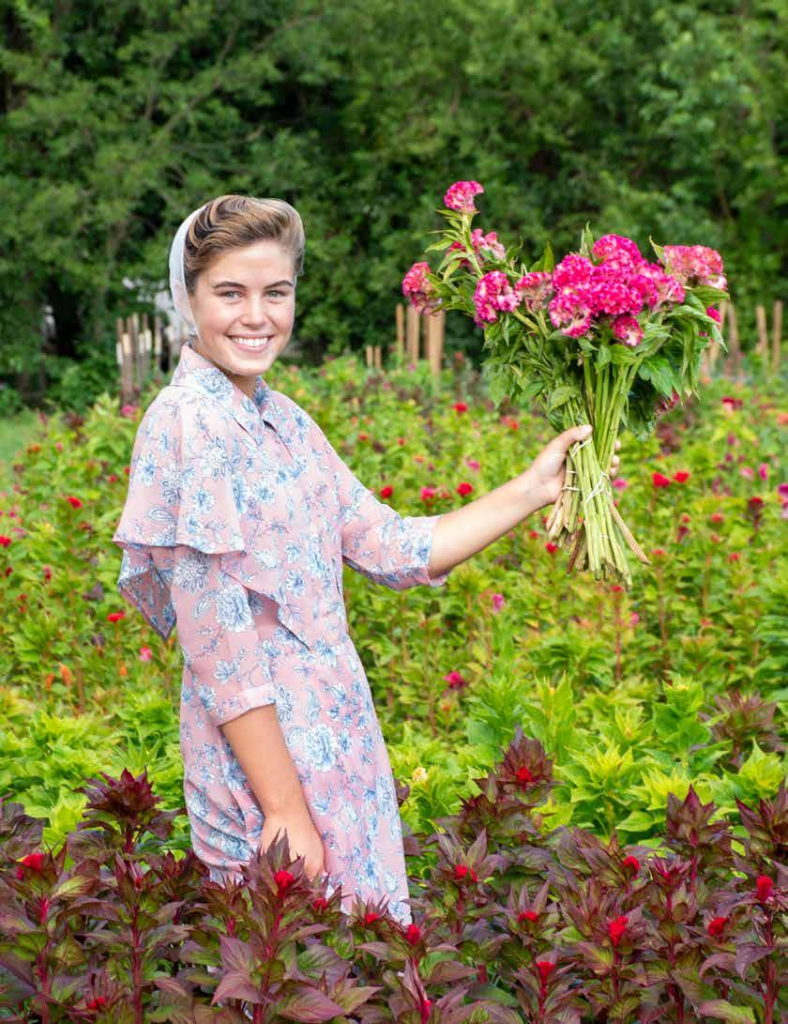
BY KAT BRAZ
PHOTOS PROVIDED
The historic Purdue Memorial Union, built in 1924 as a memorial to students who served in World War I, has stood faithfully while generations of Boilermakers, visitors and residents whirl by. The Union Club Hotel was added in 1929 and began as a small 60-room affair to meet the need for guest lodging. Even after several additions, the iconic landmarks look basically the same on the outside as they did 100 years ago. Here lies the rub, nay, the sweet surprise. What was old inside is now made new in every way, every excellent way, that it bears a revisiting.
The Union Club Hotel
at Purdue University is part of Marriott’s distinctive Autograph Collection. Only 200 independently owned boutique hotels in the world carry that distinction, which denotes being the best in upscale, luxurious accommodations. It is the first student-run hotel in Marriot’s Autograph Collection. Famed hotelier Bruce White, former Purdue trustee and founder and chairman of the industry-leading hotel company White Lodging, gifted $30 million to Purdue in 2018 to launch the modernization of the historic property, which reopened in 2020. His gift transformed the Union Club Hotel into a world-class destination, while also providing a learning laboratory environment with training and internships for Purdue hospitality students.
The décor in the guest rooms, lobby and restaurants in the redesigned hotel’s interior reflects the spirit of Purdue’s legacy of innovation and celebrated alumni. Classy, curated collections of Purdue memorabilia and symbolism, the black and gold color scheme, and historic books and photographs stimulate the senses, while the signature scent throughout adds another sensory layer to the experience. The beautiful furnishings and surroundings send welcoming messages to guests who unmistakably know they have arrived in Boilermaker Country.
Voted as 2024’s Travel and Leisure Magazine Top 500 Hotels in the World by readers’ ranking, the Union Club was the only university hotel that made the list. Only 200 winners came from the United States; it was the only one in Indiana on the list. The four-star hotel’s 182 rooms fill quickly during sports and commencement weekends. However, you can still enjoy the Union Club Hotel’s excellent restaurants and new spa facilities without an overnight stay.
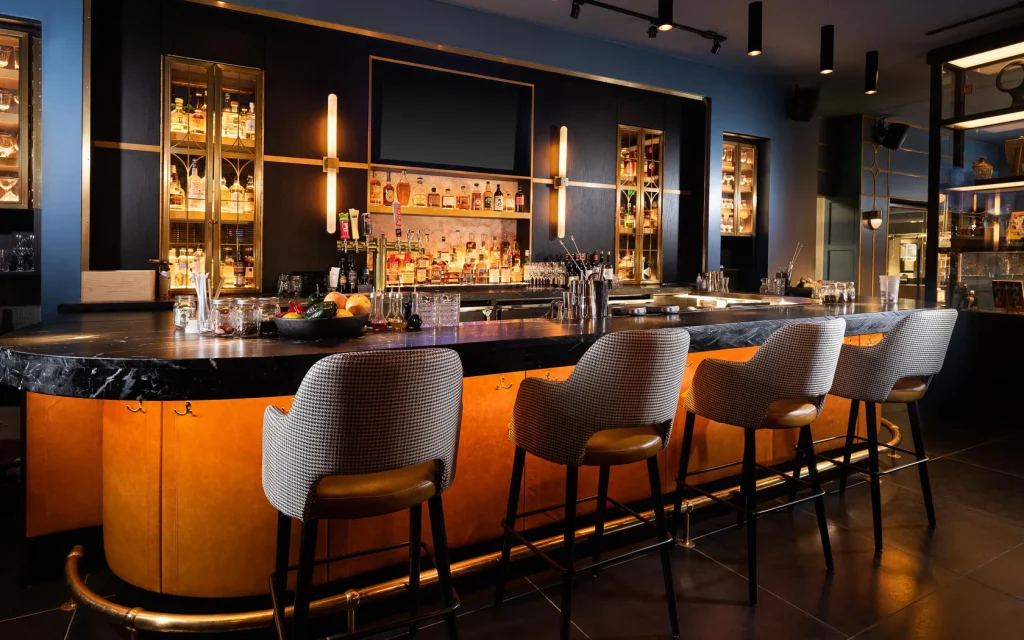

8Eleven Modern Bistro
A stellar tribute to space flight and its command pilot and Purdue alumnus Neil Armstrong, the 8Eleven was named after two of his NASA space missions, Gemini 8 and Apollo 11. Star-studded seasonal ingredients inspire the restaurant’s delicious American and French favorites. The drinks menu includes an impressive collection of premium and reserve list spirits, wines by the region, and seasonal cocktails. Enjoy breakfast, lunch, brunch, dinner or dessert for a memorable dining experience created by Executive Chef Jack Mahoney. 8Eleven is the ultimate dining destination for celebrating special occasions, to wow clients or job candidates or to indulge in dining and customer service excellence. Reservations recommended. For hours and reservations: 8elevenbistro.com
Boiler Up Bar
Treat yourself to Purdue’s most refined cocktail lounge. Boiler Up Bar honors treasured traditions and iconic alumni in a relaxing, sophisticated atmosphere. Enjoy a rotating selection of draft and local craft beers, small-batch bourbons and whiskeys or classic cocktails. The Signature Old Fashioned is a fan favorite. Nosh on tastefully prepared appetizers and drinks before or after the game or with friends after work. Open daily: 11 a.m.-12 a.m.
Leaps Coffee
Surpassing coffee chain establishments by leaps and bounds, Leaps Coffee is all about connecting with its customers through delicious coffees, teas, smoothies, made-in-house pastries and sweet treats. Talented baristas brew beautiful morning and afternoon respites every day in the Union Club Hotel. Enjoy Free Cookie Thursday with the purchase of a drink, or a half-priced pastry from 5-6 p.m. every day with a beverage purchase. Open daily: 7 a.m.-6 p.m. ★
Discover the hidden gems throughout the Union Club Hotel and Purdue Memorial Union. Bowling, e-sport gaming and restaurants abound. See the events calendar to attend cooking classes, concerts, films and much more. Purdue hospitality extends beyond the campus to touch all who visit its treasures. For more details visit: union.purdue.edu/events
BY CINDY GERLACH
PHOTOS BY CHRSTINE PETKOV
Every community has its landmarks, those businesses that define them. For West Lafayette, Bruno’s Pizza is one of those institutions. For nearly 70 years, the name Bruno’s has meant pizza, Bruno Dough, beer and Swiss favorites with a local twist.
But it’s more than a restaurant. Bruno’s is a sense of place. Bruno’s is, first and foremost, about family. It’s about community, about nostalgia. And Bruno’s wants everyone to share in that feeling.
The West Lafayette pizza place is an institution. Bruno Itin, Sr. opened the original Bruno’s Swiss Inn in 1955 at the corner of what is now State Street and North River Road. Expansion of that intersection back in the late ’90s forced the demolition of the original building, with a replacement opening across the way at Brown Street and Howard Avenue.
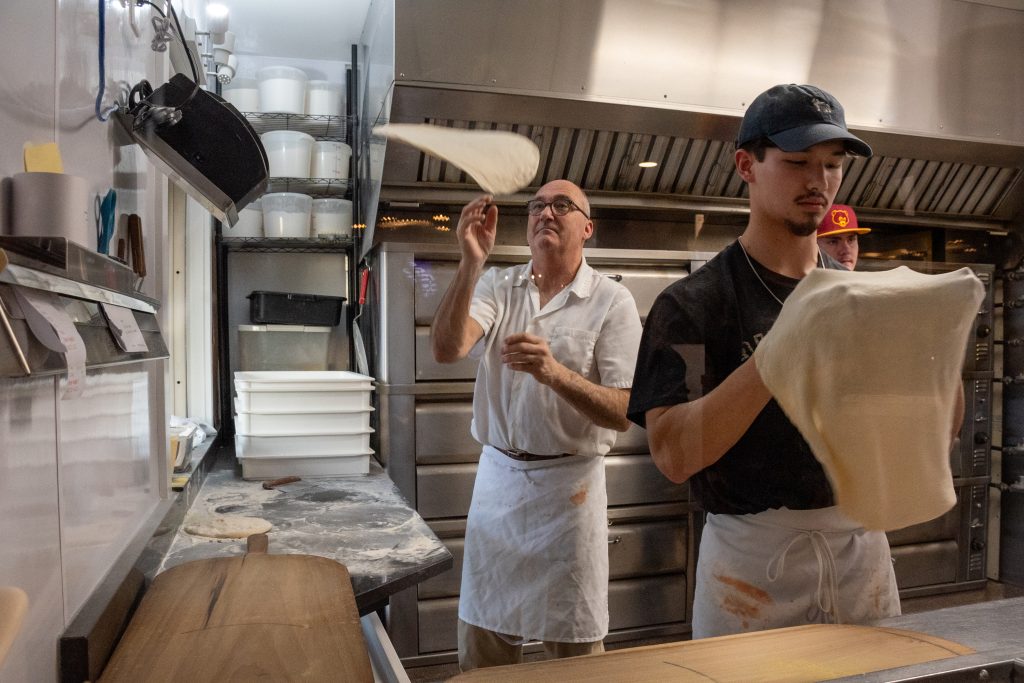
Now, with that space being ceded to plans by an Indianapolis developer, it’s moved on to yet a third iteration of the Swiss-inspired pizza chalet, this time at 2512 Covington St. in West Lafayette, next door to Brokerage Brewery.
And full restaurant operations have been handed down to a new generation of the Itin family, with Bruno Itin, Jr.’s daughters Holly Beattie, Krista Rodriguez and Angela McDonald taking the helm.
For the sisters, who grew up immersed in the atmosphere of Bruno’s, it’s the natural place for them to land. Because for the sisters, Bruno’s is all about a family legacy.
When Bruno’s closed its doors in February 2024, the sisters really thought that this second closing of the doors might be it.
“There was a real moment in time where it felt like a real possibility that Bruno’s might be done,” Beattie says. “It still gives me chills even thinking about that. Because I remember those feelings and that last day of working and thinking this is the last pizza that we’re going to make.
“Change is hard. Those last weeks at 212 [Brown St.] were really difficult. We knew what was happening and there were tears. You could just feel a sense of sadness. And I think that moving into this transition, there was always this feeling of, how can we ever recreate that? And in some ways, you can’t. There are just some things in life that cannot be recreated. But they can be honored.”
“We never gave up hope, though,” Rodriguez chimes in.
The family was open to a new location. But so many pieces had to fall into place to find something suitable. They were alerted to the possibility on Covington Street, but it took some time for the deal to come together.
“We had been looking for a place,” Beattie recalls. “But the right thing had not come up. And it seemed like every road wasn’t the right road. And the last thing we wanted to do was get into something … you can’t force these things. We closed on a Wednesday, and on Friday got the call.
“The space had possibilities. We could add a pizza kitchen. There were weeks of ‘Can it fit? Can we get our pizza oven in there? Can we make it functional?’ And we did.”
“We wanted to find something that would be a good fit for Bruno’s,” Rodriguez says. “There are certainly a lot of options around town. But we really wanted the neighborhood feel. Something unique, something a little bit different, personal, something that would be easily accessible for the community, with parking. Proximity to where people live and work. So, we’re really excited about being here.”
It’s been fun, they say, recreating a beloved eatery in a new location. There are, naturally, challenges. They brought over as much from the old place as possible – tables and chairs, light fixtures, memorabilia, stained glass — even the pizza ovens. But as anyone who has ever moved can attest, not everything fit just right, so there have been adjustments.

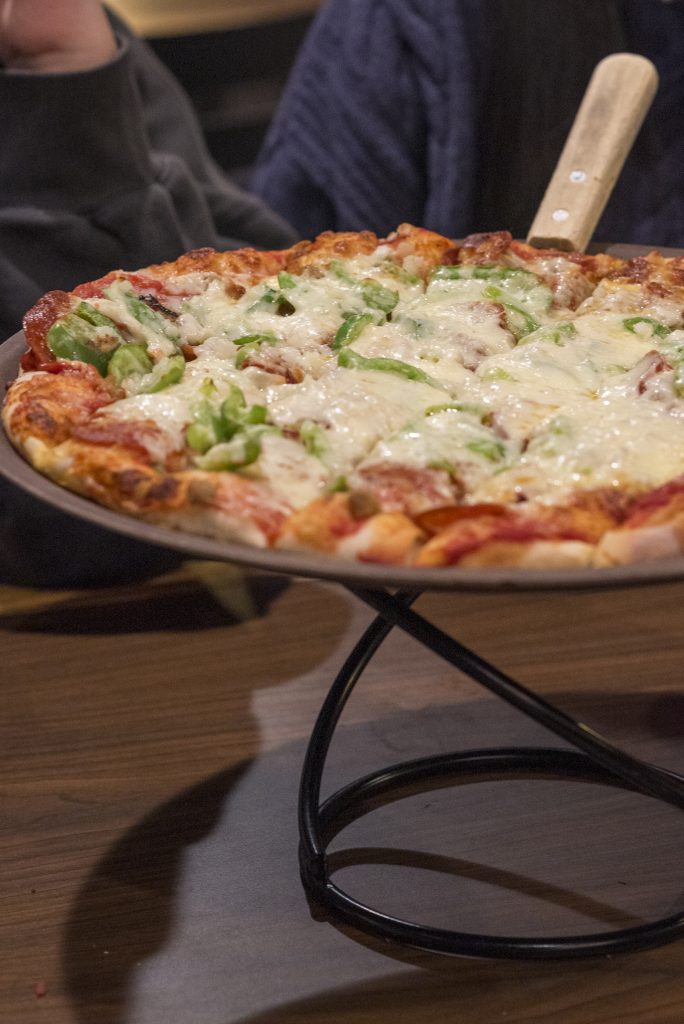
One of the biggest challenges is the dining room. The former dining room seated 275 people; the current one now seats only about 50. Only a portion of Bruno’s famed sports memorabilia collection is on display.
“The size is the biggest difference,” Beattie says. “A lot of people in the community could come to Bruno’s and there was always a table. There was this welcoming feeling of ‘bring the team, bring the family, there’s room for everyone.’ And we still have that, just on a smaller scale.”
They have worked to come up with creative solutions. The foyer is not large enough to accommodate dozens of people waiting to pick up a pizza. The answer? Send them next door to sit at Brokerage Brewery and have a beer while they wait; a text message lets them know when the pizza is ready. Or they can get their pizza to go and eat it at Brokerage.
“So many people say they can walk up or maybe they live close by and they’ll order a pizza for carry-out and go next door and enjoy a beverage while they wait for it,” Rodriguez says. “It’s been so much fun to see people enjoying themselves.”
It’s been a fun collaboration, they say, establishing a partnership with Brokerage. The two local, family-owned businesses blend well together. And Brokerage has even crafted a Bruno’s Swiss lager.
“It was released on our opening day,” Rodriguez says. “We also serve it on draft. Switzerland is near and dear to our heart and our history. It’s kind of fun to see that merge together.”
And Bruno’s responded in kind, adding a Brokerage pizza to its menu, featuring pulled pork, red onions and a beer cheese drizzle.
“It has gone over really well,” Rodriguez says. “It’s just one other nice way that we complement each other.”
The Itin sisters feel as if they’re home again. With the support of their dad and familiar employees, they can look out at the restaurant on any given night, regular customers at the tables, and feel comfortable with the transition.
“We’ve been so fortunate to have employees return that worked with our grandfather at the original location,” Rodriguez says. “So, they’ve been with Bruno’s over 40 years. And many others, 20-plus years. It was incredible, on opening night, to look around and see all these employees who’ve been around, who really we grew up with. They’ve been around our whole life. It really does feel like a team.”

Management has passed to the younger group. And they could not be happier — even if working at the family restaurant was not always in their plans.
“When my own children were little, I left and did some different things, but there was always a part of me that had hoped to be in this position someday,” Rodriguez says.
McDonald adds, “I tried to find something else, but I just kept coming back.”
Recreating the magic of Bruno’s has brought the sisters great satisfaction. Running a restaurant is hard work — that’s undeniable, they say. But the rewards make it worthwhile. Seeing happy families — generation upon generation — enjoying themselves in a new place that still feels familiar brings them joy.
“I enjoy what I do and it’s great to be able to do it with family,” Rodriguez says. “And to get back to seeing all our regular customers that we’ve missed while we were closed.”
The feedback from customers has made it clear, too, that this new version of the restaurant is wanted. And they’re pleased to be able to bring it back to life.
“It’s always been such a special place, not just for our family but for our customers and the community,” Beattie says. “And that’s one of my favorite things, hearing from customers, whether it’s their first date or an anniversary dinner or a birthday celebration, even end-of-life celebrations, that people choose to spend their time at Bruno’s. It just makes it so special.
“It makes it feel like it’s not work. It’s just something we really enjoy.” ★
BY AMY LONG
PHOTOS BY CHRISTINE PETKOV
As a Purdue University student in the 1950s, Avrum Gray was so busy with mechanical engineering classes that he had very little time for the arts and humanities.
“I think I must have had two, maybe three, liberal arts courses in four years,” says Gray, who graduated with an ME degree in 1956. “You were immersed in engineering. That’s the way it was.”
Today, nearly seven decades after his graduation from Purdue, a high-profile gift from Gray to the university’s College of Liberal Arts – a collection of 74 bronze sculptures by the French impressionist Edgar Degas – has the potential to change the way students across colleges, disciplines and majors engage with the arts on campus.

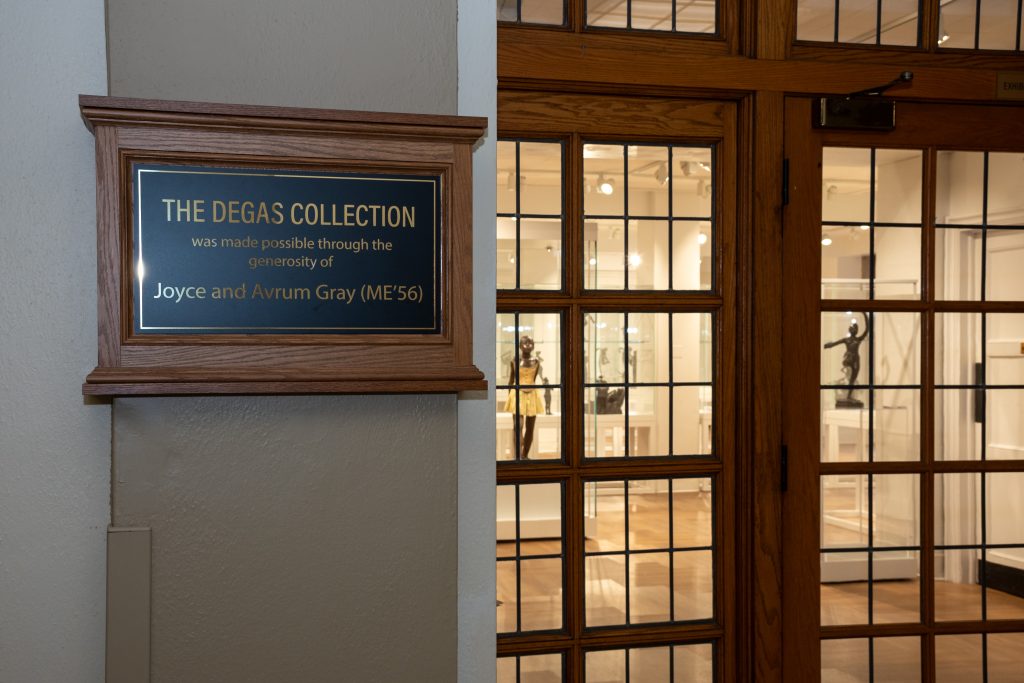
The gift, which was announced by Purdue in February 2023, is valued at more than $21 million, with a market value of as much as $52 million and represents the largest gift in the history of the College of Liberal Arts. It immediately elevated the profile of Purdue Galleries, which is now one of the world’s premiere repositories of Degas’ artwork.
The collection – which includes “La Petite Danseuse de Quatorze Ans (Little Dancer, Aged Fourteen),” one of the artist’s most iconic works – went on view to the public in September in a new, specially designed gallery in the Purdue Memorial Union. The opening was accompanied by much fanfare and even international publicity, as it is believed to be the only complete collection of Degas sculptures currently on display anywhere in the world.
“This would be a significant contribution to most museums or collections. And for us, it’s a game-changer,” said Arne Flaten, head of Purdue’s Patti and Rusty Rueff School of Design, Art, and Performance and professor of art history, in September, when the exhibition opened. That it has been given to Purdue University – an institution known for its STEM programs, and the only Big Ten institution without an art museum – is particularly notable.
“Art at Purdue will thrive as an essential dimension of a leading institution of higher learning,” Purdue President Mung Chiang said in a statement. “The visionary generosity from Av Gray brings the largest collection of Degas sculptures to our campus, and we are truly excited about the transformational impact to the creation of beauty by Boilermakers.”
Edgar Degas, 1834-1917
A French impressionist artist active in the late 19th century, Degas is renowned for his depictions of modern urban life – including ballet classes, dance performances and horse races. Though he is known primarily for his pastel drawings and oil paintings, Degas also created 150 small wax, clay and plaster sculptures – representations of dancers and horses and studies of the human body – that were discovered in his studio after his death in 1917. In Degas’ lifetime, only the sculpture called “Little Dancer” was ever displayed. The rest of the figures were working models that, like some artists’ rough sketches, were never intended to be viewed by
the public.
“Scholars think that he was making this set of sculptures to inform his two-dimensional work,” says Erika Kvam, Purdue Galleries director and head curator. In forming the sculptures, the artist could study movement or musculature before he ever put his brush to canvas, and by posing them he could observe the play of light and shadow over the lines and curves.
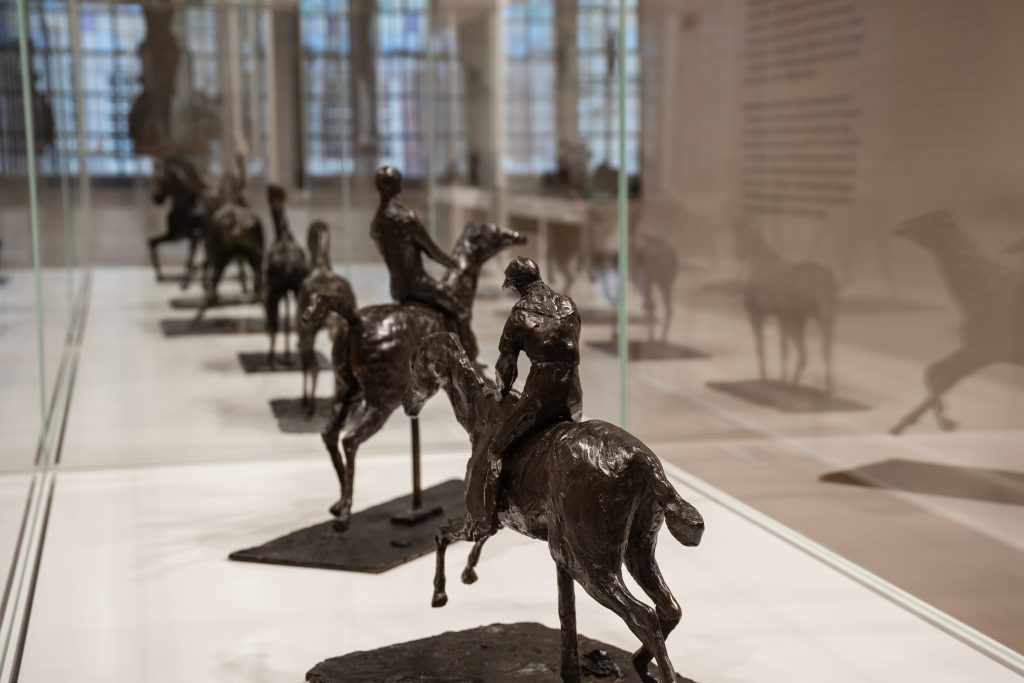
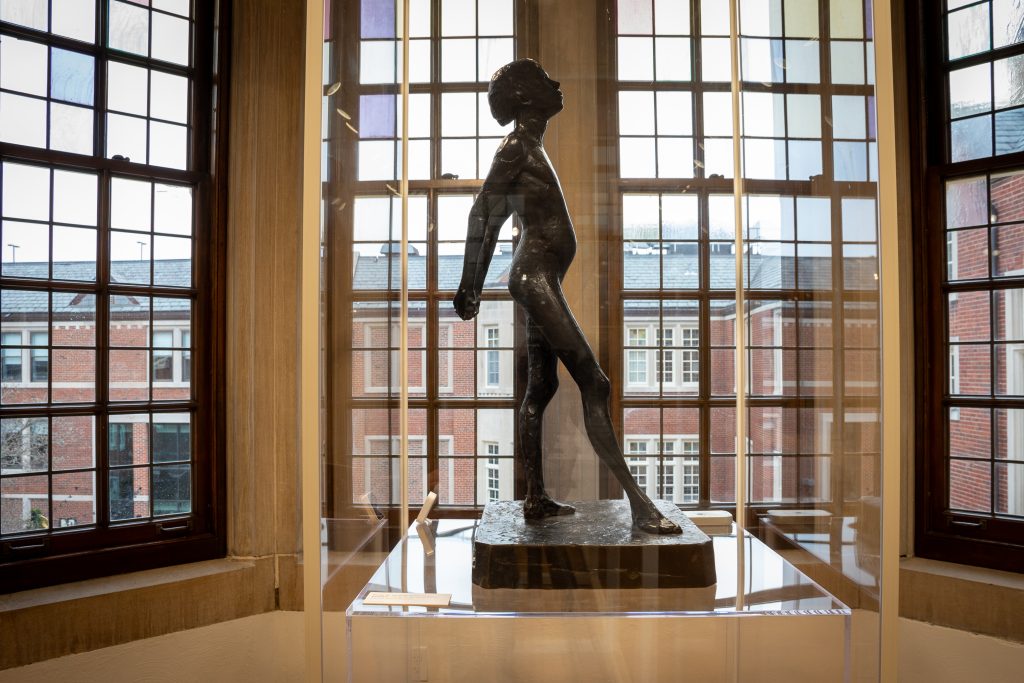
After his death, Degas’ heirs elected to commission bronzes of 74 of these sculptures – choosing the figures that were most complete or most representative of his work. Starting in 1919, a limited edition of 22 sets were cast by the Hébrard Foundry in Paris. One of those sets is now in the collection of the Metropolitan Museum in New York.
Decades later, in the 1990s, the plaster casts for the sculptures were rediscovered, and 29 more sets were produced by the Valsuani Foundry in France, and it is one of these sets that was eventually purchased by the collector Avrum Gray.
‘I got the bug’
After graduating from Purdue in 1956, Gray served as a second lieutenant in the United States Army before returning home to Glencoe, Illinois, to begin a job in automotive manufacturing – a career that lasted 25 years. A second career as an executive in money management and venture capitalism lasted another 25 years.
“I was sort of a workaholic,” Gray says.
Through the years, Gray maintained a relationship with his alma mater. In 2006, Gray and his wife established the Avrum and Joyce Gray Directorship in Purdue’s Burton D. Morgan Center for Entrepreneurship. In 2019, Gray was honored with Purdue’s Outstanding Mechanical Engineer Award.
Gray began building his art collection not long after his graduation from Purdue, as a young professional.
“I got the bug and was able to act on it,” says Gray, who had an eye for impressionist and early modern artwork, including works by Picasso, Monet and Kandinsky. “What I could afford were works on paper, so I found ones I liked, and I bought them.”
About 15 years ago, Gray purchased a complete set of Degas bronze sculptures through an art dealer. He displayed a few pieces, including “Little Dancer,” in his home, and kept the rest in storage.
“I mean, where do you put 74 pieces?” Gray chuckles. “Believe me, my house wasn’t big enough.”
Now, at age 89, Gray is taking care to ensure that his art collection will be cared for and accessible to future generations. He chose Purdue as the beneficiary of the Degas sculptures because he felt confident that they would have more impact on campus than at a renowned art museum.
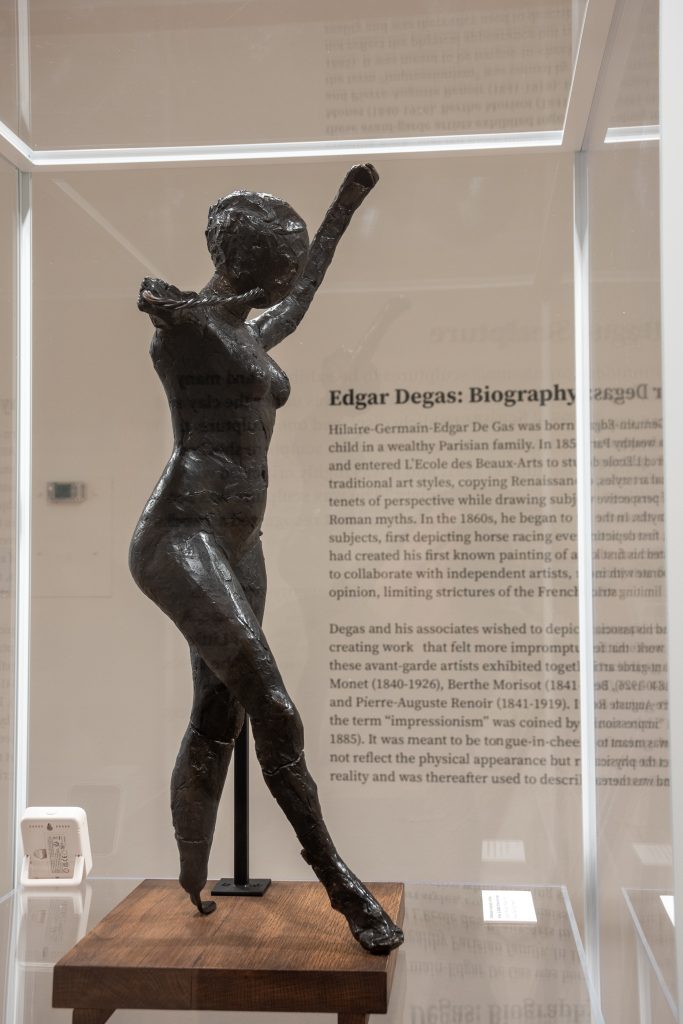
“One of the difficulties with many of the museums – including the Art Institute [of Chicago], which I’m familiar with – is they have so much art, but they only have so many walls,” Gray says. “And in their sub-sub-basements, or wherever they keep their extra stuff, they’ve got enough art to fill up two or three institutions.
“I wanted the art to be seen,” Gray continues. “To me, art should be enjoyed by people. And to have it go to some place that’ll put it in the basement and take it out every five years or something – that just didn’t feel right to me.”
Discussions with Purdue officials about the gift began in earnest in 2021. As the two parties worked to finalize the arrangement, Gray made it clear that he wanted to keep the collection intact, and that he would love to see the sculptures displayed together. Although in policy and practice, museums and other institutions do not usually accept gifts with conditions, university administrators and faculty members involved in the talks took his wishes into consideration.
“Av said, ‘I would really love to see this collection all together, all at once, even just for a week, even just for a day. That’s really important to me,’ ” Kvam recalls. At his home, “he had never been able to get it all out, to have it on display for a length of time. So that was kind of the guiding principle.”
An earthquake during the eclipse during the blue moon
From the beginning, Kvam says, Purdue administrators were on board, offering resources and support as Purdue Galleries prepared to receive and display the collection.
“We could not have been more supported by both the college and the President’s office,” Kvam says.
Without a dedicated art museum, Purdue had no existing gallery space ready to display the Degas collection. Various campus locations were considered for the exhibition, but, according to Kvam, Purdue President Chiang insisted that they use a space on the second floor of the Purdue Memorial Union – arguably the most visible and accessible building on campus.
“Essentially he said, ‘No, we’re not going to put this in some random building on campus. I want this in the Union. You can have the Sagamore Room,’ ” she recalls.
Kvam describes the opportunity to transform what was once a dark, wood-paneled faculty dining room into a light-filled showcase for celebrated artwork as a once-in-a-lifetime opportunity.
“This sort of planning is not something that happens in one’s museum career. This is something like an earthquake happening during an eclipse during the blue moon, to be able to design the space around a collection of this caliber,” says Kvam, who, along with assistant professor of interior design Laura Bittner, was given “an incredibly healthy budget” to dream up a gallery space, from the tiles on the floor to the overhead lighting. “There was no road map. There was no person I could call and say, ‘Can you tell me how you did this?’ because it’s just not something that happens all that often.”
The Degas exhibition opened to the public on Sept. 18 in Room 231 of the Purdue Memorial Union, with the iconic “Little Dancer,” standing 39 inches high and wearing a sleeveless bodice and cloth tutu, prominently displayed near the entrance. The other sculptures – representing different themes found in Degas’ work, including dancers, bathers and horses – are arrayed in custom-designed cases at various heights throughout the gallery, so that they can be visible at once from a single vantage point.
Closer inspection reveals scratches from the artist’s tools, pinch marks from his fingers, and the wire armature undergirding the figures and makes it clear that Degas’ original sculptures were all in different stages of completion. Three sculptures arranged in the same display case, for instance, show dancers in identical poses: limbs stretched, muscles taught. But while one sculpture is very rough and almost rudimentary, the second and third are subsequently more polished, with details more finely rendered, as if the artist was practicing, reworking and refining his process with each attempt.
“This is, to our knowledge, the only display of all 74 of his sculptures all together in a single gallery. And that is extraordinary in and of itself,” Kvam says. “But I think that the fact that it is so accessible to our visitors – it’s in the PMU, right upstairs from the atrium and the big map – tells them how much importance is placed on this collection.”
“You can go to the Guggenheim and there will be a handful of these kinds of things on display, and you can go to other places for a few of them, but you really don’t ever get to see all of them anywhere. And this is the only complete collection of them in the Western Hemisphere,” Flaten says. “So, this was a really sort of exciting opportunity for a place like Purdue University to really double down on doing it right.”
‘Leaps and bounds’
Indeed, the exhibition has attracted a lot of attention to the university and helps to put Purdue on the map not just as an excellent engineering and STEM-based school, but also as a destination for arts and culture.
“A lot of people come here thinking about Neil Armstrong and Amelia Earhart, and now there are other reasons to think about Purdue,” Flaten says.
In November, Kate Saragosa traveled from Melrose, Mass., to West Lafayette for Fall Family Weekend. Her son, Adam, enrolled as a freshman earlier in the fall and plans to major in statistics. The weekend’s busy schedule included a football game, campus tours and dinners out, but Saragosa made sure also to fit in a visit to the Degas exhibition, which she learned about in a “Purdue News Weekly” newsletter.
“I was very excited, because I’ve always been a huge Degas fan,” says Saragosa, who then posted about the exhibition on social media. “I was excited to tell friends that Purdue has this Degas exhibit. It definitely is a special, unique addition that they’re very lucky to have. It’s something to add to the pride of Purdue.”
Flaten emphasizes that the exhibition is not the end-all, but rather a step in the right direction. The Degas collection, while exciting and ground-breaking on its own, also helps to boost awareness and increase visibility of Purdue’s other arts and culture programs and offerings.
“Purdue has been playing catch-up in the arts, and I don’t think that Purdue’s mission should ever be to sacrifice one for the other,” Flaten says. “Purdue is big enough and strong enough and so well known that you don’t have to give up on one to be excellent in the other. And that’s sort of where we’re moving right now – to be excellent in all these areas.”
Abby Zickmund, a 2023 Purdue graduate in visual communication design, visited the Degas exhibition in November. To her, the collection represents a shift in priorities at Purdue.
“Purdue dominates the world of STEM in many areas. As an art student, or any student not in STEM, it was easy to feel left behind,” Zickmund says. “The Degas Collection on display puts the studio arts and technology program and the College of Liberal Arts on display. The hard efforts and brilliant teachers in the college will not easily be forgotten after this successful collection and gallery opening.”
Some are hopeful that the Degas acquisition takes the university one step closer to realizing the dream of a university art museum.
“The Degas collection helps us move in that direction,” Flaten says. “In and of itself, it’s terrific as it is. But the implications of where it could lead us down the road, if we’re patient and we’re focused, could be really exciting.”
“Basically, this collection deserves to be in a museum,” Kvam says. “I think that it has put Purdue Galleries and our permanent collection on the radar of more people than we have ever been on before. Therefore, we are leaps and bounds closer to possibly having a museum than we have been before. I am hopeful that enough people are recognizing that, firstly, Purdue is the only Big Ten institution without a museum, and secondly, that this is actually a possibility for us. Hopefully we will be considered when the next building is being planned or strategic plan is being drawn up.”
For the time being, though, any talk about a Purdue University art museum is merely hope and speculation. And any realization of that dream would be years in the future. In the meantime, the Degas exhibition will be on view in the Purdue Memorial Union through at least the end of the year. Although Purdue Galleries’ lease on the space expires in December, Kvam says she is “cautiously optimistic” that funding will come through to keep the exhibition there indefinitely. If not, she says, she is considering options for relocating the collection.
“It’s such a beautiful space and so much time and money and energy was put into making that happen. It would be hard for me to imagine that that’s going away anytime soon,” Flaten says.
‘You still have to fail’

The fact that the Degas collection does not have a permanent home on campus does not mean that it doesn’t belong at Purdue, Kvam stresses. As the recipient of a renowned collection of Degas sculpture, the university was an unconventional choice. At the same time, it’s a very natural fit, she says.
“It is surprising that it is here, but it is quite obviously beneficial to this particular campus. I think that it may have had an impact at someplace like the art institute or the Met. But because it’s so unexpected here, it actually has a greater impact in the lives of our campus and our community.”
Flaten suggests that there are many different ways that students can engage with the artwork within their majors. Kinesiology majors can study the musculature and movement of the dancers. Chemistry students can analyze the make-up of the bronze medium. Computer science students can practice 3D modeling of the figures. “Hopefully there will be an opportunity to start slowly, bringing in other parts of the campus to collaborate on different ways that these can be used and studied and catalogued,” he says.
If nothing else, the collection can inspire all scholars to think like artists, Kvam says. The exhibition reveals just how much study and effort and practice and failure go into the act of creation.
“A lot of people just kind of assume that artwork is either there, or it’s not; you are either an artist, or you’re not; you’re creative, or you just don’t have that. And the fact of the matter is that even if you are a world-renowned artist, you still have to practice and practice and practice. And you still have to fail. And you still have to figure out why you failed. And you still have to go through and learn.”
And, in the words of the donor, Avrum Gray: “You’ve got to broaden your education. For Purdue students to see a different side of the world by seeing art – I think it’s the right thing.” ★
BY BRAD OPPENHEIM
PHOTOS BY CHRISTINE PETKOV
After several years in the making, the cities of Lafayette and West Lafayette are jointly celebrating an addition to Greater Lafayette’s expansive trail network.
As part of the Wabash River Enhancement Corp.’s (WREC) ongoing commitment in promoting outdoor recreation and conservation in Greater Lafayette, the Lafayette portion of the Sagamore Parkway Trail, linking to the newly built West Lafayette portion, officially opened in October 2024. The new trail offers users multimodal connections to and from parks, neighborhoods, existing trail networks and business and retail destinations.
Planning for the trail, which spans 1.5 miles between the two cities, began in 2016 following the replacement of the Sagamore Parkway eastbound bridge over the Wabash River. The new bridge added a protected sidewalk for pedestrians to safely cross.
Stretching 0.9 miles in Lafayette and 0.6 miles in West Lafayette, the trail has connections to additional paths in both cities. It’s designed for hiking, biking and nature walks, and some of its amenities include scenic overlooks, wildlife viewing areas, rest areas and accessibility to individuals of all abilities. It not only offers a space for physical activity and relaxation, but also serves as a vital connector to the Wabash River, encouraging an appreciation for the natural environment that surrounds it.
“The trail’s prominent location has also increased public awareness, reinforcing our commitment to expanding and improving our trail system,” says Myles Holtsclaw, senior community development manager at the City of Lafayette’s Economic Development Department.
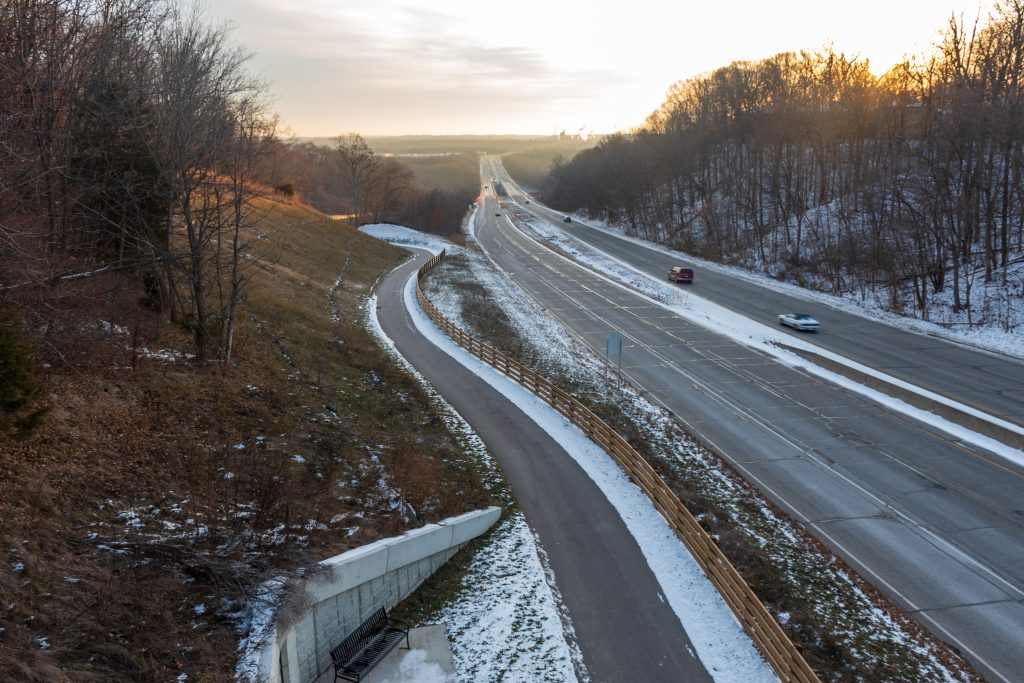

As for funding, West Lafayette City Engineer Natalia Bartos says the West Lafayette portion cost roughly $6 million, of which 20% was funded by West Lafayette’s Redevelopment Commission and 80% was funded by the Indiana Department of Transportation. On the Lafayette side, officials used a $2.7 million grant from Indiana’s Next Level Trails program to help build the trail. Administered by the Indiana Department of Natural Resources, the $180 million program is the largest infusion of trails funding in state history.
“The Sagamore Parkway Trail is a game changer for the Greater Lafayette trail network,” Holtsclaw says. “Before its completion, there was no continuous loop connecting Lafayette and West Lafayette. Cyclists could use the John T. Myers Pedestrian Bridge for a safe, bike-friendly crossing but had to either turn back or use one of the less bike-friendly bridges designed for vehicular traffic. The Sagamore Parkway Trail now resolves this problem by offering cyclists the option to cross the river at either the pedestrian bridge or the Sagamore Parkway Trail, seamlessly connecting to existing trail networks.”
As far as feedback from the Greater Lafayette community, it’s been overwhelmingly positive.
“Its strategic location has generated significant attention, and there was a great deal of excitement leading up to its completion,” he says. “Since the trail only officially opened at the end of October, there hasn’t been much time for people to fully experience it yet. However, we’re hopeful that by next spring we will see a surge in activity along this trail and the connecting routes.”
Bartos says, “Our (West Lafayette) engineering department has received positive feedback. Users appreciate the scenery and cycling opportunities.”
According to West Lafayette officials, a parking lot will be constructed at nearly the halfway point of the trail, as part of the WREC – READI 1.0 Wabash River Greenway Project. Individuals will be able to access the start of the West Lafayette portion near the Goodwill store on Sagamore Parkway W, and a halfway point via road access off the Sagamore Parkway westbound ramp.
Michelle Brantley, director of communications for the City of West Lafayette, says the trail will be open 24/7, but individuals should always keep safety in mind. In 2025, there are plans to install solar lighting along the West Lafayette portion of the trail, improving visibility and safety for trail-goers in low-lit areas. These lights will be installed on the tops of existing fence posts along the trail.
As for future expansions, according to DNR, these projects are the first of multiple-funded trail projects, expected to create an eight-mile looped section of the Wabash River Greenway connecting the communities, county and Purdue University to each other; Prophetstown State Park, and seven local, municipal and county parks.
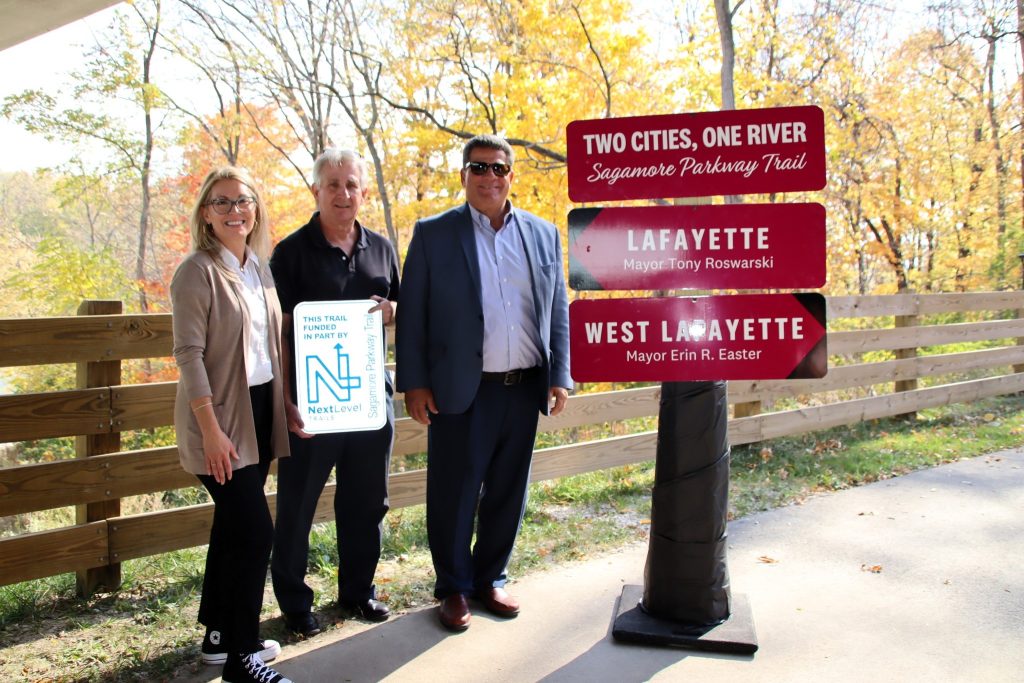
Officials on the West Lafayette side say there are plans to connect the trail to Soldiers Home Road with construction beginning as early as 2028.
“West Lafayette’s trail system has approximately 37 miles of paved trails and 15 miles of footpaths, and we’re always expanding,” says West Lafayette Parks and Recreation Superintendent Kathy Lozano.
If you have yet to experience Greater Lafayette’s vast trail system, officials on both side of the river encourage you to take advantage of what the community has to offer.
“The Greater Lafayette trail system is an excellent resource for both cyclists and pedestrians,” Holtsclaw says. “If you haven’t yet explored the trails, now is the perfect time to start.”
“West Lafayette offers an extensive trail network that provides numerous benefits for residents and visitors alike,” Brantley says. “Engaging with these trails can enhance physical health, mental well-being and connection to the community. To get started, I encourage residents and visitors to plan their visit by identifying a nearby trail that aligns with their interests and fitness level. Many trails have multiple access points and varying lengths to accommodate different preferences.”
Brantley also encourages individuals to join group activities such as organized walks, runs or biking events, making the experience more enjoyable and opening the opportunity to make connections with others who enjoy utilizing the trails.
Holtsclaw says with the right preparation, winter can be one of the best times to explore the trail systems, but he wants users to be mindful and follow proper trail etiquette to maintain a safe and enjoyable experience.
“Always stay on the right side of the trail, except when passing other users, he reminds. “Before overtaking someone, make sure to communicate your intentions by calling out or ringing a bell. Be mindful to yield to slower trail users and uphill traffic. And remember the simple rule: “Wheels Yield to Heels” — cyclists should always give priority to pedestrians and other non-wheel users on the trail.” ★
An interactive look at the entire trail network throughout Greater Lafayette may be found here.

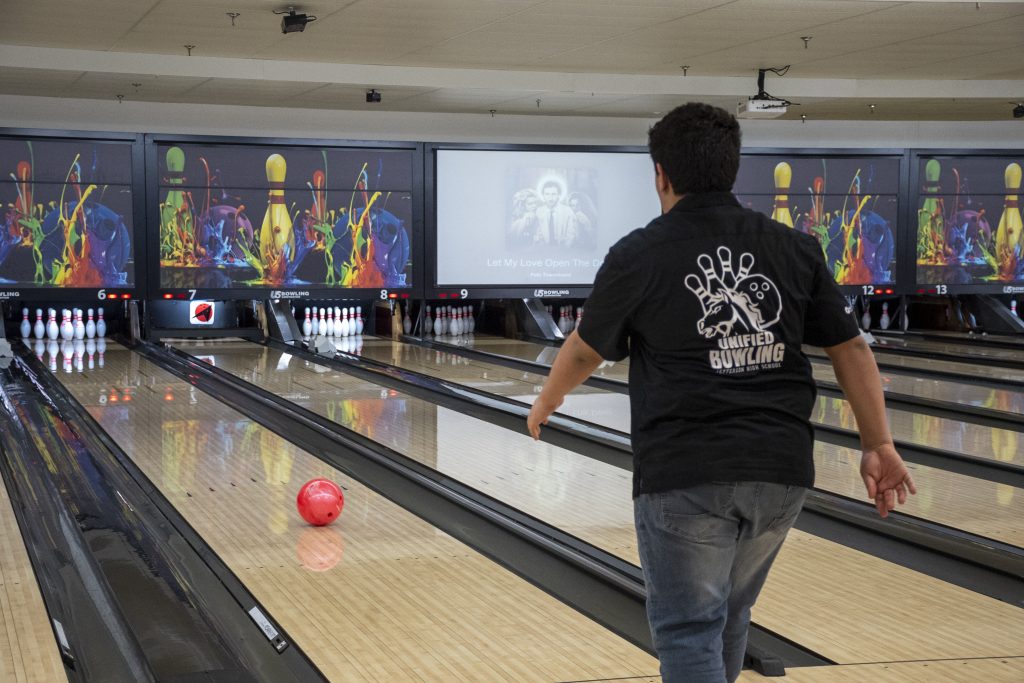


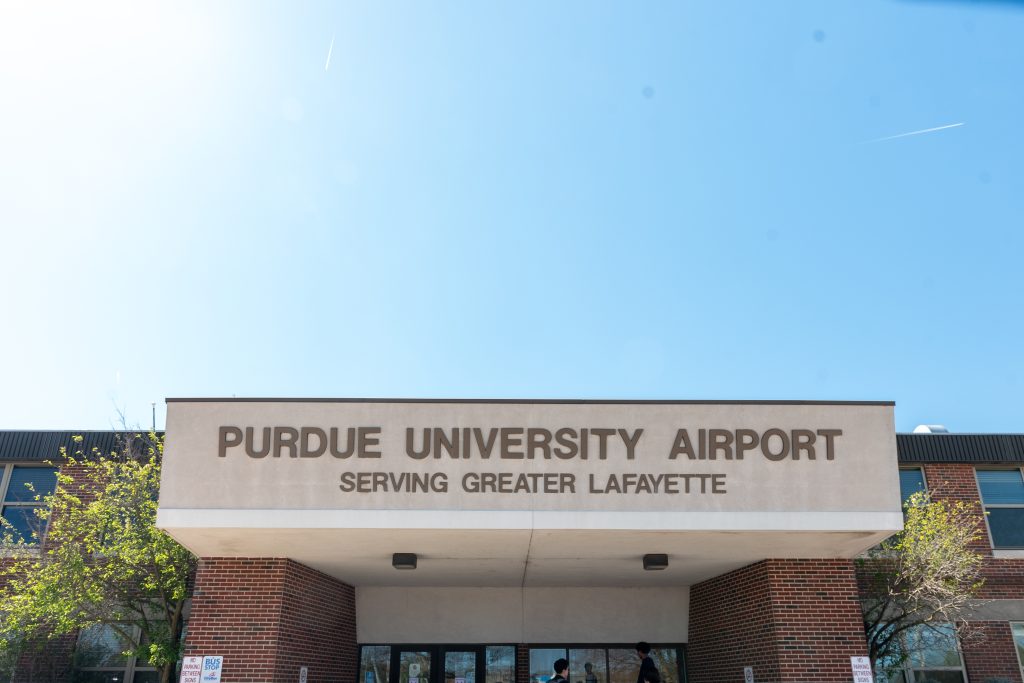


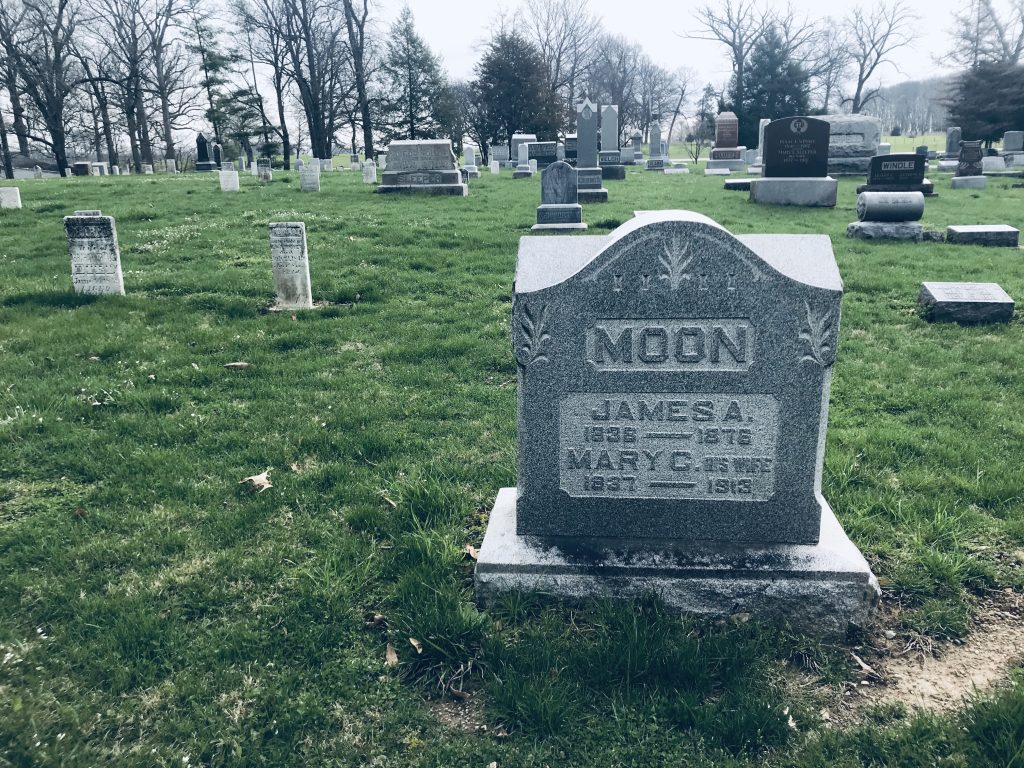
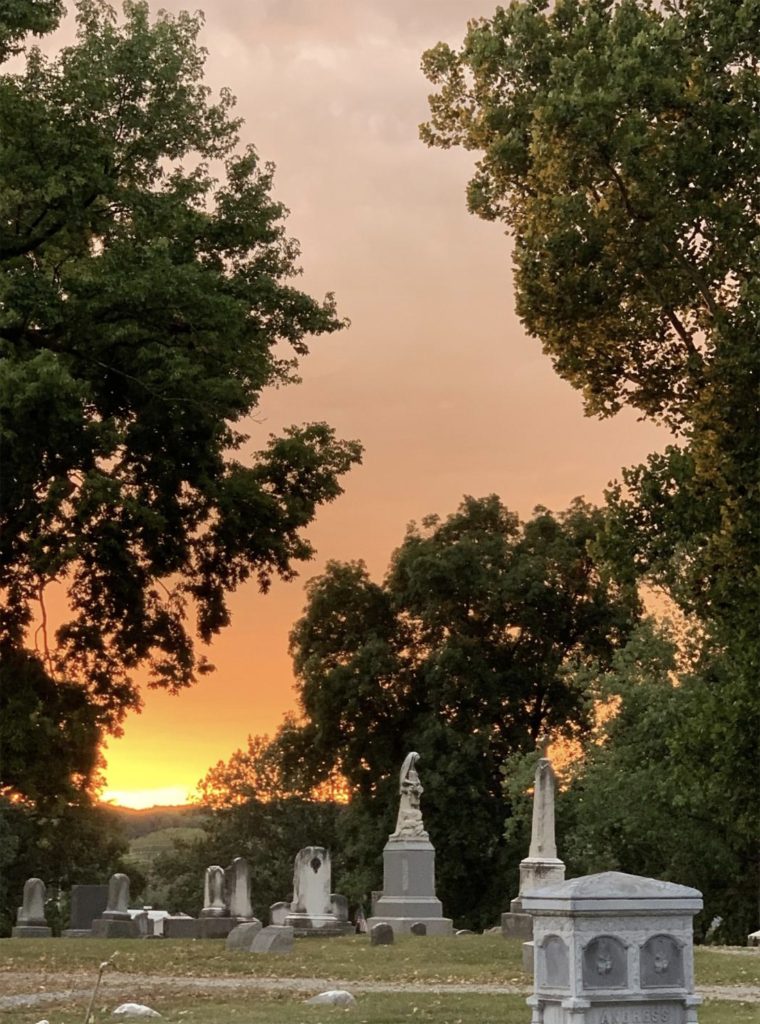
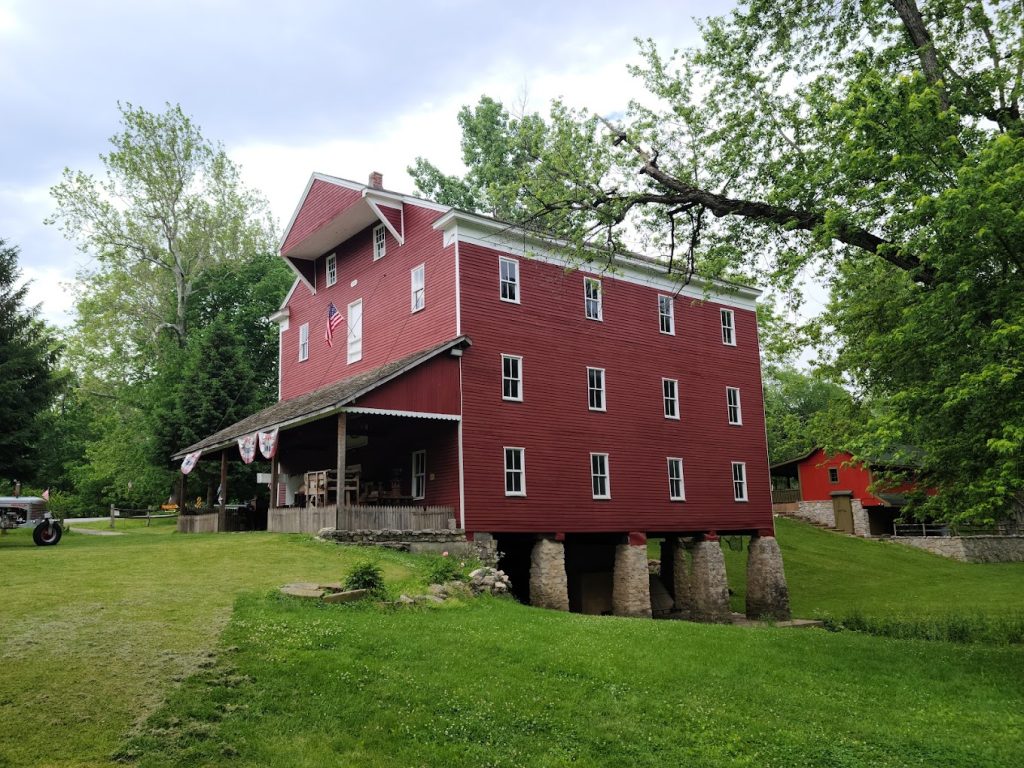
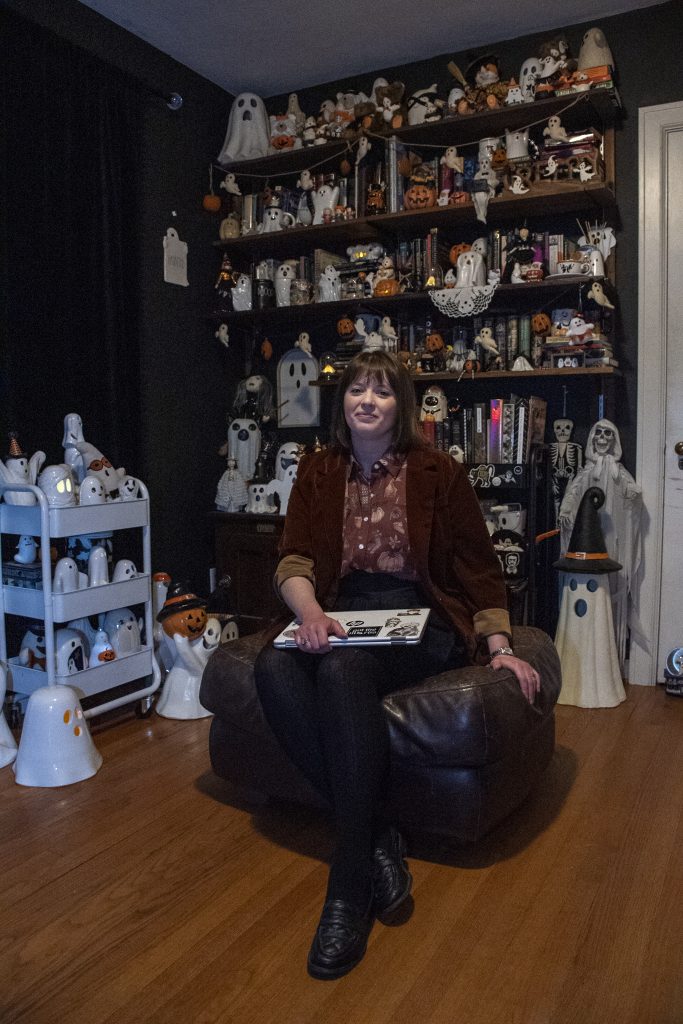










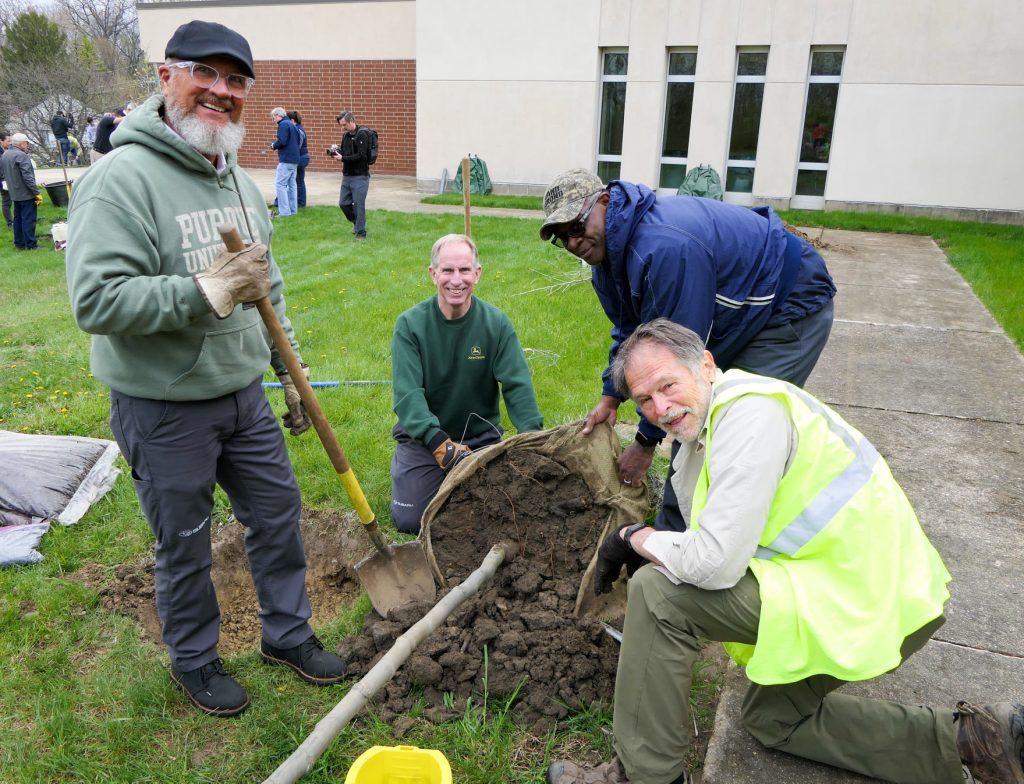

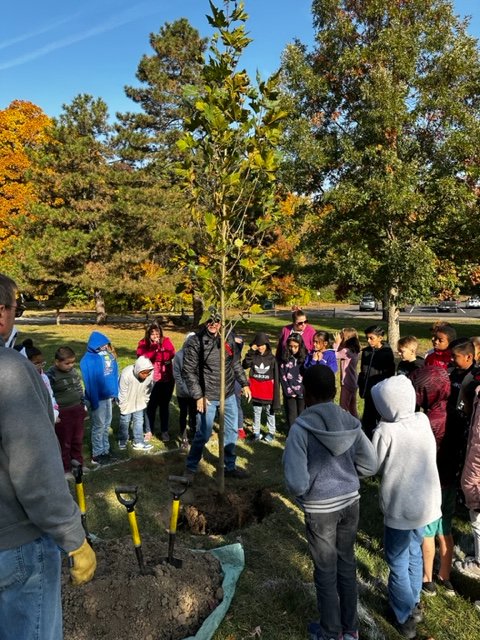
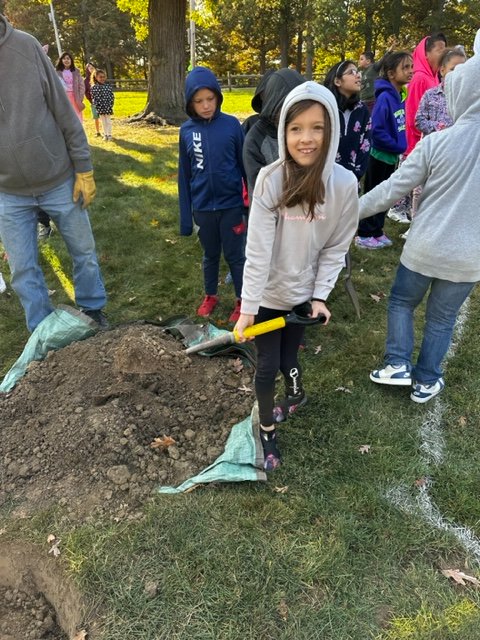
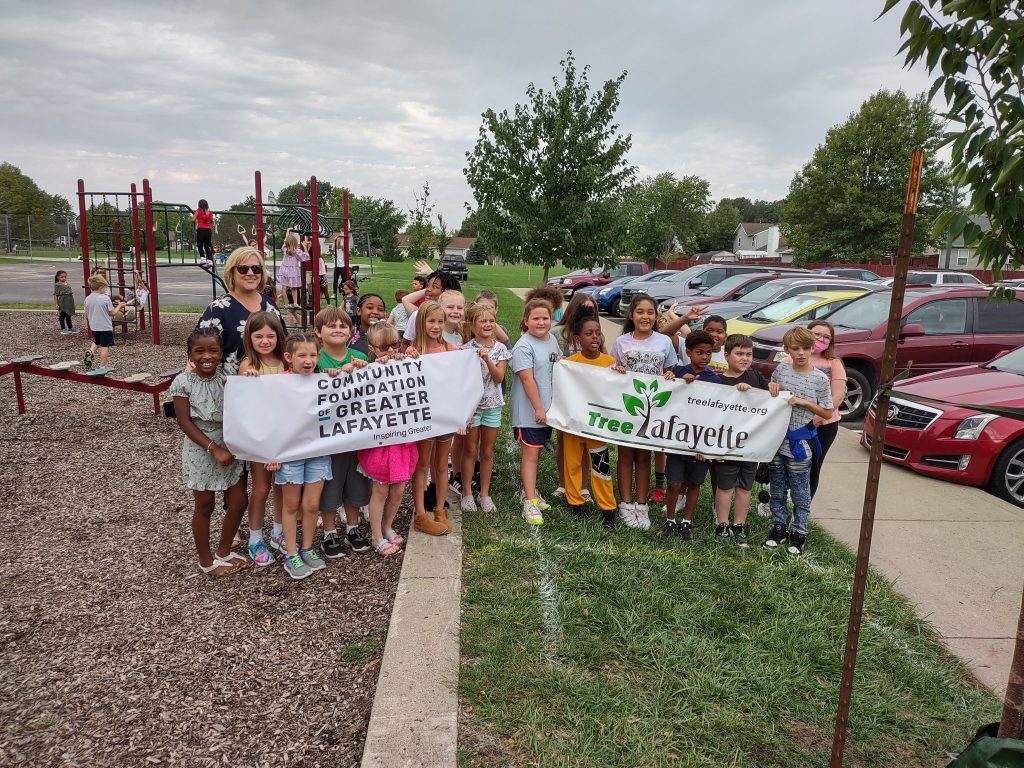


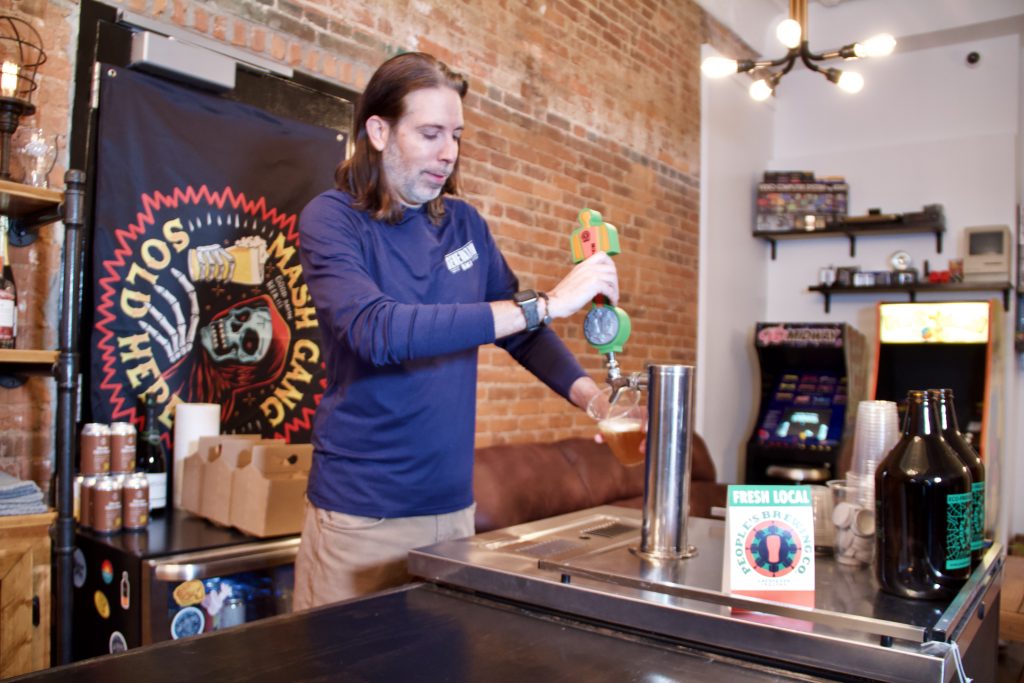
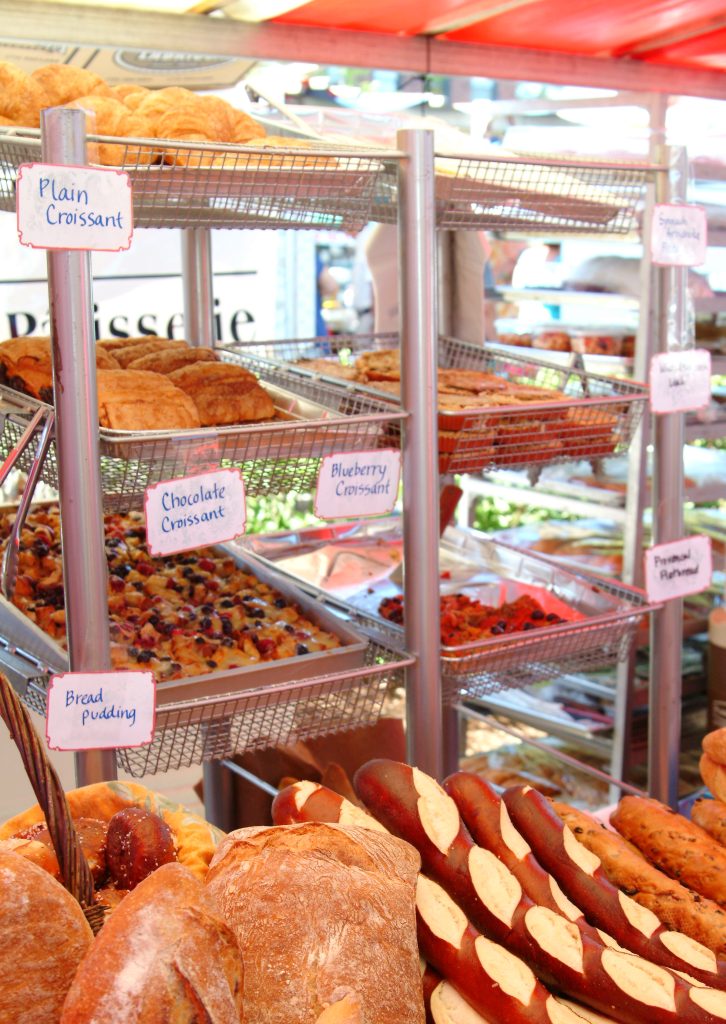


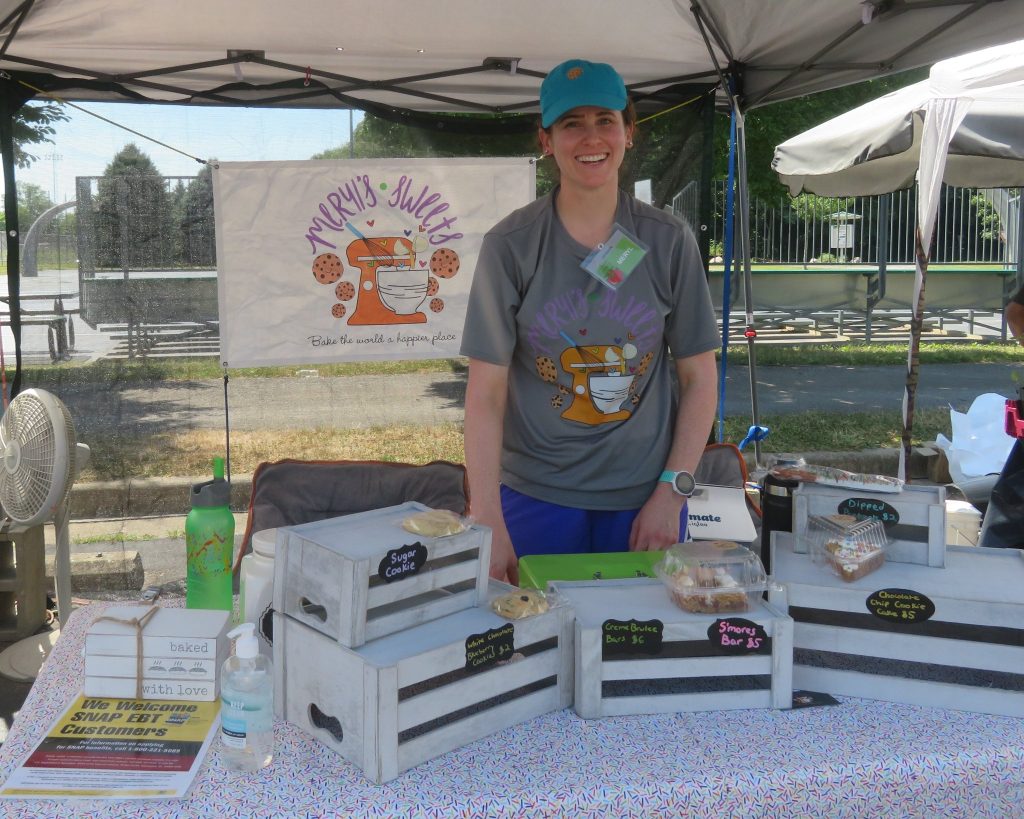

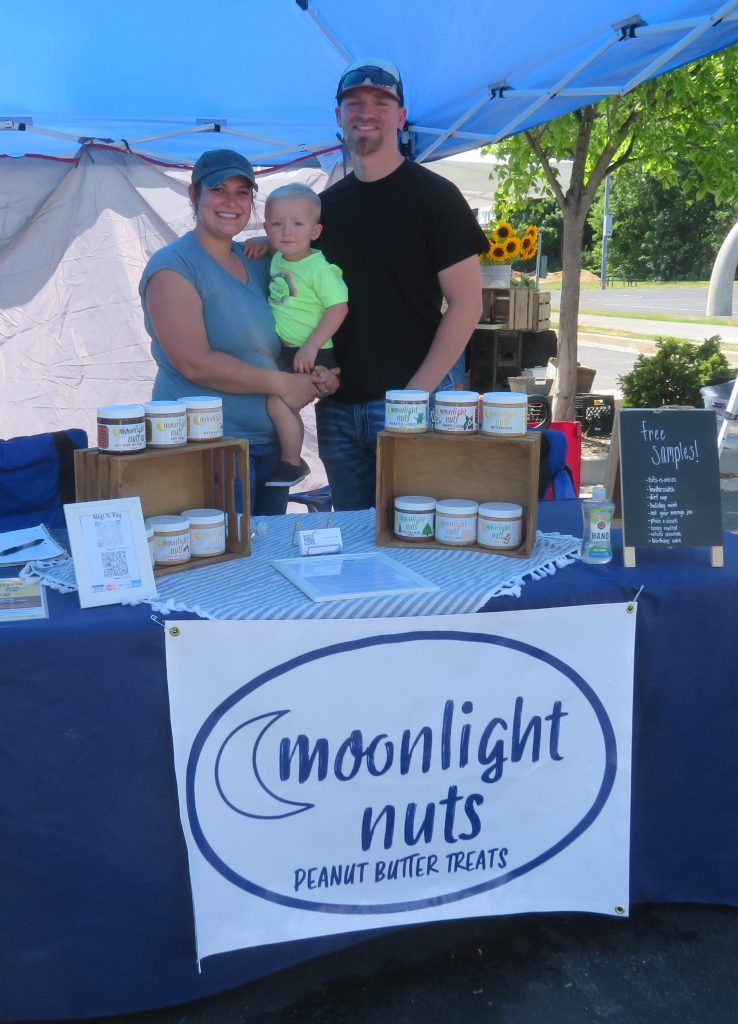
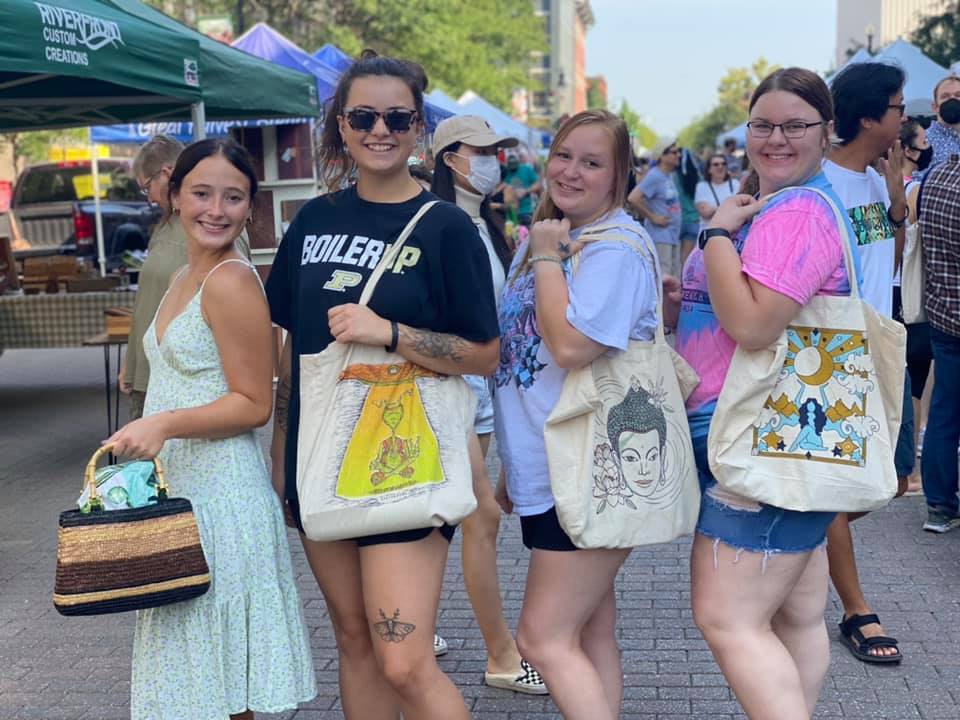


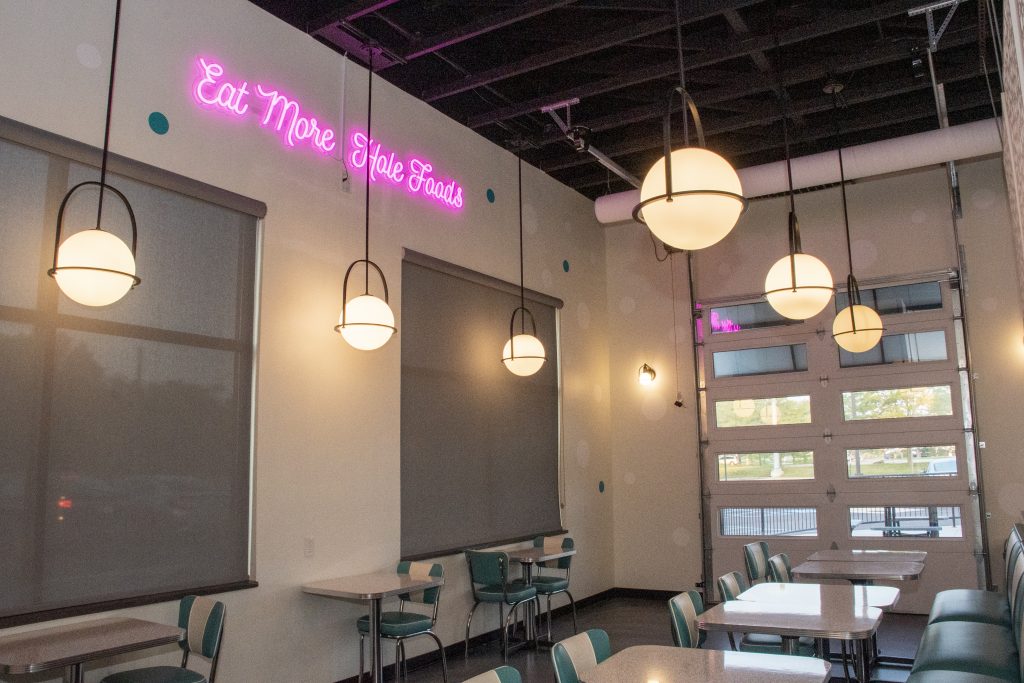
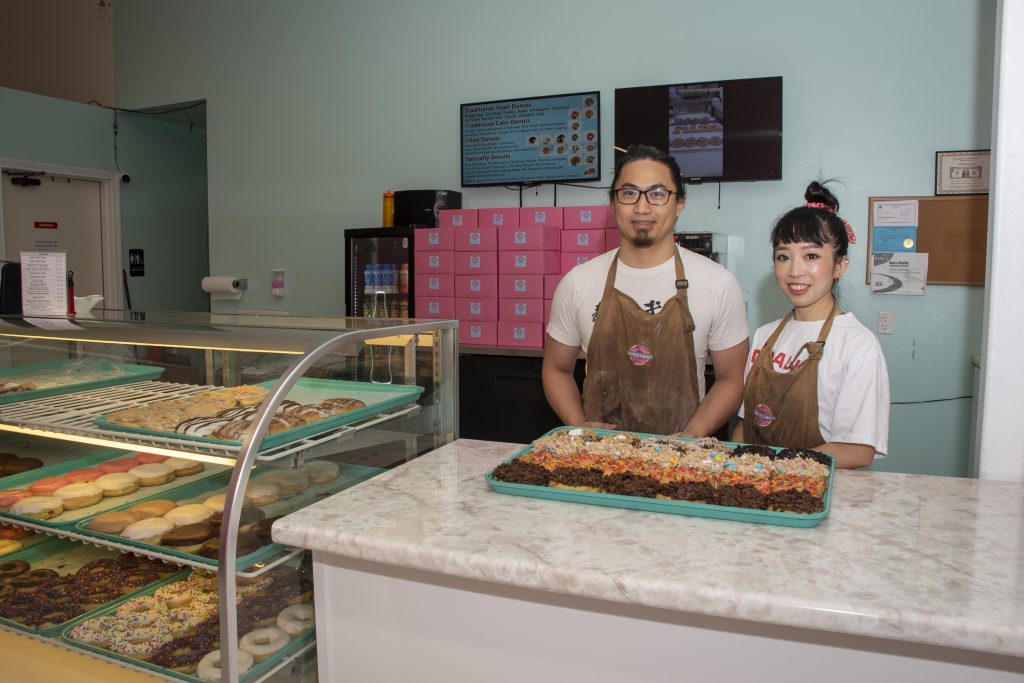
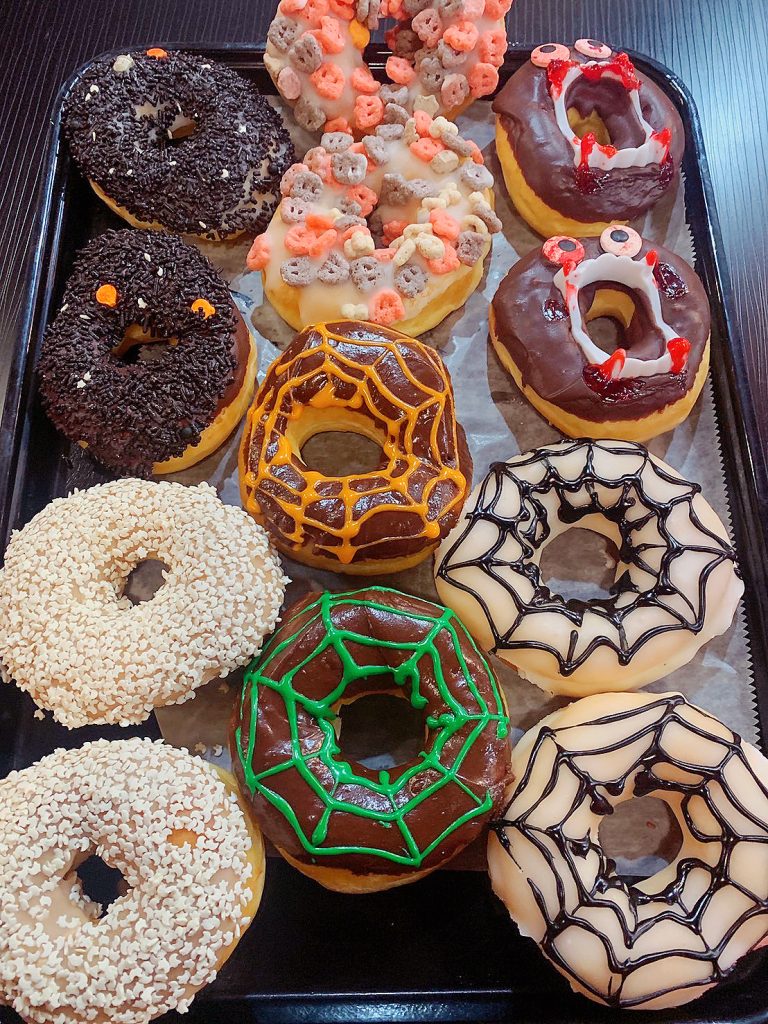
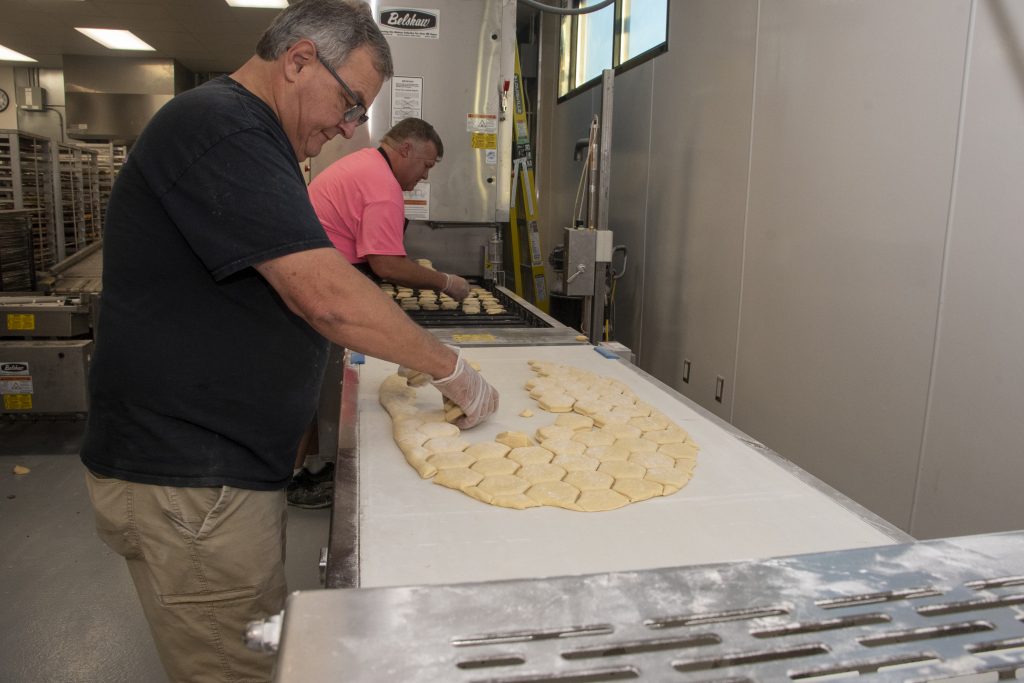




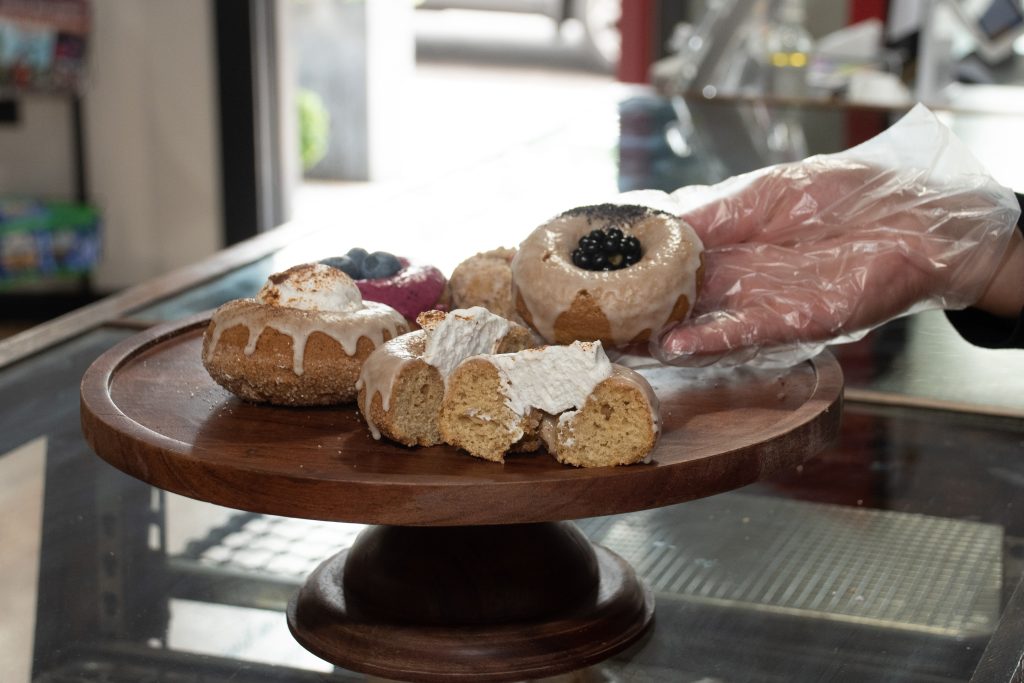
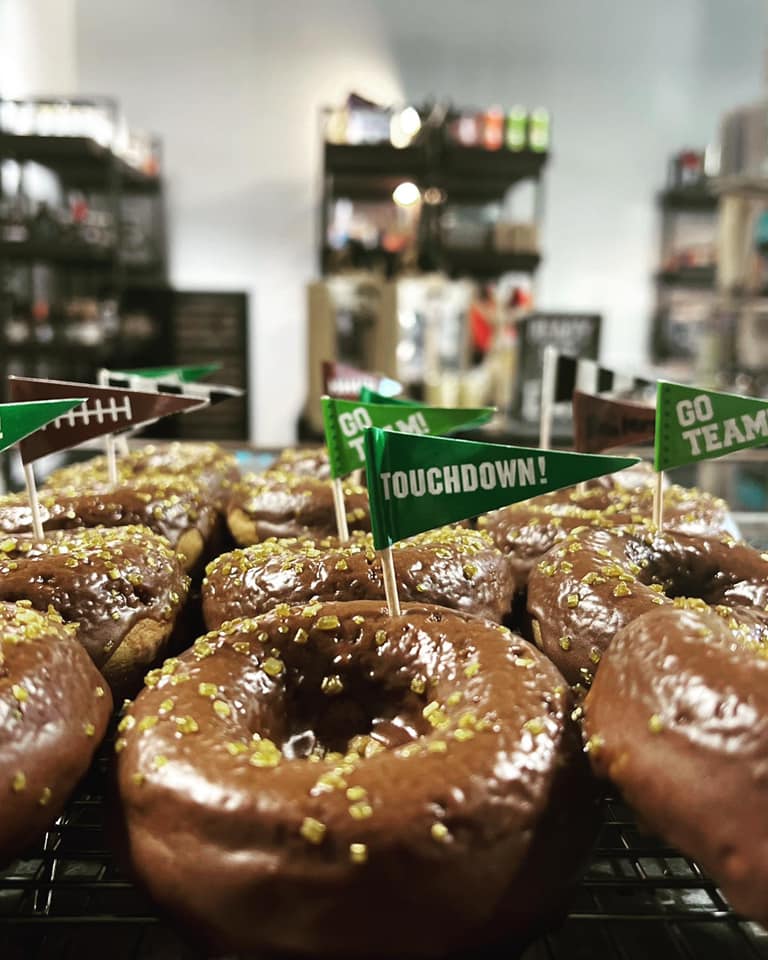

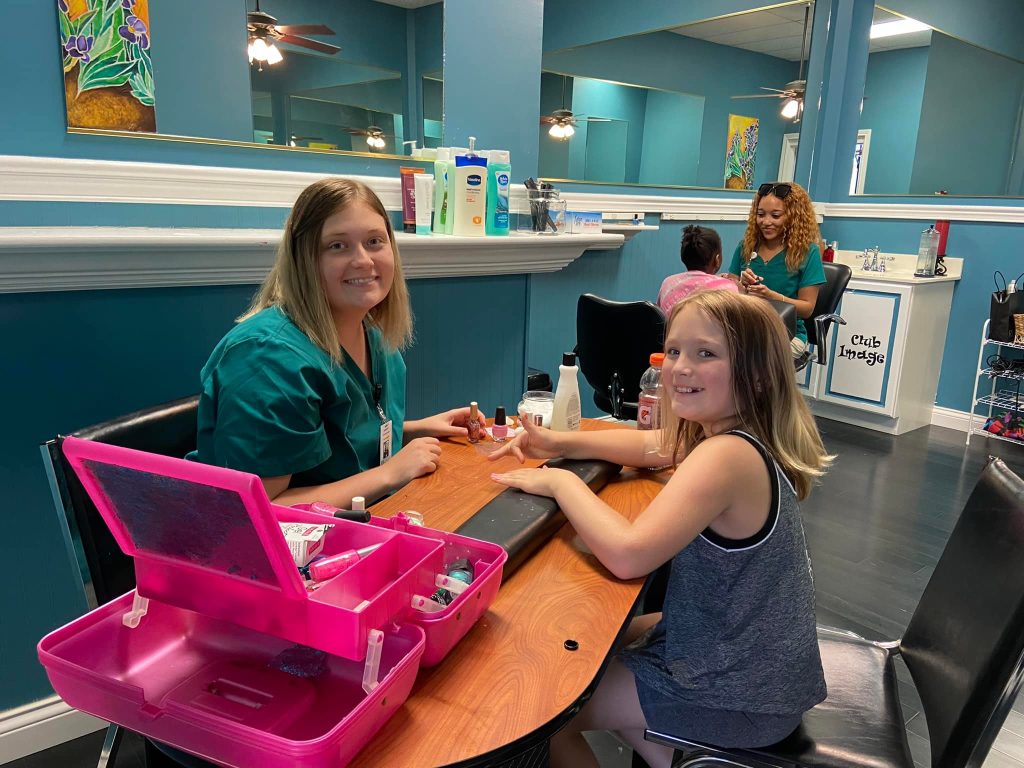



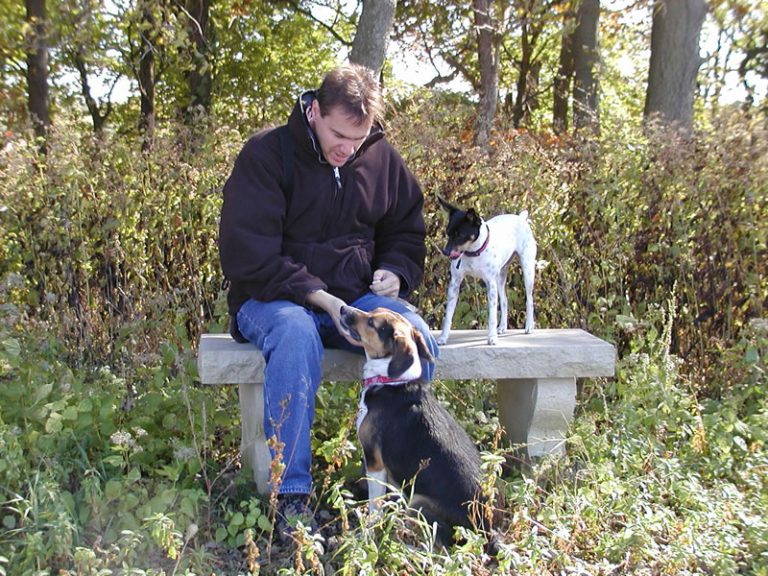
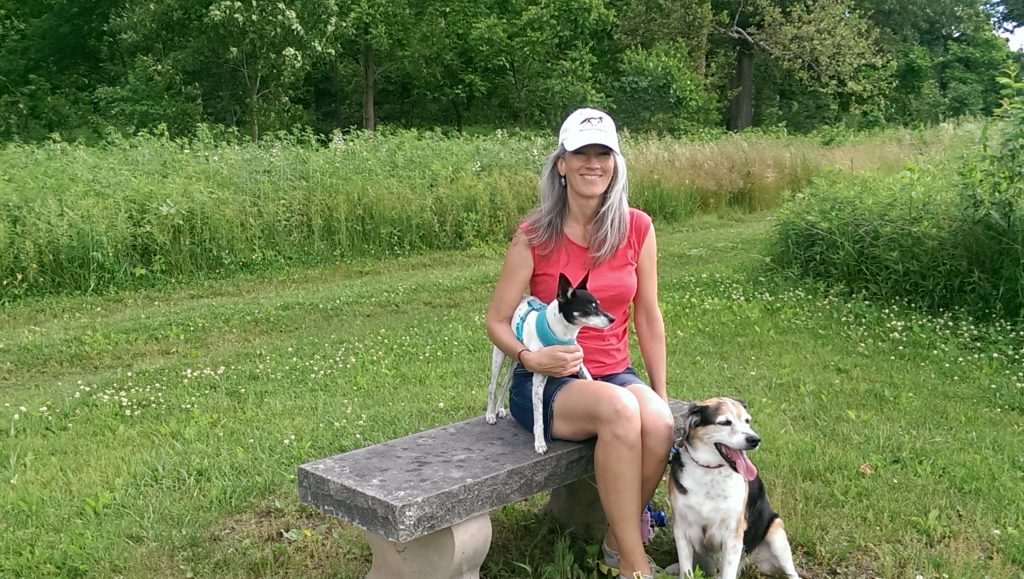


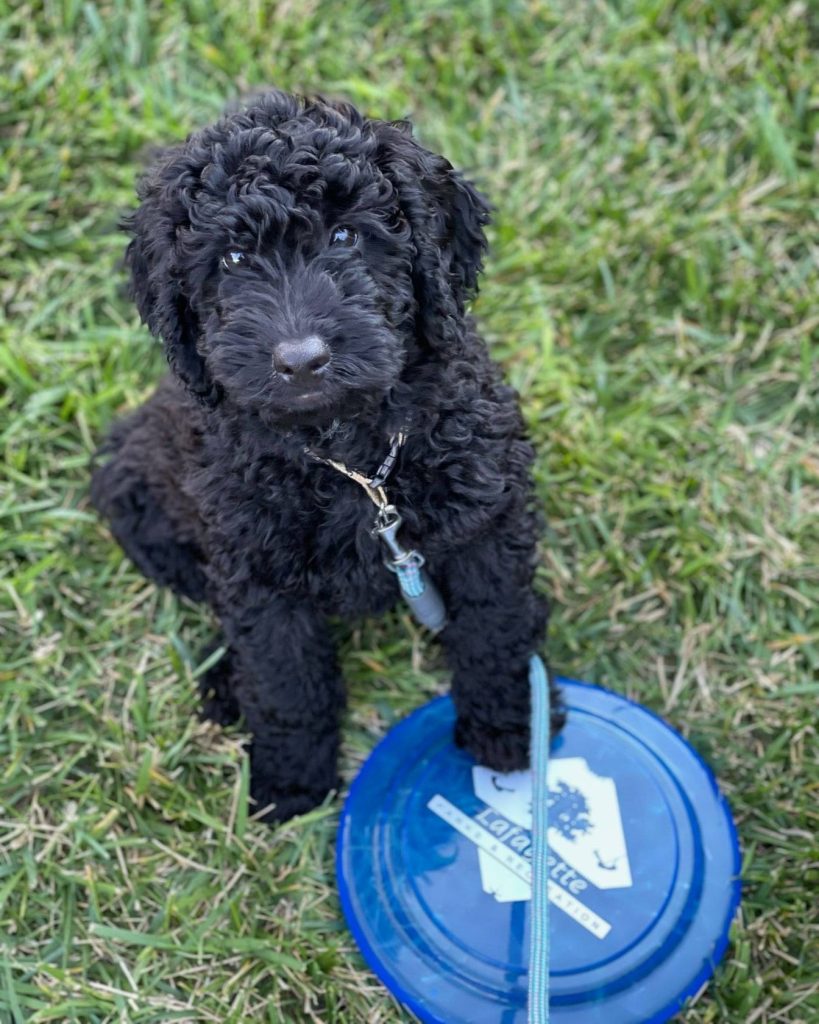





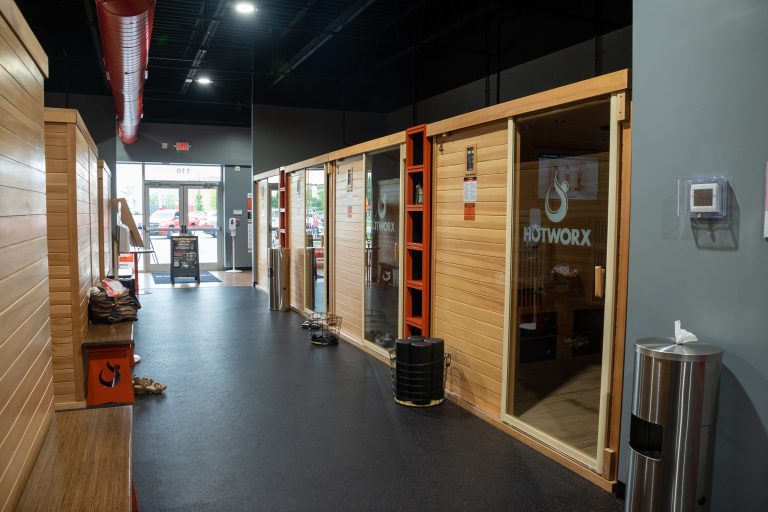


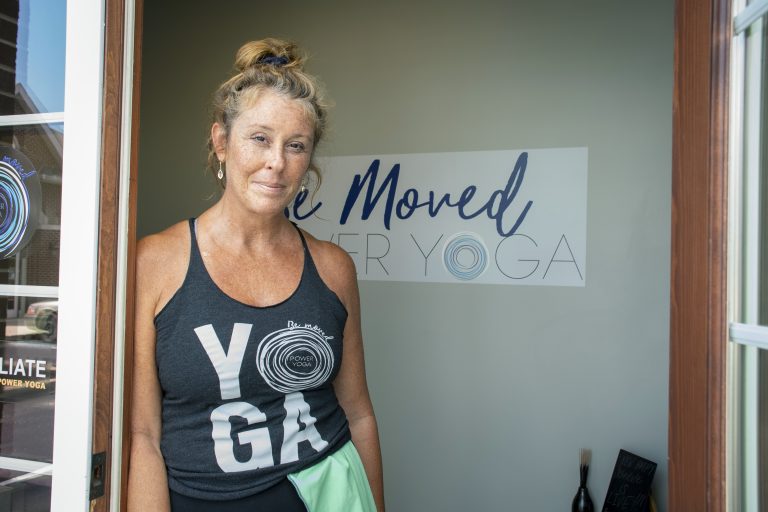
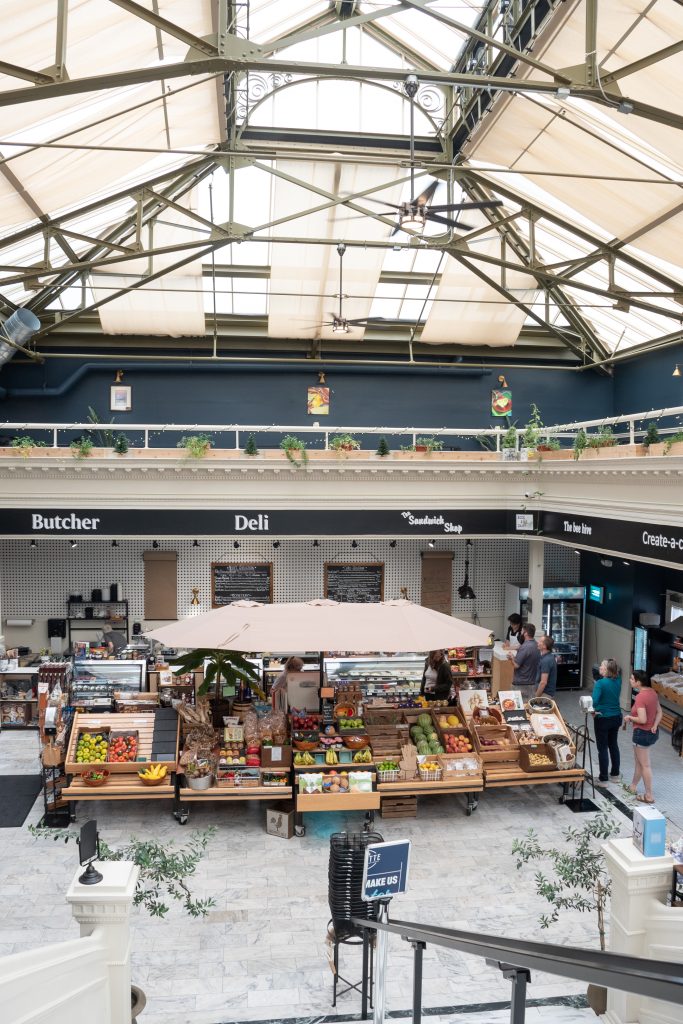
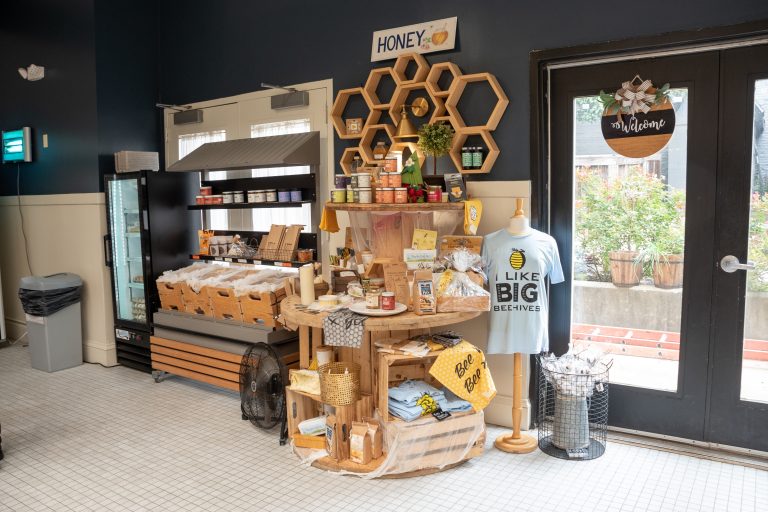

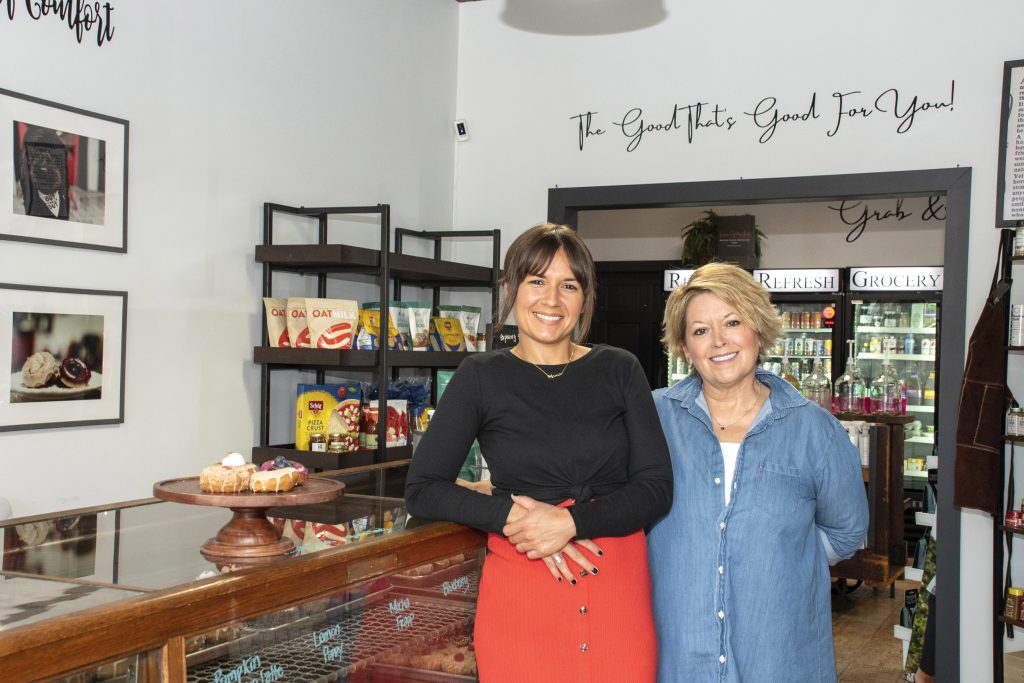
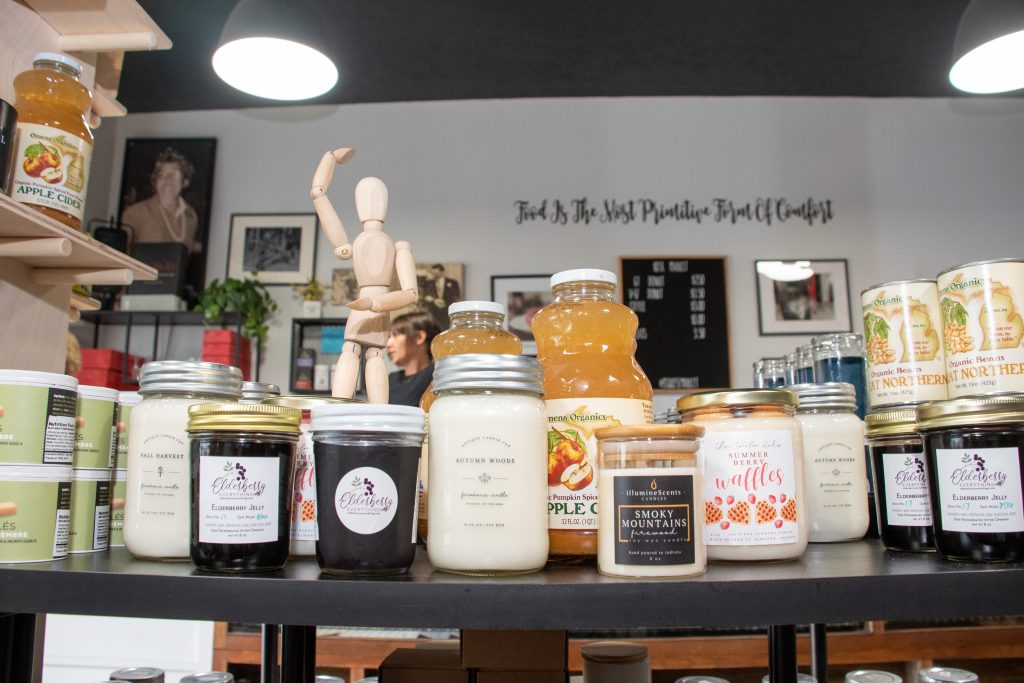
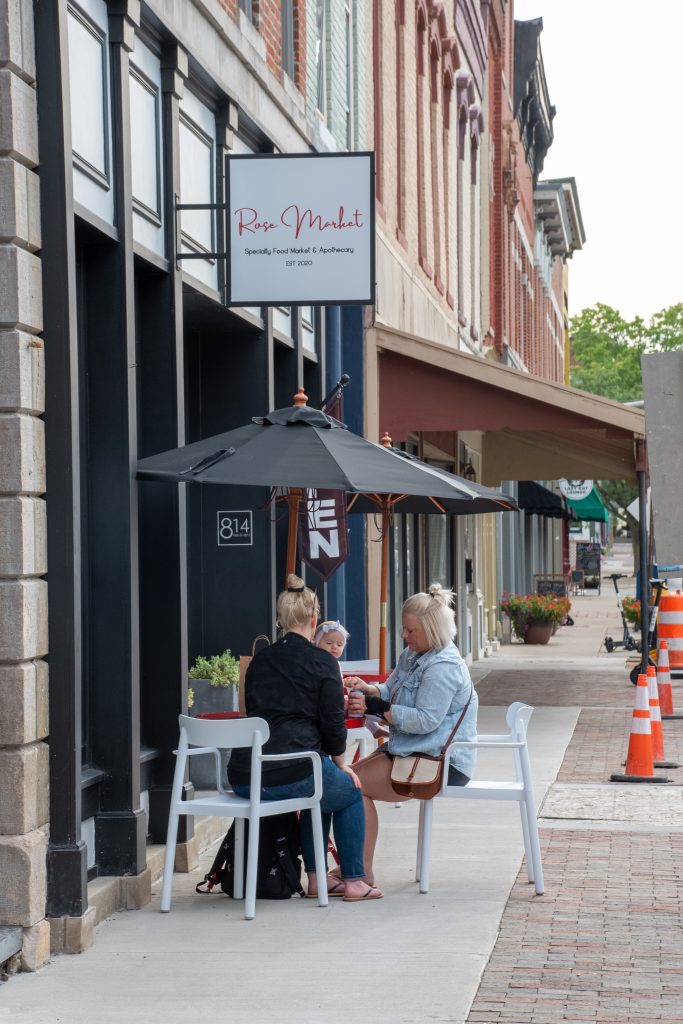




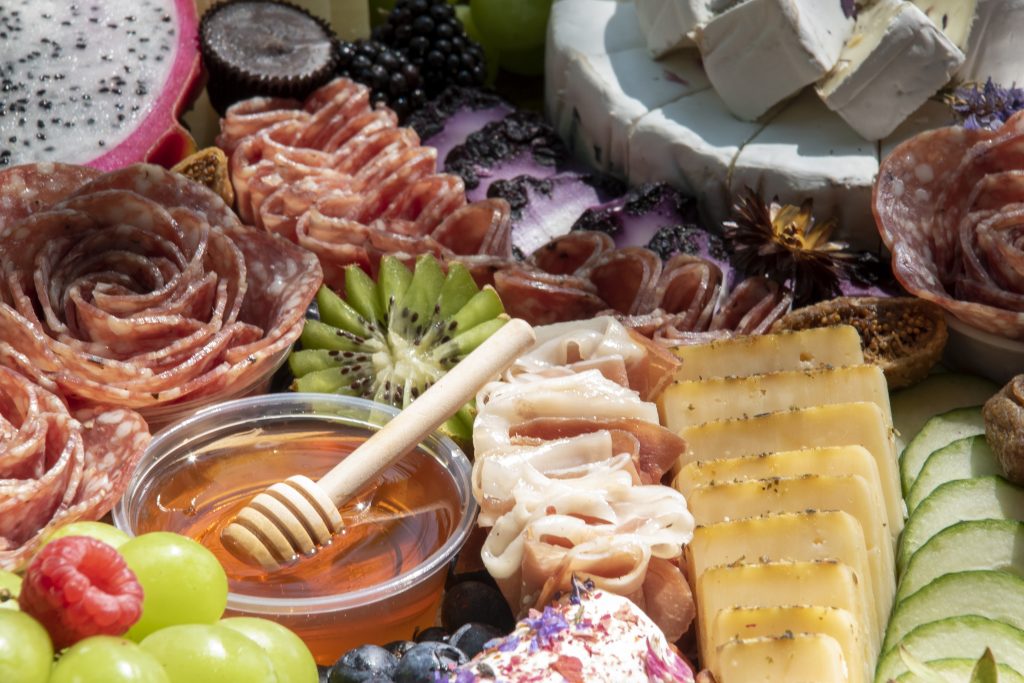


BY KEN THOMPSON
PHOTOS PROVIDED BY CHRISTINE PETKOV
Jon Miner knows first-hand the magic spell Loeb Stadium has woven over Greater Lafayette youths since 1940.
In 1984, at 15, Miner stepped foot on the Loeb Stadium infield for the first time as a member of Lafayette Jeff’s freshman baseball team and as a player for Firefighters in the Colt Recreation League.
“Growing up in this community and playing youth baseball, that was always a big deal to go to Loeb Stadium and watch a baseball game (and) hopefully play there one day,” says Miner, who played two years of varsity baseball at Jeff and visited Loeb Stadium as a senior member of the McCutcheon High School team.
Miner is now the director of operations for the Lafayette Parks and Recreation Department. At the time of this interview, the renovated Loeb Stadium was just a few weeks away from opening day.
The renovation project spearheaded by Lafayette Mayor Tony Roswarski will make sure thousands of baseball players – and hopefully other athletes – will continue to play inside Loeb Stadium for decades to come. The renovation, which was estimated to cost $20 million, was completed on schedule for Lafayette Jeff’s baseball season opener against Central Catholic on March 31.
“The driving vision behind it, Mayor Roswarski who grew up in this community and knowing the history of Loeb Stadium, was to design and build a facility that would last another 80 years, like the old Loeb Stadium did, if not longer,” Miner says. “To give this community not just a wonderful venue for baseball but a wonderful venue for other community events.”
Roswarski’s vision for the new Loeb Stadium includes the potential to host soccer and football games as well as non-sporting events such as concerts. The new stadium has a seating capacity of 2,600.
“I think when it’s finally open and we break out of this pandemic and people are able to get into the stadium and watch an event – whether it be a baseball game, a soccer game or a concert – they are going to be really pleased with how this stadium has turned out,” Miner says.
There was much anticipation in Greater Lafayette when a front-page headline in the Journal and Courier on July 2, 1940, proclaimed “Park Stadium for Athletic and Cultural Events to be Memorial to Solomon Loeb.”
Bert and June Loeb contributed $50,000 (almost $935,000 in today’s dollars) for the construction of a 3,152-seat reinforced concrete structure inside Columbian Park. The stadium was named Columbian Park Recreation Center, which remained until 1971 when it was renamed Loeb Stadium.


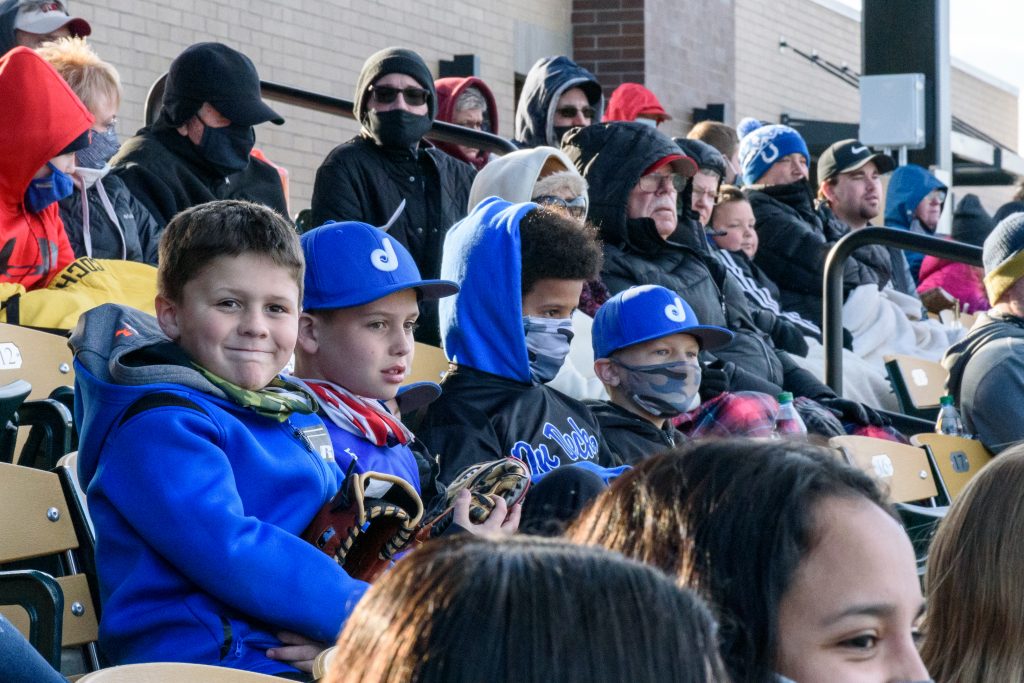

“Its purpose being to serve as a public stadium for athletic, cultural and educational events of various kinds; in fact any legitimate entertainment under sun or stars,” the 1940 article stated.
With lights installed as part of the construction, the stadium was projected to not only host baseball games but softball games, boxing matches, concerts, pageants and even horse shows.
Architect Walter Scholer had the foresight to make the stadium dimensions of Major League Baseball stadiums with 333 feet down the left field line, 404 feet to center field and 322 feet down the right field line. Retaining similar distances in the 2021 renovation required some out-of-the-box thinking.
When the decision was made to rotate the field 180 degrees from its original layout, placing home plate near the corner of Main Street and Wallace Avenue, the right field area needed a few extra feet. Since moving the zoo was out of the question, architects came up with a plan to extend the stadium entrance a few feet from the original footprint into Main.
But even that idea wasn’t as simple as it sounds.
“A lot of the fiber infrastructure in this community comes right up Main Street,” Miner says. “There’s only so far you can go into Main Street before you have to get into relocating that.”
Making the most of every foot available, home plate is positioned just a few yards from the corner of Main and Wallace.


When it comes to construction in Indiana weather, nothing comes easily. Toss in a shutdown of nearly a month in April 2020 due to COVID-19 precautions and it’s amazing that the project was completed in time for the Lafayette Jeff baseball season.
“All the contractors have done a marvelous job working through the snow we had, the cold snaps,” Miner says. “We couldn’t be more pleased with their work.”
The new Loeb Stadium also will serve as the front door to the 21st century Columbian Park. Spectators will have a view of the new carousel building beyond the centerfield fence, plus Tropicanoe Cove and the water slides just past left field.
Fans sitting in the suite level will be able to follow the progress of construction going on at Memorial Island.
“It was important to build a beautiful stadium and have the viewpoints be on the inside of Columbian Park and not have the people in the stands looking out into Oakland School, the Frozen Custard and Arni’s,” Miner says. “I think it brings Loeb Stadium more into the park and it will transform Main Street.
“We’re going to have state-of-the-art lighting, state-of-the-art concession facilities. There’s not really a bad seat in the stadium to view a baseball game. Then we have the video board that is really going to add to whatever event is going on there. This is something even communities with nice baseball stadiums don’t have.” ★

BY KAT BRAZ
PHOTOS PROVIDED
The Spinning Axe
Barbara Huddleston spent years growing her catering and event business. At the start of 2020, her calendar was booked with weddings, parties and corporate events. When the pandemic forced the cancellation of large gatherings, Huddleston watched her business evaporate almost overnight. During a trip to Bowling Green, Kentucky, over Labor Day weekend, she discovered a new passion — axe throwing.
“We actually went to visit Mammoth Cave, but it was closed due to COVID,” Huddleston says. “Looking for other things to do we found an axe throwing place near our hotel. About four throws in, I realized I loved it. I knew I needed to bring this sport back to Lafayette.”
That’s right. Urban axe throwing is a worldwide sport growing in popularity. The World Axe Throwing League, formed in 2017 by representatives from Canada, the United States, Brazil and Ireland, holds sanctioned tournaments year-round. Budding future champions could reside right here in Tippecanoe County and get their start at Huddleston’s latest enterprise, The Spinning Axe, 351 South St., Lafayette. After returning from her trip, Huddleston leased the location and took about seven weeks transforming a former sushi restaurant into an axe throwing venue and bar serving wine, beer, liquor and snacks such as nachos, pizza, soft pretzels and popcorn.
The family-friendly venue (they recommend ages 10 and up, depending on the physical ability of the child) accepts walk-ins and reservations, which are encouraged for large groups and on Saturdays. After signing a waiver, guests are assigned to a lane and an axe coach reviews safety precautions, gives pointers and explains different types of games that can be played. At the end of the lane, a large round bullseye painted on wooden boards serves as the target.
“I’ve been surprised at the number of women who’ve shown interest in axe throwing,” Huddleston says. “They want to do a girls night out, they want to schedule a date night. That’s been a really cool thing. Axe throwing isn’t as scary as it sounds. Our trained axe coaches will show you how to do it safely. We’re going to help you have a great time.”=
The Spinning Axe is open seven days a week. Cost per hour: Adults $22; Children $15. Military, fire and police personnel receive a discounted rate of $17/hour.
► facebook.com/thespinningaxe


Learning to Thrive
Struggling to take your vitamins? Thrive IV Lounge, 1343 Sagamore Pkwy N, Lafayette, offers a relaxing and hydrating infusion of vitamins, minerals and nutrients directly into your bloodstream for maximum effect. Administered by registered nurses using the same medical grade supplies found in hospitals, the medspa offers an array of therapy treatments to boost immune function, bring migraine relief, reduce inflammation and even recover from a hangover.
Owner Sarah Kurtz was inspired to open an IV lounge after learning about the rising popularity of drip spas in other parts of the country. As an emergency room nurse for the past seven years, Kurtz wanted to offer preventative care that might help keep chronic condition patients out of the ER.
“There’s just not enough information out there for people to understand the importance of how to prevent getting sick,” Kurtz says. “By building the immune system, getting a lot of sleep, staying, hydrated, taking the correct vitamins and eating healthy you can prevent a lot of things from being a lot worse. After all these years in medicine, I’m just taking a different approach to help people get there.”
Once a client fills out paperwork covering medical history, medications, allergies, height and weight, the Thrive IV nursing staff checks vital signs before discussing available drip treatments. Once the IV is started, it takes anywhere from 45 minutes to an hour to complete the infusion. There are three private treatment rooms as well as a large communal lounge which Kurtz hopes to open up as the pandemic slows down.
Afraid of needles? Thrive IV offers a numbing spray to help ease the discomfort. Or you can skip the IV and order an injection instead. The biggest seller is the skinny shot, a special blend of hydrating fluids and vitamins to boost metabolism. Pair it with a Beauty Blend IV treatment for a fully rejuvenating experience. Not ready to leave the house? Thrive IV’s mobile concierge service brings wellness to the comfort of your living room.
“One liter of IV fluids that we give you is equivalent to drinking two gallons of water,” Kurtz says. “Results vary depending on the type of treatment and an individual’s metabolism, but the benefits of IV therapy usually last about five days to a week.”
Memberships are available for clients who want to make Thrive IV a regular part of their wellness routine. Though Thrive IV offers a relaxing, calming atmosphere, all IV medspas are regulated by the state of Indiana and must maintain the same safety standards as medical clinics and hospitals. All medications, vitamins and supplies are FDA approved. An ER physician serves as medical director, overseeing the lounge. IVs are administered by experienced ER nurses with the critical care skills to identify anything abnormal in a client’s session and refer clients to the ER or urgent care if necessary.
Thrive IV is open Thursday through Monday. Follow them on social media for daily deals and monthly specials.
► thethriveiv.com


Big Woods Restaurant and Bar | 516 Northwestern Ave., West Lafayette
Originating in Nashville, Indiana, in 2009, the opening of a Big Woods Restaurant and Bar in West Lafayette marks the Big Woods Village’s 10th
location — and the farthest north. With its focused menu of signature pizzas and a selection of burgers and sandwiches, Big Woods offers a cozy sports bar environment in the location formerly occupied by The Stacked Pickle on Purdue’s campus. Cocktails of the month feature spirits crafted by Hard Truth Hills, a division of the Big Woods brand also based in Nashville. Craft beer lovers will devour the Big Woods Quaff ON! beers, such as Busted Knuckle, Hare Trigger and Yellow Dwarf.
► bigwoodsrestaurants.com/west-lafayette


Copper Moon Coffee | 351 Sagamore Pkwy & 225 S. University St., West Lafayette
Brothers Brad and Cary Gutwein purchased Copper Moon Coffee (originally founded in the late 1960s) in 2007 and relaunched the business in Lafayette. Now with four locations throughout Tippecanoe County and a booming retail business, Copper Moon is the largest family-owned coffee company in the Midwest. The latest two locations include a spot on Purdue’s campus inside the Agricultural and Biological Engineering Building and a standalone café in the former Salin Bank building next to Dog n Suds on Sagamore Parkway.
“We are delighted at the opportunity to continue expanding our reach into West Lafayette,” says Brad Gutwien, CEO of Copper Moon Coffee, in a January 2020 press release. “We think this in an ideal location that will be easy to access for most of the West Lafayette community.”
► coppermooncoffee.com
Reveille Coffee Bar | 835 Main St., Lafayette
The inviting French-inspired décor of Reveille Coffee Bar creates a warm and welcoming ambiance the moment you step in the door. This cozy spot with friendly baristas churns out all manner of gourmet coffees, specialty teas, decadent hot chocolates and iced brews. Featuring a rotating selection
of locally made pastries, Reveille is the ideal spot to lounge away a morning.
► reveillelafayette.com


Ritual Cocktail Bar | 211 N. Second St., Lafayette
The intimate, classy lounge vibe at Ritual Cocktail Bar quickly garnered a reputation for one of the coolest spots in town. A streamlined food menu features upscale snacks such as almond breaded duck tenders and roasted whole cremini mushrooms. But here, craft cocktails are the main attraction. Mixologists reimagine classic drink recipes and combine house-made syrups, bitters and juices; specialty spirits and unusual ingredients to create memorable concoctions that are meant to be savored, like a ritual. Feeling extra swanky? Stop by for Rat Pack night to sip your libation while listening to Sinatra, every Tuesday before 9 p.m.
► ritual-bar.com
Ripple & Co. | 1007 Main St., Lafayette
Fans of East End Grill have eagerly awaited the opening of Ripple and Co., a fast-casual dining concept located across the street from the high-end restaurant and run by the same executive leadership team. The new multilevel eatery features a spacious second floor with outdoor dining and a private event space. Downstairs, the atmosphere of the lively counter-service restaurant is reminiscent of a food hall. Executive chef Ambarish Lulay brings the same elevated sensibilities found at East End to Ripple & Co.’s menu. Smoked meats, pork belly and “really good tofu” are just a few of the crave-inducing items available. With both cocktails and beers on tap, Ripple & Co. is an exciting addition to upper Main Street. Plus, a partnership with Greyhouse Coffee means you can pick up your favorite cup of joe while you’re there.
► eastendmain.com/ripple-company


Rusty Taco | 3209 Builder Drive, Lafayette
Serving up authentic street tacos at affordable prices, Rusty Taco’s festive ambience encourages friends and family to linger over margaritas while enjoying boldly flavored tacos. With more than 30 locations around the country, each one emulates a neighborhood taco stand. An array of breakfast tacos is available all day. The handmade street taco menu features roasted pork, brisket, baja shrimp and fried chicken. Rusty’s commitment to high-quality ingredients and making food fresh-to-order ensures satisfaction in every bite. Wash it down with an ice-cold margarita and experience bliss.
► rustytaco.com
Wolfies Northern Woods Grill | 352 E. State St., West Lafayette
Scott and Nyla Wolf opened their first Wolfies location in 2004. Designed for the “seeker in all things sports, nature and food,” Wolfies offers a casual sports-themed environment in the Wabash Landing site formerly occupied by Scotty’s Brewhouse. The West Lafayette location is the eighth in the state and the first to venture away from the Indianapolis area. The expansive menu is packed with sharable starters, salads, wings, ribs, seafood, sandwiches, tacos and burgers. Thirsty? Try one of the 30 local and regional beers on tap, along with a full bar featuring craft cocktails. One thing is certain, you won’t go hungry at Wolfies.
► wolfiesgrill.com/West-Lafayette ★

Stay up-to-date on new businesses and more by following Greater Lafayette Commerce on Facebook or visit greaterlafayettecommerce.com
BY RADONNA FIORINI
PHOTOS BY CHRISTINE PETKOV
Located west of the Marq Apartments and Old National Bank along the Wabash River, the Riverside Promenade Deck was dedicated in July 2020 and represents the first completed project in the
“Two Cities, One River” master plan designed to enhance the quality of life along the Wabash, says Stan Lambert, executive director of the Wabash River Enhancement Corporation.
The promenade is a city block long, rising above railroad tracks and the river bank. It connects on the north to the John T. Myers Pedestrian Bridge next to Reihle Plaza, and to Columbia Street on the south, says Eric Lucas, principal with MKSK, the landscape architecture and urban design company that oversaw the project. Access also is available from the Marq building.
Because railroad tracks prevent access or a good view of the river from ground level, the promenade is at bridge level and pedestrians can enjoy a good view of the waterway without obstruction. The deck zig zags a bit, meandering through the space to mimic the flow of the river.
“The whole space takes its shape from the river,” Lucas says. “Seats rise up and tilt in different angles so the space mimics the river both horizontally and vertically. It is 15 feet wide at the narrowest spot, and 30 feet or so at its widest.” The configuration includes spaces large enough to accommodate a band or other type of entertainment.
The deck is constructed of sustainable, durable hardwood slats and steel beams with stainless steel cable netting around the perimeter. Planting areas and free-standing containers have been seeded with native pollinator flowers and grasses.
Decorative pole lights line the walkway and glowing lights under the benches brighten the pathway from dusk into the night. Even the area directly under the deck has been incorporated into the overall plan, says Lucas. A few metal grates were installed so walkers can look 20-feet down and see vegetation below. Native trees and ornamental shrubs have been planted there, some of which will eventually grow up through the grates, turning the deck into a more natural landscape.
Another feature people enjoy is an Americans With Disabilities Act-accessible walkway that connects the promenade deck to Reihle Plaza and Main Street. The gently sloping walk is a favorite with bikers and those with limited mobility, allowing stairless access from the street to the deck and the pedestrian bridge leading into West Lafayette, Lucas says.
Dennis Carson, Lafayette economic development director, says, “It’s a great event space – wide and with excellent views of the river. Even though COVID has shut a lot of things down, I see people walking on the deck and having their lunch there. We’ll be able to use it more fully in the future.”
Carson calls the Wabash a “great asset” and sees lots of opportunities for public use, recreation and private development along the river. The enhancement effort along the Wabash has been underway for more than a decade, as it began in earnest in 2004 when the WREC was formed.
The last 17 years have been spent creating and refining the master plan for public and private development along the river in Tippecanoe, Fountain, Warren and Carroll counties; creating partnerships between government officials, Purdue University, and private entities; acquiring land along the river bank; and working on watershed issues, says WREC’s Lambert.


The plan envisions a time when the river becomes the “…healthy, beautiful centerpiece of a whole, interconnected community. Building on the river’s beauty, the plan seeks to restore a healthy river ecosystem and create recreation and related amenities to create a unique quality of life and make the region a place of choice—especially for attracting and retaining employees in the high technology and bio-life sciences sectors.”
With a solid road map in place, the non-profit WREC is ready to move forward with some of the proposed projects, particularly in the Lafayette/West Lafayette urban corridor, but funding is always an issue.
The promenade deck project was pushed to the front of the line in 2015 when private developers started work on the mixed-use development that now houses the Marq apartments and Old National Bank regional headquarters.
“The promenade was in the masterplan, so we had to do it concurrently (with the Old National development) if it was going to happen,” Lambert says. “We had to get the whole project completed, including fundraising, in a very short time.”
With a $2.2 million grant from North Central Health Services, $600,000 from the city of Lafayette, and $485,000 from WREC, work on the promenade began in 2016 with plans to wrap up in about a year. Several construction setbacks and COVID-19 slowdowns pushed the finish date to 2020, but the $3.2 million project is now complete.
No other brick and mortar projects are currently underway along the riverfront, but the WREC is refining plans for the river corridor and pursuing grants and private donations for remediation of some industrial sites and development of greenspaces. The WREC has purchased 28 properties along the Wabash in Tippecanoe County and will work on river bank restoration and stormwater management.
A $325,000 grant from the Indiana Department of Environmental Management and the United States Environmental Protection Agency awarded in March will help the corporation address water quality issues in this area of the Wabash River watershed, according to information from WREC Watershed Coordinator Shannon Stanis, who will oversee the grant.
Most of that money will go toward a cost-sharing program that encourages those living within the watershed to adopt pollution reducing and water quality enhancing practices. The grant also will fund educational and community outreach programs as well as water quality testing. A similar grant obtained in 2019 was used for such projects as rain barrel and rain garden installations, tree and native turf planting, and streambank stabilization. These efforts helped reduce the amount of nitrogen, phosphorous and sediment flowing into the Wabash.
While there may not be any flashy projects in the works, there is more interest and investment than ever in downtown Lafayette and the State Street corridor in West Lafayette, Lambert says. He cites tremendous returns from money invested in riverfront enhancement in other Indiana communities.
“These kinds of projects are costly and take a long time to do, but cities who invest in their riverfronts see a $5 return for every dollar invested within five years, and a $12 to $16 return for every dollar invested in 20 years,” Lambert says. The biggest problem is finding a dedicated funding source that is not subject to the vagaries of politics and changes in governmental policies.
He harkens back to the years-long railroad relocation effort in Lafayette that removed tracks from downtown streets. About 80 percent of the funding for that multi-million dollar project came from the federal government through earmarks in the federal budget. But that funding source was eliminated years ago, Lambert recalls.
“WREC is putting together a dedicated funding plan, looking at a food and beverage tax fund or something like that to help support and develop the riverfront,” he says. “That would spread the cost across the most people, and primarily those who are using the services.”
Any tax would have to be authorized by the state and Tippecanoe County Council, and no concerted effort to pursue such a fund is currently in the works.
If the stars align and consistent funding becomes available, Lambert sees a future for life along the Wabash River in Tippecanoe County that will include private mixed-use development, a new pedestrian bridge extending Brown Street across the river into West Lafayette, new parks and green space, small boat docks, a disc golf course, a band shell for outdoor entertainment, mountain bike trails and more.
In the meantime, why not plan a leisurely stroll along a promenade? ★
More information about the Wabash River master plan, including maps and historical perspectives, is available at wabashriver.net
Interested in partnering with the WREC on a pollution-reducing cost-share project? Visit: wabashriver.net/costshare

BY KEN THOMPSON
PHOTOS PROVIDED, FIREWORKS PHOTO BY DAVE SCHMIDT
Occupying a mere block-long stretch on Columbia Street, organizers led by Steve Klink promised a 12-hour day of good food and door prizes in front of Loeb’s Department Store.
Proceeds would benefit the Tippecanoe Arts Federation.


Offerings included knackwurst and bratwurst, Teriyaki steak kabobs, oysters on the half shell and crab puffs. All that for a $1 admission plus free Coca-Cola and a chance to win door prizes and gift certificates every hour.
Loeb’s is now a distant memory for long-time residents of Lafayette. So, too, are many of the 12 local businesses that participated in the first Taste: Alt Heidelberg, Amato’s, Sarge Oak, Hour Time, Butterfield’s, Cork and Cleaver and Don the Beachcomber’s.
Gone, too, is the $1 admission price. Today, admission to the Taste is $10 for persons 13 and older. But it’s well worth the price
Digby’s, The Parthenon, Mountain Jack’s, The Downtowner and Red Lobster are the only existing businesses that helped launch what is now a 40-year-old tradition. And what a tradition it has become.
By 1991, the event had outgrown its one-block home and attracted 22,000 people to Sixth Street. Even that space was too cramped for two stages and an ever-growing amount of restaurant booths.
With 30 restaurants and an estimated crowd of 40,000, the 20th Taste of Tippecanoe in 2001 was spread out over Riehle Plaza, the John T. Myers Pedestrian Bridge, and the downtown area between Third Street to the east, Ferry Street to the north and Columbia Street to the south.
In 2019, three stages were set up along Second and Ferry streets, Fourth Street, and Fifth and Main.
That tradition was disrupted this past summer thanks to the COVID-19 pandemic. The Tippecanoe Arts Federation was forced to severely curtail its major fundraising effort of the year, settling for an online presence of live musical performances over Facebook Live.
Kyra Clark, marketing and events director for the Tippecanoe Arts Federation, says it’s safe to say that this year’s Taste of Tippecanoe, scheduled for July 31, may be the most important Taste since the first event.
“The Taste is our major fundraiser and the largest single-day arts fundraiser in Indiana,” Clark says. “It’s incredibly important for us to fundraise and get with the community.”
To make it as safe as possible for visitors, the Taste of Tippecanoe will be spread over a large area of downtown surrounding Riehle Plaza and the Tippecanoe County Courthouse. Also, there will be just two stages this year for live entertainment.
“We’ve increased the size of the footprint to make it a little easier for people to sit down and appreciate the food and the local restaurants that are going to be participating at the Taste,” Clark says.

“We are going to make things as safe as possible. We’re going to have hand-sanitizing stations, and all of our volunteers will be wearing masks. We will never hold an event that puts our community at risk. We are not going to be a superspreader event. We would never risk our relationship or our reputation with our supporters.”
If this year’s Taste is important to the Tippecanoe Arts Federation, it may be equally important to Greater Lafayette-area restaurants. Nearly every establishment has suffered from the government COVID-19 mandates that have kept away the usual numbers of customers.
But several local restaurants are bullish on the Taste of Tippecanoe. The Tippecanoe Arts Federation had 12 commitments by late February from Arni’s, Grilled Chicken and Rice, Corn in the USA, Dippin’ Dots, Gibson’s Shaved Ice, Indiana Kitchen Bacon, Java Roaster, Kona Ice of Tippecanoe County, Lepea, McGraw’s Steak Chop and Fish House, Red Bird Café and Thieme & Wagner.
“That’s pretty normal for this time of year,” Clark says, “but our goal is always 30 to 32 restaurants.”
The latter number is the most Clark has seen during her four years with TAF.
“This is an event where restaurants are incredibly busy, and it is an event where the majority of our restaurants sign up closer toward the event so they have an idea of staffing and timing,” Clark says.
Last year’s virtual event and the loss of revenue have forced more budget cuts than just the number of stages.
“The biggest change this year is that there will not be a fireworks show,” Clark says. “It was just something we could not fit in our budget.
“We’re saving a little bit of money, but we’re dedicating more space to the seating and the appreciation of the local restaurants. We’ve had to tighten our belt, but we’re working with what we’ve got and doing the best we can.”
Even with the pandemic still a concern, Clark is hoping that this summer’s Taste will be remembered as a celebration.
“The focus of this year’s event is celebrating 40 years of great Taste,” Clark says. “We’re super excited to be able to have an event again where we can provide local food to our community, especially at a time when our restaurants are hurting or struggling.
“This is an incredible marketing opportunity for them. Tens of thousands of people come downtown for this event. Obviously, with the COVID restrictions and the health guidelines, the attendance might look a little bit different this year, but we want that marketing opportunity and promotional opportunity for our restaurants and downtown businesses.”
For more information about Taste of Tippecanoe and updates on the event date and participating
businesses, visit tasteoftippecanoe.org. ★
BY KAT BRAZ
PHOTO BY CHRISTINE PETKOV
Last summer, tensions surrounding issues of racial injustice boiled over across the country in the aftermath of George Floyd’s death at the hands of Minneapolis police officers. Locally, more than 1,000 peaceful protesters marched downtown on May 31 to rally for racial justice and take a stand against police brutality.
“Witnessing the energy of the young people and the memory, or the wisdom of the older people, together, that gives me hope,” says Rodney Lynch, pastor and director of the Baptist Student Foundation at Purdue University. “I was pleased with the number of people who were there. Most of them were white, that’s the demographics of this community. But standing up for racial justice is not a one-time moment; it’s a lifetime movement.”
Motivated by a desire to join like-minded community members to address issues of diversity, equity and inclusion (DEI), Lynch joined the Diversity Roundtable (DRT) when he relocated to Greater Lafayette in 2016. An outgrowth of Vision 2020, a 2000–2001 community visioning project for the future of Greater Lafayette, the DRT began in 2002 when a small group of citizens started meeting to plan a Diversity Summit held in April 2003. It became a biennial event and this month, the DRT held its 10th summit. The 2021 Diversity Summit, held virtually and free to all participants, focused on Strategic Doing: Turning Conversation into Action.
In addition to the summits, the DRT meets monthly to discuss DEI issues in the community. The meetings are open to the public and co-facilitated by Lynch and Barbara Clark, who retired as director of the Science Diversity Office and director of the Women in Science Programs at Purdue in 2015. An all-volunteer group, the DRT is a committee of Greater Lafayette Commerce.
“We are the only group in the community focused on diversity in general,” Clark says. “We’re not organized in response to a crisis or an issue. We’re focused on raising awareness and educating people about the diversity issues in the community — anything from race to sexual orientation to disability — and how diversity, equity and inclusion intersect with social issues.”
Many of the monthly meetings feature speakers from the community, such as city government officials, school superintendents, police officers and university administrators who share their perspective on how DEI is supported in their respective institutions as well as identifying areas that still need to be addressed. Clark, who has served as a co-facilitator of the group since 2009, says although the same core issues may resurface, often they’ve been redefined in some way.
“An issue that we’ve discussed a number of times is ‘driving while Black,’” Clark says. “When we first started talking about that, it was somewhat surprising to the white folks but certainly not surprising to the people of color. One of the things the DRT does is develop programming to educate the community on these issues.”

One of the programs facilitated by the DRT addressed implicit bias. Lynch, who co-led the training, would ask attendees how many of them had “the talk” with their children. Invariably, white attendees assumed “the talk” centered around sexual activity. Black attendees gave their children the “police talk.”
“Black people do not have the privilege of not educating their children about how to conduct themselves when they are engaged by a police officer, so they get home safe,” Lynch says. “White children are raised to believe the police will keep them safe. Whereas we’ve seen time and time again, Black people are afraid to even call the police because our loved ones may not live through that interaction.”
The depth of implicit bias is magnified through a video experiment shown in the training that posits two men of different races in the same scenario. In one instance, a white man is shown breaking into a car in broad daylight. In the other, the man breaking into the car is Black. The white man sets off the car alarm multiple times, fishing with a wire coat hanger for 30 minutes trying to pop the door lock. A police car drives by without stopping. When the Black man attempts to break into the car, a passerby begins filming him with a cellphone almost immediately and the police arrive within two minutes. The video ends with the Black man in handcuffs surrounded by five police officers.
“It’s assumed that the white guy is just locked out of his car,” Lynch says. “But the Black guy must be robbing that car. These are examples of the implicit biases we all live with.”
The difficulty of identifying implicit biases lies in the fact that we don’t always know we have them. These unconscious inclinations often operate outside of our awareness and can directly contradict a person’s espoused beliefs or values. The danger of implicit biases is how they affect our reactions and behaviors without our awareness. The goal of implicit bias training is to help attendees understand and acknowledge the systems of privilege in place that influence these unconscious prejudices.
These conversations are difficult to have, even among members of the DRT, who, by their very presence at meetings, are more inclined to be receptive to reframing their personal perspectives and committed to acknowledging and addressing DEI issues within the community.
“One of the things that keeps people coming month after month is that they can be honest and open at the DRT,” Clark says. “They feel safe talking about issues in a group where people have different perspectives because of their lived experiences.”
Another program offered by the DRT for the past few years centers around the book Me and White Supremacy: How to Recognise Your Privilege, Combat Racism and Change the World by Layla F. Saad. The book operates as a workbook, outlining journaling exercises and conversation prompts that force white readers to reflect on the roots of their own unconscious bias, how they benefit from the systems in place and how white supremacy plays out in their everyday lives. Small cohorts of 20 to 25 people work through the book together, meeting for weekly discussions over the course of one month.
“It’s not really fair to expect people of color to educate white people on issues of diversity,” Clark says. “If white people care about diversity and want to make a change, they need to put some energy into educating themselves. That’s what Me and White Supremacy is all about. The journaling can be difficult. The conversations can be intense, but it’s all very worthwhile.”
Before the pandemic, approximately 30 people attended the monthly DRT meetings. After switching to virtual meetings last year, the DRT has seen a slight increase of participation with up to 50 attendees. Those numbers may seem small, but the impact of the DRT on the larger community is far greater.
“We’re not only touching the people who show up,” Lynch says. “The people who participate in the DRT are armed with information they can use when they encounter injustice at their job, in the community or in their family. That’s the beauty of what the DRT offers. If someone is serious about combatting injustice, DRT is a good place to start. We can inform and educate.” ★
To receive updates about the DRT and information about its monthly meetings, email
diversitytippecanoe@gmail.com or visit diversitytippecanoe.org.
BY KAT BRAZ
PHOTOS PROVIDED
On the hunt for seasonal fruits and veggies? You’re in luck. The bounty of community supported agriculture (CSA) in and around Greater Lafayette allows consumers to buy produce directly from the grower. Area farmers markets connect buyers with vendors who can speak with authority on how plants were grown and how livestock was raised. Buying from a local source also reduces the carbon footprint required to acquire your food. Many area farmers adhere to organic practices, harvesting at peak growing season to deliver fresh food that’s both delicious and nutritious.
Farmers markets
As COVID-19 guidelines continue to evolve, please consult websites and social media accounts for the most up-to-date information on market policies.

Lafayette Farmers Market
lafayettefarmersmarket.com
8 a.m.–12:30 p.m. Saturdays, May through October; Fifth and Main streets
The area’s largest open-air market, Lafayette Farmers Market dates back 182 years and is one of the state’s oldest outdoor markets. Vendors peddling produce, seedlings, flowers, meat, eggs, jams, breads, wood crafts, health and beauty items, home goods and even concessions line the cobblestones along Fifth Street every Saturday morning throughout the summer.
“Our market puts an emphasis on local-first,” says Rebecca Jones, quality of life coordinator for Greater Lafayette Commerce. “Our vendors come from within a 90-mile radius. We also prioritize vendors who sell produce to honor the market’s roots as a place of commerce for farmers and cultivators. At least 70 percent of items sold must be produced locally first-hand by the vendor. The remaining 30 percent must follow the same rules of being produced first-hand and be traceable to the maker or farmer.”
As a champion of local goods and services, the market offers programming that highlights community organizations, features local musicians and celebrates community holidays. The market also partners with local businesses to offer giveaways for attendees and incentivize giving blood when the Blood Bus visits the market. Vendors collaborate with the Veggie Drop program to provide excess goods to local food banks. The market is administered by Greater Lafayette Commerce on behalf of the City of Lafayette and sponsored by Subaru of Indiana Automotive.
“We know the market is not only a place of commerce, but gathering and idea sharing,” Jones says. “The success of our market is community driven.”
Purdue Farmers Market
purdue.edu/physicalfacilities/sustainability
11 a.m.–2 p.m. Thursdays, May through October; Memorial Mall
Organized by Purdue Campus Planning and Sustainability in conjunction with Greater Lafayette Commerce, the Purdue Farmers Market features several lunch vendors and other prepared goods vendors, such as bakeries, in addition to some floral and produce vendors.
Guests without a campus parking permit may pay to park in the Grant Street Parking Garage, approximately a five-minute walk. The 2020 market was canceled in adherence of the Protect Purdue COVID-19 guidelines. At press time, a decision about the 2021 market had not been made public.
West Lafayette Farmers Market
westlafayette.in.gov/farmersmarket
3–7 p.m. Wednesdays, May through October; Cumberland Park
Casual and laid-back, the scene at the West Lafayette Farmers Market welcomes shoppers to visit with its 50 to 60 vendors, enjoy dinner from local food trucks and unwind listening to live music. Started in 2005, the market showcases grown and collected goods (such as eggs, honey and maple syrup) alongside numerous crafts and body products including children’s clothing, tie-dye, jewelry, soaps and lotions.
“Our main focus is organic produce, but we have many excellent craft vendors, too,” says Shelly Foran, market manager. “All craft vendors are juried to ensure high-quality goods.”
The market makes a perfect dinner destination with a selection of prepared food vendors, food trucks and bakeries. Two local wineries rotate, serving wine by the glass. The market stipulates that 75 percent of the items sold must be produced locally, within 100 miles of the market. In addition to tips, local musicians earn a small stipend for performing, thanks to two sponsors: The Russell Company and Reliable Insurance. The market is administered by the City of West Lafayette.
Foran describes the dog-friendly market as community-oriented. “It’s a great place to visit and socialize,” she says. “Customers get to know their vendors. We have many shoppers who return each week. We want to be a destination market.”
Local farmers and CSAs
Specifics can vary among CSAs, but in general you commit to purchasing a share — a basket of produce — on a regular basis for the entirety of the growing season. Typically, you can’t dictate exactly what comes in your basket, so it’s a wonderful opportunity to experiment with cooking with seasonal ingredients you might not otherwise purchase. Some CSAs allow for half shares or split shares. Several local farmers offer direct purchase of their goods.


Beck’s Family Farm
Stop by the Beck’s vegetable stand east of Attica for homegrown tomatoes, green beans, zucchini, cucumbers, bell peppers, cabbage, onions, potatoes, cantaloupe and watermelon. It also frequents the farmers market.
Bloomer’s Greenhouse
bloomersgreenhouse.square.site
This small, family-owned farm and greenhouse in West Point sells flowers, herbs and gourmet vegetables. It’s also frequently spotted at many central Indiana farmers markets.
Double M Farms
facebook.com/farmfood4U
Operated by a fifth-generation farmer, Double M’s farming model is grass-based, meaning you won’t find GMOs, animal biproducts or antibiotics in any of the meat they sell. The farm offers grass-fed beef and lamb in the spring and pasture-raised pork, poultry and eggs year-round.
Highland Heights Farm
highlandheightsfarm.com
Based in Frankfort, Highland Heights Farm offers a monthly fresh veggie box subscription available for delivery to Boone, Clinton and Tippecanoe counties. The range of products includes lettuce, greens and herbs, eggs, tomatoes, cucumbers, bell peppers, radishes and carrots.
Huffman & Hawbaker Farms
Hhfarms.com
Tippecanoe County-based Huffman & Hawbaker Farms grows tomatoes, jalepeno peppers and banana peppers. Its U-pick strawberry farm usually opens at the end of May and lasts a few weeks.
Purdue Student Farm
purdue.edu/studentfarm
A small, sustainable farm located near Kampen Golf Course, the Purdue Student Farm grows vegetables, herbs and cut flowers using the principles that naturally govern balanced ecosystems. Operated under the Department of Horticulture and Landscape Architecture, the farm disperses its produce to university dining halls, donations to community food pantries and through publicly available CSAs.


Sycamore Springs on Springboro
sycamorespringsfarmonspringboro.com
This family farm in Brookston raises grass-fed beef and pork and grows fruits and vegetables as well as organic certified garlic. Shop its in-season selection online.
This Old Farm
thisoldfarm.com
What started as one family’s commitment to growing wholesome food for themselves has grown into a regional wholesale distributor delivering quality ingredients to restaurants, grocers, schools and cafeterias around the state.
Families can still shop its wide selection of organically farmed meats, eggs, cheeses and other artisan products
available for pick up in Colfax.
Thistle Byre Farm
thistlebyrefarmllc.com
A pasture-based, sustainable family farm in rural Delphi, Thistle Byre Farm’s mission is to help encourage others to make their homes nurturing, healthy and cozy without the use of chemicals, hormones, pesticides and genetically modified organisms. Thistle Byre offers three different levels of membership for its meat and vegetable CSA.
Trinity Acres Farms
tendfarm.com/11319
Offering certified organic chemical-free produce and animal proteins, Trinity Acres Farms of Crawfordsville offers two CSA enrollment options. The conventional box CSA features an assortment of freshly harvested produce for 26 weeks, and the shoppers CSA allows buyers to choose their products from its online store.
Wea Creek Orchard
weacreekorchard.com
Offering a wide variety of fresh U-pick produce including apples, nectarines, peaches and pumpkins, Wea Creek Orchard makes a perfect family outing. The market, located south of Lafayette, also stocks its own line of canned goods including jams, jellies, salsa and barbecue sauce. Check the website for information about special events.
The Weathered Plow
Featuring fresh produce largely supplied by its own family farm near Camden, The Weathered Plow, 2325 Schuyler Ave., also sells delicious baked goods, take-and-bake meals, made to order sandwiches, candies and more. ★
Central Lafayette

Parkside | 1902 Scott St.
A Columbian Park staple for decades, Parkside reopened under new ownership just last year. The recently constructed patio opened in September and is nonsmoking, just like the reimagined restaurant. Outfitted with reclaimed lumber, polished concrete and a hanging garden, the stylish outdoor ambiance is a welcome respite. With dinner specials, smoked meats and “the coldest beer in town,” we don’t need an excuse to stop by and stay a while.
► facebook.com/theparksidelafayette
Downtown Lafayette

Digby’s | 113 N. Fourth St.
Tucked between two tall buildings, Digby’s patio may feel like an exclusive hideaway, and spaciously positioned tables along serpentine pathways dotted with trees lend an air of privacy. Its casual atmosphere belies what is arguably the best patio view in town. Gaze at the Tippecanoe Courthouse soaring overhead as local music emanating from the outdoor stage wafts over you. Reservations accepted, and your pup can come, too.
► digbyspub.com

East End Grill | 1016 Main St.
A seasonally inspired scratch menu, creative cocktails and a modern, urban vibe have earned East End Grill a reputation as one of the hottest spots in town. The restaurant has become an anchor of upper Main Street since it first opened five years ago. Weekend nights, tables are hard to come by without reservations, even more so for the few available on the small dog-friendly patio. Reservations encouraged.
► eastendmain.com

Lafayette Brewing Co. | 622 Main St.
The first brewery to receive Indiana’s small brewers permit back in 1993, Brew Co. — as it’s known to locals — brews traditional ales and lagers on site. The kitchen sends out generous portions of unique pub fare that would satiate any appetite. Whether you stop by on Pint Night (Wednesday), Flight Night (Monday), Seven Buck Sunday or any other night, a good time is certain.
► lafbrew.com

Red Seven | 200 Main St.
Watch the world go by from your patio seat in the heart of downtown. From small plates to seafood to steaks, this new American restaurant offers an upscale urban dining experience for everyone. The extensive line up of seasonally crafted cocktails and local brews are enough to make you linger for an evening. Dogs welcome. Red Seven accepts reservations; although patio seating can be requested, it is not guaranteed.
► red7grill.com

Sgt. Preston’s of the North | 6 N. Second St.
Is there a more popular patio in town than Sgt. Preston’s on a sunny day? The Canadian-themed bar has been a staple in downtown Lafayette for decades, serving up delicious grub backed by a full bar with weekly dinner and drink specials. Often featuring live music on weekends, your best bet is to head over early to snag a table or visit on Monday for Schooner Night. 21+ only.
► sgtprestons.net
South Lafayette
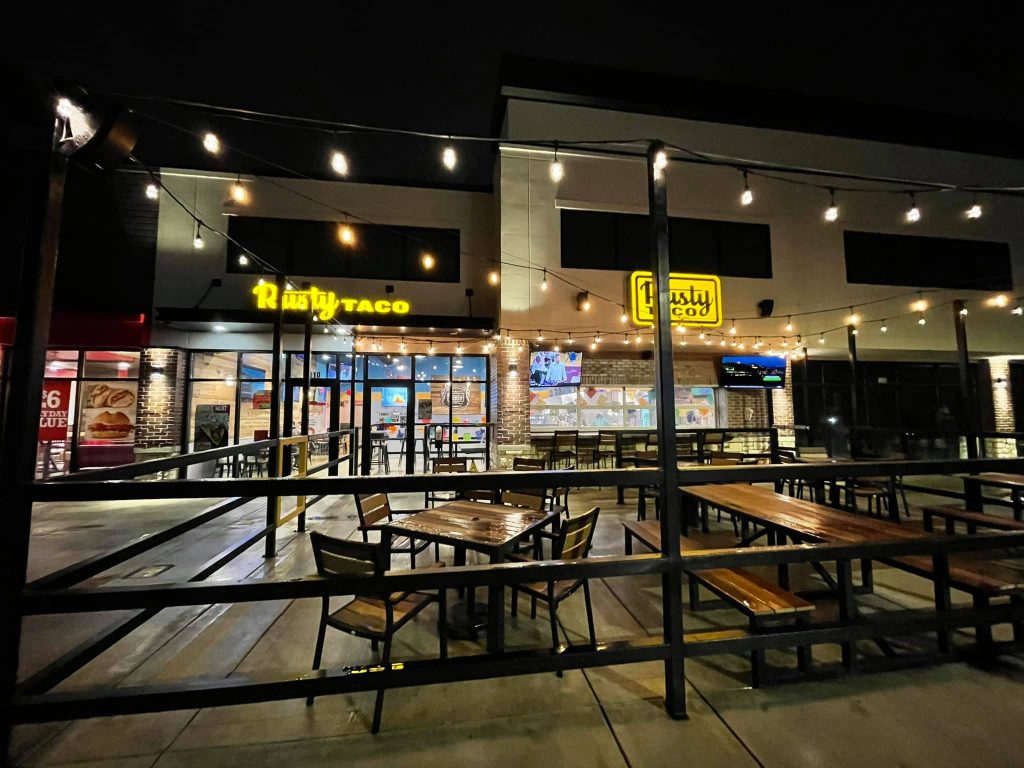
Rusty Taco | 3209 Builder Dr.
Relatively new on the scene, Rusty Taco quickly impressed with its diverse menu of street tacos that pack bold flavors. With its festive umbrellas and charming string lights, the Rusty Taco patio gives off the mellow vibe of a place where you want to kick back, relax and forget about your worries for a while. Rusty says, “Tacos are the most important meal of the day,” and we can’t disagree.
► rustytaco.com
Teays River Brewing and Public House | 3000 S. Ninth St.
This comfortable outdoor patio bedecked with picnic tables maintains a communal feeling even with sufficient social distancing. An extension of the laid-back scene that permeates inside, outdoor dining at Teays River features the same unique pub fare and tasty local brews. Bring Fido along; the patio is pooch friendly.
► teaysriverbrewing.com

Walt’s Other Pub | 3001 S. Ninth St.
Not only does Walt’s Other Pub have a patio, you might even be lucky enough to score a seat on the balcony. Its immense menu with family-friendly options is sure to please. With 12 beers on tap, a robust wine list and a full bar, you have plenty of choices to accompany your meal. And if you go for lunch you might get served by the friendliest, most outgoing waitress in town. Everyone’s welcome at Walt’s patio, even the dog.
► waltsotherpub.com
West Lafayette

The Bryant | 1820 Sagamore Pkwy W
When The Bryant first opened its doors in November 2018, it already sounded familiar to longtime residents. The restaurant’s name harkens back to the much-beloved Morris Bryant Smorgasbord, which occupied the site from 1951 to 1994. After only a few years, the Bryant has quickly gained a place in our hearts, too. Its upscale, contemporary atmosphere and ever-evolving menu are enticing enough. Throw in one of the most inventive cocktail menus around? We’re sold.
► thebryantwl.com

Town and Gown Bistro | 119 N. River Road
Don’t overlook this gem of a place. Although located on a busy thoroughfare, the landscaped patio has been outfitted with numerous pots and planters filled with lush greenery that transform this cozy patio into a delightful oasis. Billed as “unfussy American eats” the chef-driven menu features familiar fare exquisitely executed. In addition to lunch and dinner, Town and Gown also is open for brunch and features a variety of vegetarian options. As if we needed another reason to love it.
► facebook.com/townandgownbistro

Whittaker Inn | 702 W 500 N
The Whittaker Inn’s picturesque country setting is the ideal location to enjoy a relaxing meal artfully crafted with locally sourced ingredients. Not just for out-of-towners, the Whittaker Kitchen is the heart of this inviting B&B just minutes from Purdue. The ever-changing menu offers new delights with each season, though we’re glad to see the scrumptious butterhorn bread rolls have become a mainstay. We could fill up on those alone. Reservations required.
► thewhittakerinn.com
BY RADONNA FIORINI
PHOTOS PROVIDED
While much of life slowed or was outright canceled last year due to the COVID-19 pandemic, city improvement and development projects continued, and many will come to fruition in 2021. From penguins to new planned neighborhoods, here’s a peek at what’s coming for our communities.
Columbian Park
Lafayette’s Columbian Park continues to be a beehive of activity with new attractions slated to open this spring and summer.
The recently constructed $20 million Loeb Stadium, located at the corner of Main and Wallace streets, will be dedicated at the end of January, says Lafayette Parks and Recreation Marketing Manager Samantha Haville. Some COVID-related delays pushed the project’s completion back a bit, but everything should be ready for Lafayette Jefferson High School’s baseball home opener in the spring.
The original Loeb Stadium, built in the 1940s of concrete, was long the site for Lafayette Jeff’s home games, the Colt World Series, and more recently the summer collegiate baseball team, the Lafayette Aviators, part of the West Division of the Prospect League. The new brick stadium, which will seat 2,600 people when suites and lawn seating opens later this year, is also designed as a multi-use space where concerts and family movie nights will be planned.
“We hope to make a big splash for the first Jeff home game and for the Aviators’ opener in early summer,” says Haville. “And we’re opening it up to community partnerships for a wide variety of events.”
The newest additions to the Columbian Park Zoo are scheduled to arrive before the zoo opens this spring. Nine African penguins will be shipped from California to inhabit the penguin house constructed in 2020. Their arrival was delayed because of travel restrictions, but the hope is that these warm-weather birds will feel at home and be ready for visitors by late April.

Another exciting addition, an updated blast from the past, will be a new carousel. Construction on a permanent building to house this family favorite has begun, located between the zoo and Tropicanoe Cove water park. The carousel will feature hand-carved and painted wooden animals that represent some of those found in the zoo, along with exotic species and traditional horses. Haville says no date has been set for the opening of this much-loved ride.


While some of these new projects will not be fully used until the pandemic is under control, several planned features in Columbian Park will be open for individual use this summer.
Phase three of the Memorial Island project is proceeding apace. A new amphitheater with upgraded sound system is planned. The lagoon was drained last year, and sea walls are being rebuilt. Lots of new elements are being added to make the area accessible for folks with disabilities including boardwalks, new bridges, and ADA fishing nodes that jut out into the lagoon and accommodate a wheelchair, Haville says. The parks department is working with Purdue University and the Indiana Department of Natural Resources to choose fish that will be stocked in the refilled lagoon this summer.
“We are most excited about the fact that paddle boats are coming back!” Haville says. “The boats will be located on the south side of the lagoon near the train depot. We hope to have them available
in July.”
Cason Family Park
Keeping with the theme of public parks and outdoor spaces, West Lafayette has several projects in the works, says Erin Easter, director of development for the city.
Cason Family Park is a planned 14-acre prairie-style space being developed in two phases. The park, located on acreage donated by local farmer Lynn Cason at Cumberland Avenue and U.S. 231, is already home to the historic, one-room Morris Schoolhouse. Built in 1879, the school was moved to the property in 2017 and restored so it can be used for educational programs.
Construction on other park elements is slated to begin this year with completion set for 2022. Surrounding the schoolhouse will be outdoor play places, lawns and waterways. There will be picnic pavilions, public restrooms and several trails throughout the acreage.
“This will be a really fun, whimsical place to play that won’t feel forced,” Easter says. “There will be natural playgrounds with climbing rocks, wooden elements and rest areas.”
For bikers and walkers in West Lafayette, a planned 10-foot-wide pathway project will roll out this year. The path will run along Salisbury Street from Kalberer Road to Grant Street and end at Northwestern Avenue. The project will include shifting some traffic lanes and burying utilities, says Easter. Lighting and other amenities will be added during this two-year project, which will provide a safer way for pedestrians to move from the northern side of the city to the Purdue campus.
And the pathway will lead directly to the new Wellness Center just completed in Cumberland Park. This 73,000-square-foot facility houses a pool, gym, walking track, weight equipment and spaces for health classes, Easter says.
“A lot of our parks programming was put on pause in 2020,” she says. “It was difficult not to do those things last year, but we’ll have a beautiful new home (for those programs) when the time is right.” (See story on Page 22)
A New City Hall in West Lafayette

While anticipating summer activities, Easter and other city employees are spending these colder months settling into newly renovated office space at the Sonya L. Marjerum City Hall, formerly the Morton Community Center. Remodeling of the historic building began in 2019 and was largely completed in December when city workers began moving in.
The city offices have moved around for several years, but the more than $15 million renovations should allow the building on Chauncey Avenue to be a permanent home, says Easter. The name of the building was changed to honor the late Sonya Marjerum who served as West Lafayette mayor for 24 years.
“We moved into the building exactly two years to the date that construction began,” she says. “There are so many advantages to this space now. It’s ADA compliant and accessible. Four-fifths of the building space will be focused on parks or city programming and available to the community. And the new City Council chambers will serve as a true home for (the council’s) work. Before there was a sense of impermanence, but we hope this will be our final and forever home.”
City Hall’s first floor now has community space including two dance studios that can also host art programming and other activities. The first floor also houses the City Council chambers and other meeting space. The second floor is home to city staff including the mayor’s office, parks department, clerk’s office and other departments. A customer service desk is centrally located so visitors can easily get the help they need, Easter notes.
And additional community projects are planned between City Hall and the West Lafayette Public Library. Three public spaces will be added that include art pieces that also can serve as road barriers to temporarily block streets for festivals and large gatherings.
Lafayette projects


Lafayette also is completing some downtown projects and making plans for a new 70,000-square-foot public safety building and parking garage. The first public hearing concerning the facility design was held December 16, and the city hopes to begin construction this year with completion planned in 2023, says Lafayette Economic Development Director Dennis Carson.
The facility, which will be on property just east of City Hall at Sixth and Columbia streets, will house the police department and provide parking for city employees plus extra public parking spaces. The multi-story building will include open plazas for public use and be an asset to downtown living, Carson says.
Several Lafayette streetscape projects wrapped up in 2020 that have made downtown more pedestrian friendly and encouraged both investors and shoppers to see the businesses along Main Street as desired destinations. Paying attention to historic preservation and making the area more consumer friendly has paid off.
“We’ve had a lot of positive feedback and people say being downtown is now a better experience, in a safer environment that is more interactive,” says Carson. “We’ve encouraged outdoor dining, which has been so important during the pandemic, and we have more retail than we’ve had in decades.”
While the growth of brick and mortar stores is a surprise in this age of on-line shopping, Carson says there are more clothing and other retail stores downtown than have been seen in years. That trend shows that the investment in improving sidewalks, installing public art, and focusing on local businesses has paid off as people feel more comfortable lingering and shopping downtown.
“We’re very excited about it,” he says. “It’s a testament that people like to experience things (in person). We know it’s been challenging for some of these shops but we think they’ll hold up and do really well when things open up again.”
Provenance
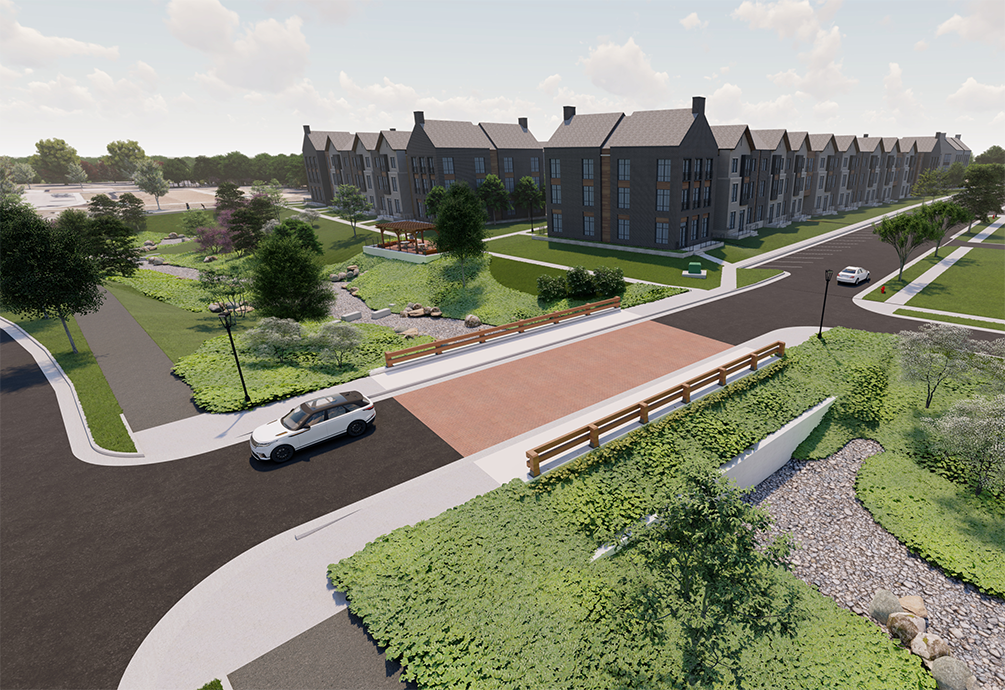
Perhaps the biggest project coming to Tippecanoe County is back across the river on the west side of the Purdue campus. As part of the Discovery Park District, the city of West Lafayette, Purdue Research Foundation and Old Town Design Group from Indianapolis have launched a planned housing development called Provenance.
Work has begun on apartments at the southwest corner of State Street and Airport Road to be followed by condominiums, town homes and single family homes, says West Lafayette’s Easter, adding that commercial and retail spaces are also part of the mix.
According to information from Old Town Design Group, this multiphase project will eventually include walking paths that connect to nearby parks, golf courses, shops and restaurants. The development includes lots for 56 single-family homes and 30 townhomes.
So grab your mask and take a drive around our communities to see the changes coming. While it feels as if our lives are shrinking, there are brighter days ahead with much to celebrate. ★
BY KAT BRAZ
PHOTOS BY CHRISTINE PETKOV
This year marks the 95th anniversary of Kirby Risk Corporation, founded in 1926 when J. Kirby Risk borrowed $500 from his father and joined Otto Keiffer to open the Keiffer-Risk Battery Company in a small, abandoned blacksmith shop in Lafayette. Keiffer left the company within the year and was replaced by George Tweedie. The company became Risk-Tweedie Electric Service, and Risk was able to repay his father that $500 loan.
After Tweedie’s departure in 1934, the company was renamed Kirby Risk Electric Company, expanded into wholesale distributions of electric supplies and moved to a new downtown location in 1941. Through it all, Risk remained committed to a concept the company now refers to as sacrificial service.

Risk’s son, company CEO James Risk III, describes sacrificial service to mean placing the highest value on customers, employees, vendors and community relations.
“My father felt strongly that your life’s activities and your business should be based on integrity, respect for people and valuing others,” Risk says. “My mother and father were an amazing team. I learned by watching them that true happiness comes from serving others or enriching the lives of other people.”
The second-generation leader recalls accompanying his father to the company warehouse on evenings and weekends as a child.
“I was fascinated walking down the aisles with all of the different products, parts and equipment,” Risk says. “I didn’t necessarily know their purpose or understand how they worked.
Risk first started working at the company during summers while he was in school. After graduating from Purdue University with a degree in management, he began his career at the sales counter and worked his way up to vice president of sales before he was named company president in 1972 at the age of 30. No stranger to leadership, Risk had already served as president of the Lafayette Chamber of Commerce.
A commitment to community service is another value Risk learned from his father. According to Risk, his parents “left us a legacy of valuing others and having a sincere concern for your fellow man.” Among his many contributions to the community, the elder Risk championed bringing Junior Achievement to Lafayette and the younger Risk participated in the program in high school.
“The cornerstone to our company’s success is a commitment to long-term relationships with our employees and their families, with our customers, and with our vendors,” Risk says. “Equally important is having a presence in our communities. Our employees are encouraged to get involved in their communities, value other people and simply do more than what is expected. My parents lived their lives that way and I just tagged along for the ride.”
Family Business

Eddy Del Real was 4 years old when his father, Jose, opened Del Real Auto Sales. Jose still worked at Alcoa at the time. He’d wake up at 6 a.m. to go to the car auction, report to the plant at 3 p.m. and get off shift at 11 p.m. His three sons, Alonzo, Eddy and Tony, began helping out at the lot as kids, washing cars and performing other odd jobs on weekends or after school. Now all three sons — and their brother-in-law — work for the family business.
“It wasn’t ever expected of us. We were raised to do what we love,” Eddy Del Real says. “For me, it’s an awesome opportunity. We’ve always been family oriented. We were all brought into the business. We each have investment in it. Dad showed us the ropes and we took it from there to broaden the business and expand it.”
Since its founding in 1987, Del Real has expanded into three locations. Eddy manages the flagship Del Real Auto Sales in Lafayette; Alonzo runs Del Real Auto Connection on Sagamore Parkway, Lafayette; and Tony opened Del Real Automotive Group in Frankfort.
In terms of his father’s leadership style, Eddy Del Real says Jose’s
approach has always been firm,
but egalitarian.
“There isn’t really a hierarchy of titles,” he says. “We were all raised as equals. We’ve never really had a boss. My dad has the knowledge, so we would ask him for advice and roll with it. He’s shown us that if you put your time and your investments into the business, you’ll reap the benefits. He’s done well for himself, and we want to continue that legacy.”
Eddy Del Real said one thing that sets the family business apart from other auto dealerships is the way they do business. Because their business carries the family name, the Del Reals are invested in every single sale. The company values stem from Jose’s strong work ethic and belief in transparency of the deal — no gimmicks, everything is sold with a warranty and deal the way you want to be treated. Though his sons manage the day-to-day operations, Jose is still involved in the business.
“We still go to the auction together,” Eddy Del Real says. “Sometimes we’ll talk business at the dinner table when we’re all together. It’s something that will always unite us. My mom and our wives are the ones that keep us grounded.”
Counter philosophy

Basim Hussain started hanging out at his dad’s place of work when he was still too young to be on the payroll. What kid wouldn’t want to spend all day in an ice cream shop? Sabir Hussain operates three Coldstone Creamery locations throughout Greater Lafayette. Once Basim was old enough, he sought employment at one of his father’s stores.
“He considered applying for other jobs, even interviewed for a few. But they just weren’t for him,” Sabir Hussain says. “The way we provide flexibility to young people in school and sports and other activities, we go above and beyond in recruiting and keeping young employees.”
Basim’s only concern about working for his dad? He was worried he’d be missing out on a real work experience.
“At the end of the day, your dad probably won’t fire you,” Sabir Hussain says. “But Basim gets admonished just like anyone else, and to be honest, a little bit more than others. There’s extra pressure if the owner’s son isn’t in proper uniform.”
Hussain takes a long-term approach in developing his young workers. He looks for opportunities to challenge them to see alternate perspectives. He encourages them to be problem solvers. He guides them in cultivating strong customer relations skills that could be applied to dealing with clients in almost any future career path. Basim, now a freshman at Cornell University, remained at home during the fall
semester due to the pandemic. While enrolled in online courses,
he still worked part-time in his father’s store.
“For all my young employees, I hope there is something they pick up from this job that stays with them for the rest of their life,”
Sabir Hussain says. “I truly believe
it takes a village to raise a young person. My role may not be
counselor or teacher or pastor, but at the same time, it’s not nothing. I’m not just a person who signs
their check.” ★
BY CINDY GERLACH
PHOTOS BY CHRISTINE PETKOV
PRODUCTION PHOTOS PROVIDED

The mere mention of coffee evokes smells and imagery that transport people to a place or a time. For many of us, it’s the first thing we reach for in the morning. Or it’s an excuse to gather with friends, to take a break or help us make it through a busy day.
It’s a staple in so many of our daily lives — it’s easy to take coffee for granted. But Brad and Cary Gutwein have taken their love affair a step further by making it their business. The brothers purchased the Copper Moon Coffee brand in 2006. And while they may not have reinvented coffee per se, they have taken this already existent brand to a new level.
This isn’t the brothers’ first foray into partnership in business. Growing up, the two always had a good relationship, says elder brother Brad. Brad graduated from Purdue University in 1989 with a degree in hotel and restaurant management – a good all-around degree with a focus on both business and hospitality – while Cary studied at Valparaiso University.
The two joined forces earlier in their careers when they operated a birdseed business, Morning Song.
“We’ve always gotten along really well,” says Brad. “We have a good balance of talent and skills. Cary is more operational, I’m more marketing and sales.”

But eventually, they outgrew their fledgling operation, ready for a bigger challenge. After they sold Morning Song they were ready for their next venture. And coffee, Brad says, was no accident — it was intentional. He had done a lot of research on coffee and knew that was a venture he was interested in — and one he knew they were well prepared to take on.
For one, they already had a company put together and an infrastructure, a hold-over from Morning Song. And many of their employees stayed on, says Nick Thompson, who currently serves as vice president for sales and marketing but has been with the brothers since 2007.
The concepts of working with birdseed — sourcing, working with an agricultural product, purchasing, packaging, selling to retailers — carry over to the coffee business.
“Those same principles work for coffee,” Thompson says. “They turned it into more of a passion.”
Brad Gutwein attended a trade show in Florida in late 2006, looking for inspiration for his coffee ambition. He visited a booth for a business based in Indianapolis. The brand, Copper Moon Coffee, was owned by a private equity firm; Gutwein knew it was a non-core asset and they might be willing to sell.
“And I was ready,” he says. “I knew what we wanted and what we were looking for.”


So the brothers took the brand name Copper Moon – formerly a part of the now-defunct Marsh supermarket brand – and ran with it. Since the purchase in 2007, the company has remade the entire franchise. Its first roasting facility was on the east side of Indianapolis; in 2012 the entire operation relocated to Lafayette. They have changed the design and packaging, experimented with new flavors and techniques.
“Everyone has an entrepreneurial spirit,” says Thompson. “We’re constantly creating things that go to market. We have that entrepreneurial ability to develop all the way to the end consumer. It’s unreal that we get to do that here in Lafayette. The ability for anyone on our team to come up with an idea on a dry erase board to producing millions of pounds of it.”
The 100,000-square-foot roasting facility on the east side of Lafayette roasts tens of millions of pounds of coffee each year, Thompson says.
Much of the coffee is sold online through its website, coppermooncoffee.com; it is also sold through other online retailers — Amazon, Staples, Office Depot, Wal-Mart.
This year has been better than ever for online sales, Thompson says. The company did a refresh that launched in late January 2020, updating its brand. Copper Moon currently ships to all 48 of the continental United States.
“We expected growth,” he says. “It’s been out of this world.”
But they would like to encourage customers to purchase through the Copper Moon website. If they can see what people order, Thompson says, they are in a better position to help them with future purchases, making recommendations, or letting them know about sales or special offers.
“We get to establish relationships with those customers,” he says.
And the business has expanded into retail operations, opening its flagship café in April 2017 on State Road 26 near Meijer in Lafayette. It gave everyone a chance to see how consumers react to their products in real time.
“I think it kind of served as a good test kitchen for the brand, for what we could produce on a larger level,” Thompson says. “We could take that same coffee to the consumer, see what works. It’s a great marketing tool to reach our local community.”
Copper Moon recently opened its second location. The latest, on Sagamore Parkway in West Lafayette, has more than one drive-through lane, which helps serve customers during these pandemic months.
It’s a challenge, says Gutwein, but they’re learning and adapting.

Yet with coffee shops on nearly every corner these days, how did the brothers feel like they could put their own spin on coffee? Coffee – the world’s second-largest commodity, next to oil — is, these days, ubiquitous; how does one put their own spin on something that is everywhere?
“Coffee is very recognizable,” Gutwein says. “Which means it’s very complicated. You need to find a lane or a niche. We understand purchasing, packaging and selling to retailers.”
Much of their sales were, formerly, to offices that provided
coffee to their employees. Now that the workplace has shifted and so many people are working from home, Copper Moon’s sales and marketing have had to shift as well. People are buying more five-pound bags these days.
“At-home brewing has grown considerably,” Gutwein says. “Consumption rates have gone up.” People are drinking coffee for more of their day, or at different times. Consumer behavior has changed, and the business will have to change with it.
Thus, Copper Moon’s mission, says Gutwein, is to adapt its marketing and advertising, reaching customers in new way.
“The customers we do pick up are sticky,” he says. “We need to continue to advertise to them. That’s a real focal point with us.”
One of the most important pillars of the business model is Reach for the Moon, the company’s philanthropic effort. Copper Moon is committed not only to selling great coffee, but to serving others and giving back to the community.
It’s a term the team takes literally, Thompson says.
“It’s our giveback arm. We think coffee can help you reach your goals.”
We Give a Cup is its offer to provide complementary drinks to health care workers, firefighter, police officers, members of the military and educators.
“We’re trying to fuel our local heroes as they work to protect us,” Thompson says. “It’s a practical way for us to support our frontline heroes at this time.”
The initiative funds pursuits in STEM fields, partnering with the Astronaut Scholarship Foundation, which provides more than 50 scholarships annually. It supports Purdue Space Day, Maurice J. Zucrow Laboratories, a 24-acre research center home to the world’s largest academic propulsion lab. And it supports a number of other organizations, including the Make-A-Wish Foundation, Girl Scouts of Central Indiana, Food Finders Food Bank and Habitat for Humanity.
Copper Moon works because of its business principles and how it practices them, says Thompson. It’s a family-owned business, and it has local roots. The company produces high-grade coffee, and it is committed to sustainability as well as social, economical and environmental concerns. And it is committed to giving back to the community.
But in the end, it comes back to family. It’s a business that feels like a family. Because, of course, it is a family. Brad and Cary work very well together, Thompson says.
“It’s very much a family,” he says. “They’re a good yin and yang. It works.”
The brothers try to model excellent relationships.
“In business there has to be a lot of give and take, humility and respect for the other’s point of view,” Gutwein says. “We’ve done it our entire lives. We understand each other; we listen. If there are issues, we talk through them.”
And it’s a feeling that extends beyond the brothers; as Thompson points out, a good number of their team have been with them since the Morning Song days, people who work in operations, sales, marketing, graphic design.
And at the heart of the business: coffee. Because what better way to be successful than to love what you do, do what you love?
“Coffee brings people together,” says Gutwein. “It’s a global beverage — it literally is recognized globally. I love coffee.” ★
BY JANE MCLAUGHLIN ANDERSON
MELISSA MORRIS PHOTOGRAPHY
As we happily flip over the calendar to 2021, discover a new place to pursue wellness for mind, body and spirit in Greater Lafayette. The West Lafayette Wellness Center opened in early January, just in time to pursue your New Year’s resolutions. Located in Cumberland Park on the north side of West Lafayette, it is open to everyone, regardless of residence. A recreation and indoor aquatic facility has been on the city’s bucket list for more than 30 years; the timing couldn’t be better to build a holistic center for health. The Wellness Center has something
for everybody.
Wellness Center Director Kevin Noe says, “This is much more than a gym or a fitness center; we are growing a community and building relationships with a wholesome family atmosphere. You can bring your kids in and drop them off at the Clubhouse while you take a class. You can work out while your kids are at basketball practice.” Having the space to create new programs and room to grow is exciting for the West Lafayette Parks Department, which most recently operated out of the former Happy Hollow Elementary School building.
The hybrid pool offers space for lap swimming, lessons and group exercises. 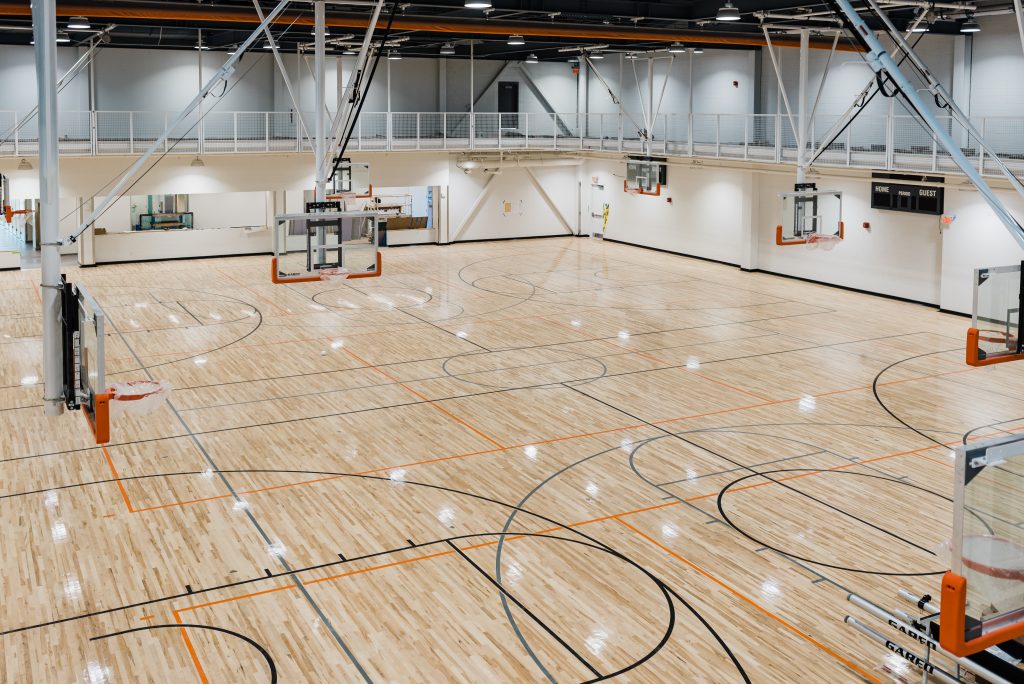
Basketball and pickleball fans have a new place to practice and compete.
The 7,300-square-foot fitness floor includes a full line-up of strength training and cardio equipment with a view. Wrap-around windows overlook the park, outdoor playground, pond and the adjacent Michaud-Sinninger Nature Preserve, teeming with wildlife. Inviting nature to indoor and outdoor activities sparks energy and wellness, reduces stress and gives people a place to connect with others the old-fashioned way – in person.
The large hybrid pool can accommodate swimmers of all abilities. There are three different ways to enter the pool: zero depth with water features for children, traditional stairs, and a wheelchair lift. The indoor aquatic facility features four lap lanes and areas for swim lessons and group exercise. There’s even a vortex section to walk with or against the current. Dive-In Movies in the pool area are just one of the fun programs in store. Parks Superintendent Kathy Lozano says, “Swimming is a lifelong exercise and something you can do well into your 80s or 90s.”
Like to play games? Great! There are plenty of opportunities to play sports in the two wooden floor basketball-sized gyms or the multi-purpose gym striped for pickleball. A four-lane running/walking track overlooks the gymnasium and is a great way to keep moving in the winter. If you like exercising in a group atmosphere, the Wellness Center has three studios for classes. The Wellness Center will hold youth and adult sports programs and summer camps in this space, but they are not included in the membership fee.
Membership includes unlimited use of the pool, open gym, strength and cardio equipment, indoor walking track, group exercise and wellness classes, and childcare while you work out. Members receive discounts on swim lessons and personal training, along with special member-only activities. Membership is open to everyone; however, households who pay West Lafayette property taxes and active military are exempt from the joiner’s fee.

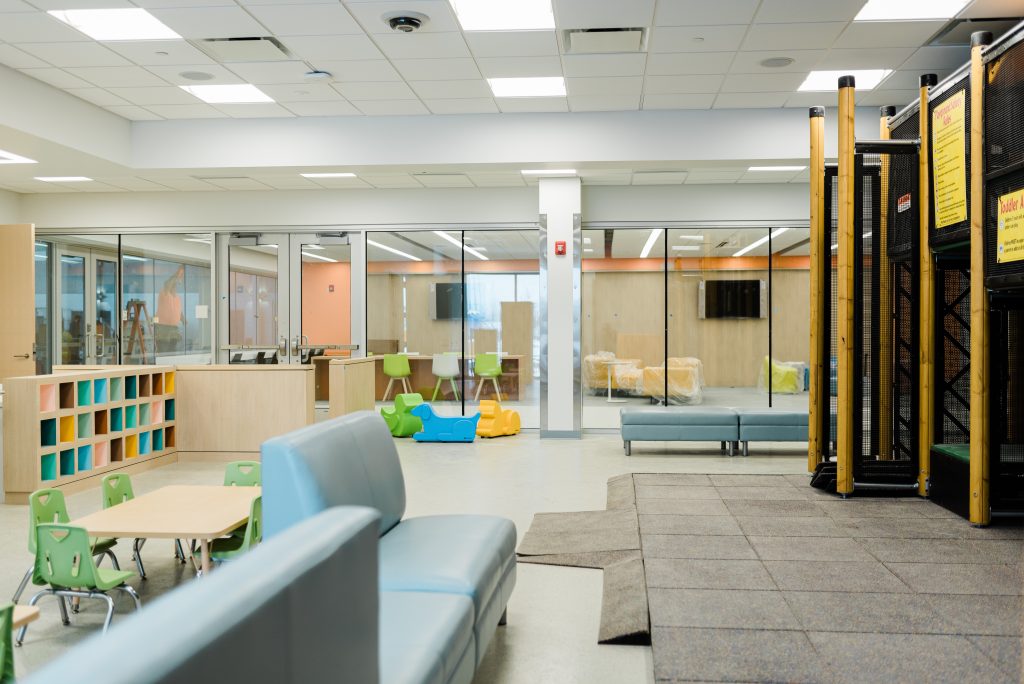
Kids can hang out at the Clubhouse while parents work out.
Non-residents pay the one-time fee in addition to their membership package. No contracts are required, and members may put their accounts on hold for three months a year if needed. A variety of individual and family memberships are available, as well as daily passes. See the website for details, wl.in.gov/parks, or stop by the Wellness Center at 1101 Kalberer Rd., West Lafayette.
Integrating the Wellness Center within Cumberland Park provides opportunities to commune with nature and increase well-being. A marked 5K trail weaves around the grounds of the building and through the park. Eventually, the trail will lead to the new Margerum Government and Community Center.
In its very definition, recreation is the refreshment of one’s mind or body after work through an activity that amuses or stimulates; play. The Well-


The Wellness Center features strength-training and cardio equipment.
ness Center is a prescription for attaining that refreshment.
“The Wellness Center has something for every health seeker,” says Wellness Coordinator Rachel MacDougall. “It’s no secret that exercise has many benefits. The Wellness Center will be a great tool for the community to focus on physical, mental and emotional health and well-being.”
Community rooms can be rented for meetings or gatherings with a nearby warming kitchen available. There’s even a party room by the pool to host children’s birthday parties. DogStudio is commissioned to create an interactive motion-sensing art piece in the lobby guaranteed to captivate and emotionally engage visitors. Check out West Lafayette Parks’ Facebook page for dynamic news, photos and videos of the Wellness Center and all parks and recreation activities. ★
“The Wellness Center will be a great tool for the community to focus on physical, mental and emotional health and well-being.”

BY KAT BRAZ
PHOTOS PROVIDED
The original idea behind Art with a Happy Heart Gallery and Studio was simple: find a way to share art and support the community at the same time. After quickly outgrowing her barn studio, owner and artist Sarah Czajkowski purchased the building previously occupied by Samson and Delilah Salon and Spa at 2139 Ferry St. in Lafayette. She set about transforming the space and opened to the public on July 1.
The gallery showcases artwork from local, regional and international artists while the studio provides an area for private art instruction, classes taught by visiting artists, seasonal craft workshops and paint parties, which is where Czajkowski got her start.
“Paint parties lend themselves to creativity and connection,” she says. “The experience fosters a real sense of self-confidence and pride. Guests are surprised and amazed that they created the artwork themselves.”
Czajkowski also offers a mobile paint party studio where she brings all the supplies to any location up to an hour away. The parties have been popular with girls’ night out groups, family reunions, children’s birthday parties, corporate events, bridal parties, church groups and fundraisers. Paint party kits are also available for purchase in the gallery. During the pandemic, Czajkowski has focused primarily on private group parties. Future plans for the venue include serving wine, beer and a small food menu on the outdoor patio and hosting live music once a week in addition to building out a full calendar of courses in fine art, pottery and jewelry making.
“To be able to do this for a living brings me so much joy,” Czajkowski says. “All I want is for people to be happy while they are here. It’s truly a magical place.”
Adapting art
The Art Museum of Greater Lafayette was founded in 1909 with a three-part mission to collect art, exhibit art and provide educational opportunities for individuals in the community to learn about art and experience art hands on. The museum has remained true to its mission over the years, but COVID-19 presented challenges for traditional in-person instruction. Instead, the museum quickly pivoted to a virtual environment.
“Many of our faculty members created online learning experiences,” says Kendall Smith, executive director and CEO. “We’re trying a lot of new things.”
Last fall, the museum offered virtual classes in painting and drawing for kids and adults through Zoom and Facebook Live. Additionally, watercolor kits are available for purchase through the museum shop for students to use at home while watching a series of watercolor technique videos recorded by a member of the museum faculty. The pottery studio remains open to advanced students with limited occupancy.
“The reaction from the community has been very positive,” Smith says. “Several of our online children’s art classes have sold out right after they were announced. We plan to continue to offer virtual education and create video productions to enhance what we offer in the future. We’re all learning a lot.”


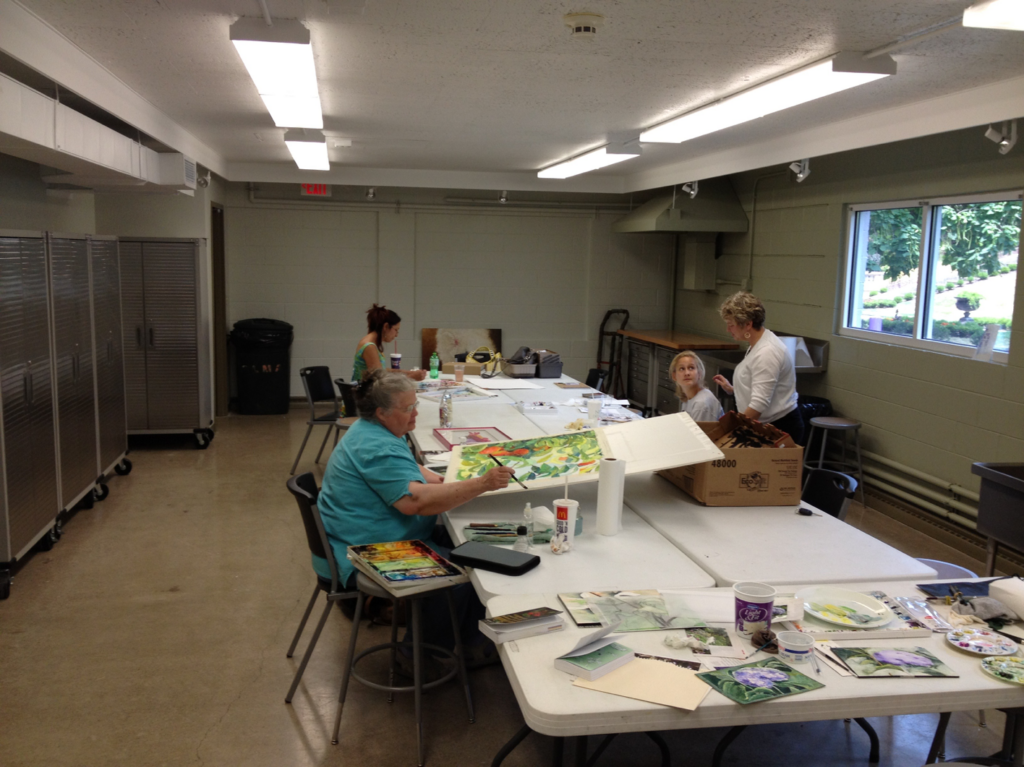


Art Classes Around Town
» All Fired Up
In addition to its paint-your-own pottery studio, All Fired Up offers off-site parties and pottery-to-go kits with everything you need to complete a masterpiece. Items painted with pottery paints can be returned to the store for firing to make them food safe. Decorative items that do not need to be food safe can be finished in acrylic paints. Learn more at allfiredupwestlafayette.com.
» Art Museum of Greater Lafayette
Find online art activities and tutorials as well as information about virtual art classes for youth and adults at the Art Museum’s website, artlafayette.org.
» Art with a Happy Heart
In addition to private paint parties, artist-led workshops and even yoga classes, this recently opened studio and gallery holds open studio events where you’ll walk away with your own seasonal craft. Find out more at artwithahappyheart.com.
» Inspired Fire
Owned and operated by glass artist Sharon Owens, this glass studio and gallery located in Shadeland offers a range of classes for ages 6 and up with no experience required. See a complete list of class offerings at inspiredfire.com.
» Lafayette Atelier
Modeled after private art studio schools that emerged in 19th century Europe, this nonprofit art education studio was founded by artist James C. Werner. Focused on classical methods of drawing, painting and sculpture, the studio offers weekly demonstration and life
drawing nights. Find them on Facebook @classicalfinearttraining.
» LaLa Gallery & Studio
Owner Angela Taylor teaches lessons, classes, parties, groups and students with special needs starting with children (3+) to adults in her private pottery studio located in the Bindery Artist Studios. Each class offering can be customized according to the student’s interest and level of experience. For more information, visit lalagallery.com.
» West Lafayette Parks and Recreation
Everything from basket weaving to watercolor to photography is on offer through West Lafayette Parks and Recreation. All programs take place at 1200 N. Salisbury St. (site of the former Happy Hollow Elementary School). View the entire recreation brochure at westlafayette.in.gov/parks.
BY ANGELA K. ROBERTS
PHOTOS PROVIDED BY GREATER LAFAYETTE COMMERCE
When you think of Greater Lafayette, what comes to mind?
A growing startup culture and world-class manufacturing?
Accessible arts and recreation for varied interests? Friendly
neighbors and excellent public schools?
For the members of the Greater Lafayette Marketing Coalition (GLMC), these qualities and more boil down to this core message, which marketing professionals call a brand promise:
“Greater Lafayette is where progress, creativity and community thrive, so you can live expansively.”
More than two years in the making, the unmasking of the brand — unveiled in the Long Center in October to dispersed guests sporting an assortment of understated and glittered masks — includes new social media accounts, a video, a set of Greater Lafayette logos and a fresh website in a saturated palette of purple, green, orange, blue and teal. The stories that the visuals and the text tell are all designed to send the message that Greater Lafayette is not just a place that we come to; it’s a place where we want to stay.
Roots in the GE deal
Greater Lafayette’s brand is rooted in part in lessons learned from a major business development deal.
“We continue to hear stories of people who came here and thought they would stay for a while, but they never left,” says Cindy Murray, Lafayette city clerk. “When we were going through the process to bring in GE, what they used to choose our community, it really began to hit home that we needed to market ourselves to compete in a global economy for global talent.”
When the GE plant was built, she says, corporate officials stayed at the Holiday Inn Lafayette-City Centre and participated in a community scavenger hunt. Afterwards, the visitors met with Lafayette Mayor Tony Roswarski and remarked that they didn’t know the region had so much to offer. Murray says that the mayor and his staff realized that they needed to tell the Greater Lafayette story in an entirely new way. “It’s all about people, the quality of life for people that makes them give Greater Lafayette a chance,” she explains.


A phased process
In May 2018, Greater Lafayette officials invited firms to bid on developing a comprehensive strategy. Ultimately, they chose Ologie, a firm that has worked with Purdue University in the past.
“They are a true branding agency who helps companies with clear, compelling and consistent strategy,” says Emily Blue, senior manager of brand, advertising and sponsorships at Purdue, who has been intimately involved in Greater Lafayette’s branding process.
The firm completed a deep dive with both qualitative and quantitative research, including an audit of economic development plans and communications materials, discussion groups and interviews with key stakeholders, and an online survey of the community. Among the constituents queried: corporations, businesses, K-12 schools and higher education, community and nonprofit organizations and government organizations.
Strategy and creative
The Greater Lafayette Marketing Coalition formed in February 2019, bringing together representatives from the City of Lafayette, the City of West Lafayette, Tippecanoe County, Visit Lafayette-West Lafayette, Purdue University, the Purdue Research Foundation and Greater Lafayette Commerce. One of the group’s first decisions was to ask member organization Greater Lafayette Commerce to coordinate the project and brand management for the coalition. Greater Lafayette Commerce promoted its marketing director, Michelle Brantley, to the role of project leader and brand manager.
Once the discovery process was complete, it was time for phase two, strategy. Against the backdrop of its research report, and with GLMC in a collaborative role, the firm identified key audiences, outlined key messages and defined a brand personality — how that messaging should look, feel and sound.
As phase three, the creative, began, GLMC again engaged in a competitive process, choosing Toledo, Ohio-based Madhouse Creative for the video, and homegrown advertising firm Dearing Group for website development. Officials also began training a small group of Lafayette business professionals, executive directors and community leaders — “An ambassador group to generate excitement,” says David Byers, Tippecanoe County commissioner.
A community on the rise
Collectively, the identity is designed to meet three main goals: increasing the talent pool by retaining and attracting a citizen workforce; spurring economic growth by attracting business investments and elevating quality of life; and increasing positive perceptions of the Greater Lafayette region. All of that can be summed up in the nearly five-minute video, starring a former NBA dancer and her husband.
“We were challenged to tell our story as a community on the rise in an exciting way,” says Brantley. “We’re focused on prospective employees, businesses and others that we are seeking to attract to our area.” That required several messages, borne out of the constituent research: what kinds of value-addeds transplants get when they relocate here, how Greater Lafayette often exceeds newcomers’ expectations, and why the region is a great place to do business.
All that, and they were shooting during a pandemic.
True fiction
After crafting a narrative, the Madhouse Creative team decided to cast a couple living in the same household so that they could shoot up close and still adhere to infection control protocols. Strategic camera angles allowed the two main characters to be shot in view of others while socially distanced from them. Filmed in August, many of the scenes take place outside.
The main character, an advanced manufacturing professional from a big city, interviews with several local companies before joining the crew at Subaru. While out running one day at the Celery Bog, she meets an agricultural tech entrepreneur. From dates at the Bryant, to bike rides, to a city hall wedding and walks with a baby stroller, we see the couple meet, fall in love — with each other and the community — and set down roots here.
Even in its fiction, the story should ring true to those who are familiar with Greater Lafayette, from the many familiar sights and sounds to the feelings that it evokes. As the protagonist muses, “When I moved here, I was looking for change. But what I found was home. This is the rich, full life I’ve always wanted. Each of us, every single person in our community, is what makes this place… greater.”
The Greater Lafayette Brand Launch Event
Un-Masking the Greater Lafayette Brand
PHOTOS BY CHRISTINE PETKOV
The Greater Lafayette Marketing Coalition held a scaled back brand launch event on Monday, Oct. 26, hosting a group of elected officials, corporate,
university and civic leaders, and brand ambassadors.
The event was planned in two parts to disperse guests and maintain COVID-19 protocol. GLMC partnered with restaurants and The Long Center for Performing Arts to provide a safe and entertaining brand premier event. Guests were asked to select their restaurant of choice and enjoy a four-course meal before the premier. Mixing and mingling at the restaurants was discouraged. Each venue was unique, providing guests with live entertainment and surprise swag bag deliveries during the dinner party experience.
After dinner, guests made their way to the Long Center for the brand premier, where they were treated to a red-carpet experience complete with a Greater Lafayette Walk of Fame. Again, mixing and mingling was minimized and guests were directed to their socially distanced seats. The program began with a dazzling performance of the Greater Lafayette brand narrative by Dance Dynamics. It was followed by short segments that revealed the elements of the new brand, including brand colors and logos, Greater Lafayette Magazine, the website and brand video.
We encourage readers to view the video at www.greaterlafayetteind.com,
the home page of the Greater Lafayette website.


Greater Lafayette’s own “Walk of Fame” 
Remy performs at Red Seven. 
One of four dinner menus and locally curated swag bag items. 
Bekki Canine performs at Bistro 501. 
Dance Dynamics performs at the Long Center for Performing Arts. 
Staff at 8Eleven Modern Bistro prepare for the arrival of guests. 
Scott Walker, CEO and President of Greater Lafayette Commerce, reveals the new website during the brand premier. 


Commissioner Tracy Brown, Beth Brown, GLMC Project Leader and Brand Manager Michelle Brantley, City of Lafayette Clerk Cindy Murray, and Commissioner David Byers delivered swag bags to guests during the dinner parties. 
BY CINDY GERLACH
PHOTOS PROVIDED BY VISIT LAFAYETTE – WEST LAFAYETTE
If someone had suggested 15 or 20 years ago that you take a drive down Wabash Avenue, that suggestion may have been met with hesitation — apprehension, even.
And a suggestion to view the art? Laughable.
Today, what was formerly a hidden neighborhood, a sort of secret enclave of life along the Wabash River, is now a bright spot. And much of the credit goes to Wabash Walls.

This public art installation, a series of murals painted on the sides of buildings both residential and commercial, has breathed new life into this decades-old neighborhood, often considered on the fringe of Lafayette society.
The project got started back in 2016 and 2017, says Tetia Lee, executive director of the Tippecanoe Arts Federation and one of the curators of Wabash Walls.

“At the time, as an artist myself, I’m always looking around,” Lee says. “When I see a beautiful wall, I think a mural would look great there.”
Lee was struck by a retaining wall along Second Avenue; the wheels of inspiration started turning. She ran into Margy Deverall with the City of Lafayette at a Neighborhood Beautification Coalition meeting. She threw the idea at Deverall: Let’s do a mural festival.
“It was all very organic,” says Lee. “We were both ready to take a bigger next step.”
And, as they say, from small things, big things come. The conversation began to draw in others — Stephanie Bible with Habitat for Humanity, artist Cameron Moberg, and Dennis Carson with the City of Lafayette. A proposal was put together, and initial funding provided $50,000 for a project that would be transformative, uplifting and engaging.
The result is a project that has indeed reinvigorated and re-branded the neighborhood. Lee has seen buy-in from not just the artists, but from local businesses – Cargill Inc. came on early as a sponsor — and neighbors. Everyone has delighted in watching the neighborhood come alive with color.

Wabash Avenue has long been considered a marginalized area. The working-class neighborhood, often referred to as the “lower part” of town, is a stronghold of a bygone era. And its reputation has suffered over the past several decades.
It’s a bad rap that seems undeserved, as a current drive through the area reveals tidy houses with well-kept lawns and a diverse population, with younger people gravitating there to live and work. Not to mention a neighborhood spirit that is evident.
“The most important part is that we established a trust with a neighborhood that is marginalized and over promised,” Lee says.
The Wabash Avenue residents were quick to get on board with the project. Early on, Lee says, they opened their doors, inviting her in as the early stages of the feasibility study kicked off.

“They became the vital and most-important part of informing the neighborhood study,” Lee says. “That really demonstrates trust between the city and the neighborhood.”
People who live there can see the charm that others might not. And the murals helped highlight the beauty hovering at the surface.
“They got excited about having artwork in their neighborhood,” Lee says. And about the influx of visitors, as the artists and those who want to view the art descended on their once hidden part of town.
“That’s the real reason it’s been so successful,” Lee says.
Trent O’Brien and his wife, April, run Sacred Ground Coffee House. Like most of the neighborhood, they have seen nothing but positives come out of Wabash Walls.

“It was definitely a really good thing,” O’Brien says. “The whole area has changed.”
O’Brien has seen people getting more involved in the neighborhood, becoming more welcoming. Last year, Sacred Grounds helped host a neighborhood Harvest Festival. Years ago, maybe a handful of people would have shown up, but this 2019 festival brought out hundreds of people.
“This never would have happened 15 years ago,” O’Brien says. “I do believe the art has helped.”
This opening up of the neighborhood, this newfound sense of community is a credit to the art and the artists, he says.
“It brought people here who were out to see the art,” O’Brien says. “It has been very positive.”
In 2018, 10 murals were painted in the neighborhood; 2019 saw 11 more added. Artists featured were from all over — not just the United States, but from as far away as Australia. The onset of COVID-19 delayed the progress for 2020, but the project will expand to areas around the avenue, including crosswalk art to encourage more pedestrian-friendly zones.

Funding from the National Endowment for the Arts and Indiana Department of Health have helped the project continue for a third year.
The fun and funky murals are a boon for the neighborhood, providing beauty, conversation and a real sense of shared identity. Visitors have come from all over the city, the county, even the state, anxious to check out the project.
But the real benefits are more far-reaching. Lee says they’ve seen property values increase as the art has helped improve the area, making it a better, healthier place for residents to live and interact with one another. Once-abandoned buildings have been reclaimed and now feature murals. The micro-economy in the neighborhood has improved as the area has rebranded. It’s a huge improvement in the quality of life.
Working with the neighbors, watching the project come to life has been an amazing process, says Lee.
“Wabash Walls continues to be a highlight to my career,” she says. “I could not have asked for a better neighborhood to work in. They treat me like family. I’m an honorary resident — I love it.”

Because at the end of the day, it’s truly about people.
It’s about the artists who have spent time in the neighborhood, sharing their stories with folks who would stop to watch the work and visit for a bit. It’s about the residents who have opened their arms, welcoming and embracing both the artists and the patrons who come to see the art. It’s about businesses that have come alive and welcomed the partnership of the artists, encouraging the camaraderie among all involved.
It’s the story, Lee says, of the transformative power of art.
“More than ever, we are turning to the arts to remind us that we’re human.”
BY CINDY GERLACH
PHOTOS BY CHRISTINE PETKOV
Small Business Saturday is a national movement launched in 2011, designed to get shoppers into smaller locally owned businesses on the Saturday after Thanksgiving. Locally, friendly neighborhood businesses partner with Greater Lafayette Commerce and offer specials and swag bags, resulting in a festive holiday shopping atmosphere.
Small boutique shops offer products that are often local and more specialized, says Richelle Peterson, owner of Richelle in a Handbasket at Market Square.
“We’re all about gifts,” she says. “We go back to the basics of giving with a purpose.”
At Richelle in a Handbasket, the shopping experience is very low-key and stress-free, very friendly. Customers are always greeted with a warm hello, Peterson says, and the shopping experience is very personal. There won’t be fighting in line or battles over items; instead, people will sit back, enjoy a cup of hot cocoa, and find exactly the gift they were looking for, as Peterson and her staff help customize gift baskets and selections.

“It’s like you’re coming into my house,” Peterson says. “It’s warm, it’s very laid back, very happy.”
Helping customers find exactly the gift they are looking for, and not just settling for what is easy, is part of the shop’s mission, says Peterson. They specialize in customized gift baskets, which can be tailored to meet a customer’s exact needs, thus creating the perfect gift.
“We help people put thought into their gifts,” she says. “We try to make it a little more personal. People can take their time. It’s about the thought — we help with that. We’re here to help, not to push.”
At Boutique LoriAnn, 101 N. Sixth St., the emphasis is on quality and catering to customers’ exact needs, says owner Lori Schlaifer. Holiday shopping in the boutique will be upscale and, again, more personal.

The shop won’t be as crowded as a women’s clothing retailer at a mall, she says. And because she only orders a very limited number of each item, a customer can be sure that she won’t see everyone she knows wearing the exact same item she buys.
Because her boutique is small, Schlaifer gets to know — really know — her customers, their likes and preferences. When an item comes that she thinks might suit someone, she lets them know.
“It’s more intimate,” she says. “It’s more personal.”
Down the road at Stall & Kessler’s, 333 Columbia St., the focus is also on personalization and customization, says co-owner Kris Kessler. The shop values all its customers, he says — “We’re excited to see anyone walk in the front door.”
As a specialty business, they do focus on high-end jewelry, and pieces are customized to each person’s needs — everything from earrings, bracelets and necklaces to cufflinks and specially designed rings. People tend to think that means a higher price tag, Kessler says. But that is not necessarily the case.
Plus, he feels they are selling much more than a mere product.
“We’re selling on a deeper level than most retailers,” he says. “We are selling quality pieces of jewelry that celebrate these moments in people’s lives. I really find the joy and the connection when people come in and are celebrating that engagement or anniversary.
“Yes, what we’re selling is rock and metal. But it’s part of these moments in a lifetime. We really cherish that.”

There are people who might find shopping downtown intimidating, fearful of finding — or, more importantly, not finding — parking, or of stores not feeling welcoming. That could not be further from the truth, say both Schlaifer and Kessler.
“One of the nice things we have downtown is parking that is 15 feet away from our front door,” Kessler says. “At the mall, it’s a lot longer walk.”
Schlaifer agrees — it’s one of the benefits of her location at the corner of Sixth and Columbia streets, which is surrounded by two-hour parking spots.
“It’s pretty easy to find parking,” she says.
When people shop in locally owned businesses, much more of the profit stays in town. According to shopsmall.com, for every dollar spent at a small business, about 67 cents stays in the local community. Locally, businesses noted an 80 percent increase in sales on Shop Small Saturday over a regular Saturday, according to Greater Lafayette Commerce.
Peterson says this is definitely part of the appeal of Richelle in a Handbasket, which proudly features locally made products.
“People shop here because we have Indiana products, a plethora of them,” she says.
The effects of COVID-19 will certainly affect how people shop this holiday season. Kessler says their store has never been cleaner as they focus on keeping their environment as safe as possible for everyone.
And Peterson says she has seen a huge shift in how people interact given the limits on how people can be together. She has shipped a lot of gifts so people can send a little love with a gift basket, because people can’t be near those they care about.
“I think people have forgotten how to be human in their giving,” Peterson says. “A lot more matters. Families, people, neighbors matter. I think it’s brought some humanity back.”
But the biggest benefit of shopping small is the relationships among people. Kessler says he has seen many people turn to online shopping during these days of the pandemic. Stall & Kessler’s is not set up for online shopping. However, he says, their staff can make that work. They were recently able to help a customer purchase a piece of jewelry as an 80th birthday gift — over the phone. It was an accommodation they were happy to make.
“We really appreciate the people who choose to support us,” he says.
Christmas shopping should be fun. Gift-giving should be about the thought and about the experience. Local businesses, Peterson says, are better able to make those connections with customers and make it happen.
“We like talking to people,” she says. “We want people to enjoy shopping and enjoy giving, not break the bank. In today’s world, that matters.”
Exciting changes for Shop Small 2020
Greater Lafayette Commerce and its Main Street committee are developing a series of scavenger hunts, using the GooseChase app, to promote local businesses this Shop Small season. The scavenger hunts will run through December 31. Participating small businesses will create missions for people playing the games. Players need only download the app on their phones and click the shop small missions.
The scavenger hunts will include missions where participants take photos of special items within stores, photos of the foods they eat, or videos of them making purchases. Players will compete for points; the more missions someone completes, the more points they earn. There will be prizes for top point earners (swag bags filled with gifts and gift certificates from participating businesses).
To help maintain social distancing the missions will be randomly ordered to drive players to different stores every day.
“We know our small businesses are gearing up this year to offer consumers unique products and gifts. We hope the players find the scavenger hunts to be a fun way to get their competitive juices flowing while getting them out to the retailers’ shops,” says Mark Lowe, small business consultant for Greater Lafayette Commerce.
You can learn more about Shop Small Greater Lafayette at greaterlafayettecommerce.com Or contact Mark Lowe at mlowe@greaterlafayettecommerce.com. To participate in the Shop Small Greater Lafayette scavenger hunts, players can download the GooseChase app at goosechase.com or from the google or apple app stores.
BY KEN THOMPSON
PHOTO BY CHRISTINE PETKOV
In a region that has more than its share of locally owned restaurants competing with national chains, it should be no surprise that Greater Lafayette has a mixture of long-time favorite donut shops, two others on the way to earning that status and a newcomer that is growing its clientele.
Mary Lou Donuts
Mary Lou Donuts opened for business in 1961, but the only thing about it that feels close to its age is its mid-century modern A-frame building on South Fourth Street.
That’s because owner Jeff Waldon is always thinking about the future while making the most of the present. What did Waldon see when he purchased Mary Lou’s in 2017?
“That it could be bigger than that little A-frame on Fourth Street,” says Waldon, a former teacher and Lafayette Jeff girls basketball coach. “The people who came before me – Mary Lou Graves, Keith Cochran and especially Brian Freed, who spent 37 years of his life there – 27 years as owner, 10 as a worker. They made that place. All we needed to do was not screw that up.”
Waldon and his son, Courtney, made sure of that by sticking to what makes Mary Lou’s so popular. They make their own glaze, whipped cream filling and icing.
“It’s a fresher product,” Waldon says. “The more you can make it like home-made, the better it’s going to be.”
COVID-19 affected Mary Lou’s like it has virtually every business in the United States. Closing time is now at 1 p.m. Monday through Saturday. Mary Lou’s is closed Sundays, and that will remain in effect even when the pandemic guidelines are rolled back.
Mary Lou’s counter remains closed but the drive-thru is doing good business. Even the regulars have found a way to enjoy their coffee and donuts.
“I used to have a 9 o’clock group, a 10:30 group and I had my 1 o’clock guys, motorcycle riders who would come by and eat every day,” Waldon says. “My 4 o’clock group that was there until we closed, and we usually had to kick them out at 5, now some of those people are coming in the morning and sitting in their lawn chairs in the parking lot.”
One of Waldon’s innovations – the food truck – also has been mostly sidelined by COVID-19. The good news is he’s getting ready to roll it back out this fall in smaller communities.
When the food truck hits the road, demand will be high for Mary Lou’s apple fritter.
“It’s the best one ever, anywhere,” Waldon says. “No one makes one like it anywhere.”
Like elsewhere across the country, the glazed yeast donut is popular. So is Mary Lou’s blueberry cake donut. Waldon looks forward to when he can reopen the front doors so he can sell more iced sugar cookies and cut-out iced cookies. Waldon boasts of having sold 15,000 cut-out cookies at Christmas.
“We just started doing blueberry muffins, chocolate, chocolate chip and banana nut chocolate chip,” he says. “Not everybody loves donuts and when you get something for the family, we want to make sure everybody gets something.”
Mary Lou’s will get a boost when the Big Ten Network airs its third season of “Campus Eats.” The production team spent the weekend of Sept. 12 at Mary Lou’s.
If Waldon gets the chance, here’s the message he’d like to send to Big Ten country.
“Wherever you came from, you probably had a favorite donut. And if it’s unfortunate enough to have been one of the big chain donuts, you really missed out. If you have a favorite hometown donut, you are going to go to (Mary Lou’s) and you’re going to forget about all those other places. The thing about our product—and I hear it over and over and over again—is that people will say I’ve never had another donut like this anywhere. The taste, the texture, the size of donut I get, the quality and the price, it’s ridiculous.”
O’Rear’s
This mainstay of downtown Lafayette has been around since the 1920s when William O’Rear opened the bakery. O’Rear’s moved to its current location, 312 N. Ninth St., in 1957.
Greg and Judy Lintner have owned O’Rear’s since 2005, coming from a family that owned a bakery in Rensselaer for 47 years.
“When we came from Rensselaer … we were more of a breakfast roll and cake bakery but we did everything: cookies, brownies, pies,” Greg Lintner says. “You name it, we did it, just like here. The only difference is we do a few rolls compared to a ton of rolls we did in Rensselaer. We are more of a pastry shop with all our cookies, cupcakes and brownies. I like it a lot better.”
Lintner admits that competing with the likes of Mary Lou and Corlew Donuts is difficult since donuts are “90-some percent of their business.”
“Whereas when you come in here you see just a few pans of donuts we make,” he says. “Sometimes what’s so frustrating is you make six or seven pans and sell three. The next day you sell them out and customers ask where are your donuts.
“My mother and father told me from the get-go when I first got into the business, if you can figure out the American public, you have done something that we have not done yet. You don’t know from one day to the next who is coming through that door.”
When customers do come in to O’Rear’s, they ask for pastries, cupcakes, cut-out cookies and regular cookies. Two big sellers are the butter stars and tea cookies.
“Judy makes those two or three times a week,” Lintner says. “She’ll always tell me, ‘You’re not going to believe this but we have to make tea cookies again.’ Just to show you the difference between Rensselaer and here: the red star cookies that we do are a staple here. In Rensselaer, it was strictly a holiday cookie.
In addition to closing six days a week at 1 p.m. (O’Rear’s is closed on Mondays), COVID-19 has affected business. With the churches being closed in the early days of the pandemic due to Indiana’s stay-at-home mandate, Sundays were no longer one of O’Rear’s most profitable days.
But a couple of positives did come out of the COVID-19 regulations.
“Since coming back now, our cakes are even fresher than they used to be,” Lintner says. “Now we make smaller batches, so they are even fresher and more moist.”
O’Rear’s also changed the way it displays its baked goods.
“One good thing that’s immensely helped is everything is now packaged,” Lintner explains. “Whereas before people almost frowned on the fact that it was packaged. They wanted it from the pan, open aired. Now our shelf life has doubled or tripled because it stays fresher longer.”

Hammer Donuts
The West Lafayette bakery gets the word out to Purdue University students and the public about its product mostly through social media platforms Facebook, Instagram and Twitter.
Owner Michael Cho, who started working at Hammer Donuts as a manager, says marketing was a lot easier before COVID-19 sent most of his clientele packing from Purdue housing.
“We lost a few orders due to the impact of this pandemic. We used to have weekly standing orders from a few churches and wedding orders from time to time. However, we are fortunate that we still have the order from Circle K convenience stores, which can keep our business running,” he says.
The seven Circle K Stores in West Lafayette are now the only places to buy Hammer donuts. The pandemic forced Hammer to alter its sales from retail to a store-to-store business.
Cho believes in the potential for Hammer Donuts’ growth, so much so that he says he decided to take a risk and take over when the previous owner, a partner of Discount Den, was selling it.
Popular items include filled donuts, glazed yeast donuts and cereal topping donuts.
“We are a local business and we try our best to keep everything local,” Cho says. “Our employees are mostly Purdue students. Almost all of them are inexperienced and for many of them, this was their first job. We taught and trained them how to make donuts from scratch.
“We often support student events by donating free donuts. We are a new and growing company, but we are always trying our best to give back to our community.”
Mama Ines Mexican Bakery
Rosa Cornejo is one of 10 children raised by Maria Ines Cornejo in the small village of Salazares Tlatenango in Zacatecas, Mexico.
There, Rosa Cornejo developed her personal philosophy of “everyone else’s ‘can’t’ is my “I can.’”
After moving to Lafayette and establishing herself in the community, Cornejo likely heard people saying “she can’t” when opening the bakery named after her mother.
What those doubters didn’t realize was that the decision to open a bakery was not made lightly. Rosa and her sister, Livier Alvarez, saw many Mexican restaurants in Greater Lafayette but not many bakers that were serving Mexican bread. That’s as much a staple in the Latino diet as donuts are to Americans.
From a modest beginning, a 1,000-square-foot location on Greenbush Street and Sagamore Parkway, Mama Ines made the big leap into an 11,000-square-foot building in 2014, once occupied by Ryan’s Grill, Buffet and Bakery.
Mama Ines’ authentic holiday Mexican fare of Day of the Dead bread and Sugar Skulls drew attention from the PBS show “A Few Great Bakeries” in 2015. In 2016, Cornejo was cited by the state of Indiana as the Latino Business Owner of the Year.
In addition to Mexican Sweet Bread, the bakery’s most popular items are tamales and burritos, cakes, flan and specialty desserts, cookies, fresh fruit and vegetable juices. Mama Ines also is proud of its wedding cakes, made with only fresh, all-natural ingredients.
Corlew Donut Co.
The apple fritter is also a popular item on the menu at Corlew Donut Co., which has been in business since 1999.
Debbie and Tom Corlew were among the first to see the potential for business along what is now Veterans Memorial Parkway. They’ve been rewarded with a loyal following that indulges in cinnamon rolls, tiger tails, cream-filled bismarcks and blueberry cake donuts.
Corlew Donut Co. is open Tuesday through Sunday from 5 to 11 a.m.
BY ANGELA K. ROBERTS
PHOTOS PROVIDED BY VISIT LAFAYETTE – WEST LAFAYETTE AND NICHES LAND TRUST
“Indiana … is a garden
Where the seeds of peace have grown,
Where each tree, and vine, and flower
Has a beauty … all its own.
Lovely are the fields and meadows,
That reach out to hills that rise
Where the dreamy Wabash River
Wanders on … through paradise.”

In his ode to Indiana, “Indiana,” that was adopted as the official state poem in 1963, Arthur Franklin Mapes (1913-1986) did not specify during which season he most enjoyed the fields, hills and the wandering Wabash River. Most of us today would agree, however, that when the greens of an Indiana summer transition to the golds, auburns and russets of fall, it’s a great time to get out into nature.
In anticipation of this most colorful season, we laced up our athletic shoes and road-tested several trails in Greater Lafayette, including some far off the beaten path. Here are our recommendations.
Clegg Memorial Garden
Ninety years ago, Harold and Ruth Clegg purchased a plot of land overlooking Wildcat Creek as a country home. After the death of their only son, they turned their private garden into a public memorial and added trails for visitors to enjoy. Today, the botanical garden is owned by Niches Land Trust, a west central Indiana conservation group whose offices are located in the former Clegg cottage. Sloping 100 feet down into the valley, the well-maintained paths meander through a variety of ecosystems, including woodland, prairie and savanna. During fall’s peak, the canopied forest displays an array of vibrant colors. Bridges connect some parts of the trails, but be careful of some narrow slopes on the way downhill.
• 1782 N. 400 East, Lafayette
• Parking: Gravel lot across the road from the property entrance
• 16.5 acres with 1.1 miles of trails
• nicheslandtrust.org

Granville Sand Barrens
Ten miles southwest of West Lafayette lies a rare Indiana example of a sand barren, a sandy-soiled area that appeared in the wake of glacial melts. The Granville Sand Barrens, adjacent to the Roy Whistler Wildlife Area, includes a restored prairie and savanna. Niches Land Trust has mowed a half-mile trail along which you can enjoy a dense group of golden aster — also a rarity in the state — and other wildflowers. The sandy soil is most visible just before the trail connects with a forested section that is part of the Roy
Whistler Wildlife Area.
• Southwest of Granville Bridge in western Tippecanoe County
Closed in November for deer-control hunting
• Parking: Gravel and grass lot at the trailhead
• Size: 80 acres with a .5 mile-trail connecting to the Roy Whistler Wildlife Area
• nicheslandtrust.org
Mulvey Pond

Considered one of the better places in the West Lafayette area to see waterfowl and shorebirds, Mulvey Pond is nestled among farmland, wetland and marshland just off US 231 near Montmorenci, an unincorporated town north of West Lafayette. Niches Land Trust operators have mowed a labyrinth of sorts into the tall prairie grasses around the pond, where birds and insects drown out the hum of nearby roads.
• Near Montmorenci off US 231
Seasonal Features: Waterfowl migration
• Parking: Gravel lot at the trailhead
• Size: 52 acres with mowed trails through the prairie
• nicheslandtrust.org
Celery Bog Nature Area
Once a large vegetable farm operated by immigrants from Holland, the Celery Bog Nature Area now provides a suburban respite near several neighborhoods and apartment complexes. Operated by the West Lafayette Parks and Recreation Department, it contains both paved and unpaved trails rambling through prairie, savanna, woodlands and marshland. Cattail Trail, which runs through the Celery Bog and passes by Lilly Nature Center, is part of the city’s 27-mile paved trail system and is designated as a National Recreation Trail. Bicycling is allowed in paved areas.
• 1620 Lindberg Rd., West Lafayette
• Parking: Paved and gravel lots near trailheads and the Lilly Nature Center
• Restrooms: Lilly Nature Center
• Size: 195 acres, with 4.3 miles of paved trails and several footpaths with interpretive signs and viewing decks
• westlafayette.in.gov
Trailhead Park
North of the Celery Bog, tucked away near Purdue Research Park, is the tiny Trailhead Park. The park links to a fairly wide, straight section of the National Recreational Trail-designated Northwest Greenway Trail. Walkers, runners, bicyclists and rollerbladers share this section of the paved path, which starts at the roadside park and connects to the Soleado Vista neighborhood up north. South of Kalberer Road, the trail continues, eventually joining up with Cattail Trail. If you travel east along Kalberer, the trail connects to Cumberland Park.
• Intersection of Kalberer Road and Kent Avenue, West Lafayette
• Parking: Just east of the trail, next to a shelter and picnic tables
• Size: 4 acres
• westlafayette.in.gov
Armstrong Park
A beautifully landscaped greenspace with tennis courts, softball fields and the Castaway Bay swimming pool, Armstrong Park anchors the corner of South Ninth Street
and Beck Lane on the south side of Lafayette. Named after Purdue alumnus and astronaut Neil Armstrong, the park features Armstrong Trail, a paved asphalt loop encircling the pond. Lafayette Parks & Recreation maintains the trail, part of 6 miles of paved trails in the city, along with many more unpaved. All Lafayette trails are available for walking, running, bicycling, rollerblading and cross-country skiing. Pets must be leashed. Because of its popularity as a dog-walking destination, Armstrong Trail may not be suitable for dogs that aren’t well-socialized.
• 821 Beck Lane, Lafayette
• Parking: Several lots, including one near the tennis courts and north end
• Size: 30 acres with a two-thirds mile trail
• lafayette.in.gov
Prophetstown State Park
For thousands of years, Native Americans hunted and lived in the area near current-day Battle Ground where the Tippecanoe and Wabash rivers meet. Today, Prophetstown State Park, named for an indigenous village established in 1808 by Tecumseh, who was Shawnee, and his brother Tenskwatawa, who was called the Prophet, features 2,000 acres where park officials are restoring native landscapes. Nine miles of trails ranging from easy to moderate snake their way through the park, which also includes picnic areas, a campground and seasonal aquatic center. Trail No. 1 takes you through a former Christmas tree plantation of Douglas fir before winding its way through tallgrass prairie, a marsh and a field of wild cherry and Osage orange (hedge apple) trees.
• Mapping address is 5545 Swisher Road, West Lafayette
• Gate fee: Noncommercial vehicles with Indiana license plates are $8, and with out-of-state plates, $10. Fee includes admission to the Farm at Prophetstown next door.
• Restrooms: Comfort stations and vault toilets in several locations
• Parking: Several parking lots are available, including some near trailheads
• Size: 30 acres with 9 miles of trails
• lafayette.in.gov
BY CINDY GERLACH
Everyone loves eating out. Perhaps your ideal evening is sitting down to fine dining, with candles and linen napkins, a fine bottle of wine; maybe you like to be perched on a stool across from your favorite bartender, chatting with other regulars. Or maybe your idea of a fun night out is grabbing hamburgers or pizza with the kids. However you do it, it’s a treat to have someone else mix your drink or prepare your dinner and have it brought to your table, served with a friendly smile.
And suddenly, in March, it all stopped. Under orders designed to help contain the spread of COVID-19, restaurants around the state were forced to close to dine-in customers, relegated only to carry-out. Restaurants quickly had to adapt and change. Now, as they slowly reopen their dining rooms to customers, what does that mean? What changes have they had to make? And what does the future look like?
Bistro 501
The popular restaurant on the corner of Main and Fifth streets in downtown Lafayette is not necessarily known for its carry-out menu, though it’s always been an option, says Theresa Buckley who, with sister, Cheyenne, and mother, Mary, owns and operates the restaurant.

Most people, says Buckley, choose the Bistro for its atmosphere and service. But when forced to shut its doors, having done carry-out, they were quickly able to adapt.
“We had to adjust what we were offering so it would travel well,” she says. They focused on a menu with entrées that would look appetizing when people opened the box.
Menu changes were made; staff members who had been servers were suddenly delivering meals — anything people could do to get hours.
Flexibility has been important. In general, Buckley says, they try to be as green as possible and not order a lot of disposable products. But with the carry-out model, they had to change. And change again and again, as food shortages might mean ingredients were not available, or a particular carry-out box or bag was suddenly not available through their suppliers.
They used the opportunity to unveil the Bistro Market, allowing customers to purchase specialty food items through the store, including dairy and eggs, bakery and breads, produce, butcher and fresh seafood, meal kits, pantry items (dried beans and pasta, deli items) and even household items such as hand sanitizer and paper products. It was an idea they’d been mulling, Buckley says, but with the shutdown, it seemed like an opportune time to try it. Yet it brought up its own issues, as many of the items purchased arrive in bulk, so plans had to be made for repackaging.
Following a deep cleaning, when the restaurant reopened in June, Buckley had to oversee a number of changes in protocol. The restaurant created a safety promise to its customers and implemented some changes, including one door for entry and a separate door for exits; all restroom doors have foot openers. Customers must have reservations. Employees are screened for their health every day and will be wearing masks, even in the kitchen. Tables are six feet apart, and parties must be six or fewer. Water service will be different, and salt and pepper will not be on the table.

Buckley is doing everything she can to keep the restaurant safe for both customers and her staff. She knows how much regulars miss sitting at the bar, but that reopening will have to wait until it’s approved.
It’s an unpredictable time, says Buckley, as she juggles the already challenging job of day-to-day restaurant business with the extra hurdles of life during a pandemic. Like many people, she has had difficulty getting the proper personal protective equipment needed for her employees. And she is sensitive to the needs of people struggling with anxiety and depression during these difficult days.
The restaurant’s bottom line has suffered, she says; with no Purdue graduation weekend or Mother’s Day brunch, Bistro lost business. With no downtown events, they know their revenues will be down. Ordinarily Bistro would have had its annual Lobster Bake and jazz Thursdays — sadly, not this year.
“We have a high ratio of high-risk guests,” she says. “It’s a lot to manage, and we’re trying to do so super-respectfully of our staff. We’re not comfortable taking risks with others’ health.”
Folie
Across the street at Folie, Hallie Gorup and her husband, John, were monitoring the situation long before many locals, as John is a local physician and their daughter was studying in Italy last spring. They were tuned in to what was happening with the novel coronavirus; thus, even before the state mandated closures, the Gorups had decided to shut Folie’s doors for a time.

“We were paying more attention than the average person,” Hallie Gorup says. “We decided the respectful thing to do would be to shut down temporarily.”
Many of their staff members are Purdue students, so when the university closed, they left, meaning Folie did not have to deal with layoffs.
As they pivoted to a take-out model, they dealt with many of the same issues Bistro did, as they tried to adapt a menu that is based on presentation, on a plate, to a box. The menu was scaled way back, and they used the opportunity to experiment with the menu; knowing that volume was down, if food items weren’t a big hit, they had not made quite the investment.
“It’s been a nice challenge for the chef,” Gorup says, as he would try out his creativity with different entrées. “Sometimes it was robust, sometimes it was nothing.”
When restrictions were lifted to offer wine as a carryout option, that helped boost the bottom line as well, Gorup says.
As the restaurant reopened, Gorup says the transition back was not too difficult.
“We were never a crowded restaurant,” she says. “And we have a small kitchen staff, which allows for better distancing.”
Folie has made accommodations to meet the guidelines, which means no bar seating and not filling the restaurant. And while there is a lot more cleaning, Gorup points out that they were already meeting those sanitation standards anyway. Staff members were already washing their hands frequently, and the sanitizing was already happening. Now they’re just more cognizant.
“Our biggest challenge is not being able to seat parties of six or larger,” she says. “But we’re more than happy to comply. You have to be a part of the solution.”
While the restaurant is not yet overflowing with business, they do have groups come in, pleased that there is someplace to go for a special celebration or an evening out. And they are weathering the storm. Summer has always been a slower time, and there is uncertainty about when large-scale entertaining will be back in full force.
“‘Recovery’ is a generous word right now,” Gorup says. “But I’m not complaining.”
Christos, The Bryant, Red Seven and Café Literato
For the Christos hospitality group, adding extra hygiene standards is just par for the course, says owner Manny Papadogiannis.
“For us, all the pieces were there — washing hands for 20 seconds, sanitizing surfaces,” he says. “Those are all in the health department guidelines.”
The restaurants have merely upped the work they were already doing. They’ve added hooks to bathroom doors, enabling customers to open them using their wrists; employees are wearing facial coverings.

Papadogiannis says they’re adhering to the county health department guidelines. But they are also tapping into other resources.
Customers are encouraged to use apps for reservations or to get their names on a wait list — available through the restaurant websites.
“Everybody has to step up their game,” he says. “You want to be safe wherever you go.”
Papadogiannis points out that, for all the worries about restaurants, they are much cleaner than other places. In a big box store, hundreds, maybe even thousands, of people go through each day. Restaurants have much lighter traffic and they are cleaning so much more often.
“If you compare the number of staff and customers we have coming in, we can do that with that ratio,” he says.
“It’s a little bit of an adjustment. But you do what you need to do to get through this. It’s going to take a while. It’s going to be a very long road for the restaurant industry.”
La Scala
La Scala used to be known for its farm-fresh food and Italian fare in its historic downtown Lafayette locale.
But that was before. It closed the doors on its dining room right before the shutdown.
Owner Kirsten Serrano found herself reeling, trying to figure out what to do as the business she and her husband, Paco, opened 21 years ago was shuttered.
The couple’s first response was to found Community Comfort, a plan to feed the community — because, Serrano says, that’s what she does. With donations, they fed between 1,200 and 1,300 people in one week.
“It was a lot,” she says. They were working around the clock.
But what was next?
“I literally just sat with a pencil and paper one day, and thought, what can we do?” she says. “We have all these assets — a community kitchen, a farm, experience.”
And the answer came to her — not out of pessimism, but out of realism. Because she does not see herself reopening La Scala before the time feels rights.

Hence, she developed Good to Go, a meal subscription service. It is modeled after many other meal-kit services, except with this one, it’s not just ingredients, but food that is chef-prepared, ready to serve.
“Our stuff is cooked, it’s ready to go,” she says. “It’s farm-fresh food; we prepare it and deliver it to your door.”
Good to Go is delivered on Thursdays. Depending on your plan, you’ll get entrees, sides, dessert, and an extra surprise — local products, extra produce from the farm or promotions.
As the service grows, they’ll be able to bring back more of their employees. It’s satisfying, Serrano says. Because, after all, feeding people is what she does best. And this venture? It’s helping La Scala stay afloat.
“We’re building a model that can survive a pandemic.”
Revolution Barbeque
Opening a new restaurant is challenging enough. If your grand opening was scheduled for March 2020? Well, it’s tough to open a new business when the entire country is shutting down.
But Revolution Barbeque has simply rolled with the punches, says Debbie McGregor. They just turned the opening into more of a soft opening.
“It didn’t stop us!” she says.
McGregor runs the new restaurant — an off-shoot, if you will, of Revolution Bakery on Fifth Street — with her daughter, Sarah McGregor Ray (the creative force, her mother says) and her son, Jonathan. Her husband, Geoff, a contractor, has helped with the remodeling of the restaurant on Main Street. It’s a true family endeavor.
The restaurant was already set up for fast-casual dining, says McGregor. So take-out food was easy enough to accommodate.
Because they ended up rolling out their business a little slower than they had planned, it allowed them to defer some remodeling in the dining room. And when they did open, they had rearranged the space, removing some tables to factor in distancing requirements.
“Not many people are able to reconstruct their whole dining room,” McGregor says.
Like all restaurants, they’ve paid attention to hygiene and sanitation standards. But of course, she says, they would have anyway.
“You are cleaning all the time; you’re always washing your hands,” she says. “We always wore gloves.” They just added a few extra steps, such as how they take items to and from the table.
And, sadly, they had to put away the cute napkin holders they had purchased for the tables — they’ll have to make their debut at a later date.
McGregor knows that for some people, dining out is still filled with some unease. But she is anxious to make everyone’s experience as painless as possible. For people worried about the exchange of cash or touching a screen to sign for a credit card transaction, she will meet people where they are, at their level of comfort.
Customers who were already regulars at the bakery had been eagerly anticipating the opening of the new barbeque place, McGregor says. And they’ve all been very supportive. From a promotion through Greater Lafayette Commerce promoting purchasing of restaurant gift cards to generous tips from customers, McGregor has felt embraced by the city.
“It has been working,” she says. “We’ve had good support from the community.”
As restaurants work to keep their doors open, anxious to serve their customers, Gorup says she hopes people will stop and realize how vital these businesses are to the lifeblood of Lafayette.
“They live in the community and they’ve always been very giving. When people need donations, restaurants are on the front lines, the first asked,” Gorup says. “I do hope there is better recognition and support for the restaurant community.”
BY KEN THOMPSON
In any other year, one of the joys of summertime is an ice cream cone after a ballgame or a day at the park.
But 2020 hasn’t been any other year. Fortunately for Greater Lafayette, two ice cream institutions and a relative newcomer are open for business. The COVID-19 pandemic impacted Silver Dipper more than the Original Frozen Custard and Budge’s, which unlike Silver Dipper, are seasonal businesses.
David Carlson, whose family opened the first of two Silver Dipper stores in 2001, lost about a month of business.
“In mid-March we decided to close out of an abundance of caution,” Carlson says. “We sold our existing inventory to other small independent ice cream shops in Indiana. By mid-April our supplier was ramping up production again and we decided to reopen.”

Silver Dipper, which has locations at 201 E. State St. and 307 Sagamore Parkway West, has strictly followed guidelines from the Tippecanoe County Health Department regarding cleaning, masks and social distancing.
“The reopening has gone well,” Carlson says. “Since we began accepting credit cards in 2016, we were already set up to provide contactless payment options. We also created an online store thru silverdipper.com, where customers can order and pay online, then pick up their order through carryout or curbside.”
The Carlson family spent years working in Chicago and commuting from northwest Indiana, all with a goal of buying a business in central Indiana. The Carlsons purchased the Baskin Robbins store at Purdue West in 2000, believing the presence of Purdue University and Tippecanoe County’s diversified economy was a good business risk.
A year later, the Carlsons broke away from Baskin Robbins and opened the Silver Dipper location on Sagamore Parkway. Two years later, the Levee store followed.
“We decided to go independent in order to have more control over product quality, pricing and equipment,” Carlson says.
“We consider the Sagamore Parkway store to be our ‘family store’ and the Levee to be the ‘campus store.’ But we see a lot of families and Lafayette customers at our Levee location too. Plus being the largest city in the county we see customers from all over the area.”
One of Silver Dipper’s trademarks is a variety of flavors, approximately 40 year-round flavors which are available on the website.
“We try to keep a variety to appeal to everyone, but it is customer demand that determines which flavors we carry,” Carlson says. “We also carry ‘no sugar added’ options as well as Italian ices, which are non-dairy and non-fat.”
When asked to list Silver Dipper’s best-selling flavors, Carlson names Zanzibar, Oreo, Cookie Dough, Zoreo (Zanzibar and Oreo mixed together) and Peanut Butter Cookie Dough.

Only Zanzibar made the lengthy list of Carlson family favorites, which include Toffee Chocolate Chip, This S&@! Just Got Serious, Chocolate Cherry Bomb, Coconut Almond Bliss and Pistachio.
Carlson and his family are grateful that not only have customers returned to buy ice cream but also merchandise such as Silver Dipper themed T-shirts, sweatshirts, hats, cups and stickers.
“Lately, we have seen customers purchase them as a way to support their favorite local businesses during this difficult time,” he says.
“We have been touched by the amount of support and concern for our business. We have loved being a part of the community the past 20 years and look forward to many more years serving our customers.”
When it comes to years of serving Greater Lafayette customers, few local businesses can approach the many decades that the Original Frozen Custard and Budge’s have been open.

The Original Frozen Custard had a humble beginning in 1932, when Florence and Charles Kirkhoff began selling vanilla frozen custard from a stand next to Columbian Park. A year later, the Kirkhoffs’ secret recipe was expanded to include chocolate and strawberry frozen custard.
The Kirkhoffs had to use salt to freeze their frozen custard because modern refrigeration and freezers were not yet available. While the recipe remains a secret to this day, we do know that frozen custard contains 4 percent egg yolk and a fraction of the whipped air contained in regular ice cream.
Another Frozen Custard tradition, the fruit drink, was created because Florence Kirkhoff didn’t care for soda pop. Charles Kirkhoff’s business sense, though, led to a deal with Coca-Cola in 1934. The Original Frozen Custard remains one of Coca-Cola’s oldest accounts.
The iconic art deco building was constructed in 1949 across from what is now Loeb Stadium. Twenty years later, the Kirkhoffs passed the business to their daughter, Charlene, and her husband, Dick Lodde. They expanded the menu to offer more products, flavors and food.

The Kirkhoffs originally called their business “The Igloo,” a name that was revived in 1998 by Bill and Kathy Lodde. The two Igloo locations on Veterans Memorial Parkway have expanded the line of Frozen Custard flavors, added more sundaes and sandwiches, including an old favorite: the Original Double Decker.
Budge’s (pronounced bud-gees) bills itself as “Lafayette’s best kept secret since 1942.”
Like the Original Frozen Custard, Budge’s had a simple beginning when Wallace Budge converted a gas station on the corner of 14th and Hartford streets into a root beer stand.
The original stand was razed in the 1950s and the current structure was built facing 14th Street. It was then that Budge’s added ice cream, burgers and other treats to the menu.

That helped Budge’s draw lunchtime business from nearby St. Elizabeth Hospital and after- school lines from Linnwood Elementary students. Budge ran the business until he sold out in 1968.
The years have passed, and St. Elizabeth is no longer in the neighborhood. Neither is Linnwood Elementary School. But Budge’s is still around and approaching its 80th birthday.
Its menu probably wouldn’t be recognized by Charles Budge today, with flavored drinks, a wide variety of ice cream, shakes, parfaits, sodas and sundaes. Food options range from the traditional cheeseburger to chicken tenders and coney dogs.
BY CINDY GERLACH
If you think downtown Lafayette is looking picturesque these days, then you’ve been watching its evolution. Over the past decades, while the downtown had its share of charm, sidewalks were looking as if they needed an update, a little tweaking to enhance the ambience.
Rejuvenating Main Street, a streetscaping program that has been underway for more than 15 years, continues this summer, improving sidewalks, adding gathering places downtown and planting trees.
It’s a beautification project that not only makes the downtown scene more attractive, but it is a boon to business as well.
Plans for this project date back as far as the late 1970s, says Dennis Carson, economic development director for the City of Lafayette. Funding was made available in the mid-2000s; the first phase of the plan was rolled out in 2005.
So why the need to change the look of downtown? For decades, when people lived and worked near the downtown, it was the major shopping and business center, with retail shops lining the streets, anchored by the Courthouse, with restaurants and movie theaters. It was the shopping and business district.

The feel of downtown Lafayette began to shift and change in the 1960s and ’70s, as it did in downtowns throughout the United States. With widespread use of the automobile and people moving farther away from the city center into more suburban neighborhoods, a shift occurred. By the 1980s, many businesses had fled to Market Square or the Tippecanoe Mall; single-screen movie theaters — places like the Long Center and the old Mars Theatre — had been abandoned in favor of larger multiplexes.
Downtowns were in danger.
But, Carson says, Lafayette’s downtown fared much better than those of other, similar-sized cities.
“Fortunately, even in that time, there was a lot of interest in downtown,” he says. Along with the Courthouse, many law firms and banks remained, as well as the newspaper and other government offices.
So the city took the lead, focusing on historic preservation. Much of the downtown consisted of buildings dating back to the first half of the 20th century, and the city wanted to preserve that architecture, knowing its value.
“One of the early efforts was historic preservation, to establish the historic district,” says Carson. “They really tried to preserve the architecture we have. We lost some, too, but we’ve been able to preserve a lot.”
But the need went beyond historic preservation and into safety. The sidewalks were so old that many had the WPA stamps, dating them back to the 1930s.
“It got to a point where not only did we need to do it for aesthetics, but there were several safety and ADA issues,” Carson says.
Thus the streetscape plan for downtown was meant to enhance the district on several fronts. Clearly, part of the goal was simply to beautify downtown. Sidewalks have been widened, and the corners are larger, with benches added, making it easier for people to gather.
And with wider sidewalks, downtown restaurants were able to take advantage and add more outdoor dining space.
Bike racks encourage people to use other methods of transportation. And public art installations add visual interest.
If you’ve walked through downtown, you’ve seen the improvements. These all make downtown more accessible to people with a specific destination or those who just want to walk and browse, soaking up the small-town yet big-city aesthetic.
“One thing we really want to improve on is the pedestrian experience,” Carson says. “So they don’t park, go into the shop, then get in their car and leave. We want to encourage people to walk the downtown as much as possible.”

For summer 2020, the project expands to upper Main Street, between 10th and 11th streets. Both sides of 10th Street, from Main north to Ferry, will see the widened sidewalks, striping and tree installation. The next phase will see the same improvements on the south side of Main Street between 10th and 11th, as well as 11th Street between Main and Ferry. The final phase, wrapping up at the end of September, will take the project south on both sides of 10th Street to Columbia.
The project is paid for through Tax Increment Financing, or TIF districts. Business owners have been asked to contribute to a portion of the project in front of their buildings.
“There was a little apprehension at first,” Carson says. “But once it was done, everyone was really pleased.”
The energy and enthusiasm associated with downtown has increased over the past few years, with urban living opportunities and more retail and restaurants than ever, says Carson.
Over time, that value will continue to increase. With the variety of arts and culture opportunities, the festivals, and more shopping and dining
options, people will continue to see and enjoy the revitalization of the streetscape project.
“It’s really transformed Main Street,” Carson says. “We’ve gotten a lot of comments; it’s been pretty well received. Over time we’ll see increased property values. It helps, helps maintain these historic structures. It’s been a fun thing and it’s been well received.”
For details on the project, visit lafayettedowntownisopen.com.
BY KEN THOMPSON
PHOTOS PROVIDED
Growing up in Lafayette during the 1960s and 1970s, I probably took for granted that my family lived between Murdock Park and Columbian Park.
Surely everybody had a basketball court/baseball field almost within eyesight of their house. Or a swimming pool, zoo and kids’ rides just a few blocks away.
Time has taught me that Greater Lafayette is more fortunate than most in having so many parks to enjoy. A few, notably McCaw Park and Prophetstown State Park, have come along since my teenage years.
Here’s a look at the parks you’ll find scattered all over Greater Lafayette.

Prophetstown State Park
History lessons abound at Indiana’s newest state park, located just outside of Battle Ground.
The park’s name is derived from the Native American village located between the Wabash and Tippecanoe rivers, established in 1808 by Tecumseh and his brother, who was called The Prophet.
Native Americans hunted and lived along the Wabash and Tippecanoe rivers, which serve as boundaries for Prophetstown. Through a partnership with The Farm at Prophetstown, visitors can observe 1920s farm lifestyles and Native American culture. For those who like to walk among nature, there are 900 acres of restored prairie.

There’s also an aquatic center, open Memorial Day through Labor Day from 11 a.m. to 7 p.m. Cost is $5 per person but ages 3 and younger are free.
Gate fees are $8 for cars with Indiana license plates, $10 for out of state plates.
Columbian Park
Spread over 40 acres in the heart of Lafayette, Columbian Park has seen many changes over the decades, but the biggest is yet to come.
Loeb Stadium, the home of the Lafayette Jeff High School baseball team and events such as the Colt World Series and professional/semi-pro baseball since it opened in 1940, was recently demolished to make room for a modern baseball stadium that will seat 2,600. The new Loeb Stadium is scheduled to be ready by winter 2021.

Next door to Loeb Stadium is another big draw to Columbian Park. The zoo is home to wildlife such as a bald eagle, a laughing kookaburra and an emu. A new penguin exhibit also is under construction.
Loeb Stadium also is bounded by Tropicanoe Cove water park, which traditionally opens Memorial Day weekend.
Like Prophetstown, there’s also history to be found on the appropriately named Memorial Island. Dedicated in 1949 through the efforts of local patriotic and military organizations, Memorial Island is a permanent reminder of the price paid for our freedom. The tribute honors the men and women from Tippecanoe County who gave their lives defending our nation.
OTHER LAFAYETTE PARKS

Arlington Park, 1635 Arlington Road, is home to a playground, basketball and tennis courts, plus a picnic shelter.
Armstrong Park, 821 Beck Lane, is named in honor of Purdue graduate and first man on the moon Neil Armstrong. The large (30 acres) park has three youth baseball fields, five lighted tennis courts, lighted basketball courts, a playground and for fitness buffs, a 2/3 mile paved trail. Armstrong Park also is home to Castaway Bay aquatic center.
Centennial Park, Sixth and Brown streets, features a playground, basketball court and picnic shelter.

Hanna Park, 1201 N. 18th St., is located adjacent to the Hanna Community Center. It boasts unique playground equipment targeted for children ages 2-5 and 5-12. Hanna Park also is home to a basketball court and picnic shelter.
Tucked inside a north side neighborhood, Hedgewood Park, 2902 Beverly Lane, features plenty of green space and a playground.
Also on the north side, Linnwood Park, 1501 Greenbush St., is home to a basketball court, playground and picnic shelter.

Once home to the world horseshoe championships, Lyboult Sports Park, 1300 Canal Road, still has the horseshoe facility along with three lighted softball fields, a sand volleyball court and basketball courts.
McAllister Park on North Ninth Street is home for model plane enthusiasts and is part of the Wabash Heritage Trail.

As Lafayette’s east side began to grow in the latter part of the 20th century, McCaw Park, 3745 Union St., came into existence thanks to a $70,000 donation from William and Michele McCaw. At first, McCaw Park had three lighted youth baseball fields and a couple of picnic shelters. But in the past few years, a state-of-the-art playground and 12 pickleball courts have been added.

Munger Park, 3505 Greenbush St., also exists today thanks to the generosity of Cinergy-PSI donating the 32 acres and a $100,000 contribution from Thomas and Alice Munger. A one-mile paved trail is surrounded by open space and curves around a pond. Fishing is permitted. There’s also a playground and a 100-seat picnic shelter available for rent.
Back in the heyday of Marion Crawley and Bill Berberian, high school basketball players would spend hours playing at Murdock Park, 2100 Cason St. Thanks to former Purdue standout Brian Cardinal, the remodeled Cardinal Court is still home to future stars. An overlooked feature of Murdock Park is the 39 acres of urban forest located just off 18th Street, one of Lafayette’s busiest streets. What little area isn’t occupied by nearly 40 variety of trees is home to a sled run that operates even when Mother Nature hasn’t provided enough of the white stuff. A challenging disc golf course is located near the Ferry Street border of Murdock Park.
North Darby Park, 14 Darby Lane, features a basketball court and playground.

Tucked away alongside the Wabash River, Shamrock Park, 115 Samford St., is home to Lafayette’s first dog park. As you might expect of a riverfront park, there’s a small boat ramp. The 11-acre park also is home to a basketball court, horseshoes, an outdoor roller hockey rink, picnic areas, a playground and a volleyball court.
Recently renovated, SIA South Tipp Park, located at Third and Fountain streets, features two unique multi-age playgrounds, a half basketball court, a picnic shelter and a misting station.
Sterling Heights Park, 610 Harrington Drive, is Lafayette’s newest park and it has a neighborhood playground feel. There’s plenty of open green space, flower beds and shade trees surrounding the playground and picnic shelter.
Wedged into a corner along Ferry Street in between Erie and Sheridan streets, Stockton Park, 307 Erie St., has a spring-rider for small children, a swing and a picnic shelter.
WEST LAFAYETTE PARKS

Of the properties under the auspices of the West Lafayette Parks and Recreation Dept., the Celery Bog Nature Area is by far the largest. Including the Lilly Nature Center, it occupies 195 of the city’s 464 acres of recreational areas, picnic grounds, nature trails and playgrounds.
Once upon a time, the Celery Bog, 1620 Lindberg Road, was a large vegetable farm. Now it is a sanctuary for rabbits, coyotes, opossums, nearly 120 different species of birds and other small mammals. Much of the acreage is contained by five wetland basins. The Lilly Nature Center features exhibits and educational programs available throughout the year.
Happy Hollow Park, 1301 Happy Hollow Road, is a great location for hiking or walking. There’s the 1-mile paved Trolley Line Trail that will appeal to hikers. Three different footpaths are available as well.

For the younger residents, there are two playgrounds. Older, active residents might enjoy the small softball field. Four picnic shelters have always been popular and available for reservations.
Cumberland Park is far more than the Arni Cohen Memorial softball fields drivers see while traveling on North Salisbury Street. Nearly half of the 62-acre complex is taken up by the Michaud-Sinninger Woods Nature Preserve and the large turf/soccer area.
There are also the community vegetable gardens, two lighted basketball courts, the Pony League baseball field and a volleyball court.

Tapawingo Park, 100 Tapawingo Drive, contains the one-and-a-quarter mile paved Wabash Heritage Trail and a playground. When cold weather arrives, the Riverside Skating Center is a popular hangout.
Mascouten Park, 900 N. River Road, has easy access to the Wabash River with a boat ramp. Picnic tables also adorn the 15-acre park.

University Farm Park, 500 Lagrange St., contains playgrounds and a picnic shelter inside one of the city’s newer neighborhoods.
There’s something to do for all ages at George E. Lommel Park, 300 Wilshire Ave. A small softball field and soccer area provide plenty of space for older children. Two playgrounds and picnic tables make the park a nice place to spend an afternoon.
How many of you would have enjoyed a climbing boulder growing up? Peck-Trachtman Park, 3300 Dubois St., has one to go with a playground and picnic shelter.
Lincoln Park packs a lot into a half-acre lot at 255 Lincoln St.: A playground, picnic tables inside a 12-by-20-foot shelter and a swing set.
Formerly known as Centennial Neighborhood Park, Paula R. Woods Park was renamed in 2011 in honor of the former West Lafayette Board of Parks and Recreation member. This small park on the corner of Lawn Avenue and Vine Street is a fitting tribute to the lifetime resident of the New Chauncey Neighborhood. A small picnic shelter and a playground for pre-school children is appropriate for the neighborhood.
The Northwest Greenway Trail inside Trailhead Park, 1450 Kalberer Road, provides an experience with nature over its four acres. A picnic shelter and tables are also available.

A basketball court and exercise area are part of Tommy Johnston Park on 200 S. Chauncey St. Johnston was a long-time Purdue employee and president of the West Lafayette Board of Parks and Recreation for 14 of his 20 years on the board. A picnic shelter and swing set also occupy the half-acre park.
TIPPECANOE COUNTY PARKS

One relic of Indiana’s French heritage is Fort Ouiatenon (wee-ah-the-non), established along the Wabash River in 1717 as a fur trading post. Named for the Wea tribes in the area, Ouiatenon was one of Indiana’s earliest settlements. That heritage is recognized each fall with the Feast of the Hunters’ Moon. The replica blockhouse, built in 1930, is open weekends from mid-May to August. Programs and tours may be arranged through the Tippecanoe County Historical Association.
Nearly 100 years after Fort Ouiatenon was established, another milestone moment in Indiana history took place in Battle Ground. On Nov. 11, 1811, General William Henry Harrison led his troops into battle against Tecumseh and his Native American confederation. The site of that battle, which led to Harrison becoming the ninth President of the United States, is the home of Tippecanoe Battlefield Park, a National Historic Landmark.

Visitors can’t miss the 85-foot tall marble obelisk monument to the Battle of Tippecanoe. There’s also the Wah-ba-shik-a Nature Center, open daily from mid-April through early November. The Tippecanoe County Historical Association operates the museum inside the park that tells the story of Harrison’s victory.
Nearby, the Tippecanoe County Amphitheater began as the home for an outdoor historical drama but in recent years has been home to summer concerts, festivals, weddings, picnics and high school cross country events. Soccer fields and hiking/biking trails also occupy the 166-acre campus.
Ross Hills Park and the adjoining Ross Camp is spread out over 380 acres off South River Road in West Lafayette. In addition to the restored David Ross House, visitors will enjoy the Sullivan and Hentschel picnic shelters, adjoining volleyball courts, hiking trails, wooded picnic sites and a softball backstop.
The scenic Ross Camp has nearly 200 wooded acres and is home to a chapel and dining hall ideal for weddings, receptions and banquets. A frame lodge is available for meetings and overnight retreats. If camping is more your style, a campground with modern and primitive sites is available. Other amenities include a catch-and-release fishing pond and hiking trails.

Speaking of hiking, the 13-mile Wabash Heritage Trail begins at Tippecanoe Battlefield Park and follows the Wabash River to Riehle Plaza in downtown Lafayette, back across the Wabash southward toward Fort Ouiatenon. Picnic tables and benches are available along the trail.
Part of the Wabash Heritage Trail, Davis Ferry Park – located on Ninth Street Road along the Wabash – also has a boat launch and picnic area.
Granville Park also offers boat access to the Wabash River, located just off South River Road.
Wildcat Park provides not only canoe access to Wildcat Creek, but is available for fishing and picnicking.

Mar Len Park has been home to outstanding softball for decades, most recently the Indiana Magic girls team. A picnic shelter is also located on the site just south of Wea Ridge Elementary School on County Road 150 E.
BY KEN THOMPSON
STOCK PHOTOGRAPHY
With the calendar pointing to spring, there are plenty of opportunities in Greater Lafayette for people who’ve had enough of being cooped up indoors and are ready to get out and exercise.
Whether it’s running, cycling or playing a newer sport – pickleball anyone? – there’s no excuse to not get into shape. Three local groups welcome beginners as well as long-time participants and those with experience somewhere in between.
Wabash River Cycle Club
The Wabash River Cycle Club was founded in 1978, and it continues to prosper more than 40 years later because there are rides available for just about every level of cyclist. For the advanced rider, there are mountain bike trails and gravel roads. For the beginner and intermediate cyclists, there are rides featuring bike paths and roads.
Long-time club member Gary Brouillard, a member of the group’s executive board, offers these reasons for joining the Wabash River Cycle Club:
• Having a group to ride with for safety, companionship, encouragement and improving your biking skills;
• Access to the list serve for changes to calendar rides and for rides not listed on the calendar;
• Learning various safe bicycle routes; and
• The knowledge available within the membership.
As of January, there were 217 club members, a number that does not break down family memberships. To Brouillard’s knowledge, 90-year-old Gilbert Satterly is the only founding member who still belongs to the club.
Board member Molly Cripe Birt says in the past year, 280 riders logged more than 161,522 miles.
The club boasts that it provides a great social scene not just for the cyclists but for their families and friends as well. The 501c non-profit group offers annual memberships for families ($40), individuals ($30) and students ($15). To join, go to wrcc-in.org/page/join#join.
The club’s big annual event is the Wabash River Ride, set this year for Aug. 29 starting at Fort Ouiatenon, on South River Road in West Lafayette. Cyclists have a variety of routes to choose from, covering Tippecanoe, Fountain and Warren counties. Routes cover distances of 33, 47, 66 or 100 miles. In addition to scenic views of the Wabash River, riders could see area landmarks such as the Rob Roy Covered Bridge, historic Williamsport Bridge and the Fountain County Church.
Cumberland Park will host the club’s New Rider Callout in May. Cripe says the callout will include a 1- to 2-hour ride as well as a donut social and a fun lunch. Information will be available about other club activities and membership signup.
May is a busy month for the club. A weekly Wabash River Cycling Club Women’s Ride will offer rides based upon skill and speed. Within the weekly rides will be an educational feature called Stand Nights. Here, women can learn bike skills, maintenance and female-related cycling issues.
The Wabash River Cycling Club also will support Bike to Work Week activities in Greater Lafayette.

Wabash River Runners Club
If you prefer two feet to two-wheeled transportation, the Wabash River Runners Club welcomes runners of all levels, from recreational jogger to the competitive road racer. The group was formed in the mid-1980s and in four decades membership has reached nearly 250.
Weekly group runs take place on Wednesdays, Saturdays and Sundays. Tapawingo Park is the starting point for Wednesday’s group runs, beginning at 6 p.m. Saturday’s run begins at 8 a.m. from the West Lafayette Panera Bread location in Wabash Landing. An early start from Café Literato on Sunday, 7 a.m., caps the week.
When warmer weather arrives in Greater Lafayette, the Wabash River Runners Club holds two race series: a Farmers Market 5K out of the Cumberland Park farmers market and a trail race series of varying distances out of Battle Ground Memorial Park, according to club president Natalia Sanchez.
Annual membership fees are $15 for individuals, $25 for couples and $35 for families. Those who register online at runlafin.org will incur an additional $1 processing fee. Membership is not necessary to participate in a run, but club members do gather for additional workouts to improve speed, weight training and hill climbing.
The club’s website offers valuable tips for training for a 5K race, half or full marathons and trail runs.
Sponsored races include The Purdue Challenge 5K Run/Walk. The race begins and ends at Ross-Ade Stadium and all the money raised goes to support cancer research at the Purdue Center for Cancer Research. The event’s website, raceroster.com, boasts that in the previous 12 years, the Purdue Challenge has raised more than $1 million for cancer research.
Another event is the ninth annual Purdue Boilermaker Half Marathon/5K, set for Oct. 17, with the start/finish at Ross-Ade Stadium. Register at purduehalf.com.

Lafayette Pickleball Association
Despite the name, pickleball has nothing to do with the condiment you might find on your hamburger. Instead it’s a game that’s been around since the 1960s when it began as a children’s backyard activity.
It’s a paddleball sport that combines elements of tennis, badminton and table tennis. Like those sports, two or four players can participate in a match. Holding solid paddles, the players attempt to hit a perforated ball that might remind some of a Wiffle Ball, over a net.
The wife of one of the game’s founders, Joel Pritchard, called it pickleball because “the combination of different sports reminded me of the pickle boat in crew where oarsmen were chosen from leftovers of the other boats.”
Another of the founders, Barney McCallum, claims the game was named after the Pritchard’s dog, Pickles. The dog would chase the ball and run off with it, McCallum said.
The Lafayette Indiana Pickleball Association’s roots trace back to May 2011, according to membership official Cheryl Parker. Tom Plummer and friends Joe Yuill, Dick Wiegand, Max Fitzgerald, Vern Mayrose and Jim Ciccarelli met at Armstrong Park. They played pickleball with homemade paddles composed of cutoff old tennis racket handles and pieces of plywood.
Others saw the group playing and by winter, the roster of players reached 18. That winter, the group petitioned the Lafayette Parks and Recreation Department to paint permanent pickleball lines on the tennis courts at McCaw Park.
Today, the Lafayette Pickleball Association boasts more than 250 members and says that the sport is the nation’s fastest growing. Some proof of that can be seen at McCaw Park, which hosts a 12-court complex for pickleball that was dedicated in the summer of 2018 in partnership with the Lafayette Parks and Recreation Department.
Five sites are available for indoor play. The Lyn Treece Boys and Girls Club, 1529 N. 10th St., Lafayette, has three tiled courts available during the public school year. Cost is $2 per session or $20 a month. Portable nets and balls are provided to association members.
The YWCA, 605 N. Sixth St., Lafayette, is open to association members. Cost is $3 per session. Portable nets and balls are provided to association members. Three courts on a wood gym floor are available.
Five striped pickleball courts on a wood gym floor are available at the Lafayette YMCA, 3001 Creasy Lane. A single court can be reserved for one hour but YMCA membership is required. Guest passes are available. Also, players must provide their own pickleballs.
Faith East Community Center has two tiled courts available for play. Cost is $2. Nets and balls will be provided for association members.
Also, Purdue’s Cordova Recreational Sports Center offers multiple wood courts and nets are available, but players are asked to bring their own pickleballs. The facility is open to members but non-members are welcome to purchase a one-day pass for $7.
Annual membership fees are $30 for individuals and $50 for families. The Lafayette Pickleball Association offers lessons for beginners and supports all levels of play from recreational to highly competitive.

Lafayette Boxing Club
For decades now, local youths and young adults have learned the skill of boxing and developing into Golden Gloves participants.
Club president Terry Christian, a former Golden Gloves state champion under the guidance of club founder Sherman Depew, takes pride in the club’s history, which began as the Twin Cities Boxing Club. In addition to 1993 National Golden Gloves light middleweight champion Darnell Wilson, the Lafayette Boxing Club has produced multiple state individual and team champions while providing facilities and training at no charge to its members.
Its current home is 2423 Poland Hill Road in Lafayette.
Lafayette Bike Polo
A game that has been a part of the Olympics (a demonstration sport in 1908), the Lafayette Bike Polo club is based at Shamrock Park.
The game is just like it sounds, polo on bicycles instead of horses, with teams of three or five. The only other equipment needed is a mallet and a polo ball.
For more information, including how to participate, email lafayettehardcourt@gmail.com.
BY CINDY GERLACH
PHOTOS BY CHRISTINE PETKOV
Chic. Hip. Trendy.
These are the words that come to mind when one pictures living in an urban downtown. Surrounded by high-rise buildings, eclectic architecture and nightlife — it’s a young sophisticate’s dream.
And it’s available right here in River City.
Downtown, right on the riverfront, a short walk to the courthouse, with stunning views — it’s the hip and happening place to live in Lafayette.
And if you want to be part of it, brace yourself: There may be a wait.

Destination of choice
When Ben McCartney and Cathleen Campbell moved to town in 2018, downtown was their preference on where to live. McCartney actually grew up in West Lafayette. But after being away for several years living near the East Coast, he and his new wife decided they wanted that urban feel.
“When moving to Lafayette, Cathleen and I were hoping to embrace what small-town life has to offer,” says McCartney. “For us that meant walking to work, walking to church and walking to our favorite restaurants and hang-out spots.”
It’s been a perfect fit for the two of them; McCartney walks to work at Purdue University, and they’ve found their niche with places to eat downtown. They wouldn’t have it any other way.
Convenience and charm
Proximity to bars and restaurants plus the ability to walk places are all reasons given for opting to live downtown, says relocation specialist Faye Cole of Lafayette Relocation Services.
“Part of it is just the charm of living downtown,” Cole says, “A lot of my clients are younger people. They love to be able to walk to bars and restaurants, and they don’t want to risk getting a DUI.”
Downtown culture is a big draw, says Kelsey Talbot, property manager with W.H. Long. Adding to that, the allure of the uniqueness of the architecture makes it a desirable place for young professionals to get their start.
“The downtown market is hot,” she says. “The proximity to campus without being on it, that’s a really big draw.”
Plus, she says, people are attracted to the historic buildings.
“The exposed brick, the character of these buildings,” she says. “You don’t get that everywhere. The corner units with downtown views — people really like that aesthetic, being in the heart of things.”
Yet it’s not just young people who opt for life downtown.
“We see all walks of life in terms of ages and lifestyle,” Talbot says. She sees graduate students who want to be near campus, but not right in the heart of the undergraduate party scene, which can be a little loud and rambunctious. She also sees Purdue faculty and professionals who travel frequently, thus they don’t want the upkeep of a house and a lawn.
“Downtown draws a lot of different people in; so many people are here for different reasons.”
Arts and culture at your fingertips

Part of the attraction of living in downtown Lafayette is the proximity to entertainment, arts and culture.
For some people, it’s the convenience of being able to walk to so many restaurants and bars. And the options don’t disappoint — downtown Lafayette is home to more than 20 eateries, with food options from hamburgers and pizza, Italian, sushi, pub fare and high-end dining with fine wines. Plenty of these restaurants offer patio seating for warm weather dining. And for people who live just up the block, these all come without the hassle of searching for parking.
And for others, it’s access to performances and nightlife. Downtown Lafayette is home to multiple art galleries, which open their doors several times each year to host downtown Gallery Walks. Many bars offer live musical performances by local bands. And regular performances by local performing arts groups are featured downtown, including Civic Theatre, the Lafayette Master Chorale, the Lafayette Symphony Orchestra and the Tippecanoe Chamber Music Society — all of which perform in downtown theaters and churches.
The Long Center for the Performing Arts and the Lafayette Theater both bring in outside programming, an eclectic variety of shows geared toward audiences of all ages.
There are multiple houses of worship downtown that also are easily accessible. Fun and funky gift shops, antique stores and bookstores — locally owned — offer fun for both buyers and browsers alike. The county library is convenient. And from May to October, the downtown farmers market offers shopping for high-quality food items from local vendors.
Downtown festivals are another big draw. The aforementioned Gallery Walks keep downtown alive on Friday evenings throughout the warmer months. Mosey Down Main Street, designed to highlight upper Main Street, also draws crowds, as it features local musical performances and eateries. The annual Taste of Tippecanoe features multiple stages with live performances and dozens of local restaurants. Lafayette’s giant Independence Day celebration also is downtown, with fireworks being lit from the pedestrian bridge over the river. And come December, the Christmas parade and Dickens of a Christmas bring a fun and festive holiday air — again, right downtown.
Downtown residents get to take part in all of these celebrations and activities — again, minus the frustration of looking for parking. It’s a perfect mix, says Talbot.
“You’re a part of downtown but not right in the middle of it,” she says. “You still have some quiet and serenity when you want it.”
For some young people, being right in the midst of things is a lifestyle choice. Talbot finds that a lot of her younger clients are committed to living more sustainably, to buying local and living in a community they know well. For them, downtown living means they drive less and frequent businesses with whom they have a relationship.
“Buying local, supporting small businesses,” she says. “You see that familiar face — it makes you want to go back and be a part of it.”
Options for living

Just like the people who live downtown, the downtown residences are not all the same. From quirky lofts to high-end luxury apartments, downtown dwellings come in all shapes and sizes.
Many apartments are part of buildings that are around a century old. For example, the historic Schultz Building, 216 N. Fourth St., is a mixed-use building with businesses on the main floors and apartments above. An older building, the units feature high ceilings with an urban loft feel, some with exposed brick and vents and tall windows, giving a panoramic view of downtown. The apartments vary, from studio to two bedrooms, anywhere from 460 square feet to nearly 900. They all come with renovated kitchens with a dishwasher, garbage disposal and microwave. Plus, each unit comes with in-unit laundry facilities.
Contrast the older architecture with the Marq apartments, just a few blocks away on Second Street. The Marq is brand-new construction with more of a luxury high-rise ambience. The apartments have private balconies, walk-in closets, in-unit laundry and garage parking. Upper floors have stunning views of the Wabash River.
Multiple other complexes are scattered throughout downtown, from the Lahr Apartments — a former hotel — to Renaissance Place, across from Riehle Plaza. And all over downtown are various apartments hidden above shops and storefronts, all with a variety of floorplans and amenities.
Drawbacks
For some people, worrying about parking might make living downtown a bit intimidating. Talbot says there are places to rent a space that are affordable. And Cole, whose office is downtown, says the lack of parking downtown is exaggerated.
“The perception is there’s no downtown parking,” she says. “In my experience, I can always find a parking space within one block of where I’m going,”
Plus, with the Connector Bus, which runs between downtown and Purdue University every 20 minutes, it’s easy to get from one place to another.
Safety might be a concern for some, with downtown areas generally having a reputation as being a bit more gritty and edgy. Also not true, says Cole.
“There is no place in Lafayette/West Lafayette I wouldn’t park my car and still get out and walk,” she says. “We’re still a better community than most of them.”
And for people who might rent in a building that does not offer standard amenities such as laundry and workout facilities, those places are all available downtown, just a short walk.
If living downtown sounds like the perfect fit for you, be prepared: Vacancies are few. Talbot says there is a waiting list, with most places near capacity.
“In the last two years, prices have shot up,” Cole says. “There’s beautiful new construction, but it’s executive housing. Affordable housing will soon be lacking.”
For McCartney and Campbell, living downtown has proven to be exactly what they were looking for.
“Downtown Lafayette has so much going for it that it’s been super easy to live mostly on foot,” McCartney says. “And with new restaurants — and the spring — just around the corner, we’re excited to continue to live downtown!”
Whether you prefer sourdough bread or frosting-stuffed cupcakes, vegan cheesecake or flourless chocolate tortes, Greater Lafayette bakeries offer something for nearly every taste and dietary restriction. After contacting shop owners and asking locals for recommendations — and trying some on our own — we compiled a list of some of the best baked goods around.
Flour Mill Bakery, Rossville
Sandra Hufford and her sister, Sheryl, started the Flour Mill Bakery in 1996 in Hufford’s house, “literally in the middle of the cornfield,” she says. While the sisters had not intended to sell donuts, word had gotten around town that a donut shop was opening, and so they added them to the menu. “Donuts have always been our biggest seller,” Hufford says. “We sell approximately 450 dozen per week.” After Hufford’s sister moved on to other ventures, Hufford sold the business in 2016, only to repurchase it three years later. At its current location on State Road 26 in Rossville, the bakery sells donuts, pies, cookies and angel food cakes, along with homemade salads, soups, espresso drinks and deli meats and cheeses.
Gigi’s Cupcakes, Lafayette
As a young girl in Wolcott, Indiana, Brittany Gerber loved watching her mom decorate wedding cakes and began dabbling in the art as soon as she was old enough. After attending Purdue University and working in customer service for several years, Gerber purchased the Lafayette Gigi’s franchise in 2019, where she serves up cupcakes, cakes, cookies stuffed with frosting, macarons, cheesecakes, cake truffles and miniature cupcakes. Three gluten-friendly options are on the menu every day, including the GF Triple Chocolate Torte. Custom cakes and vegan options are also available by special order. An annual sponsor of the Cupcake Run/Walk for the Public Schools Foundation of Tippecanoe County, Gigi’s donated 1,248 cupcakes for race participants in 2019.

Great Harvest Bread Company

Thirteen years ago, Jerry and Janet Lecy were working in a Christian non-profit organization when they decided to buy the local Great Harvest franchise. Within two years, the bakery’s sales had doubled, and the business has continued growing since then. Great Harvest specializes in made-from-scratch breads using flour that is ground in-house with a stone mill. The bakery also offers cinnamon rolls, muffins, scones, cookies and bars, along with fresh granola and sandwiches. “Most of our breads are vegan, the basic bread having five basic ingredients — fresh-milled flour, water, yeast, honey and salt,” Jerry Lecy says. All six of the couple’s children have worked at Great Harvest over the years.

Mary Lou Donuts, Lafayette


Started in 1961 by Mary Lou and Steward Graves, Mary Lou Donuts changed hands several times before being purchased in 2017 by Jeff Waldon, who has seen a growth in sales and is considering expansion. The bakery specializes in donuts, cream horns, apple fritters and cookies, and also serves danishes, brownies and cupcakes. The cream horns are vegan. Mary Lou produces several thousand dozen donuts weekly, providing all the donuts for Purdue’s Universiy’s dining halls and retail locations on campus. This fall, the bakery — and its Donut Truck, which regularly visits campus — will be featured on the Big Ten Network’s program “Campus Eats.”

Scones and Doilies, Lafayette

After immigrating to the United States, Sergei Dhe and Natasha Vasili worked in the food service industry while crafting pastries and cakes on the side. In 2014, with their daughters’ encouragement, the couple launched their own business. They currently share a space with City Foods Co-op on Main Street in Lafayette. Scones and Doilies specializes in European-style baked goods using original recipes, including seasonal items such as decorated Easter cookies and Greek Easter bread. “Our goal is to share the same excitement and creativity we have for food with our community,” says Vasili. Signature items include scones, rugelach, biscotti, galettes and specialty cakes. Several gluten-free pastries are regularly available, and gluten-free cakes and vegan items can be made to order. The couple supports the International Center at Purdue University, participating in such events as 2019’s Summer Supper series.

Smittybread, Lafayette

If the name of this newish bakery sounds familiar to you, that’s on purpose: This artisanal bread shop pays homage to the old Smitty’s Foodliner, which served customers for five decades at the corner of Northwestern and Lindberg in West Lafayette before closing in 2005. As the story goes, when veteran Journal & Courier editor and reporter Dave Smith decided to turn his breadmaking hobby into a business, he received permission to use an updated version of the grocery’s logo. Ever the wordsmith, Smith gives his bread creations one-of-a-kind names like Amber Wave and Kalamata Olive Pain au Levain, and occasionally blogs on topics like friendship, travel and farmers markets. Along with breads, the shop offers a rotating selection of cinnamon rolls, croissants, Danishes and morning buns, noted on the daily schedule online. If you have your heart set on a particular goodie, however, the shop advises that you call ahead. Smittybread also serves up soups and sandwiches, including the B.E.S.T. (bacon, egg, spinach and tomato) and Farmers Market (ham, salami, provolone and veggies), all made on house-made bread.

Stone House Restaurant and Bakery, Delphi
facebook.com/stonehouserestaurantandbakerydelphi

Bacon-wrapped pastries, anyone? For the Stone House Restaurant and Bakery in Delphi, last year’s Indiana Bacon Festival was the perfect occasion for dispensing more than 800 crème-filled, maple-iced long johns covered in bacon — and that was despite the blistering hot weather. “We don’t let the heat stop us,” says owner Lisa Delaney, who opened the shop nearly 20 years ago after purchasing an existing bakery in town. On regular days, Stone House serves up more traditional offerings, such as cookies, pies and specialty brownies, many based on recipes from Delaney’s grandmother. Sugar- or dairy-free options are available with 24 hours notice. The bakery, which also offers breakfast, lunch and dinner, crafts all of its own sandwich buns, bread and rolls onsite, including its newest addition, dill pickle bread.
Sweet Revolution Bake Shop, Lafayette
Passionate about baking since she was a child, culinary school graduate Sarah McGregor-Ray worked in the industry for more than a decade before joining forces with her brother, Jonathan, and her mom, Debbie, to launch a bakery of her own. After selling at local farmers markets and festivals, McGregor-Ray opened a brick-and-mortar bake shop in 2017 next door to the Knickerbocker Saloon. Sweet Revolution offers daily seasonal pastries, quiches and pies, baked fresh with all-natural ingredients. Gluten-free, keto and vegan options are available, including keto vanilla cheesecake, vegan and gluten-free apple cinnamon muffins and flourless chocolate torte. Customers can wash down their treats with cold brew coffee and chai tea, among other specialty drinks.
Two Guys Catering and Bakery, Brookston and Lafayette
Randy Griffin and Chad McFally began their catering business by tailgating for Purdue football games, which eventually led to graduation parties and weddings and then to selling their goods at local farmers markets. When a commercial kitchen became necessary, “those two guys,” as their customers called them, began using the YWCA’s facilities. In late 2019, Griffin and McFally purchased the Klein Brot Haus Bakery in Brookston, where renovations are currently underway. Once reopened, the bakery will serve cinnamon rolls, cheesecakes, cookies, brownies and cakes along with pies and specialty breads made from original Klein Brot Haus recipes. Their specialty item is the Big Daddy, a peanut butter cookie stuffed with a brownie and a peanut butter cup and drizzled with chocolate. If you’re not so hungry, you can get the Little Mama, a smaller version of the same concoction.