Ben Carson sees bright future for Imagination Station
BY KEN THOMPSON | PHOTOS BY CHRISTINE PETKOV
Turning a child’s curiosity into an educational experience has been Imagination Station’s mission for nearly 30 years.
Ahead of its time when it comes to STEAM (Science, Technology, Engineering, Arts and Mathematics) education, Imagination Station’s mission is to provide hands-on learning experiences to increase the scientific literacy of children and families in Greater Lafayette.
“It’s giving kids opportunities to play, explore and take on a handson approach to learning rather than the didactic classroom style you might typically get where they’re talked at,” says Ben Carson, executive director of Imagination Station.
“It has its value, but kids learn really well when they’re engaged not just with their brain but physically.”
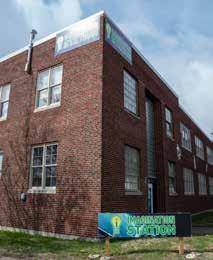
Located inside the former home of Indiana Gas Co. at Fourth and Cincinnati streets since Oct. 1996, Imagination Station boasts two floors of interactive exhibits and toys.
“We like to have our exhibits on the first floor, making sure they’re very tactile and interactive and learn cause-and-effect. That’s something adults take for granted. That’s a huge part of science and fits under the STEAM umbrella,” Carson says. Imagination Station’s target audience is children ages 2 to 12, but Carson says 5- to 10-year-olds are the most typical visitors with their parents.
“There’s an immediacy of fun that the exhibits give, and the upstairs playroom with the giant building blocks and all the different things they can play with, learn with and explore,” Carson says. “That tends to fit more into the mold of a younger child’s brain where they just want to go to something and grab it and twist it. That really speaks to them very well.”
Carson admits to having a couple of favorite exhibits.
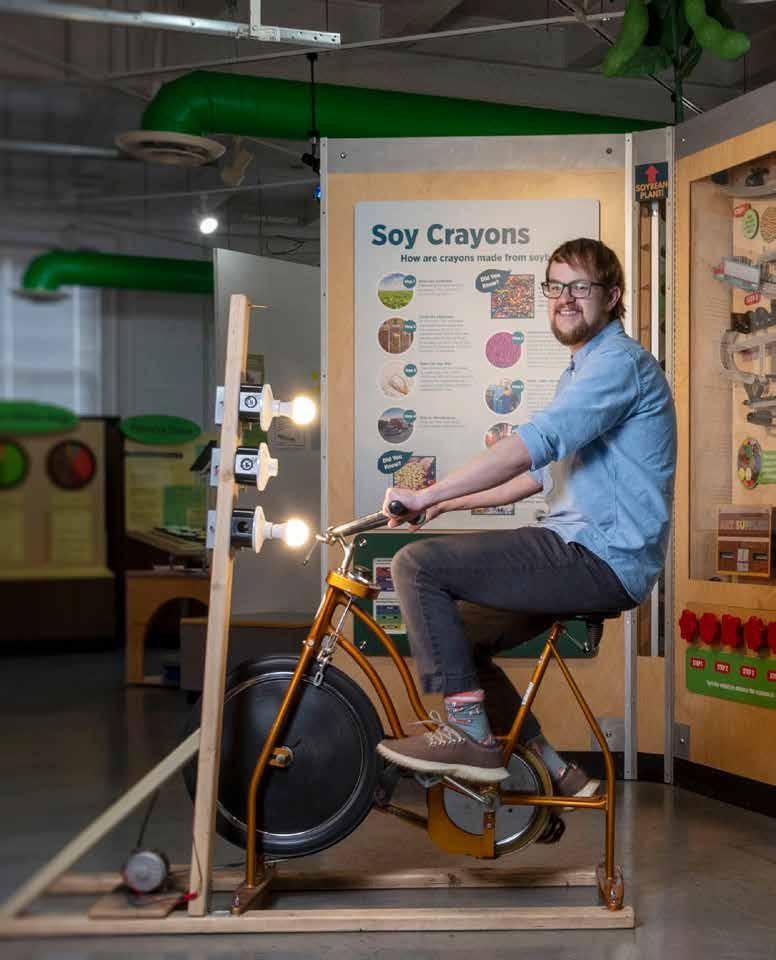
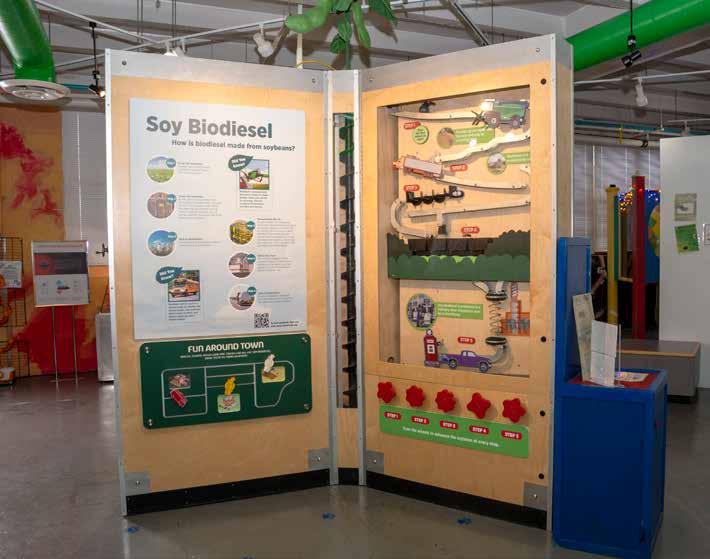
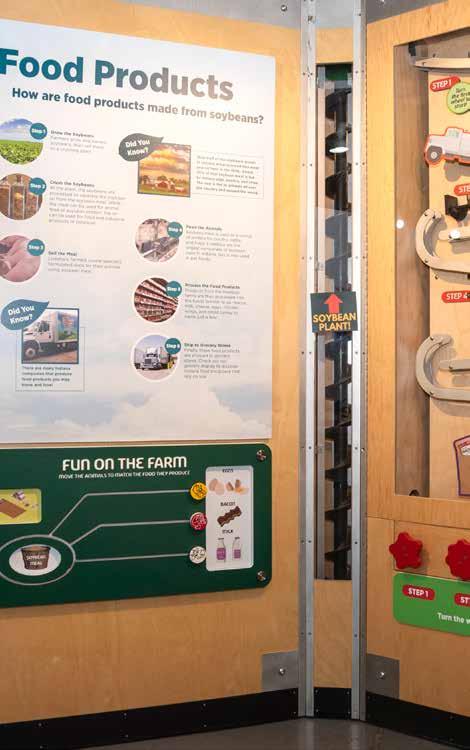
“We have a really cool soybean exhibit that combines play with learning,” he says. “It shows the steps that it takes from soybeans getting farmed and processed to going all the way into being, for example, made into the soy wax for a crayon. It shows the steps on a board in an informational way so that a parent or older kid can heed it and follow along.
“But it also has these handles. As you turn the handles there’s a ball that goes through a miniature Rube Goldberg machine that represents the steps in the process. There’s a horizontal auger that pushes the ball through. It’s just a fun way to watch the ball go through these steps of the soybean manufacturing process.”
Another Carson favorite demonstrates the effect of air pressure.
“It’s really simple and one I enjoy a lot,” he says. “It’s a set of tubing that has an air compressor at the bottom. You can put a ping pong ball through it and watch the air pressure suck it through and spit it out. It’s very easy for them to understand the simple cause-andeffect process. (Children) can repeat it over and over again and have a lot of fun with that.”
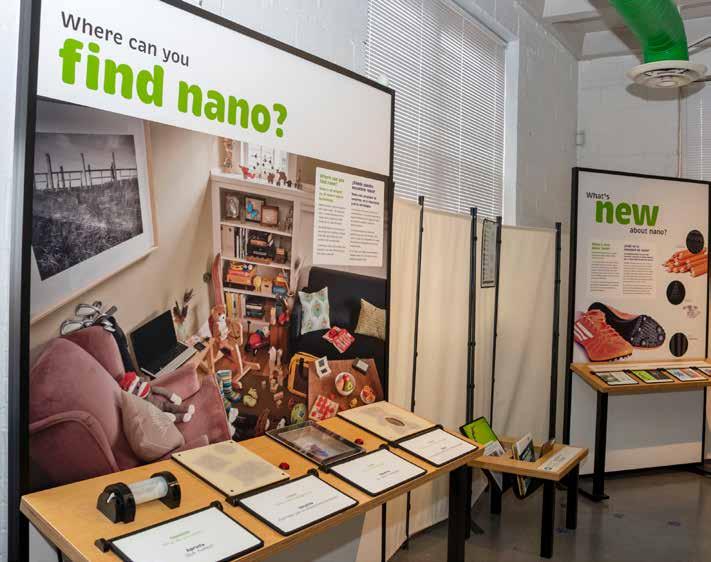
Thanks to a donation from the Purdue Nanotechnology Center, children also can discover how materials and devices are created by the manipulation of matter.
Good timing, good fit
Carson’s background in education technology and computer engineering made the Imagination Station post a good fit when he became executive director in September 2025. The timing of the opening helped, too.
“I was just finishing with an education technology startup,” says Carson, whose high school curriculum included robotics. “That didn’t pan out as well as I had hoped. I’d come back into town looking for the next step I wanted to do in my career.”
Carson saw an opportunity to use his experience in the classroom as a speech and debate teacher for middle school and high school students in a different way.
“When I saw the job posting, it really fit nicely with a lot of different interests that I have,” he says. “I started off at Purdue in computer engineering and did that for about two years. I ended up switching majors but that engineering side of me has stuck around.
“When I saw this opening it was a nice intersection of building relationships with the community, helping improve kids’ lives and also developing interest in science and engineering.”
Carson came on board Imagination Station with two goals in mind.
“The first one is a bit more short term,” he says. “Simply, maximize all the ways that a kid can come into Imagination Station and explore and learn. We’re trying to improve and expand the diversity of options we have, cover as many different science concepts … even arts and humanities concepts. That there’s something for everybody. Different exhibits are going to click for different kids. We’re trying to give kids as many options as we can to keep them interested and engaged. Maybe help them find a passion area or a science that speaks to them more.”
Carson’s long-term goal is to expand Imagination Station beyond its current capabilities.
“We’re trying to improve and professionalize the space, things like bringing in new exhibits and increasing community awareness,” he says. “We want to have more events that bring in a lot of community collaborators. Right now we have one annual event called Hands on Transportation. We bring in lots of different forms of transportation: fire trucks, emergency vehicles. Caterpillar will bring in a bulldozer, Wabash National will bring over a freight truck. We have one of the larger farm drones. Kids get a chance to learn in a very hands-on way and get to sit in these vehicles.”
Building partnerships, spreading the word
The presence of Purdue University, as well as a large number of industry partners and the support of Greater Lafayette gives Carson optimism that he can increase the number of Imagination Station events.
“We have two amazing cities that are so closely connected,” Carson says. “We have a really good university with so many different areas of expertise. We’re looking to see what are all the ways we can bring everybody together and give kids a chance to see everything that happens in our community.”
But doing that requires making Greater Lafayette aware of Imagination Station. One way is to get more directly involved with schools.
“We do field trips, and we’re trying to expand those and meet some of the core curricular standards (schools) need,” Carson says. “We want the community to be more aware of Imagination Station. During the pandemic it got very close to shutting down for good. Thankfully we were able to power through that. There are a lot of people in the community who either don’t know much about us or remember going there as a kid but maybe don’t realize we’re still open. We’re trying to spread that awareness and give people a chance to check us out again.”
Several membership levels are available and can be found at imagination-station.org. Carson notes that there’s an extra benefit for Imagination Station members.
“Our membership program is part of the ASTC (Association of Science and Technology Centers) passport program,” he says. “For example, if you buy a family membership at Imagination Station, it also gets you free access to any other ASTC facility in the world, outside of a 90-mile radius of Lafayette. That includes the Science Centers and the Museum of Science and Industry in Chicago, and the Columbus (Ohio) Science Center.”
Walk-in visitors are welcome during regular hours for a $10 admission fee. Imagination Station is open Wednesdays and Thursdays 10 a.m. to 1 p.m.; Fridays and Saturdays 10 a.m. to 5 p.m.; and Sundays 11 a.m. to 5 p.m.