
Architect Sam Kim’s vision embraces relationships, simplicity
BY AMY LONG | PHOTOS BY ROBERT GRANOFF
For almost 19 years Byunghoo Jung, a Purdue University professor of electrical and computer engineering, and his wife, Jeeyeon Ku, raised their family in a traditional twostory home in West Lafayette’s Amberleigh Village subdivision. But three years ago, after their younger daughter left for college, the couple decided it was time to move – and set their sights on a house with a clean, modern design.
“After becoming empty-nesters, we thought maybe it’s time to move to a new place that is just for us – me and my wife,” Jung says. “We really wanted to have a house that is modern, simple and not too big –just good for the two of us.”
Jung and Ku toured about 50 existing homes but didn’t see any that fit their style. They met with local builders but didn’t find an outfit that could cater to their taste.
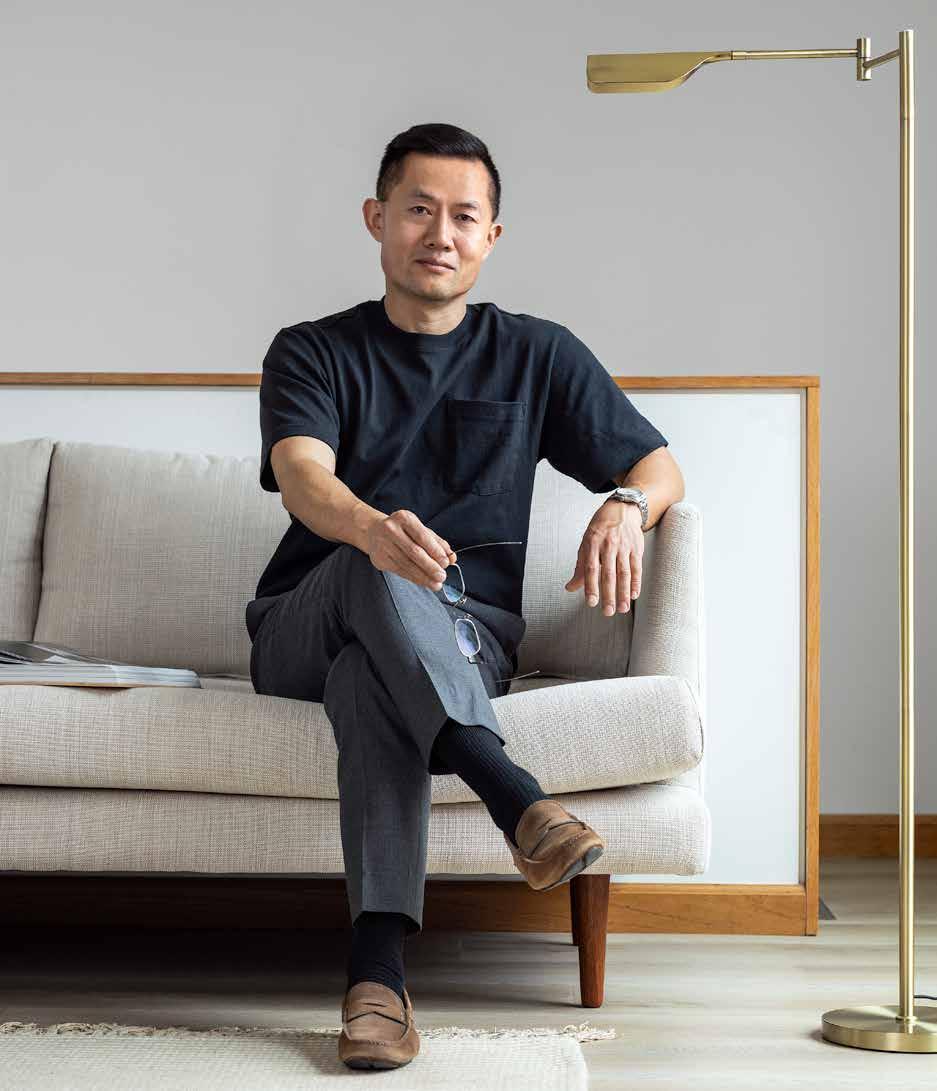
And then through a friend they met Seungsu (Sam) Kim, a design architect from New York and the director of Studio Seung, an emerging design-build firm based in Lafayette. Since 2019, the business has been slowly building a portfolio of new home designs, additions and renovations and introducing Kim’s take on Midwest modernism – a simple, elegant aesthetic that emphasizes authenticity, sustainability and affordability – to a local residential landscape packed with cookie-cutter spec homes and traditional suburban designs.
Like modernist architecture in New York and California, hallmarks of Midwest modernism include large windows; bright, airy interiors; indoor-outdoor flow; and a focus on practicality over excessive decoration. The style distinguishes itself in part by integrating with the Midwest landscape and accentuating locally sourced, natural materials, such as wood and stone, for warmth and durability.
When Jung and Ku first met him, Kim had not yet accomplished a complete ground-up custom build. Still, they hired him to build their new home on Pawnee Place in West Lafayette – on one of the last remaining lots bordering Happy Hollow Park – and, with a budget of $600,000, they embarked with him on the process of siting, designing and constructing the house.
“I was nervous,” Jung chuckles. “If I say I was not, that is a lie. But we couldn’t find any local builder that has such a strong architect background. No one in the local area could show us a style that we really wanted. Sam showed us a few potential designs that he had in his mind, and we really, really liked it.”
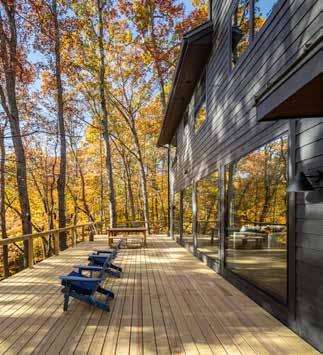
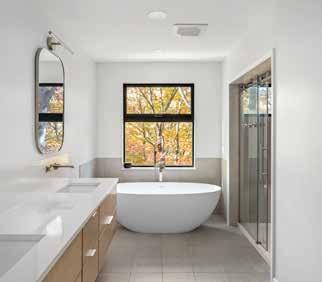
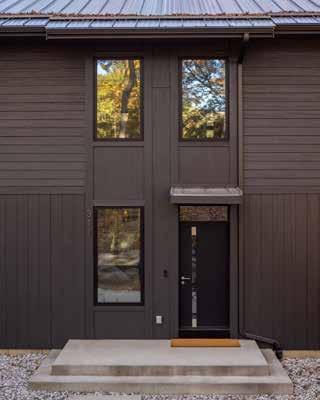
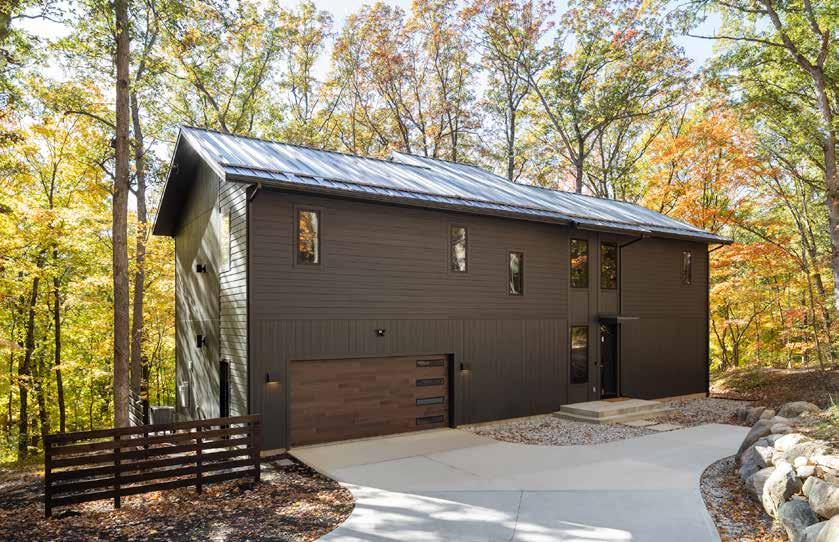
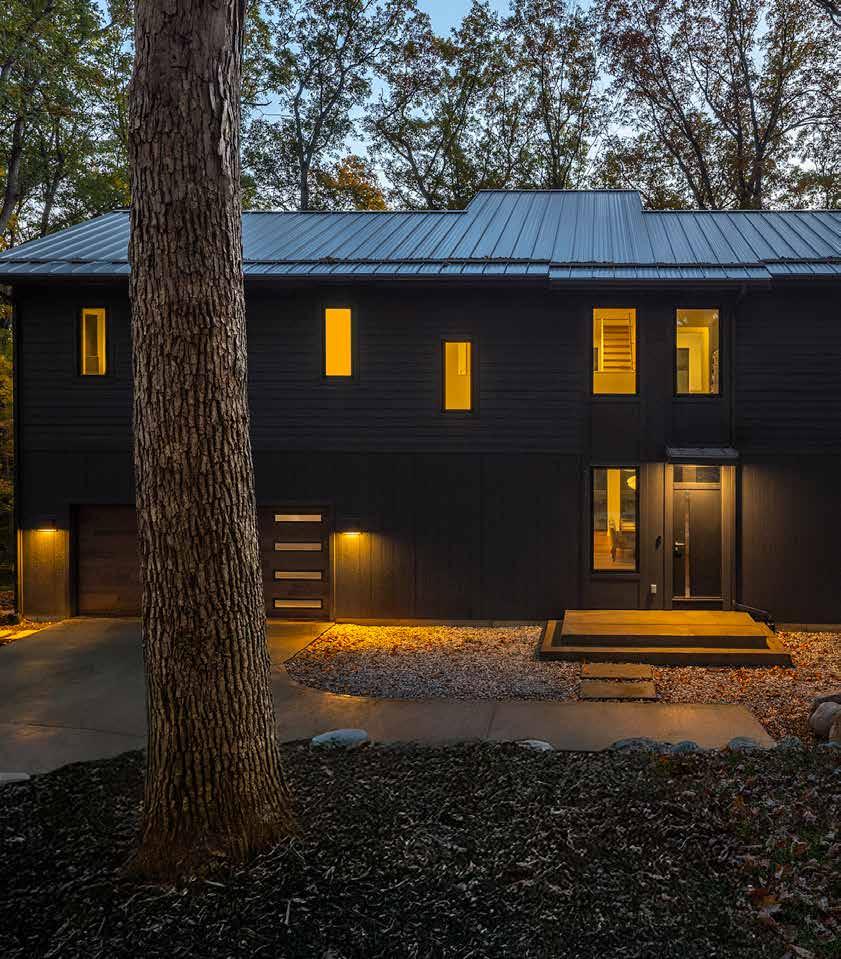
The 2,950-square-foot, four-bedroom home, which was completed in 2025, stands as one of the newest examples of Kim’s clean, modern style. The understated exterior blends into its surroundings – with siding the color of tree bark and a metal roof that reflects the sky. Inside, large windows frame views of the surrounding woods and allow sunlight to stream in and illuminate the whitewashed walls and the warm wood floors. The heart of the home is a 750-square-foot deck that extends the living space and provides privacy, blocking the view of the home from the public trail below.
“I wanted those homeowners to love nature, and the nature to love the people who live there,” Kim says.
The house is the result of Kim’s painstaking approach to design, which involves hours of reflection – observing the site and the neighborhood, pondering scale and proportion and considering the needs of the family – before he even starts his preliminary sketches. The goal, he says, is to design a home that subtly and tastefully serves as the backdrop to the homeowners’ life and lifestyle.
“I try to create the house that was meant to be there. If God created something, it would be something like this. It’s not really coming from my own ideas. I’m just filtering and re-shuffling and then creating something that has harmony and balance,” Kim says.
“One of my favorite Japanese architects, Yoshio Taniguchi compares good modern architecture to a teacup. If it’s doing its job, you don’t notice that it’s there. So it is with a house: Its job is simply to contain the life of a family.When it does that well, without flourish or embellishment, it’s a thing of beauty.
“To me as well a house is just a little container to contain the life of the homeowner,” he says. “When you have a good background, it becomes the gallery of their life.
Finding a purpose
The completion of the “Pawnee House,” as Kim calls it, was a major milestone for the fledgling Studio Seung. It is even more remarkable, given Kim’s rocky introduction into Lafayette only 10 years ago.
Born and raised in South Korea, Kim studied sculpture at the University of Seoul before moving to the U.S. and enrolling in a Master of Architecture program at the City College of New York. There, he was steeped in the study of critical regionalism under professor Kenneth Frampton, the idea that architectural design should be rooted in the local culture, climate and topography and reflect local character, as he began to develop his clean, unembellished modern style.
After receiving his degree in 2007, Kim went to work for McKean architecture, a small, very high-end architectural design firm that offered plenty of hands-on experience and then the award-winning interior design firm Pembrooke & Ives.
One of his highest-profile professional projects involved designing the exterior façade of a three-level Fifth Avenue penthouse while he was at Pembrooke & Ives – a home that was eventually purchased by Amazon founder Jeff Bezos for $80 million. It is a point of pride for Kim, though he would eventually realize that he is drawn to more modest-scale projects that can be accessible to more people.
“I was exhausted doing too much high-end,” Kim says “It doesn’t really improve the world. I like to provide affordable, modern housing for a lot of people.”
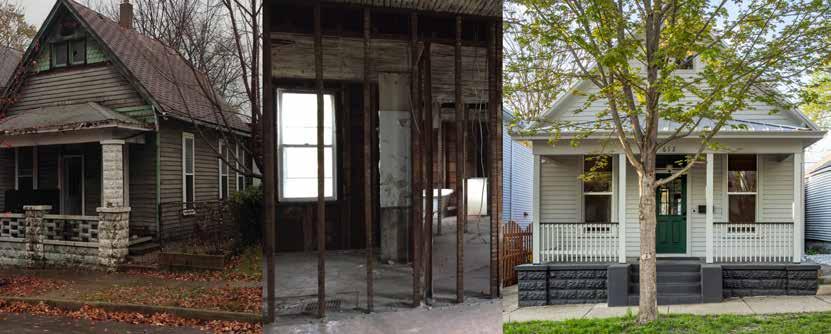
In 2016, Kim relocated to Lafayette, following his girlfriend, who was a Ph.D. student at Purdue. Quickly, though, the relationship fell apart, and Kim found himself essentially homeless, jobless and deeply in debt. Needing not only a place to live but also a project that would showcase his work, Kim searched Zillow for the cheapest available houses – eventually buying a ramshackle cottage on Oregon Street, in the Ellsworth Historic District, with $26,000 borrowed from friends in South Korea. Bounded by Fourth, Eighth, South and Romig streets, the Ellsworth neighborhood includes an eclectic mix of grand brick homes, row houses, Craftsman bungalows and workers cottages built in the late 1800s. In recent decades, the area has become known more for absentee landlords and derelict properties than for its historical character. At the time he bought the house, Kim thought, “The whole neighborhood is sick. And this house is the sickest house. I need to heal this house first. It’s small enough. I can handle it. I can make a good impact in the neighborhood.”
True to his process, when he first arrived on the block Kim spent hours each week just walking around the area, assessing, observing and trying to figure out how to improve it. He spent so much time lurking that one anxious neighbor mistook him for an undercover narcotics officer – a misunderstanding that underscores the condition of the neighborhood at the time.
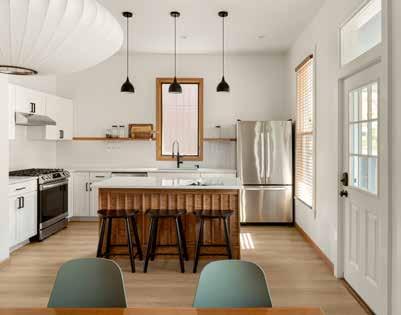
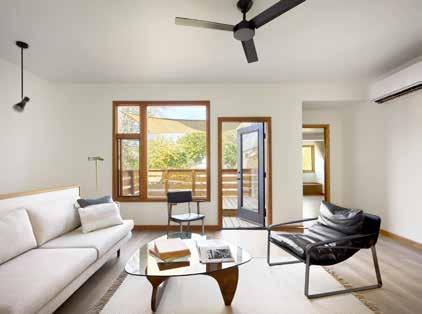
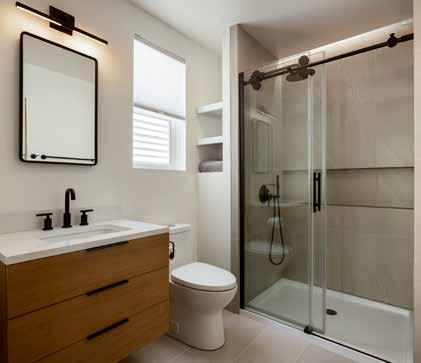
His 1,200-square-foot cottage had been gutted by previous owners, and for the first 12 months of the renovation, it was completely unlivable. Ultimately, the project dragged on for nearly seven years as Kim – supported by a small rotating cast of subcontractors – painstakingly renovated the house room by room. Work included peeling off aluminum siding and salvaging the 100-year-old poplar planks they found underneath; relocating the kitchen; adding a bathroom; and moving bearing walls to open up the living space. The project – officially finished in 2024 – transformed the house into a bright, modern cottage with clean lines, tall ceilings, whitewashed walls and natural finishes.
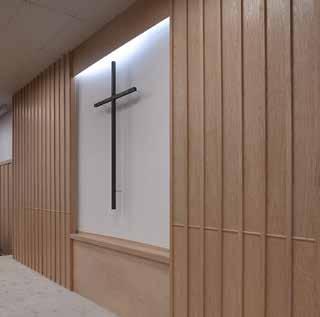
Once he started work on the Oregon Street cottage, Kim discovered that he is not only a designer but also a builder. He had come to the project homesick and heartbroken, but working with his hands and connecting to the community offered Kim a sense of redemption. Neighbors noticed the work at the cottage and stopped to introduce themselves. At his office in the Matchbox Coworking Studio, Kim met other Lafayette business owners and entrepreneurs. He joined a church – the Korean Presbyterian Church of Purdue – and volunteered his time and talent to construct a new chancel and altar.
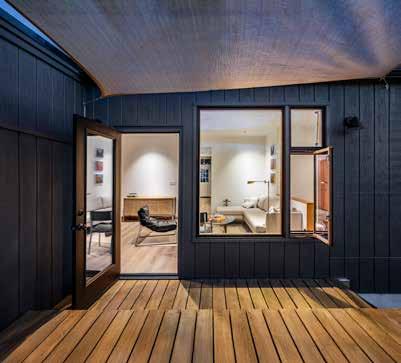
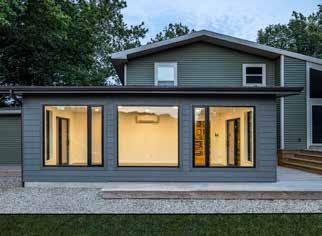
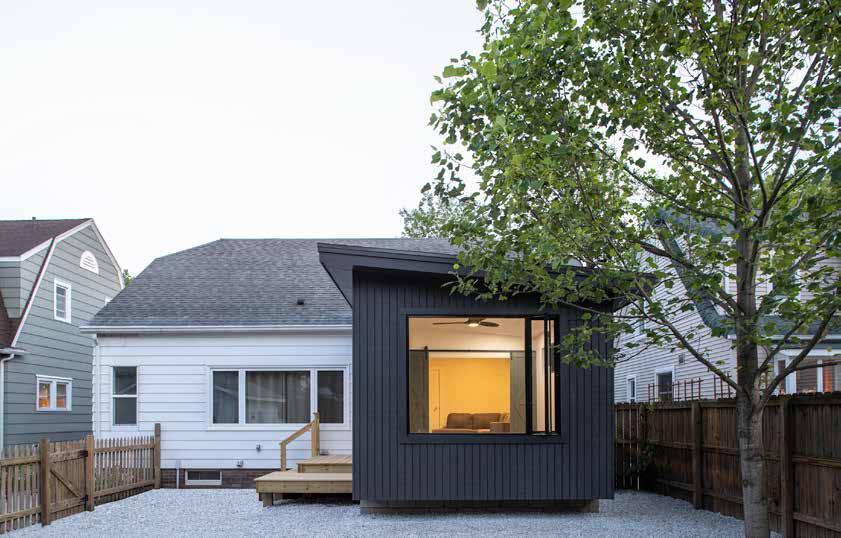
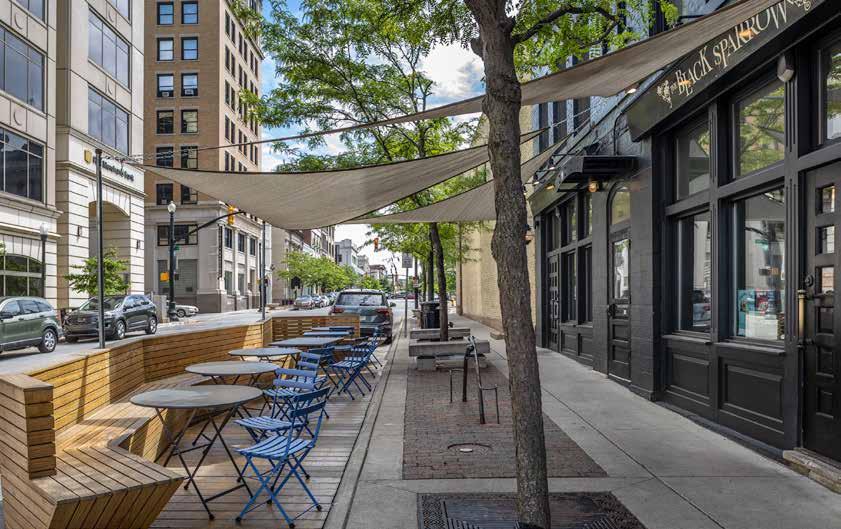
Slowly, through friends and friends of friends, Kim took on paid work and established his own design-build firm, Studio Seung, in 2019. Projects included a yoga-studio home addition in Rossville; a couple of sunroom additions in West Lafayette; a primary bathroom renovation in Lafayette’s Ninth Street Hill neighborhood; and the Black Sparrow parklet – the outdoor dining space that unfurls over the curb and onto Main Street in front of the Lafayette eatery during the summer months. As he got back on his feet and repaid his debts, Kim nurtured in himself a sense of calm and control.
“It wasn’t just a financial victory,” he says. “It was more, to me, a spiritual victory. I spiritually got better and stronger. And I had the confidence that whatever happens to me, I’m able to do it.”
Kim says he also discovered a sense of purpose that would anchor him in Lafayette. He is now on a mission to elevate and enrich the lives of the residents of Greater Lafayette by designing and building beautiful, unique, affordable housing. With each nail that he pounded and each room that he built, he says, his spirit felt nourished. “I feel like I owe something to Lafayette.”
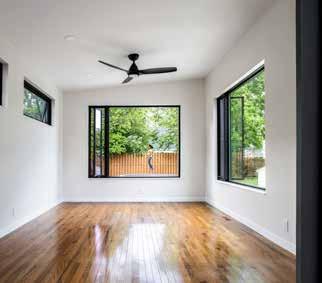
He adds, “I strongly feel that I was brought to this town for the purpose of celebrating 200 years of history in Lafayette. I knew I was brought here for a purpose but didn’t really think it would change my whole career path. I want to create a new housing prototype that is affordable and sustainable yet expresses regional character. My design and creation process for a custom home is like a journey with a new friend. I study the relationship between clients, their needs, the site and the neighborhood, and try to contain their life in a simple but balanced form of enclosure that will make their life better, healthier, more peaceful and closer to nature.”
Kim compares modern design to Levi’s jeans: high quality, classic and affordable –respected by salt-of-the-earth folks and one-percenters alike. “We don’t have anything like that in housing [in Greater Lafayette],” he says, noting that the only options tend to be inexpensive cookie-cutter spec homes or exorbitant, sprawling custom builds. “We need somebody to provide interesting, nice, affordable modern homes [for everyone]. That’s what I’m going to do.”
Developing a vision
Kim has been especially focused on the Ellsworth district, where his business got started, and where he maintains an office at Matchbox; the area is kind of Ground Zero for this mission.
The neighborhood, Kim says, is ripe for renovation and reconstruction. He wants to see it thrive as a place where Purdue graduates and young professionals buy their first homes and put down their roots.
“They can live there, and then they can walk just like me to Matchbox to work, and then share their ideas and create, and develop not just the neighborhood but the whole city,” Kim says. “We have so many talented people at Purdue, but they all leave. I want Lafayette to be the city where everyone wants to stay.”
To date, Kim has been involved in five different projects in the four blocks between Alabama and Romig streets, including renovations on a few aging properties and the design of a new home built on an empty lot, as well as the Oregon Street cottage, which is now Kim’s home and also serves as his showroom. And in partnership with Paul Baldwin, a downtown business owner and rental property owner, plans are in the works for one more project – a new multi-home development (Kim’s first) on a lot on New York Street in downtown Lafayette. By introducing modern design into an historic neighborhood, Kim has raised some eyebrows. Sean Lutes, the vice president of Lafayette Historic Preservation and the founder of the Preserve Historic Lafayette Facebook group says that he’d rather see renovations that are historically faithful, although he appreciates Kim’s vision and his commitment to the neighborhood.
“I don’t agree with him on some of the architecture that he’s implemented,” Lutes says. “But he’s a good guy improving the neighborhood, putting his energy, time, passion and skill where his mouth is.”
Although Kim understands the criticism, he considers historic reproductions to be dishonest.
“You never want to create a fake history,” Kim says. Instead, he carefully and deliberately blends old and new into something altogether different and of-the-moment. “You have to reflect the current time. You have to respect the context and just rewrite it in a modern sense.
“The key is to intentionally create a contrast that is very, very balanced,” he adds. “It’s really beautiful to see two completely different things [side by side], like a man and a woman at a wedding.”
Jeff Rider, a local property developer, also has been working to revitalize the neighborhood, albeit on a much larger scale, for more than a decade. His company, Rider Partners already has built three new high-end single-family homes on a large tract near Eighth and Oregon streets, with plans to build up to 20 total.
Friends for 10 years, since Kim moved into the neighborhood to start the Oregon Street cottage renovation, Rider and Kim share the same vision for the Ellsworth blocks. “If we get all these pieces of the puzzle together, this neighborhood could be really, really cool,” Rider says. “It’s just adjacent to the main heart of downtown. It just seems perfect for owner occupancy – people buying in and living downtown. It’s just a perfect little neighborhood, I think.”
Rider feels a deep respect for Kim and for his contributions to the area. “He’s invested his time and money, which is a big deal,” Rider says. “If you go back six, seven, eight years ago, not too many people want to put money into that neighborhood. It just seemed too risky.
“He’s just been a big influence in bringing in modern architecture with some new ideas because he believes – and I believe – that good architecture stands the test of time. Every era has its own type of architecture. And if it’s done right, it’s going to be a beautiful thing forever, really.”
Looking ahead, Kim finds himself at a crossroads. He strives to make a bigger impact on the community than he can building single homes one at a time. He’s worked as a designer and as a builder – the next logical step, he says, might be to take on a job as a developer. Soon, Kim says, he’d like to start to develop entire neighborhoods and, under his supervision, cultivate a new generation of designers and builders who can create and execute modern architecture and make it available to the masses.
“My end goal is to see those middle-class people flourish and succeed. They don’t have to live in a spec home or a McMansion anymore,” he says. “To me, that’s my mission: to heal the whole city.”